Back in Brussels, our Europe editor Ian Traynor reports that the Greek PM got a harsh reception when he asked fellow leaders for support in the ongoing debt talks:
#euco @atsipras try to discuss went badly.merkel+several others shut him up.holland's rutte said if eurozone summit,only on plan B, not deal
— Ian Traynor (@traynorbrussels) June 25, 2015
And Britain’s PM made his case for reform, although perhaps not for very long...
#euco cameron had to wait till almost midnight for his spiel. it was short. sounds perfunctory
— Ian Traynor (@traynorbrussels) June 25, 2015
Apparently EU summit dinner has now returned to argument about Med migrants after brief palate cleanser from Cameron on UK negotiation #euco
— Faisal Islam (@faisalislam) June 25, 2015
Greece makes the front pages again:
Όμορφα... pic.twitter.com/ndlOT0IeJo
— George Terzis (@geoterzis) June 25, 2015

Another sign of optimism:
Alexis Papachelas, probably Greece’s best informed political analyst, has told SKAI News that he thinks “an agreement is very close, very near.”
“There is a detectable shift in stance. Under pressure lenders have retreated on several issues,” Syriza’s prominent MEP, Dimitris Papadimoulis told the Guardian.
“We are beginning to see that differences are bridgeable, that an agreement will be reached.”
Echoing the German chancellor Angela Merkel, insiders in the leftist led Syriza government said it was vital that Greece cut a deal with the bodies keeping it afloat before markets opened on Monday.
The optimism – the first real sign of a thaw in relations between Athens and its creditors at the EU, ECB and IMF – followed extraordinary scenes of brinkmanship in Brussels and outbursts of fury in Athens
Earlier in the day, Papadimoulis, a Syriza moderate, had denounced the tactics of hardliners in the EU and IMF who, he claimed, were deliberately thwarting an agreement with prime minister Alexis Tsipras.
A spot of optimism:
#Greece aid deal on Saturday is 'quite possible', Greek Official says acc to BBG.
— Holger Zschaepitz (@Schuldensuehner) June 25, 2015
Greek anti-capitalists vow to fight new deal
Over in Athens, Greeks who are far to the left of the ruling Syriza party, have pledged to step up protests against the government over concessions it appears willing to make to cut a deal.
Some of the thousands who marched through the streets of Athens tonight belong to the ultra radical anti-capitalist Antarsia group, a collection of far far left groups that make Syriza look centrist. Holding banners demanding that Greece leaves the European Union and writes off its monument debt, protestors gathered at Athens university campus before marching on parliament.

The radicals, who are gaining in popularity and may well prove to be a headache for the government, have pledged to step up protests and strikes in the event that Tsipras reaches a deal with the EU, ECB and IMF that they have already denounced as a “new memorandum.”
Seamen aligned with the group have announced they will go on strike on Tuesday and said they will bring all ships/ferries to a grinding halt on the 1 and 2nd of July.
If a deal is reached, activists say they want to stop it being brought before the 300-seat House where creditors have demanded it be ratified.
“If it is signed and passed by parliament we will stage protests and strikes to ensure it is not put into effect,” Stamatis Hadzidimou, an activist with the socialist workers’ party, told me.
“If it is not passed and the country goes bust, we will also stage protests and strikes to ensure that capitalists don’t start closing enterprises and laying off people. There is going to be unrest.”

More on that Tsipras-Tusk clash:
Greek gov source: @eucopresident told @tsipras_eu 'game over' + Tsipras said not to underestimate the point nation can reach when humiliated
— NikiKitsantonis (@NikiKitsantonis) June 25, 2015
Some intriguing reports coming out of Brussels, where leaders have discussed Greece’s bailout.
According to a Greek official, Tsipras told leaders they must respect January’s election result..... And was then challenged by Donald Tusk:
Greek official says Tusk told Tsipras at EU summit 'game over' --BBG
— Live Squawk (@livesquawk) June 25, 2015
Tsipras’s call for another leaders’ meeting is being rebuffed too....
"No #eurozone summit today, no eurozone summit tomorrow," says rather definitive #EU official. #Greece
— Peter Spiegel (@SpiegelPeter) June 25, 2015
Updated
Costas Lapavitsas, a Syriza MP, has made a new call for Greece to break away from the Eurozone, following the rejection of Athens’ compromise proposal.
Writing in the Guardian, Lapavistas said an influential group of Syriza’s MPs would soon make an “intervention”:
#Greece Lapavitsas: "a significant intervention by the Left Platform expected" on €xit http://t.co/uXxxhctXFS pic.twitter.com/IQowskfPl7
— Zoe Keller (@KellerZoe) June 25, 2015
Thursday night in Athens. pic.twitter.com/eomUST7pW3
— Duncan Weldon (@DuncanWeldon) June 25, 2015
Could be another lively evening in Athens too:
Riot police, Communists and breakdancers: all within yards of each other on Syntagma Sq Athens #Greece pic.twitter.com/vXb4jeYIIY
— Tony Connelly (@tconnellyRTE) June 25, 2015
Afternoon Summary: Heading into a crunch weekend

So, where do we stand in the Greek crisis?
Greece and its creditors are still divided, with less than six days until its bailout programme expires.
Another of frenzied diplomatic activity, starting at dawn, has again failed to reach agreement on the economic measures Greece must take to obtain €7.2bn of bailout funds before Wednesday morning.
Talks between Alexis Tsipras, Christine Lagarde, Mario Draghi and Jean-Claude Juncker foundered again this morning, after the quartet had already talked past midnight.
That prompted the creditors to slap Tsipras with an ultimatum, and then draw up their own new proposal, which gave some ground on pension reforms and VAT, but still crosses some of Athens’ Red Lines. [see the full leak and early reaction here]
Leaked creditors' bail-out plan for Greece - not quite take it or leave it but close #Grexit http://t.co/g2Eud9fepF http://t.co/eCiHsdhQQj
— Lionel Barber (@lionelbarber) June 25, 2015
It wasn’t good enough for the Greek side, which swiftly produced its own counter-proposal.
The resulting mash-up was discussed by eurozone finance ministers at their fourth gathering in a week (photos here), but they couldn’t find common ground.
Their meeting broke up this afternoon, dashing any lingering hopes of a deal tonight.
And according to Greek finance minister Yanis Varoufakis, some finance ministers aren’t happy with the latest proposal from creditors.
So the issue is currently sitting in the lap of EU leaders, at their summit tonight.


Leaders are officially discussing Europe’s migration crisis, and Britain’s reform demands, but the Greece issue will surely be aired?
Alexis Tsipras, indeed, is pushing for a eurozone leaders summit tonight:
Still talk of a #eurozone leaders summit tonite. @atsipras wants it discussed at heads, official tells me. #Greece
— Peter Spiegel (@SpiegelPeter) June 25, 2015
Going into the summit, Tsipras told reporters that there will be a compromise, but one based on HIS proposals:
So after the comprehensive Greek proposals, I am confident that we will reach a compromise that will help the eurozone and Greece to overcome the crisis.
And Donald Tusk also put on his best brave face, saying:
The last hours have been really critical, but I have a good hunch that unlike in Sophocles’ tragedies, this Greek story will have a happy ending.
But right now, Eurogroup president Jeroen Dijsselbloem sounds downbeat. Here’s his statement:
The Eurogroup has finished.
The institutions informed us about their intensive negotiations with the Greek government. We agreed that they will do an assessment of the last Greek proposals, because they came in very late today, just before the Eurogroup meeting.
The institutions informed us that on a number of issues there is still a wide gap with the Greek authorities. In the meantime, the door is still open for the Greek authorities to accept the proposals tabled by the institutions.
Now, I will inform the Heads of State or Government on the state of play. The Eurogroup will probably reconvene on Saturday to take stock of the situation.
"The #Eurogroup will PROBABLY reconvene on Saturday to take stock of the situation." Most downbeat sentence ever? http://t.co/poq9at3PSo
— Maxime Sbaihi (@MxSba) June 25, 2015
.@J_Dijsselbloem: The door is still open for the Greek authorities to accept proposals tabled by institutions (meaning: that´s all folks)
— Jorge Valero (@europressos) June 25, 2015
But with a series of Greek MPs slamming the creditors and refusing to be “blackmailed”, it isn’t easy to see how Tsipras could push the institutions’ plan through the Athens parliament....
An anti-austerity demonstration is taking place outside the Commission now, in another sign that tensions are building around the Greek crisis.
That’s via AFP’s Danny Kemp:
Anti Troika protest at EU summit #Greece https://t.co/XW3F9hJKct
— Danny Kemp (@dannyctkemp) June 25, 2015
How did today’s deadlock rock the markets?
Well, it didn’t. The Athens exchange finished the day ever-so-slightly higher, up 0.1%. And the main European markets were fairly calm too:
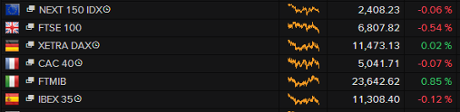
That’s partly because traders believe a deal will be done....and partly because they (like the rest of you?) are weary of the whole process.
Tony Cross of Trustnet Direct captures the mood:
My dad had a Ford Cortina back in the 1980s which was perennially in the garage having something or other done to it in an attempt cure one of its many ailments, yet while it chugged along, stalled and broke down on many times it did so on fewer occasions than Greece’s current debt bailout talks.
And as European leaders headed in and out of yet another summit it seems that deal is looking as far away as ever.
Our Europe editor hears that if the Eurogroup meet on Saturday morning, and if they agree a deal, then the Greek parliament could then begin debating it on the Sunday.
And if Athens MPs do sign up to the plan (not a given), then the Bundestag could give its approval early next week too.
#grexit eurogroup prob saturday, not friday, deal to gk parlt sunday, to bundestag monday. if it works
— Ian Traynor (@traynorbrussels) June 25, 2015
But what about €1.6bn IMF repayment that Greece faces on Tuesday?
Well, Ian reports, that could be paid out of the profits which the ECB has made on its Greek bond holdings.
#grexit imf payment tuesday could be facilitated by smp profits - eu official
— Ian Traynor (@traynorbrussels) June 25, 2015
Updated
There’s a sudden flurry of activity in the Commission as Yanis Varoufakis appears in the press area, apparently after briefing Alexis Tsipras about the eurogroup meeting.
Reporters flock around the finance minister, like moths to a particularly bright candle:
Es por una estrella de rock? No...es por Varoufakis saliendo del Consejo atravesando toda la sala de prensa. pic.twitter.com/ojvZF46gK8
— Alberto Fernández (@Alberbel) June 25, 2015
#euco Varoufakis provoque quasiment une émeute en traversant la salle de presse pic.twitter.com/knYYjnkJRJ
— Samuel Le Goff (@S_LeGoff) June 25, 2015
There are VIP exits, Yanis! (maybe he should brush up on the special badge system)
Greek finance minister @yanisvaroufakis leaving the house, the EU summit, with rucksack, after talking to Tsipras pic.twitter.com/NhDjrxvKJ6
— Faisal Islam (@faisalislam) June 25, 2015
Updated
And here’s a reminder of how we got to this point:

If you look carefully at photos from today’s European Council summit you can see that the leaders are wearing little pins.
They’re the pinnacle of an extremely complicated hierarchy that determine who can go where on these occasions.
My colleagues Alberto Nardelli and George Arnett explain:
If you’re lucky enough to have gold, and thus access to the 80th floor, there’s the VIP dinner – one feature of which is that there is no note-taking. A tighter confidentiality regime applies on this floor of the building, and this is where, on Thursday evening, Cameron will lay out his plans for renegotiating the terms of Britain’s membership of the EU.
Ambassadors and their “antici” (jargon for powerful assistant and scribe) have red badges. One peculiarity of the Euco system is that note-taking during meetings often takes place in a separate room.
A level below these are the blue and grey badges used by delegation members and admin personnel. They spend most of their time on the “50th floor”, which includes meeting rooms, delegation rooms and the presidency room.
After that it gets more complicated. Alongside the regular badges each country delegation also gets a number of floaters. These work like the “power-up mushroom” in Super Mario Bros: participants with a floater are temporarily of bigger status until the floater is taken away from them.....
Learn more here (including why there isn’t really an 80th floor)
Super Mario Bros meets House of Cards: the European Council's dizzyingly complex badge system http://t.co/C10MlvmW14 pic.twitter.com/DZwJ4LQEuR
— The Guardian (@guardian) June 25, 2015
Greece’s PM is pushing for eurozone leaders to hold a summit this evening, reports the FT’s Peter Spiegel.
Still talk of a #eurozone leaders summit tonite. @atsipras wants it discussed at heads, official tells me. #Greece
— Peter Spiegel (@SpiegelPeter) June 25, 2015
Which is a good excuse to drop these pictures in, from today’s summit meeting:


#Eurogroup cancelled in order to assess what points of latest Greek proposal can be included in the creditors' offer (EU sources) #Greece
— Jorge Valero (@europressos) June 25, 2015
Reuters has now published the full quotes from Yanis Varoufakis as he left the eurogroup.
And he reveals that some euro finance ministers refused to support the latest offer from the IMF/ECB/EC today (which included some concessions to Athens)
Varoufakis said:
“Interestingly, several colleagues disagreed and criticised not only our text but also the text of the institutions.”
“We shall continue our deliberations, the institutions are going to look again at the two documents - our documents and their own, there will be discussions with the Greek government, and we’ll continue until we find a solution”
Minister @yanisvaroufakis making doorstep statement on way to EU summit said Eurogroup ministers disagreed over the document of institutions
— Dimitris Yannopoulos (@DimitrisY) June 25, 2015
It’s the same old, same old story.
Pierre Moscovici, the EU commissioner, has said that there is still no agreement on the pension reforms and VAT rate changes that Greece should implement.
- EU’S MOSCOVICI SAYS VAT, PENSIONS REMAIN STICKING POINTS IN DISCUSSIONS WITH GREECE
- EU’S MOSCOVICI SAYS STILL DISCUSSING HOW TO REACH GREECE’S FISCAL TARGETS
Varoufakis: Talks will continue
Greece’s finance minister, Yanis Varoufakis, is telling the press pack that discussions will continue, and hinted that there was much disagreement at today’s meeting.
- GREEK FINANCE MINISTER SAYS THERE WAS A LOT OF DISCUSSIONS OF TWO DOCUMENTS, LOTS OF COLLEAGUES CRITICIZED OUR TEXT AND THAT OF CREDITORS
- GREEK FINANCE MINISTER SAYS WE WILL CONTINUE DISCUSSIONS UNTIL WE FIND A SOLUTION
Grexit @yanisvaroufakis no agreement. More discussions. Wouldn't say when
— Ian Traynor (@traynorbrussels) June 25, 2015
Updated
Jeroen Dijsselbloem, Eurogroup president, has told reporters in Brussels that the door is still open for Greece to accept the proposals tabled by its creditors today (see earlier).
Eurozone finance ministers have agreed to meet again in two days time - they must be sick of the sight of each other.
I've also confirmed that #eurogroup will reconvene on #Greece on Saturday. #NeverEndingStory
— Peter Spiegel (@SpiegelPeter) June 25, 2015
#Eurogroup is over now. No conclusion on #Greece. Another Eurogroup (the 5th in 10 days) on Saturday morning
— María Tejero Martín (@Maria_Tejero) June 25, 2015
EUROGROUP ENDS WITH NO DEAL
It’s official: The meeting of eurozone finance ministers has ended without a deal (that’s via Finland’s fast-tweeting finance minister)
That's it for today. Institutions and Greece to continue work. #Eurogroup back later, but not today.
— Alexander Stubb (@alexstubb) June 25, 2015
So what happens next?
We could be looking at another eurogroup meeting on Saturday morning....
Next #Eurogroup for #Greece on Saturday morning acc to #EU source
— EfiKoutsokosta (@Efkouts) June 25, 2015
Several Brussels reporters are reporting that the “indefinitely suspended” Eurogroup meeting resumed a few minutes ago, and then broke up again. Classic.
The #eurogroup will soon be over.
— Jennifer Rankin (@JenniferMerode) June 25, 2015
I'm hearing #eurogroup is now finished. #Greece
— Peter Spiegel (@SpiegelPeter) June 25, 2015
Our Europe editor, Ian Traynor, reports that leaders are very keen to avoid another emergency summit on Greece (they’ve already held one this week, back on Monday).
But that relies on finance ministers reaching a deal on their own.
#grexit #euco msg from leaders going in is we don't want another eurozone summit. let the eurogroup sort it. then again...
— Ian Traynor (@traynorbrussels) June 25, 2015
Ireland’s Enda Kenny predicts a long weekend ahead of us:
Irish PM Kenny: Difficult to reach a #Greece deal today. I can see the Greek negotiations going into the weekend.
— Holger Zschaepitz (@Schuldensuehner) June 25, 2015
Updated
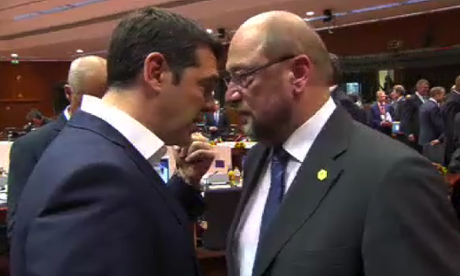
Once inside the commission, Alexis Tsipras has held some intense-looking chats with Martin Schulz, president of the European parliament....
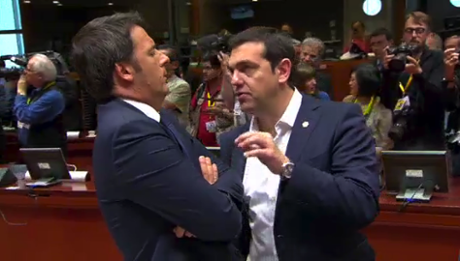
...and Italian prime minister Matteo Renzi.
Updated
Greek PM predicts a compromise
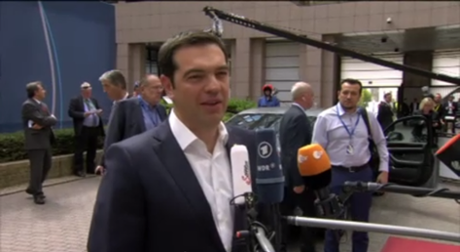
Alexis Tsipras actually teased a reporter as he arrived in Brussels for tonight’s Summit.
Asked “What’s going on”, he replied “What’s going on? You don’t know?” (“No, we don’t”, the reporter shot back).
The Greek PM then predicted a deal, saying:
European history is full of disagreements, negotiations, and then compromises.
So after the comprehensive Greek proposals, I am confident that we will reach a compromise that will help the eurozone and Greece to overcome the crisis.
Do you have a basis for agreement?
Yes, it is a basis, a good basis, Tsipras replies.
He declined to be drawn on Britain’s In-Out referendum.
Props to BBC's James Landsdale shouting at Tsipras about Cameron's referendum. "Do you care about Cameron's reforms..." *SILENCE*
— Mehreen (@MehreenKhn) June 25, 2015
Updated
Greece’s prime minister Alexis Tsipras tells reporters that he’s confident a deal will be reached, as he arrives at the European council summit.
After all, arguments and compromises are what Europe’s all about.
Going into EU summit @atsipras says he is confident that an agreement can be found. Europe is about "disagremeents & comprimises" #Greece
— Nick Malkoutzis (@NickMalkoutzis) June 25, 2015
Updated
As finance ministers scramble for the Eurogroup exits, Francois Hollande has arrived at the EU Summit.
Speaking in French, the president states twice that an Greek agreement is possible, and necessary. But it’s up to the negotiating teams to work it out.
Hollande and Merkel now both say 'we have to let the negotiators work' on Greece. Hands washed
— Danny Kemp (@dannyctkemp) June 25, 2015
Eurogroup 'indefinitely suspended'
Eurozone ministers have told Greece to come back with a better set of proposals -- in the meantime, their meeting is ‘indefinitely suspended’
*EUROGROUP WAITS FOR GREECE TO COME BACK WITH BETTER PROPOSAL *EUROGROUP HAS BEEN 'INDEFINITELY SUSPENDED:' EU OFFICIAL
— Mark Barton (@markbartontv) June 25, 2015
NEWSFLASH: Eurozone finance minister have just taken a break from their Eurogroup meeting.
And an EU official has told Bloomberg that there is no sign of an agreement, after around two hours discussing the latest proposal from Greece’s creditors (see earlier leak) and Greece’s counter-proposal.
*NO EUROGROUP AGREEMENT IN SIGHT ON GREECE: EU OFFICIAL *EUROGROUP MEETING HAS BEEN INTERRUPTED: EU OFFICIAL
— Mark Barton (@markbartontv) June 25, 2015
Angela Merkel does not appear to share Donald Tusk’s optimism of a happy ending.
Arriving at the EU summit, she tells reporters that she has the impression that Greece has “gone backwards” on some issues” -- but in any event it’s up to finance ministers at the Eurogroup meeting today to decide.
Ok. Now let's start these talks. pic.twitter.com/sBLpRSgjlT
— HansNichols (@HansNichols) June 25, 2015
My colleague Sean Clarke has created a really handy interactive, showing the main issues which Greece and its creditors are still arguing over today (it’s updated to reflect today’s proposals)
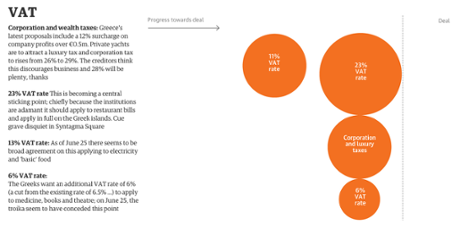

The endless to-and-froing over Greece’s bailout programme has been dragging down spirits in a country that has already suffered years of austerity.
From Thessaloniki, my colleague Angelique Chrisafis reports:
At Thessaloniki’s bustling market, along the narrow alleys of bargain clothes and some of the cheapest meat and vegetables in the city, the continuing uncertainty surrounding a bailout deal was weighing down those already struggling to get through the month.
Michalis Nastos, 54, who runs a clothing stall selling €10 jeans, €6 shirts and an array of cheap summer dresses, had been following the finer details of the negotiation offers and was bracing himself for the impact of possible steep VAT rises and pension changes.
“The uncertainty of this whole process has a psychological effect – people worry about what’s going to happen, they don’t know how or when it’s going to end. We just know everyone is going to be affected, particularly by any rise in VAT.”
Already his profits had fallen by more than 50% after years of crisis, unemployment and tax hikes. The market, which once served mostly low-income families, now increasingly attracts a wider range of customers from all over the city in search of the lowest prices.
Nastos said his main fear was the proposed rise in VAT — an indirect sales tax that would push prices up and indiscriminately affect all shoppers, most of whom are already struggling with the effects of previous tax hikes. “Of course I’m against VAT rises, it’s already very high, it will have a knock-on effect. It’s the little details that will really affect people. The price of bread would go up — that’s important because people in Greece still eat a lot of bread, so you could see the price of a sesame-seed loaf rise from say 50 cents to 70 cents, that would really have an impact. Packaging costs will rise, energy, basics like pasta. Low-income people won’t be able to afford to buy and more and more people won’t be able to make it.”
Raising the retirement age was another key issue in discussions in Brussels. One fifth of the Greek population is over 65 and, with the extended family serving as a social safety net, one in two Greek households currently rely on pensions to make ends meet. May have already seen pensions cut and about 45% of pensioners receive pensions below what is considered the poverty limit of €665 per month.
Natsos, who had worked in the market trade for 32 years, would likely have to wait another 11 years to retire. “The problem is the country just can’t cover its pensions obligations to this number of people,” he said. But he was more concerned about the long-term state of the economy.
“Greece definitely needs help, there has to be some kind of debt relief, the country won’t be able to make it otherwise.”
Michalis Hadji-Athanasiadis, 84, a former police officer who had retired aged 50, said his pension had shrunk from €1,600 a month to €1,000 a month, and his extra benefits had been cut. But his pension was still far higher than the shrinking salary of his 52-year-old daughter who was a high-school teacher and who, like her brother and his wife, still lived with their parents to make ends meet.
He said:
“People are hungry. For five months it seems there has been no progress and business is down everywhere, a lot of shops have closed. Income is down, with VAT going up everything you need to buy becomes so much more expensive.”
Near the market, one woman in her 50s, who said her main income came from selling black market Balkan cigarettes, described how customers used to buy five or six packets but were now only buying one or two. “It feels like life is over,” she said. “We can barely manage to feed ourselves.” Her adult children, who had lost their jobs as shop-assistants during the recession both lived with her.
She adds:
“It feels like they’re going after the little guy, all the high-income people got away with it and got their money out of the country.”
Tsipras speaks with Greek president

Over in Athens the government has announced that the Greek prime minister has just spoken by telephone to the country’s head of state Prokopis Pavlopoulos.
Helena Smith reports.
“The prime minister Alexis Tsipras had telephone contact with the president of the republic Prokopis Pavlopoulos a little while ago. He informed the president about the negotiations which are underway,” the statement said.
Pavlopoulos, a veteran politician on the right before assuming the largely ceremonial role of president earlier this year, has said he will go to “the boundaries of my authorities” to ensure that Greece remains at the heart of Europe in the single currency.
“I know that my role, not least because of my election by the majority of the parliament who chose me, is to ensure the course of the country in Europe and the euro zone,” he said last week.
“And that in front of this aim there has to be a solid internal front of all democratic forces. Petty party views and friction can’t come before the achievement of such a goal.”
Updated
Full quote #Greece pic.twitter.com/9QaJ2t5DGc
— Derek Gatopoulos (@dgatopoulos) June 25, 2015
Austria’s chancellor, Werner Faymann, is also optimistic....although he warns that the crisis could run for several more days.
Austria's Werner Faymann: I am hoping for a solution to Greece if not tonight than by Monday or Tuesday at the latest
— Open Europe (@OpenEurope) June 25, 2015
Tusk: My hunch is Greek story can have a happy ending
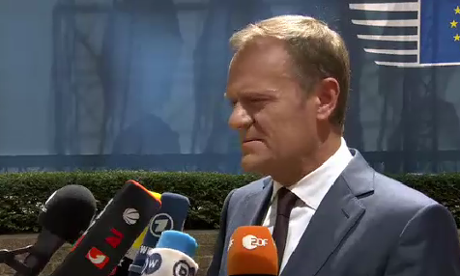
Donald Tusk, head of the European Council, has arrived at today’s EU summit meeting - and predicted that the Greek crisis will not end in tragedy.
On Greece, he tells reporters that:
Work is underway, and for sure it will need still many hours.
The last hours have been really critical, but I have a good hunch that unlike in Sophocles’ tragedies, this Greek story will have a happy ending.
He adds that he’ll give the media more information tonight after leaders have met (they’ll be discussing the migration crisis and Britain’s plan for an EU referendum).
European Council pres Donald Tusk says #Greece will need many hours, but has a hunch that Greek story will have a happy ending.
— Jennifer Rankin (@JenniferMerode) June 25, 2015
Updated
More photos from inside the eurogroup, showing Yanis Varoufakis in quite decent spirits:


Updated
There is already speculation that ANOTHER meeting might be called over the weekend, which is bound to lift spirits in Brussels, Athens and beyond.
Brussels chatter of possible 'very last chance' Eurogroup meeting on Saturday.
— Yannis Koutsomitis (@YanniKouts) June 25, 2015
Sigh, the next last chance meeting on the horizon.. https://t.co/uJXUs64YpW
— Jennifer Rankin (@JenniferMerode) June 25, 2015
Here’s the seating plan for today’s meeting, via Finland’s finance minister.
For good old times sake, here is the seating order in the #Eurogroup. Different from normal rotation. pic.twitter.com/cAGGZvy4nD
— Alexander Stubb (@alexstubb) June 25, 2015
It’s interesting that Ireland’s finance minister, Michael Noonan, is next to Yanis Varoufakis.
Noonan denied claims he’d “stabbed the Greek people in the back” this week by reportedly suggesting that capital controls might be needed.
Photos: Inside the eurogroup
The photographers in Brussels have surpassed themselves, with a selection of photos from inside today’s eurogroup meeting.
Everyone looks remarkably upbeat, given the importance of this meeting, and the dangerous consequences that could follow.


Updated
Finland’s finance minister, Alex Stubb, has warned that there’s still a significant gap between the two sides....
FINLAND'S STUBB: GREECE DOCUMENTS HAVE `PRETTY BIG' DIFFERENCES earlier reports said differences were 'not that big'
— Steve Collins (@TradeDesk_Steve) June 25, 2015
Malta: We've received a document from Varoufakis....
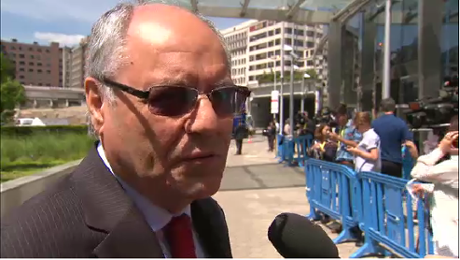
Malta’s finance minister, Edward Scicluna, has just explained what’s happening right now in Brussels.
Arriving at the Eurogroup, he tells reporters that the latest Greek proposal is going to be compared with the 11-page of ideas drawn up by creditors, to see where the disagreements are..
“We’ve run out of comments, we’re also running out of patience, but we’ve received the document from [Greek finance minister Yanis] Varoufakis just over half an hour ago, so we just merged them before coming here.
We need to see what’s been deleted and what’s been added, Sciclina explains, so we can see if a deal is possible.
Are you edging closer to a deal?
Scicluna suggests that they are positive signs..
The fact we are talking from the same book.... that there’s a specific text, which the three institution have submitted, and there are additions and deletions from that document, well...
At least we’re talking from the same text. But there are disageements -- and honestly now I don’t know what they are.
Scicluna also refuses to speculate on whether this is the last chance of a deal, or what might happen next....
#EU's Moscovici: Troika plan is solid, economically, socially. Says #Greece solution is 'within reach.' (BBG)
— Holger Zschaepitz (@Schuldensuehner) June 25, 2015
Several ministers and officials are slipping into the meeting without speaking, including ECB chief Mario Draghi:
Confused about the chances of a deal today? Join the club. Even Slovakia’s finance minister says the situation is up in the air.
I honestly don't know what are the chances to reach a deal today #Greece #eurozone #Eurogroup #ECB #IMF
— Peter Kažimír (@KazimirPeter) June 25, 2015
Updated
Dijsselbloem: No Greek agreement yet
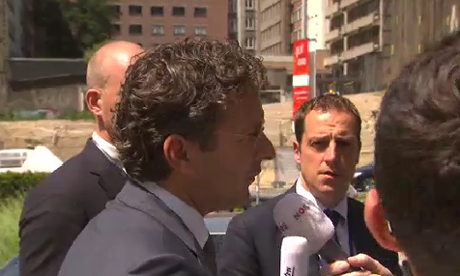
Jeroen Dijsselbloen, head of the eurogroup, has confirmed that a deal hasn’t yet been reached.
Arriving at today’s meeting, he says:
The only thing we have presented to the eurogroup is what the institutions have drawn up. We don’t have a Greek agreement on that...
Dijsselbloem confirms no deal with the Greeks, will have to wait and see what their ideas are.
— Jennifer Rankin (@JenniferMerode) June 25, 2015
Oh dear. Germany’s finance minister is not happy. We have not made progress, Wolfgang Schäuble tells reporters in Brussels, adding that Greece has moved “backwards”.
Several experienced crisis watchers agree that Greece’s lenders have given some ground in their latest proposals, while sticking firm on other issues:
Creditors' proposal includes several concessions to #Greece. Blame game not as easy now.
— Yannis Koutsomitis (@YanniKouts) June 25, 2015
Institutions agree on 13% VAT on basic (and not unprocessed) food, but not on hotels at 23% (vs #Greece proposal at 13%). #ec #ecb #imf
— Manos Giakoumis (@ManosGiakoumis) June 25, 2015
Quite a step institutions postpone by 2 years (end 2019) phasing out supplements for low income pensioners #Greece https://t.co/3RUuTxtGDt
— Jorge Valero (@europressos) June 25, 2015
Carsten Brzeski of ING reckons that the two sides are getting closer:
According to this new compromise obtained by @SpiegelPeter differences have become smaller once again. Debt relief looks like final red line
— Carsten Brzeski (@carstenbrzeski) June 25, 2015
Creditors are also refusing to accept the Greek plan of raising the corporation tax rate from 26% to 29%. In their latest proposal, it would rise to 28%.
They are also keeping a firm red line through Athens plan for a one-off 12% tax on all corporate profits over €500,000.
But one other measure has survived, as the FT points out:
But the plan keeps Mr Tsipras’s plan to raise luxury tax on yachts from 10% per cent to 13%.
Now this is interesting too.... Greece’s creditors are offering that these VAT hikes could be “reviewed at the end of 2016”, if Athens has proved that it has raised more revenue through fighting tax evasion and better VAT collection.
Updated
This leaked proposal shows that creditors have given some ground on the VAT issue -- although they still want to raise a full 1% of GDP through various reforms.
They have accepted that Greece could maintain a 6% low rate for pharmaceuticals, books, and the theatre. In previous plans, this rate would have been abolished.
But, they are still insisting that the lower VAT rate on Greece’s islands is abolished. Alexis Tsipras’s junior coalition partner, ANEL, has already refused to accept such a move.
Creditors also want restaurants and hotels to face the full 23% VAT rate -- they have already warned that this would cost thousands of jobs.
VAT @ 23% for hotels, restaurants & processed food 13% for elect, basic food 6% for pharma Feasibility blueprint pic.twitter.com/GMVccKk3e7
— wolf piccoli (@wolfpiccoli) June 25, 2015
LEAKED: The creditors' new Greek proposal
The FT has just published the document which Greece’s creditors have drawn up and submitted to the eurozone finance ministers (nice one, Peter).
At first glance, it looks pretty similar to the infamous red-ink counter-proposal that the IMF drew up earlier this week. But there are some concessions on pensions.
Leaked: Got my hands on 9-page #Greece bailout plan sent to #eurogroup earlier today. Copy posted here: http://t.co/s06qInNIUB
— Peter Spiegel (@SpiegelPeter) June 25, 2015
The full 11-page document is online here.
Peter Spiegel says:
Under the plan sent to finance ministers, Athens would ensure the retirement age is moved to 67 by 2022, significantly faster that Alexis Tsipras, the Greek prime minister, had sought. Originally, Athens was pushing for 2036, but Mr Tsipras’ compromise plan submitted on Monday moved that to 2025.
There is an important creditor concession in the pension reforms, too, though. Creditors have been trying to get rid of a “solidarity grant” programme that provides a top-up bonus to poorer pensioners, know by the Greek acronym EKAS, by 2017 at the latest. Athens had offered 2020. The new plan splits the difference and goes with December 2019.
The EKAS phase-out will start immediately, however, with the wealthiest 20 per cent of the recipients losing the benefit as soon as legislation is passed.
There are some other elements of the Greek plan that survived as well, including raising contributions pensioners must make towards healthcare from 4% to 6%.
Leaked: Greece bailout plan sent to eurogroup
Analysts are digesting the proposals right now....
Updated
No deal.
It’s now clear that there isn’t an agreement between the two sides, despite this morning’s ultimatum.
The latest rumour is that both sides are going to submit their own proposals to the eurogroup
*GREECE SUBMITTED SEPARATE DOCUMENT AT EUROGROUP: GOVT OFFICIAL / *GREEK OFFICIAL SAYS 2 DOCUMENTS SUBMITTED AT EUROGROUP
— Guy Johnson (@GuyJohnsonTV) June 25, 2015
I can guess whose proposal will be turned down at the #Eurogroup #Greece https://t.co/xvj9PdcvlE
— Daphne Papadopoulou (@daphnenews) June 25, 2015
Yanis Varoufakis has arrived at the eurogroup meeting, carrying a sheet of paper along with his rucksack:
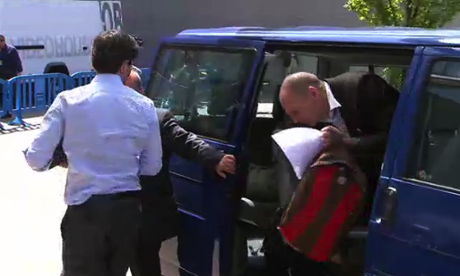
Greece’s finance minister then heads inside without speaking to the assembled press.
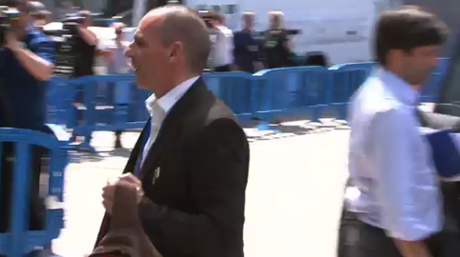
Updated
EU diplomat: Creditors are sending documents to eurogroup
An EU diplomat is briefing that the creditors have sent a proposal up to the eurogroup which, they say, could potentially be the basis for an agreement (Jennifer Rankin reports from Brussels)
EU diplomat says creditors have sent documents to eurogroup that could form basis for agreement; insists no 'take it or leave it'.
— Jennifer Rankin (@JenniferMerode) June 25, 2015
Important point: This doesn’t mean that Greece has also signed up to the plan. It actually confirms that this morning’s meeting did not deliver a breakthrough.
This distinction was missed by some traders, or computer algorithms, which just got rather overexcited:
#Germany's Dax jumps on latest #Greece optimism. pic.twitter.com/gT9glrLrLr
— Holger Zschaepitz (@Schuldensuehner) June 25, 2015
BUNDS pic.twitter.com/KUt2mI19wp
— Joseph Weisenthal (@TheStalwart) June 25, 2015
There goes Alexis Tsipras, out of the building after this morning’s talks ended:
Exit Tsipras @la_stampa pic.twitter.com/pabdrDxGNg
— Marco Zatterin (@straneuropa) June 25, 2015
Greek officials are also briefing that a compromise wasn’t reached at this morning’s meeting.
Greek govt official says Greek proposals were realistic and Greek side has shown willingness for solution
— Mauro Ippolito (@MauroIppolito) June 25, 2015
Just to be clear: #Greece is not on board with proposals agreed unanimously by institutions for #Eurogroup as basis for deal (sources)
— Jorge Valero (@europressos) June 25, 2015
It’s not looking good:
- EURO ZONE FINANCE MINISTERS WILL WORK WITH A PROPOSAL FROM THE CREDITOR INSTITUTIONS ON GREEK DEAL AS THERE IS NO AGREED DEAL WITH ATHENS - EURO ZONE OFFICIALS
'Feasibility' means no agreement, documents now in prep by EC to see if it's feasible for eurogroup to talk. It's very difficult - source
— Bruno Waterfield (@BrunoBrussels) June 25, 2015
Lagarde out. Light smile @la_stampa #Grexit pic.twitter.com/vbfJqdYhX3
— Marco Zatterin (@straneuropa) June 25, 2015
So, now what?
1) Has Alexis Tsipras yielded at today’s meeting with Draghi, Lagarde, Juncker, Dijsselbloem and Redling, meaning an agreement can be passed onto the eurogroup?
2) Or has he refused, meaning that eurozone finance ministers will be presented with a proposal drawn up by the creditors?
There’s a lot of chatter around, but we should hear the truth soon enough.....
Lagarde leaves the meeting too #Greece pic.twitter.com/w51dn3FHTo
— María Tejero Martín (@Maria_Tejero) June 25, 2015
Outriders waiting to escort PM Tsipras out of EU building after another round of debt talks over #Greece pic.twitter.com/buyWukkiGQ
— Derek Gatopoulos (@dgatopoulos) June 25, 2015
Belgian police waits for tsipras @la_stampa pic.twitter.com/p3KgsmQKjW
— Marco Zatterin (@straneuropa) June 25, 2015
The meeting between Alexis Tsipras and the heads of Greece’ creditors appears to have broken up, with the main players heading out of the Commission.
Regling and Dijsselbloem have left the @EU_Commission . Talks still fraught with no breakthrough pic.twitter.com/UCQy1H6ITu
— Simon Marks (@MarksSimon) June 25, 2015
All the principals leaving @EU_Commission HQ. Motorcade w/@J_Dijsselbloem & others just pulled out
— Peter Spiegel (@SpiegelPeter) June 25, 2015
JP Morgan’s economist, David Mackie, agrees that Sunday is the next serious deadline, and fears Greece could impose capital controls if it is missed.
Useful summary of where the #Greece talks might go from here by David Mackie at JP Morgan: pic.twitter.com/cpKRkTL51s
— Ed Conway (@EdConwaySky) June 25, 2015
Austria: Sunday is the final deadline
Austria’s finance minister, Hans Jörg Schelling, has stated that Sunday is the final deadline to reach an agreement with Greece.
That would then give enough time (just) for national parliaments to vote on the plan.
He hopes that a compromise can be reached by 4pm Brussels time, though, in time for the EU leaders summit.
Schelling made the comments as he arrived at the Commission HQ for this afternoon’s eurogroup meeting
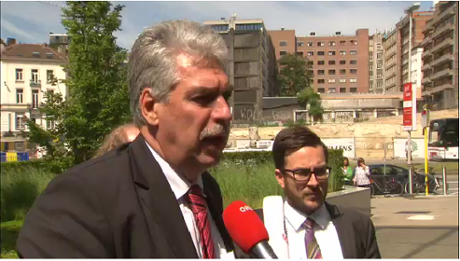
Reuters snapped the key points:
- AUSTRIAN FINMIN SAYS: IF PAPER NOT AGREED BY GREECE, WILL HAVE TO LOOK AT ALTERNATIVES*
- AUSTRIAN FINMIN SAYS: IT’S GETTING HARDER BY THE MINUTE, SUNDAY IS FINAL DEADLINE*
- AUSTRIAN FINMIN SAYS: EUROGROUP TO LOOK AT NEW PROPOSALS ON GREECE*
- AUSTRIAN FINMIN SAYS: HOPE HAS BEEN TO REACH COMPROMISE BY 1400 GMT
#Austria's FinMin Schelling on #Greece: Summit has give FinMins 4pm deadline. (BBG)
— Holger Zschaepitz (@Schuldensuehner) June 25, 2015
The Eurogroup meeting was scheduled to start at 1pm Brussels time, or noon BST, but appears to be running late....
Austria's Schelling says Eurogroup delayed by 30 mins
— Danny Kemp (@dannyctkemp) June 25, 2015
Updated
When all else fails, reach for a feasibility blueprint:
As 11am deadline passes, officials trying to put final touches on a "feasibility blueprint" to serve as basis for #eurogroup talks. #Greece
— Peter Spiegel (@SpiegelPeter) June 25, 2015
But how feasible can it be for Tsipras to cross his ‘red lines’ on pensions? This piece on MacroPolis explains how creditors rejected Greece’s plan to raise contribution levels, and also demands that reforms start straight away.
Deal now in front of Tsipras is lenders' proposals he rejected plus some of the ones he made on Monday #Greece https://t.co/oH4a9oWBmJ
— Nick Malkoutzis (@NickMalkoutzis) June 25, 2015
Correction: The ECB has actually agreed to a request to maintain Greece’s emergency liquidity at the current level, rather than raising it again, Reuters says.
That’s an encouraging sign; suggesting that Greek banks weren’t been hit by further cash withdrawals yesterday.
The European Central Bank has just approved today’s emergency liquidity request from the Greek banking sector, according to the newswires.
No word on how large the request is, but Greek officials are briefing that the ELA funding could be reviewed again tomorrow.
Greek official says ECB stands ready to review ELA in next 24 hours
— Annmarie Hordern (@AnnmarieHordern) June 25, 2015
The ECB has already provided around €89bn of ELA support, to allow Greek banks to handle the deposit flight while bailout negotiations continue.
Of course the ECB will review ELA within 24 hours. If negotiations collapse, no more basis for a cap expansion.
— Frederik Ducrozet (@fwred) June 25, 2015
Updated
The clocks have struck 11am in Brussels, and everyone watches to see if Greece does produce the new proposal demanded this morning....
The church bell in Brussels #EU quarter just rings: It's 11. Time for #Greece MP @atsipras to decide. Eurozone or #Grexit #Eurogroup
— Dirk Hoeren (@DirkHoeren) June 25, 2015
As Hans Nichols puts it on Bloomberg TV, “until you see Alexis Tsipras’s motorcade heading to the airport”, there’s still hope.
Reuters has also heard that Greece was told to produce a new proposal this morning, or else...
- CREDITOR INSTITUTIONS GAVE GREECE UNTIL 1100 CET TO PRODUCE A NEW, WORKABLE PROPOSAL - EURO ZONE OFFICIAL
- IF GREECE DOES NOT DELIVER, CREDITOR INSTITUTIONS WILL SUBMIT THEIR OWN PROPOSAL TO EURO ZONE FINANCE MINISTERS AT 1300 CET - EURO ZONE OFFICIAL
FT: Creditors issue bailout ultimatum to Greece
The crunch moment may just have arrived.
According to the Financial Times, creditors have given Alexis Tsipras until 11am Brussels time to produce a ‘workable’ proposal. That’s in just under 10 minutes time!
If he doesn’t give some ground, Athens could then get a ‘take it or leave it’ offer.....
Over to the FT’s Peter Spiegel and Alex Barker:
Greece is down to its final hours for negotiations over its soon-to-expire bailout, with creditors giving Alexis Tsipras, the Greek prime minister, until 11am Brussels time to come up with a workable economic reform plan to release €7.2bn in desperately needed rescue aid.
According to two senior eurozone officials, if Mr Tsipras fails to reach an agreement — which people briefed on the talks say is now likely after fruitless all-night talks — the creditors’ offer will be presented to eurozone finance ministers for a “take it or leave it” choice by Athens.
“The Greeks didn’t move at all,” said one senior official of the talks between Mr Tsipras and the heads of the European Commission, International Monetary Fund and European Central Bank, which stretched into the early hours of Thursday before breaking up and resuming at 9am.
“The level of frustration is so high. I don’t see a deal,” the official added. “It’s looking pretty grim right now.
MNI’s Simon Marks also reports that tensions are very high....
Officials aware of ongoing talks eerily tight lipped right now!
— Simon Marks (@MarksSimon) June 25, 2015
creditors now have no choice but to do the 'take it or leave it' they always wanted to avoid #Greece https://t.co/WgaKAwCgpl
— Famke Krumbmüller (@FKrumbmuller) June 25, 2015
Updated
Interesting... The Greek stock market has reversed its early 2% fall and is now UP almost 1%. Optimism in Athens?

Greece’s labour minister Panos Skourtletis has also been making some incendiary comments this morning, reports Helena Smith.
Accusing Athens’ international creditors of deliberately attempting to corrode the Greek government’s authority, Skourletis told the ERT TV station that NOTHING could now be ruled out.
“Nothing can be excluded by anyone in relation to the success or not of an agreement.”
Skourletis claims that creditors are deliberately exhausting Greece financially - “asphyxiating the Greek economy” and rejecting any proposed reforms that would have a better effect socially, to weaken the country at the negotiating table.
“They want to reduce the government’s authority,” he added insisting that no deal could be cut if the issue of the country’s monumental debt pile - at €320bn the highest in the EU - was not also addressed.
“There will be no deal without tackling debt and getting a growth program. No reduction in salaries or pensions”.
Government insiders are saying that “all scenarios” are now being considered. The leftist daily Syntaktwn this morning said “rupture with Europe” was now also on the table.
One source said.
“We can’t hide that, yes, there is shock on our part. They are immovable, unyielding.”
It all suggests that, even if Tsipras does reach a deal, getting it through the Athens parliament will be a major challenge:
Negotiations could easily drag on into the weekend, warns Robin Bew of the Economist Intelligence Unit.
#Greece talks not looking so good. Still think they'll do some kind of deal but may run into weekend.
— Robin Bew (@RobinBew) June 25, 2015
Here’s our early dispatch from Brussels, by my colleague Jennifer Rankin:

SYRIZA spokesman Fylis on Skai TV, doesn't sound like a man who expects Tsipras to return to Athens without some kind of deal #Greece
— Nick Malkoutzis (@NickMalkoutzis) June 25, 2015
Syriza MP: We won't be humiliated

More fighting talks from Syriza MPs this morning.
Alexis Mitropoulos says:
“We are being confronted with a cartel of lenders....
“The message that the government has to send is that we are a proud people. We are not going to accept being humiliated,”
Speaking on STAR TV, Mitropoulos adding that the EU and IMF had to respect the “democratic choice” of the Greek people.
State-run TV station ERT is reporting that international lenders are now pushing for €2.3bn in extra measures on top of the €8bn Athens has already agreed to.
“They want 1 % of GDP in Value added tax and are insisting that 23 percent be slapped on restaurants.”
Updated
A striking front page from Greece:
Today's @TOPONTIKI frontpage: Shameful #Europe: committed to the "lethal prescription" insists on executing #Greece pic.twitter.com/5iADe8xUb1
— spyros gkelis (@northaura) June 25, 2015
The front-page headline of another paper, the left-leaning Syntaktwn newspaper, is also very forceful, Helena reports:
“Up to here and enough is enough!” it declared. “The prime minister rejected the far fetching demands of the lenders.”
Updated
Over in Athens, politicians, the media and commentariat all concur that D-Day has come.
Our correspondent Helena Smith reports.
Defiance and dismay are the name of the game in Athens this morning. Almost everyone agrees that both sides will have to do what has not been done in five months to date: make crunch decisions that may well change the course of tiny Greece’s history.
“These moments are something more than critical,” the news portal, newsit.gr, wrote with a touch of understatement. “White smoke” it said had still not appeared despite negotiations being drawn out into the small hours.
A gap of around €600m appears to be the source of differences, although Greek officials worry that with the International Monetary Fund “taking such a tough stance” that figure could rise to €1bn in extra measures. Athens’ leftist-led government says it cannot add that to the €8bn euro in savings it has already offered.
Leading officials in prime minister Alexis Tsipras’ radical left Syriza party repeated accusations this morning that by pushing Greece to the place where it has now pushed it, it had become quite clear that creditors had another agenda: regime change in Athens.
The phones have been ringing off the hook between Brussels and Athens with Tsipras, conferring with ministers in the Greek capital – not least the labour minister Panos Skourletis.
“The hardline faction (among lenders) does not want a an agreement, but rupture, the humiliation of Greece and the fall of the Tsipras government. It is not going to pass,” Syriza’s leading MEP, Dimitris Papadimoulis, wrote on his twitter account.
Η σκληροπυρηνική φράξια των δανειστών δεν θέλει συμφωνία,αλλά ρήξη, ταπείνωση της Ελλάδας κ πτώση της Κυβέρνησης Τσίπρα.Δεν θα τους περάσει!
— Dim. Papadimoulis (@papadimoulis) June 25, 2015
Creditors had, he railed, lost touch with reality.
“They refuse to tax e-gaming but want to add 23% VAT on milk. Are they doing it for … growth or out of interest?” he wrote in another tweet.
Οι δανειστές αρνούνται την φορολόγηση του ηλεκτρονικού τζόγου, αλλά θέλουν 23% ΦΠΑ στο γάλα. Το κάνουν για την... ανάπτυξη η για συμφέροντα;
— Dim. Papadimoulis (@papadimoulis) June 25, 2015
Carsten Brzeski, ING’s chief economist, says people are “getting exhausted” with the endless routine of meetings and deadlines around the Greek crisis.
It’s very hard to tell fact from fiction, he told Bloomberg TV this morning.
The fact that Tsipras, Lagarde, Draghi and Juncker met until midnight, and technical staff resumed work early this morning, shows there is still political will for a deal.
But still:
“If anything, the chances that these negotiations will fail have increased over the last 24 hours.”
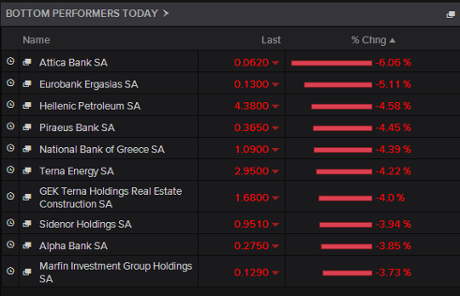
Athens stock market falls
The Greek stock market has just opened....and shares are, unsurprisingly, falling fast.
Bank shares have dropped by 5%, helping to drag the main ATG index down by almost 2%.
Updated
Europe’s stock markets have fallen a little in early trading, extending yesterday’s losses.
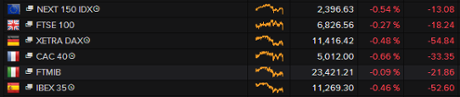
Connor Campbell, financial analyst at Spreadex, says:
The markets are slightly more tentative this morning as another Greece dominant day looms...
An unhappy IMF on one side, which wants stronger pension reforms instead of a reliance on raised taxes, and an angry Greek government on the other means Tsipras, and Greece is general, is caught between the proverbial rock and a hard place as judgement day (i.e. a whopping €1.6bn payment to the Washington-based institution) grows ever closer.
Greece and its creditors now have less than four hours to reach some agreement, before Eurozone finance ministers resume their own meeting (which ended so early yesterday)
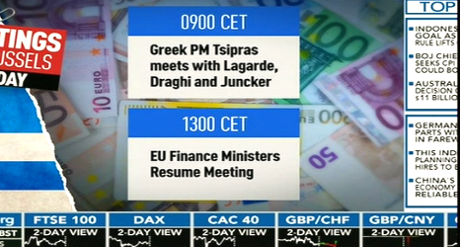
Over in Brussels, MNI reporter Simon Marks has spotted Alexis Tsipras arriving back at the European Commission for more talks with the IMF, ECB and EC:
And the main man-@tsipras_eu has entered the ring. pic.twitter.com/v8LwofhiKx
— Simon Marks (@MarksSimon) June 25, 2015
Analysts at Royal Bank of Scotland reckon a deal probably won’t be reached today:
EU sources have been reported as saying that logistically Sat is deadline for negotiations if #IMF payment on Jun30th is to be made on time.
— Holger Zschaepitz (@Schuldensuehner) June 25, 2015
RBS on #Greece negotiations: Our baseline (50%) continues to be that there will be an agreement before Tuesday but not likely today.
— Holger Zschaepitz (@Schuldensuehner) June 25, 2015
RBS: We certainly cannot rule out that a Greek deal only follows after missed IMF payment, change in Greek govt composition or cap controls.
— Holger Zschaepitz (@Schuldensuehner) June 25, 2015
Greek government: we're being blackmailed

A senior official of Greece’s ruling Syriza party has claimed that creditors are trying to “blackmail” the country.
Nikos Filis, the ruling Syriza party’s parliamentary spokesman, told Mega TV that:
“The lenders’ demand to bring annihilating measures back to the table shows that the blackmail against Greece is reaching a climax.”
Filis added that Greece is adamant that lenders must embrace the issue of debt relief:
“There cannot be a deal without a substantial reference and specific steps on the issue of debt.”
(Thanks to Reuters for the quotes)
Updated
Europe’s indefatigably optimistic economics affairs commissioner, Pierre Moscovoci, has tweeted that “Where there is a will, there is a way”.
Là où il y a une volonté, il y a un chemin
— Pierre Moscovici (@pierremoscovici) June 25, 2015
That phrase was used by Angela Merkel earlier this month; wonder if she still agrees....
Updated
Introduction: Here we go again (again)

Good morning.
Last ditch talks. Going to the wire. Groundhog Day. Pick your cliché, because it’s going to be another one of those moments.
Greece and its creditors are hunkering down for another attempt to reach an agreement over its bailout package, which expires in just six days.
Technical teams are already at their desks working away.
And soon, Greece’s prime minister, Alexis Tsipras, will meet with IMF managing director Christine Lagarde, ECB president Mario Draghi, and European Commission president Jean-Claude Juncker. Those talks are expected to start at 9am Brussels time, or 8am BST.
They can’t have had much sleep -- emergency talks between the quartet lasted until after midnight. Juncker still had enough energy to wave at our Europe editor, Ian Traynor - which must be a good sign.
Juncker has left the building. He waved at @traynorbrussels. Really. He did pic.twitter.com/URGMlyK4Fk
— Bruno Waterfield (@BrunoBrussels) June 24, 2015
The meeting ended in the early hours of Thursday with Greece “remaining firm on its position” according to a Greek government official.
The two sides are really struggling to close the yawning gap over the measures Greece must take to obtain bailout funds.
As we covered yesterday, the IMF refuses to accept Athens’ plan to raise €8bn mainly through tax rises, and is demanding much tougher pension reforms.
Today’s goal is to make serious progress this morning, so that eurozone finance ministers have a proposal to sign off when they meet - for the fourth time in a week - at 1pm Brussels time (or noon BST)
Greek talks to resume today at 0800BST in order to construct new proposals, which can be presented at the Eurogroup summit 1200BST
— RANsquawk (@RANsquawk) June 25, 2015
Then, EU leaders gather for a two-day summit this evening that was meant to focus on the migration crisis, and Britain’s renegotiation plans. Greece, though, could hijack the event, with Tsipras’s insisting that Greece must be given debt relief.
Morning from Brussels where multiple crises collide: med migrant crisis, Grexit & Brexit. #EUco Summit in 1 building. next door Greek talks
— Faisal Islam (@faisalislam) June 25, 2015
We’ll be tracking all the events through the day....
Updated