Summary: Greece compromises, at the last moment
So to recap, Greece has put forward a plan of reforms, spending cuts and tax rises that is close to what was demanded by its creditors before Alexis Tsipras called last Sunday’s referendum.
The plan includes sweeping chnages to VAT to raise a full 1 percent of GDP, moving more items to the 23% top rate of tax, including restaurants - a key battleground before.
Greece has also dropped its opposition to abolishing the lower VAT rate on its islands, starting with the most popular tourist attractions, despite firm opposition from Tsipras’s coalition partner.
Athens also appears to have made significant concessions on pensions, agreeing to phase out solidarity payments for the poorest pensioners by December 2019, a year earlier than planned. It would also raise the retirement age to 67 by 2022.
And it has agreed to only raise corporation tax to 28%, as the IMF wanted, not 29% as previously targeted.
Greece is also proposing to cut military spending by €100m in 2015 and by €200m in 2016, and implement changes to reform and improve tax collection and fight tax evasion. It will also press on with privatisation of state assets including regional airports and ports; some government MPs had vowed to reverse this.
In return, Greece appears to be seeking a three-year loan deal worth €53.5bn.
Two obvious questions -- will this still be enough for creditors, or will they push for even tougher “conditionality” now we’re talking about a new bailout programme. And how will Alexis Tsipras persuade his party, including the hardline Radical Left, to support it?
We may find out both questions on Friday, so tune in then. Goodnight! GW
Updated
The Greek proposal doesn’t appear to cover debt relief. But apparently, Athens has also released one of its ‘non-papers’ to the media, explaining that they are also seeking “regulation’ of debt” and the €35bn investment package promised by Jean-Claude Juncker.
@SpiegelPeter Gov nonpaper accompanying prior actions sez request to ESM incl ‘regulation’ of debt + €35-bn ‘frontloaded investment package'
— NikiKitsantonis (@NikiKitsantonis) July 9, 2015
This - http://t.co/GKzYq0g4Zk - looks v similar to the 26th June draft plan. The one voted down in the referendum.
— Duncan Weldon (@DuncanWeldon) July 9, 2015
Basically: Syriza get presented with 26th June plan, call referendum, win referendum, Creditors hit back with "deal or Grexit", Greeks fold.
— Duncan Weldon (@DuncanWeldon) July 9, 2015
Read Greece's bailout request here
A round of applause for Greek newspaper Naftemporiki, who has uploaded the full proposal:
The Greek reform proposals
It does appear that Greece has, errr, compromised rather substantially:
New #Greece proposal appears to meet creditor demands for phasing out pension system's "solidarity grant" by 2019
— Peter Spiegel (@SpiegelPeter) July 9, 2015
With a quick read, new #Greece proposal appears to move closer to creditors on VAT & pension reforms. But was pre-June 30 creditor position
— Peter Spiegel (@SpiegelPeter) July 9, 2015
Greek proposals leak!
Hot out of Brussels, the Greek proposal is starting to leak.
And it shows that Greece is promising to hit the surplus targets demanded by its creditors, after months of resistance
Got copy of new #Greece proposal. Maintains primary surpluses at 1%, 2%, 3% & 3.5%, though 1st 3 years in parentheses
— Peter Spiegel (@SpiegelPeter) July 9, 2015
And here’s how they’ll do it:
BREAKING: Greece offers sweeping sales tax hikes, pension cuts in new proposals to creditors.
— The Associated Press (@AP) July 9, 2015
* Greek reforms proposal to raise corporate tax in 2015 - RTRS
— Fabrizio Goria (@FGoria) July 9, 2015
* Greek reforms proposal to increase tax on shipping companies - RTRS
— Fabrizio Goria (@FGoria) July 9, 2015
* Greek reforms proposal to increase luxury tax and implement tax on TV adverts immediately - RTRS
— Fabrizio Goria (@FGoria) July 9, 2015
* Greek reforms proposal ekas benefit to be gradually phased out for all pensioners by end December 2019 - RTRS
— Fabrizio Goria (@FGoria) July 9, 2015
Updated
And finally (probably), the first reactions are already coming in from outraged leftists following news of the new measures, says Helena.
The communist party has called on supporters to attend a mass rally in Omonia Square at 7pm (5pm BST) on Friday to protest “the barbaric memorandum.”
“Fight now to cancel the plans to pauperise the people,” it declared in a statement released in the last five minutes.
“Let’s say NO to the barbaric memorandum.”
Time to dig out the OXI signs again?
Updated
Panic over! A signed copy of the Greek proposal has landed in Brussels.
Now received. Signed. Three institutions will now assess. #withJuncker
— Martin Selmayr (@MartinSelmayr) July 9, 2015
So what happens now? Over to Athens.....
Our correspondent Helena Smith has confirmed that the proposed reforms have indeed been sent to the country’s creditors - and three hours AHEAD of the midnight deadline central European time.
Government insiders are saying the proposals were sent at 1OPM Greek time (9 PM central European time) to all three creditors and the president of the Euro Group of euro area finance ministers Jeroen Dijsselbloem.
The Dutch finance minister must sign off on the reforms before they are submitted for further discussion to EU leaders.
The proposed package - a biting mix of tax hikes and swingeing cutbacks - was tabled in parliament as an emergency bill on Thursday. It will, say officials, be put to vote on Friday evening in order to invest the Greek prime minister, his deputy Yannis Dragasakis and finance minister Euclid Tsakalotos with the appropriate authority to conduct talks around the proposed reforms.
Until a cast-iron agreement is reached, the vote will not be binding - rather is is aimed exclusively at furnishing the central protagonists in Greece’s negotiating team with the authority to debate with creditors around the proposed reforms.
Once negotiations are completed it will become law.
After several drama-filled days, replete with apocalyptic scenarios, a ray of hope was seen tonight. The vast majority in Tsipras’ radical left Syriza party accept that chaos lies the other way.
But the devil will be in the detail. Panagiotis Lafazanis, who heads Syriza’s militant wing, the Left Platform, has already expressed his wholehearted opposition to the proposed plan saying it fails to give any hope of a breakthrough to the Greek economic crisis. The Left Platform represents about a third of the party.
Zoe Konstantopoulou, the president of the parliament and a member of Syriza’s hard left herself, has publicly announced that no new memorandum outlining further austerity will be passed by the 300 seat House.
Although, Konstantopoulou has just spent 3.5 hours with Tsipras.... and has left his office refusing to make any comment!
Updated
Ah, there may be a hitch...
Signed letters are needed.
— Martin Selmayr (@MartinSelmayr) July 9, 2015
Eurogroup president Dijsselbloem’s spokesman has confirmed that the Greek bailout plan has arrived!
New Greek proposals received by #Eurogroup president @J_Dijsselbloem, important for institutions to consider these in their assessment
— Michel Reijns (@MichelReijns) July 9, 2015
Sounds like the Greek proposal has been fired across to Brussels; if so, that’s AHEAD of the midnight deadline.
#Greece reforms' proposal sent to the Institutions and #Eurogroup's Dijsselbloem ~official
— Yannis Koutsomitis (@YanniKouts) July 9, 2015

Full story: Athens accepts harsh austerity in push for bailout
Here’s our latest news story about tonight’s developments:
Greece debt crisis: Athens accepts harsh austerity as bailout deal nears
The Greek government capitulated on Thursday to demands from its creditors for severe austerity measures in return for a modest debt write-off, raising hopes that a rescue deal could be signed at an emergency meeting of EU leaders on Sunday.
Athens is understood to have put forward a package of reforms and public spending cuts worth €13bn (£9.3bn) to secure a third bailout from creditors that could raise $50bn and allow it to stay inside the currency union.
A cabinet meeting signed off the reform package after ministers agreed that the dire state of the economy and the debilitating closure of the country’s banks meant it had no option but to agree to almost all the creditors terms.
Parliament is expected to endorse the package after a frantic few days of negotiation that followed a landmark referendum last Sunday in which Greek voters backed the radical leftist Syriza government’s call for debt relief.
Syriza, which is in coalition with the rightwing populist Independent party, is expected to meet huge opposition from within its own ranks and from trade unions and youth groups that viewed the referendum as a vote against any austerity.
More here:
A group of pro-EU demonstrators have gathered outside the Greek parliament tonight:


Friday will be busy....
Greek PM Tsipras has called a meeting of party lawmakers for 0600BST tomorrow (@RANsquawk)
— Open Europe (@OpenEurope) July 9, 2015
Greece may get bailout and humanitarian aid
International observers have been telling us today that the package is likely to be so punitive that humanitarian aid cannot be ruled out.
EU president Jean Claude Juncker had mentioned humanitarian aid as part of the “detailed Grexit scenario” plans creditors had drawn up. EU diplomats based in Athens said some form of assistance is likely to be given even if am agreement between Greece its creditors is reached.
Syriza MPs have been telling our Helena Smith that the big no received in the referendum on Sunday was a “confidence vote” in Tsipras who like no other prime minister before now has the popular support to enforce such punitive measures.
That is not how the far far left (or indeed the far left in Syriza) see things. Strikes, rallies and protests should be expected in weeks ahead.
We don’t yet know the details of Greece’s plan, but one report says there will be €13bn of fresh austerity. A heavy blow for the economy after years of recession, and the current banking shutdown.
#Greece reforms proposal foresees €13bn of fiscal measures and €50bn of requested loan ~source #ESM
— Yannis Koutsomitis (@YanniKouts) July 9, 2015
The irony has not been lost on anyone - even though governing MPs are making light of it - that after the Greeks’ resounding rejection of further biting austerity at the weekend, prime minister Alexis Tsipras has with lightning speed now agreed to put his name to the most punitive austerity package any government has been asked to implement during the five years of economic crisis in Greece.
Greek government agrees reform plan
Breaking news in Athens.
In an emergency meeting the Greek government has approved the package of measures it will present to creditors (hopefully later this evening) to break the impasse and reach an agreement, our correspondent Helena Smith reports.
A senior Syriza MP has just told me that the radical left party’s parliamentary group has been “asked to be on standby” to vote on the package possibly as early as tomorrow.
“We have all been told to be here. We may have to vote on it tomorrow,” he said.
The defence minister who leads the right-wing populist Independent Greeks party, the government’s junior partner, has also just said: “Very shortly the Greek proposal will be tabled.”
Updated
Afternoon summary: Waiting for Greece's homework
Time for a recap
The Greek government is furiously scrambling to draw up a credible package of economic reforms to deliver to its creditors before midnight tonight, ahead of Sunday meetings that will decide its future in the eurozone.
French officials are providing “invaluable support” to Greece, we hear.
Greek media claim that the plan could include up to €12bn of tax rises and spending cuts, more than expected.
The world waits for the #Greek proposals which have been penned here at the office of @atsipras #GreeceCrisis pic.twitter.com/eNxUCP9V7U
— Jack Parrock (@jackeparrock) July 9, 2015
One Syriza MP has told us that he’s optimistic about a deal for the first time in weeks.
And Ireland’s Michael Noonan has suggested there’s a better than 50% chance of a deal.
But there are also signs of tension in the Greek coalition. Panagiotis Lafazanis, the energy minister and influential hard-leftist, has ruled out a new tough austerity package.
And Mario Draghi, the ECB chief, has warned that reaching a Greek deal is “really difficult” this time.
European Council president Donald Tusk has thrown his weight behind calls for Greece to be given the debt relief which the IMF says is essential.
Tusk tweeted his message too:
Realistic proposal from Athens needs to be matched by realistic proposal from creditors on debt sustainability to create win-win situation
— Donald Tusk (@eucopresident) July 9, 2015
And threw in a bit of Latin:
No matter what. Help to #Greece no justification of wrong economic philosophy causing the crisis. "Magnum vectigal est parsimonia"
— Donald Tusk (@eucopresident) July 9, 2015
That’s “Thrift is a great revenue”, ‘pparently.
Tusk’s comments pile more pressure on eurozone hard-liners to face up to Greece’s need for debt relief.
But Germany’s chancellor Angela Merkel has warned that Greece cannot receive a ‘classic haircut’ on its loans.
And finance minister, Wolfgang Schäuble, has echoed this point, telling an audience in Frankfurt that:
“Debt sustainability is not feasible without a haircut and I think the IMF is correct in saying that....
There cannot be a haircut because it would infringe the system of the European Union.”
Schäuble has also pushed back at US interference:
Schaeuble: "We could take Puerto Rico into euro if #US were willing to take #Greece into dollar. (Jack Lew) thought that was a joke” #uhm
— Alessandro Speciale (@aspeciale) July 9, 2015
Europe’s stock markets have jumped by 2% today, partly on hopes of a Greek resolution soon.
As analysts at City firm Jefferies explain:
By Monday morning, hopefully, it should be pretty clear whether or not Greece is staying in the euro area – at least for the next few months.
It seems very unlikely that over the next 72 hours the two sides will bridge the gap between Tsipras’ desire for a debt write-down and the Europeans’ reluctance to offer anything up-front without Greece actually implementing (as opposed to promising to implement) reforms.
So a long-term deal seems illusive, but a short-term bridging loan allowing Greece to pay the IMF and, most importantly, the ECB on 20 July (the following Monday), could be on offer.
And the weekend is going to be busy, with eurozone finance ministers meeting on Saturday:
* Euro zone finance ministers plan to start Eurogroup on Greece at 3pm cet (1300 gmt) Saturday to discuss Greek proposals - officials - RTRS
— Fabrizio Goria (@FGoria) July 9, 2015
Followed by leaders on Sunday:
Sunday's #EuroSummit to start at 16.00, subsequent special meeting of the European Council to start at 18.00. #EUCO #Greece
— EU Council Press (@EUCouncilPress) July 9, 2015
European commission vice-president Valdis Dombrovskis has confirmed that Greece’s lenders are working on a debt sustainability analysis, ready for the weekend.
Debt relief: EC is not interfering on IMF's work. Now we're working together with ECB & IMF on t debt sust analysis: @VDombrovskis #Greece
— María Tejero Martín (@Maria_Tejero) July 9, 2015
In Spain, a video is doing the rounds shows Greek prime minister Alexis Tsipras -- whether intentionally or not -- snubbing his Spanish anti-austerity ally, Podemos’ Pablo Iglesias.
The video, shot as Tsipras visited the European parliament on Wednesday, shows the Syriza leader greeting politicians. As Iglesias puts his hand on Tsipras’ shoulder and holds out his other hand, Tsipras instead turns to French MEP Jean-Luc Mélenchon.
Thousands have shared the video on social media, asking whether the gesture was intentional or simply an oversight by Tsipras.
On Monday, Iglesias welcomed the results of the Greek referendum, but sought to dampen any speculation that Spain would follow in the footsteps of Greece. “We have a great friendship with Syriza, but luckily, Spain is not Greece,” Iglesias told local media.
“The circumstances are different and it makes no sense to draw parallels.”
Mr Schäuble is in a witty moody today....
What? --> GERMAN FINANCE MINISTER SCHAEUBLE: OFFERED LEW TO TAKE PUERTO RICO IF US TAKES GREECE - MNI
— Fabrizio Goria (@FGoria) July 9, 2015
Don’t take the offer, Jack - the Puerto Rico default is bad, but not as bad as Greece.
#MichelSapin @Min_Finances and #Schäuble @BMF_Bund discussion finished, video follows at http://t.co/0d35dsGAa7 pic.twitter.com/LHbDfVA7jZ
— Deutsche Bundesbank (@bundesbank) July 9, 2015
Woah! Back in Frankfurt, Wolfgang Schäuble has said the IMF is correct that Greece needs a haircut make its debt sustainable; but alas this isn’t possible under European rules.
GERMANY'S SCHAEUBLE SAYS DEBT SUSTAINABILITY IS NOT FEASIBLE WITHOUT A HAIRCUT, THINK THE IMF IS CORRECT IN SAYING THAT
— Steven (@Systematic_FX) July 9, 2015
- GERMANY'S SCHAEUBLE SAYS CANNOT BE A HAIRCUT BECAUSE IT WOULD INFRINGE SYSTEM OF EUROPEAN UNION so they are out
— FxMacro (@fxmacro) July 9, 2015
Schäuble also played down the significance of ‘reprofiling’ Greece’s debt mountain (eg, by extending maturities)
*SCHAEUBLE: LEEWAY FOR GREEK DEBT REPROFILING VERY SMALL
— World First (@World_First) July 9, 2015
Spotted: Greece’s new finance minister, Euclid Tsakalotos, chatting with his predecessor Yanis Varoufakis in the Athens parliament today.


Updated
French finance minister Michel Sapin has also weighed in on the Greek crisis.
Reuters has the details:
“Balanced budgetary strategies are necessary and efforts are needed to boost investment,” Sapin told a conference in Frankfurt. “We must find the right balance between indispensable budgetary consideration and boosting growth.”
Regarding Greece, Sapin said there was a need to rebuild confidence and trust to find a solution to the current crisis
#greece macron, valls, sapin, even god forbid hollande. nice to see the french standing up for a change #vivela...
— Ian Traynor (@traynorbrussels) July 9, 2015
Over in Frankfurt, German finance minister Wolfgang Schäuble called for the eurozone to be strengthened to avoid a repeat of the Greek crisis.
Schäuble warned:
“A monetary union constructed like ours is nothing but an invitation for somebody that doesn’t stick to the rules and that’s called moral hazard.”
Schäuble added that Greece can’t expect any help until it’s taken ‘prior actions’, and there’s no sign of that yet.
Hopefully Greece’s new proposal, due by midnight, will illuminate that point.
Schäuble says he hasn't seen any Greek prior actions yet, while everyone knows they are discussed now in Gr Cabinet & will be sent tonight.
— Yannis Koutsomitis (@YanniKouts) July 9, 2015
For all its concern about Greece’s debt sustainability, the IMF isn’t planning to offer any relief itself.
Olivier Blanchard, its outgoing chief economist, has pointed out that poorer countries (Fund members themselves) haven’t received the kind of treatment Athens is seeking:
Asked if #IMF should restructure its own #Greece loans, chief economist Blanchard says much poorer countries not been given such benefit
— Peter Spiegel (@SpiegelPeter) July 9, 2015
IMF's Blanchard: Greece's arrears "have implications". "We cannot just extend without a programme". Rules out IMF debt relief for Greece
— Mehreen (@MehreenKhn) July 9, 2015

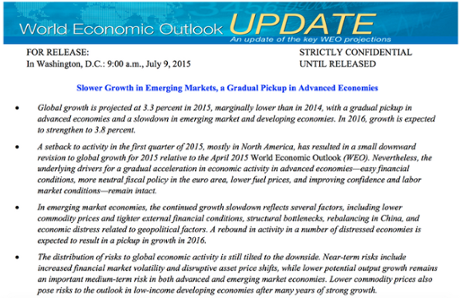
Gloomy news from the IMF: They’ve just cut their global growth forecasts.
They now expect world GDP to rise by 3.3% this year, down from 3.5% back in April.
For once, the eurozone doesn’t get the blame -- instead, the Fund has slashed its growth forecasts for the US and Canada, and also predicted slower growth in Japan and the UK.
IMF Growth Forecasts From The World Economic Outlook: pic.twitter.com/1QRAAfSH4P
— Live Squawk (@livesquawk) July 9, 2015
IMF cuts UK 2015 growth forecast to 2.4% from 2.7%
— MineForNothing (@minefornothing) July 9, 2015
Merkel: Classic Greek haircut is out of the question

Angela Merkel has ruled out slashing the face value of Greece’s government debt, during a visit to Bosnia today.
Reuters has the details:
“In 2012 we dealt with the issue of debt sustainability. We stretched out the maturities, we pushed back the repayment requirement for EFSF loans out to 2020. So we are not dealing with debt sustainability for the first time,” Merkel said when asked about differences with the International Monetary Fund (IMF) over a debt writedown for Greece.
“I have said that a classic haircut is out of the question for me and that hasn’t changed between yesterday and today.”
That is likely to play well back home.
But it also doesn’t rule out a ‘reprofiling’ of Greek debt -- ie, cutting the (already low) interest rates or giving Athens more time to pay its borrowings back. That could make the debt more sustainable.
Speaking of haircuts.....
LOL ! ECB haircut guide (via @hellahueck) pic.twitter.com/9uZikgdNtN
— Robert Went (@went1955) July 9, 2015
Updated
Europe allowed the negotiations with Greece to drag on too long, says European Council president Donald Tusk in an interview published today.
Tusk told Dutch newspaper NRC Handelsblad that tougher limits should have been drawn from the beginning of negotiations, after Syriza won January’s general election. Instead, the two sides talked for months, meaning Greece’s second bailout expired on 30 June before a deal was reached.
Tusk also warned that last weekend’s referendum makes it harder to reach a deal, as Tsipras will have to make proposals which go against the “No” result to get a new aid package.
@graemewearden For your liveblog, Tusk has done i/view with Dutch @nrc, saying EU should've drawn a clear line sooner http://t.co/n5IQUr168k
— Henk van Klaveren (@hvklav) July 9, 2015
Thanks Henk!
Connor Campbell, financial analyst at Spreadex, explains why European markets are rallying:
Reports have circulated this morning that the latest Greek plan could contain €12 billion in tax rises and cuts. Whilst this will be music to creditors’ ears, or it will if relationships haven’t been soured too much, this level of reform is more than the amount the Greek public rejected by voting ‘no’ in last weekend’s referendum.
Tsipras remains stuck between the creditor rock and the Syriza/Greek public hard place, and if the €12 billion reform plan reports are true it’s going to be a tough sell back at home, to put it mildly.
Things might be eased, however, if the growing calls for debt relief are heard by those (Germany) who are so opposed to them. Donald Tusk joined Christine Lagarde and Jack Lew in stating that negotiations do not go one way, and that if Greece’s proposal is sufficient it has to be matched by an ‘equally realistic’ proposal by the creditor cabal on debt sustainability.
Rumours of a French helping hand in drawing up these proposals also suggest that the Eurozone, or at least certain members of the region, remain committed to avoiding a Grexit, with Irish finance minister claiming that there is more than a 50% chance of a deal being made.
Stock markets rally on Greek hopes
European stock markets are pushing higher, following Donald Tusk’s warning to creditors that they must consider Greek debt sustainability.
The main indices are up over 2%, on hopes that a deal could come by Sunday.

Germany's DAX continues to surge. Now up nearly 2.3% pic.twitter.com/8R3BG6dBSO
— Joseph Weisenthal (@TheStalwart) July 9, 2015
Who voted No last Sunday? The Greek poor. And who voted yes? The wealthy.
And here’s the proof, from my colleagues Achilleas Galatsidas and George Arnett. They’ve taken the voting data from last weekend’s referendum, and mapped it against average income levels across Athens.
They report:
Wealthy suburbs in the north such as Kifisia voted definitively in favour of a deal with Greece’s creditors. However, in some of the lower-income districts, particularly in the west of the city, the no vote was backed by the vast majority of residents.
This map shows how divided Athens was in the Greek referendum http://t.co/azvqmeLmeE pic.twitter.com/d1ubk9xl0M
— The Guardian (@guardian) July 9, 2015
Updated
Bad news for eurozone crisis watchers who fancied a quiet weekend - eurozone finance ministers will meet at 2pm BST (4pm Athens time) on Saturday to discuss Greece’s proposals (once they’re written):
* Euro zone finance ministers plan to start Eurogroup on Greece at 3pm cet (1300 gmt) Saturday to discuss Greek proposals - officials - RTRS
— Fabrizio Goria (@FGoria) July 9, 2015
Political developments in Athens....
#Greece Cabinet council meeting in 30 minutes. Should make final decision on reform proposal. #GreeceCrisis
— Yannis Koutsomitis (@YanniKouts) July 9, 2015
Tusk puts pressure on Germany over Greek debts
Donald Tusk’s comments on debt sustainability could be an important development, following a double-whammy of pressure from America last night.
Yesterday, International Monetary Fund MD Christine Lagarde warned that Greece is now in “a situation of acute crisis”; reforms and a “debt restructuring” are both needed to escape it.
And US Treasury secretary Jack Lew made his clearest signal yet that America believes restructuring is inevitable.
He said:
“In the next few days what we’ll see is [whether] the parties come together and build enough trust that Greece will take the actions that it needs to take so that Europe will restructure the debt in a way that is more sustainable”
The IMF had already made his point a week ago; its new Debt Sustainability Analysis showed that Greece needs “comprehensive” debt relief, with repayments delayed for decade.
The eurozone has been trying to kick this issue under the carpet for months.
Tusk’s comments suggest that the message has got home to Europe; helpful for the Greek government, but problematic for the likes of Germany.
Tusk blindsided everyone with that debt relief call, which echoes US and IMF. What on earth will Merkel make of it?
— Danny Kemp (@dannyctkemp) July 9, 2015
EU's Tusk follows Lagarde in saying any deal must involve 'realistic' proposal for handling Greek debt. Comments help Tsipras at home#Greece
— Gavin Hewitt (@BBCGavinHewitt) July 9, 2015
The EU has just announced the timings for Sunday’s leaders’ meetings on Greece:
Sunday's #EuroSummit to start at 16.00, subsequent special meeting of the European Council to start at 18.00. #EUCO #Greece
— EU Council Press (@EUCouncilPress) July 9, 2015
Tusk has also tweeted that Greece’s creditors must show how they would help Greece bring its debt pile down to a sustainable level:
Realistic proposal from Athens needs to be matched by realistic proposal from creditors on debt sustainability to create win-win situation
— Donald Tusk (@eucopresident) July 9, 2015
Updated
While I was watching Donald Tusk, the European Commission was giving its morning briefing.
And it emerged that president Juncker will meet Greek opposition parties today:
Juncker to meet Greek opposition parties today and Friday, says @MargSchinas. #grexit @JunckerEU @tsipras_eu
— James Kanter (@jameskanter) July 9, 2015
There are murmurings from Athens that opposition parties fear that Alexis Tsipras is either unable or unwilling to reach an agreement.
New Democracy leader Evangelos Meimarakis met with Tsipras and four other party leaders on Monday, resulting in the issuing of a joint statement. However, the conservative said on Wednesday that he refused to hold another meeting in private with Tsipras and called on him to address Parliament.
Meimarakis said that he wanted Tsipras’s comments to be officially recorded, which suggests that the New Democracy chief has become suspicious of the prime minister’s motives. Meimarakis also decided to send ex-ministers Dora Bakoyannis and Costis Hatzidakis to Brussels for discussions with officials there.
Former PASOK leader Evangelos Venizelos suggested that Tsipras is trying to trap the opposition parties so he can call snap elections without reaching any agreement with the institutions.
Luxembourg’s PM, Xavier Bettel, says that he will speak with Tsipras later today to push him to deliver ‘serious’ proposals.
Luxembourg's Bettel, at presser with Tusk, says he'll call Tsipras today to urge 'serious' proposals
— Danny Kemp (@dannyctkemp) July 9, 2015
Standing alongside Donald Tusk, Bettel also signals that patience is stretched:
We have had months of goodwill. we now need proposals.
Updated
Tusk: Creditors must make proposals on Greek debt sustainability
Donald Tusk, EC president, says we have just three days to tackle the Greek crisis.
Speaking in Luxembourg, Tusk says that Greece remains the most pressing issue for Europe. We stand ready to do whatever is necessary to protect the stability of the euro area.
I spoke with prime minister Alexis Tsipras today, says Tusk. And I hope that today we will receive concrete and realistic proposals from Athens.
And if that happens, we will also need parallel proposal from the creditors.
If Greece provides a realistic proposal, then “it will need to be matched by an equally realistic proposal on debt sustainability by the creditors”.
Only then will we have a win-win situation.
Otherwise we will continue the lethargic dance that we have been dancing for the last five months.
Donald Tusk, president of the European Council is giving a press conference with Luxembourg’s prime minister Xavier Bettel now, and discussing Greece.
Updated
Francesco Papadia, former director general for market operations at the European Central Bank, has put his finger on the political challenges ahead:
Tsipras more than Merkel will have difficulty in having a decent agreement between #Greece and its creditors approved in Parliament.
— Francesco Papadia (@FrancescoPapad1) July 9, 2015
Ireland’s finance minister, Michael Noonan, has an Irish radio that he believes Alexis Tsipras will manage to reach a deal to keep Greece in the eurozone.
The odds, he says, are over 50%.
I’m trying to get hold of the quotes - in the meantime, Twitter has the top lines:
Michael Noonan believes Greece has a "better than 50 percent" chance of getting a new bailout deal. pic.twitter.com/5qqH5ANftw
— Today FM News (@TodayFMNews) July 9, 2015
NOONAN SAYS TSIPRAS HAS A WINDOW OF OPPORTUNITY FOR DEAL *NOONAN SAYS THINKS TSIPRAS `WILL CARRY A DEAL'
— Manus Cranny (@ManusCranny) July 9, 2015
Noonan was also complimentary about Greece’s new finance minister, Euclid Tsakalotos, calling him “very impressive” (among other things...):
Irish FinMin Noonan says 'seems like' #Greece working on conditionality; believes Tsipras 'will carry a deal'; 'very impressed' w Tsakalòtos
— Yannis Koutsomitis (@YanniKouts) July 9, 2015
Noonan in fine flying form on Greece....describes new fin min ``wealthy, impressive, marxist''
— Dara Doyle (@DaraDoy) July 9, 2015
Greece falls deeper into deflation
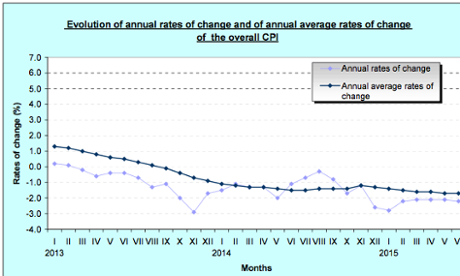
There’s no escape from deflation in Greece. Consumer prices fell by 2.2% annually in June, down from a 2.1% drop in May.
This month’s figures will surely be even worse, given the imposition of capital controls at the end of June.
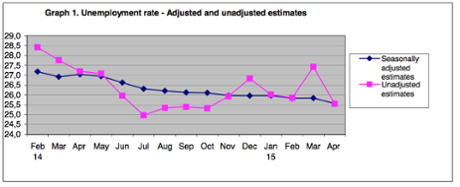
Greece’s jobless rate has dipped, but is still at depression-era levels.
The seasonally adjusted unemployment rate in April 2015 was 25.6%, according to Elstat, down from 25.8% in March 2015.
Europe’s stock markets are rallying this morning, partly due to hopes that the Greek government will meet tonight’s deadline.
The French CAC and German DAX are both up over 1%.
Mike van Dulken, head of research at Accendo Markets, says:
Optimism is rising that Greece will deliver on promised proposals, both on time (today) and extensive enough (€12bn of reforms?), to allow creditors sign off on a third bailout for the beleaguered nation rather than its exit from the single currency.
Traders are also reacting to the latest twists in China - shares have soared today, after days of panic plunges prompted a ban on some shares sales.
Temporary respite or something more lasting? China stocks bounce back after days of panic selling among investors http://t.co/FudXYMP0x9
— Julia Kollewe (@JuliaKollewe) July 9, 2015
Alexis Tsipras is now meeting with his top cabinet ministers to discuss the reform plans, according to local media
Meeting of #Grece PM #Tsipras w/ Dep PM @YDragasakis, FinMIn @tsakalotos, Econ Min @g_stathakis & FM @NikosKotzias underway (via @amna_news)
— Manos Giakoumis (@ManosGiakoumis) July 9, 2015
Hold the optimism.
Greece’s energy minister, the influential left-wing Panagiotis Lafazanis, has said today that he expects a deal soon - but won’t accept a new bailout programme with tough austerity.
At conference in Athens, Energy Minister Lafazanis insists gov't will not sign new MoU, says #Greece has other options. #euro
— Nick Malkoutzis (@NickMalkoutzis) July 9, 2015
#Greece EnergyMIn Lafazanis: We are not going to sign an MoU, we are not Europe's hostages
— Efthimia Efthimiou (@EfiEfthimiou) July 9, 2015
A MoU, or Memorandum of Understanding, is a list of measure Greece must take in return for aid. And any third bailout would certainly include one.
Lafazanis represents the radical far-left wing of the Syriza coalition, an important bloc of Tsipras’s government. Analysts have speculated that the Left Platform could potentially break away, rather than sign up to a new austerity package.
Greek media are also reporting that Greece’s reform plan could include €12bn of cuts and tax rises -- several billion euros than previously expected.
And that’s because of the deterioration in the Greek economy, which plunged back into recession this year.
Enikos has the details says:
The report said that instead of growing by 0.5 percent this year, months of uncertainty and almost two weeks of capital controls meant “there are estimates of a recession of about 3 percent.”
“It is estimated that the measures of 8 billion euros that Greece had presented for 2015 and 2016 will have to be increased by 2 billion euros per year, raising the total to 12 billion euros for the two years,” Kathimerini reported.
Tsipras called #Grereferendum for a €8-9bln austerity package, now he is gonna have to implement about €12bln #result
— Yiannis Mouzakis (@YiannisMouzakis) July 9, 2015
Greek media report team of French experts helping Athens prepare bailout plan. So that's how Valls knew it was good! (ht @robr1)
— Danny Kemp (@dannyctkemp) July 9, 2015
That’s French PM Manuel Valls, who insisted yesterday that Greece must not leave the eurozone.
Optimism builds in Greece as French pitch in
Over in Athens insiders are saying that French help in drawing up the country’s new reform proposal is proving invaluable.
Our correspondent Helena Smith reports.
Officials here are saying that all hope now rests with the French connection. Paris has dispatched a team of technocrats to help finance minister Euclid Tsakalotos draft the new proposal in an effort to ensure it is as convincing as can possibly be.
One insider says:
“It is being done all over again, measure by measure. They are offering invaluable assistance.”
Tsakalotos, who returned to Athens last night, will convene with prime minister Alexis Tsipras and other senior officials to discuss the new measures – a mix of biting taxes, swingeing cuts and administrative reforms.
At this point in time, the third bailout will allegedly be in the range of €52bn with Greece asking for the emergency aid to be disbursed over three years. The media here is also reporting that the IMF is pressing for the package to be higher, in the range of €60-€70bn.
Events have happened so fast, that Greeks have almost not had the opportunity to digest the news that after nearly six months of drama-filled negotiations they could soon be hit with a heavier austerity package than at any other time.
But for the first time in several days there is hope that a way can be found out.
I spoke with Greece’s pre-eminent sociologist, professor Konstantinos Tsoukalas, who also sits as a state MP with the governing Syriza party this morning, and he said:
“I am very optimistic for the first time in days.”
Updated
Greek pensioners have been queuing at bank branches today, to receive the maximum €120 they are entitled to under capital controls.


#Greece FinMin Tsakalòtos back in Athens. To meet with PM Tsipras this am to finalize Greek prior actions proposal to the #Eurogroup.
— Yannis Koutsomitis (@YanniKouts) July 9, 2015
There’s no hope of buying or selling shares in Greek companies this week; it’s just been announced that the stock market will remain closed until at least Monday night.
***Greece's capital markets commission says stock exchange will remain closed until July 13 inclusive - RTRS
— Fabrizio Goria (@FGoria) July 9, 2015
Draghi on Greece: this time it's really difficult

Mario Draghi, one of the crucial players in this drama, has warned that resolving the Greece crisis will be very tough.
That’s according to Italian financial daily Il Sole 24 Ore today.
It reports that Draghi was asked about the prospect of a Greek deal when on a flight from Brussels to Rome yesterday, and replied:
“I don’t know, this time it’s really difficult.”
Question to Draghi: "Will you manage to close the #Greece dossier?" Answer: "I don't know. This time it's really difficult". (@sole24ore)
— Vincenzo Scarpetta (@LondonerVince) July 9, 2015
Draghi also downplayed the prospect of Russian President Vladimir Putin stepping in, saying:
“I don’t see it as a real risk ... and then, they don’t have money themselves.”
(thanks to Reuters for the translation)
Updated
Introduction: Greece must produce plan today

Good morning, and welcome to our rolling coverage of the Greek debt crisis.
“I love deadlines. I love the whooshing noise they make as they go by.”
With that attitude, Douglas Adams would certainly have enjoyed the eurozone crisis. But Greece now faces one of those deadlines that one really can’t miss.
Alexis Tsipras’s government must draw up and deliver a credible economic plan to its creditors by the end of the day, to have any chance of securing the third bailout plan it requested on Wednesday.
Tsipras, back in Athens after his bruising trip to the European Parliament, will meet with his cabinet today to discuss the details.
That could be a tense affair; sections of his Syriza party will surely battle against the imposition of fresh austerity measures, especially after last Sunday’s referendum.
But if the cabinet can stay united, finance minister Euclid Tsakalotos will draw up the details and send them winging to creditors. Germany expects them by midnight Thursday (although EC president Jean-Claude Juncker has suggested the finally final deadline is 8.30am Friday morning #whoosh).
The pressure on both sides to reach a deal is hitting new heights. Yesterday, the IMF and the US Treasury urged Athens and its lenders to reach a deal, and warned that Greece must be given debt relief.
Government spokesman Gabriel Sakellaridis has already been on TV today to insist that agreement can be reached.
Sakellaridis told Antenna TV this morning that:
“I am certain the agreement will pass Syriza’s parliamentary group, [and] the governing coalition.
The government is doing everything it can to reach an immediate deal and end this cycle of uncertainty.”
That certainty will be tested today, as we rattle towards a weekend of drama that could surpass anything seen in the last five years of the eurozone crisis.
If an acceptable plan isn’t drawn up in time, Sunday’s EU leaders summit will be about handling the fallout of Greece’s departure from the eurozone.
We’ll be tracking all the main events though the day....
Updated