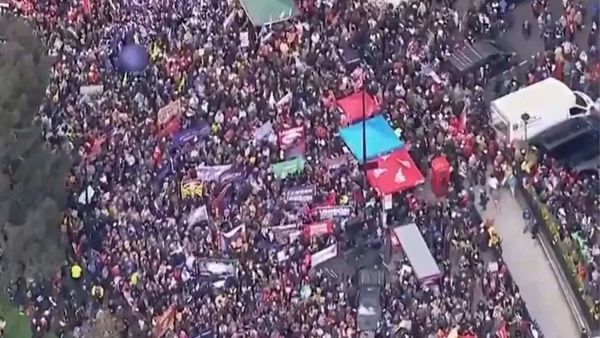
Greece’s minister of state Nikos Pappas has said the deal with the country’s lenders will be backed by parliament and supported by the people, according to Reuters.
And on that positive note, it’s time to close up for the evening. Thanks for all your comments and we’ll be back again tomorrow.
Updated
Dog wearing the pennant of PAME trade union, Athens protest against IMF/ECB deal tonight pic.twitter.com/TWKA3uoiQX
— Paul Mason (@paulmasonnews) June 23, 2015
More marches:
Another day, another march. pic.twitter.com/rv1bkMNOMs
— Duncan Weldon (@DuncanWeldon) June 23, 2015
They've been going by for ten minutes and not letting up yet. Big march. pic.twitter.com/nnsRsXdLk0
— Duncan Weldon (@DuncanWeldon) June 23, 2015
Tonight's march - older, calmer, more organised. Trade union & communist led. pic.twitter.com/PX02jeKaBX
— Duncan Weldon (@DuncanWeldon) June 23, 2015
Greece's junior coalition party wants debt relief as part of deal
Back in Athens, the government’s junior coalition partner, the small right-wing Independent Greeks party (Anel), has made resolution of Greece’s debt problem, a precondition of its support of any deal that is eventually reached, reports Helena Smith.
“Our red lines remain,” Panos Kammenos, the party’s leader, is reported to have told MPs who (as we flagged earlier) met in extraordinary session this afternoon to discuss the government’s proposed reforms. “It is now very clear that it is Greece that is negotiating, not simply a government that is negotiating. We hope that the course of negotiations will be positive for the Greek people.”
Parliamentary endorsement of the agreement would be premised on whether the debt issue was tackled with a legal commitment on the part of creditors to some form of debt relief, party members said.
Elimination of tax exemptions on Greek islands was another red line that the Independent Greeks would not cross “even if the government falls,” kammenos was quoted as telling MPs.

Updated
Markets higher on hopes of Greek deal
Signs that Greece and its creditors might be edging towards a deal ahead of the deadline for bailout funds to run out have again given investors cause for optimism. Equities have moved higher again and Greek bond yields slipped back, but everyone is still too well aware there are still some hurdles to negotiate. The final scores showed:
- The FTSE 100 finished 9.20 points or 0.13% higher at 6834.87
- Germany’s Dax was 0.72% higher at 11,542.54
- France’s Cac closed up 1.1% at 5057.68
- Italy’s FTSE MIB edged up 0.35% to 23,567.25
- Spain’s Ibex ended 0.3% better at 11,402.5
- The Athens market jumped 6.11% to 794.98
On Wall Street the Dow Jones Industrial Average is currently down 7 points.
Greece shortened from 1/5 to 1/7 to remain in Eurozone during 2015, out to 4/1 from 10/3 to exit. #Grexit
— William Hill (@sharpeangle) June 23, 2015
Over in Athens, a top government officials reiterated this afternoon that an agreement, when (if?) sealed, would be put before parliament for vote possibly as early as this weekend, reports Helena Smith.
As negotiations continue in Brussels there is mounting speculation in Athens that an agreement will be reached by Friday – and brought before the 300-seat House for endorsement possibly as early as the weekend.
Speaking to the leftist radio station Kokkino.gr, the minister of state, Alekos Flambouraris, said there would be no quashing of dissent. Parliamentarians would vote on the legislation according to their conscience and not under the threat of party discipline. In the event of the legislation not being passed, “it would have to be resolved by resorting to the people,” he said.
“I think the government will achieve an agreement which is quite difficult but indispensible in my view,” said the politician widely seen as mentor to prime minister Alexis Tsipras. “There will not be an issue of discipline,” he added, insisting that it was vital the deal won the backing of the majority of government MPs.
“For the government to forge ahead in difficult conditions after the agreement, and to restart the economy and kick-start the country’s productive reconstruction, it has to have a unanimous parliamentary group which will put the programme into effect,” Flambouraris said.
The politician insisted that the debt issue was now being addressed as the leftist-led government had put it on the table. Athens’ hope was that it would secure a commitment from creditors acknowledging the need to resolve Greece’s unsustainable debt mountain.
Here’s Reuters snapshot of the MNI report:
- IMF & EC still have differences in approach to Greek deal-MNI citing sources
- Creditors working on expectation that IMF will “come on board” by Thurs summit
- IMF objects to Greek proposals emphasising taxes & less spending cuts
- Small differences to be ironed out, 6-mth extension likely to be introduced
A potential problem perhaps, as apparently flagged up by news agency MNI:
IMF DISAGREES WITH GREECE ON CORPORATE TAX, VAT AND PENSIONS - EU SOURCES
— Morris Cabrioli (@insidegame) June 23, 2015
The IMF is keener on spending cuts that tax rises so this fits it with its general thinking, but the key question is whether any disagreement would disrupt a deal to release the necessary bailout funds to Greece.
Perhaps not:
with latest MNI story its all a matter of headline choice as the bottomline conclusion of article is that IMF will come aboard on Thursday
— econhedge (@econhedge) June 23, 2015
Updated
Here’s an early picture of the pensioners protest in Greece:
Angry pensioners have descended from all over #Greece. Organisers say at least 70 coaches have arrived in #Athens pic.twitter.com/rK9sG5NzBo
— Nanette van der Laan (@NanettevdLaan) June 23, 2015
Greek shares climb, bond yields fall
Any agreement between Greece and its creditors may not yet be done, but the progress that seems to have been made in the past day or so has continued to give a sense of optimism to the markets.
So the Athens stock market has ended the day up 6.11% - making a two day rise of 15.66% - while on the bond markets, the yield on Greece’s two year paper has fallen from 23.77% on Monday to 21.04%.
More talk about how things may progress (or not) from here:
German parliament may vote on 29/30 June on Greek deal; will not vote before Greek lawmakers have approved deal, however
— Live Squawk (@livesquawk) June 23, 2015
And here’s why some may be unhappy with the Greek proposals:
#Greece proposals equivalent to an upfront tightening of 3% of GDP, which is nearly as big as the first wave of tightening in 2010 ~Deutsche
— Yannis Koutsomitis (@YanniKouts) June 23, 2015
Emergency funding from the Bank of Greece to the country’s banks rose by 4.3% in May to €77.58bn, new figures have shown.
Of course Greek prime minister Alexis Tsipras still has to get any agreement through his own parliament:
Some Syriza MPs unhappy w Greek proposal but revolt tht could unseat gov not (yet) tangible. Coal partner stance unclear
— NikiKitsantonis (@NikiKitsantonis) June 23, 2015
Gabriel added, “We will see if the Greek proposals are sufficient. If not, we’ll have to keep talking.”
Germany’s vice chancellor Sigmar Gabriel has joined the chorus saying there is now a chance of agreement, although he adds that a debt haircut for Greece would be no use if new debts were racked up (quotes courtesy Reuters):
- 23-Jun-2015 14:24:23 - GERMAN VICE CHANCELLOR GABRIEL SAYS IT WOULD BE POLITICALLY AND ECONOMICALLY BAD IF GREECE LEFT THE EUROPEAN HOUSE
- 23-Jun-2015 14:25:05 - GERMANY’S GABRIEL SAYS STILL SEE THE POSSIBILITY FOR AN AGREEMENT ON GREECE NOW PROPOSALS ARE ON THE TABLE
- 23-Jun-2015 14:25:24 - GABRIEL SAYS GERMANY AND EUROPE CANNOT ALLOW THEMSELVES TO BE BLACKMAILED
- 23-Jun-2015 14:26:26 - GABRIEL SAYS DEBT HAIRCUT FOR GREECE WOULD NOT LEAD ANYWHERE IF NEW DEBTS ARE SOON ACCUMULATED

Updated
If a deal is done, then Greece is unlikely to miss its €1.6bn payment to the International Monetary Fund due at the end of the month. But as a reminder here is what would happen if it did:
REMINDER: Here's what happens to a member missing an IMF payment. Nothing bad, really. @Lagarde and #Greece know it. pic.twitter.com/UL53J0vorD
— Maxime Sbaihi (@MxSba) June 23, 2015
Summary: Greek reform plan criticised
Time for a recap.
The Greek government has come under fire over the compromise proposal it submitted to its lenders on Monday, amid warnings that it will hurt growth and cost jobs.
Government spokesman Gavriel Sakellarides told Ant 1 TV.
“We are fully aware that there are in the proposal, measures that are hard and which under other circumstances we would never take.”
According to Sakellarides, Greece’s plan will create “breathing space” to support the recovery, and also spare the country from plunging out of its bailout programme within days.
- Charging higher VAT rates on many products,
- Imposing a higher corporation tax rate, and a windfall tax on profits
- Raising pension contributions, and phasing out some early retirement schemes.
Greece sent the proposal in yesterday morning, having spent months trying in vain to persuade its lenders to accept less onerous budget surplus targets, and thus fewer cuts and tax rises.
The plan has triggered a backlash in Athens, with government and opposition MPs criticising the plan - and the time it has taken to reach a potential agreement.
-
Business leaders fear it will trigger renewed recession, and called for more growth-friendly measures.
-
Restaurant chains have predicted thousands of job cuts, if VAT on food sales is hiked to 23%
-
Pensioners are due to protest tonight, having been hit hard since the crisis began.
Will I be seeing more elderly ppl in shabby suits(suit =the last illusion of dignity) rummaging in supermarket bins? pic.twitter.com/ITbOv0dAJG
— Omaira Gill (@OmairaGill) June 23, 2015
And economists warn that it will hurt the Greek economy badly.
Utter, comprehensive brain-deadness of Europe : supporting crashing #Greece economy with higher taxes & state charges. Well done, #Euro land
— Constantin Gurdgiev (@GTCost) June 23, 2015
The European Commission has hinted that it will provide investment funding to Greece to help the country recover. That money would come from Jean-Claude Juncker’s €350bn Investment Plan for Europe, which aims to leverage private sector funding - so there’s no guarantee exactly how much money is around.
Still, it could help repaid Greece’s shattered economy, and perhaps sugar some of the pain of fresh austerity measures.
In other news.....
Eurozone finance ministers are to meet on Wednesday night at 7pm, to have one last attempt to agree on Greece’s economic reform proposals. It could be a late one.....
#Eurogroup meeting has been called. Party starts at seven. https://t.co/BXrIQzqdgt
— Rik Winkel (@RikWinkel) June 23, 2015
Financial markets continue to price in a high chance of a breakthrough. The Athens stock market is now up 5% in late afternoon trading, on top of yesterday’s 9% surge.
And Greek bonds are rallying, pushing down the yield on its 10-year bonds down to around 10.6%, from 11.2% yesterday.
Off the Cliff: 10-year bonds as deal in sight #Greece HT @Investingcom pic.twitter.com/F4uFpIVUjg
— Derek Gatopoulos (@dgatopoulos) June 23, 2015
Updated
List: Greece's latest reform plans
Here’s a handy list of the Greek proposals which are now being examined by officials from its lenders right now:
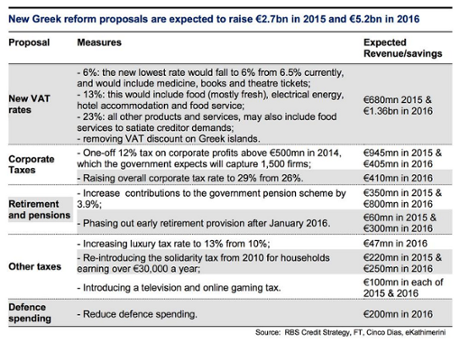
Economist Sean Richards fears that these €8bn of tax rises will have a very serious impact on the economy. He writes:
When I see headlines proclaiming that the new deal offers hope for Greece I do wonder what universe the writers are living in! The cycle so far involves Greece implementing austerity followed by economic weakness and at times collapse which means that yet more austerity is required and then repeat. On that road the economy has shrunk by a quarter and real wages have fallen by a third.
What has been done to Greece is bad enough but to learn so little from it that you are willing to do it again seems insane under the Albert Einstein definition. Even worse is the fact that one of the ways that Greece entered its crisis was an inability to collect its taxes particularly on the wealthy and its equivalent of the oligarchs. Thus a solution essentially based on higher taxes has an obvious flaw.
It seems that US Treasury Secretary Tim Geither was correct that Euro leaders wanted to punish Greece and the current form of that seems to be making sure that it remains in its ongoing economic depression.
This new Greece bailout proposal will crash the economy once again http://t.co/08CTsehe0e via @notayesmansecon #Greek #Depression #IMF
— Shaun Richards (@notayesmansecon) June 23, 2015
Updated
Greek business community attacks new proposals
Over in Athens the business community has reacted with horror to the Greek government’s proposed reform package.
Helena Smith reports
It’s not only politicians who are up in arms over the purported measures. Greece’s biggest chamber of commerce has also waded in saying the proposed measures will stymie growth and worsen recession and joblessness, the latter already at record levels.
While moving in the right direction and keeping bankruptcy at bay, the proposal might well make Greece’s plight a great deal worse, businessmen said.
“The proposed measures throw all the weight on the privately-run economy with new taxes and increases in contributions that more than certain will lead to recession and an increase in unemployment,” the Hellenic-American Chamber of Commerce’s president Simos Anastasopoulos announced.
“A proposal with a different mix of measures and growth plan would satisfy the demands of a viable solution.”
But echoing a widely held view this morning, Anastasopoulos noted that an agreement was better than no agreement, given Greece’s urgent need for funds.
And the former leader of the socialist PASOK party, Evangelos Venizelos, has criticised prime minister Alexis Tsipras’s handling of the situation, saying:
“Relief that the country has averted catastrophe, that the government itself threatened it with - five years after 2010 - can’t hide the fact that we got here in the worse possible way.”
Updated
Greek readers: Tell us your experiences.
We’d like to hear from Greeks about their experiences of living with the economic situation in Greece. You can share your perspectives with GuardianWitness by clicking on the blue contribute button.
Θα θέλαμε να ακούσουμε από τους ίδιους του Έλληνες, πώς είναι η ζωή στην Ελλάδα υπό τις παρούσες οικονομικές συνθήκες. Στείλτε μας την άποψή σας.
Eurozone finance ministers are to meet tomorrow night to discuss the Greek crisis, according to reports from Brussels.
That’s the third meeting in six days, and surely the last chance to sign off an agreement.
*EUROGROUP TO MEET JUNE 24 AT 7 P.M.: DIJSSELBLOEM SPOKEMAN #Greece #euro
— Michael N. (@mnicoletos) June 23, 2015
Another eurogroup meeting on Greece tomorrow. Soon they'll probably just start announcing the days on which a meeting not to be held.
— The EIU Europe (@TheEIU_Europe) June 23, 2015
Updated
The Athens stock market is rallying hard today, as the risk of Greece leaving the euro decline.
The main ATG index is up another 4.4%, having surged by 9% on Monday:
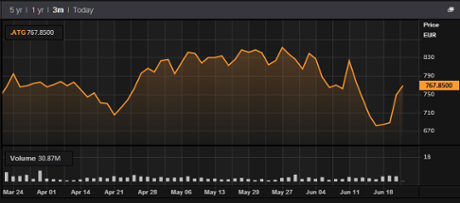
Greece’s newspapers are united in warning that the country faces fresh pain, thanks to the €8bn of new tax rises and cuts contained in yesterday proposals submitted by Athens:
#Greece Headlines Ta Nea: 8bn Cuts and They Want More! EtS: Toward a Harrowing Compromise ET: Shock Memorandum pic.twitter.com/8Zswmdt9Hl
— Derek Gatopoulos (@dgatopoulos) June 23, 2015
The cost of buying protection against a Greek default has fallen sharply today, as this chart of credit default swap prices (which pay out if Athens defaults) shows:
Price to insure against Greek default (CDS) drops as S&P assumes #Greece to be in € at yr-end. http://t.co/HUPWxnF7Jk pic.twitter.com/151GWuI9i2
— Holger Zschaepitz (@Schuldensuehner) June 23, 2015
Greek pensioners to protest tonight
There are mounting signs that Greeks are not going to take the new measures lying down, despite the government’s attempts to defend the plan this morning.
Helena Smith reports:
Pensioners have announced that they will be taking to the streets at 6pm (4pm BST) in what they say will be a mass display of protest against the leftist-led government’s proposed austerity package. Some 70 coaches, packed with retirees, are currently on their way to Athens.
I have just spoken to Manolis Rallakis, general secretary of the federation of Greek pensioners, who says older Greeks feel “totally betrayed” by the tough measures envisaged in the leftist-led government’s proposed austerity package.
“We feel totally betrayed, totally disappointed, that this government is continuing the cut-throat policies that every other government also enforced. What we are seeing are countless indirect and direct taxes that, once again, the little man on the street will be forced to carry,” the 75-year-old told me.
“Pensions have been cut by between 60 and 40 percent and now they want more with additional income for health care and the like, services that we paid for all our working lives through contributions to funds. It is outrageous. Where are the 13 and 14th pensions that they stole from us? Why should we go on paying the price?
The 13th and 14th payments were the two supplementary monthly incomes that pensioners received until they, too, were cut with the crisis.
The plan presented by Greece yesterday includes higher “health contributions” for pensioners, effectively cutting their income (see opening post)
Nearly 45% of Greece’s 2.5 million retirees now live on incomes of less than €665 a month – below the poverty line defined by the EU. Over half that number fell below the threshold at the start of the crisis in late 2009.
The Greek communist trade union, Pame, will also take to the streets this afternoon to protest an agreement that will not only bankrupt but butcher people, it said.
“We have shed enough blood and we have paid enough. Now is the time to resist!”
EC promises €35bn in aid funding, if Greek deal reached
The Commission is dropping some heavy hints that it will announce a new stimulus programme to help Greece soon, once an economics reforms deal is agreed.
Last night, Jean-Claude Juncker told reporters that:
“I want ordinary Greeks to know we are offering €35bn to help the economy”
And in today’s press briefing, spokeswoman Annika Breidthardt explained that this money is available to Athens from the current Europe budget from 2014-2020.
She says:
The Commission is currently preparing a package on this... the package and the €35bn are conditional to the conditions being met, and obviously an agreement being found.
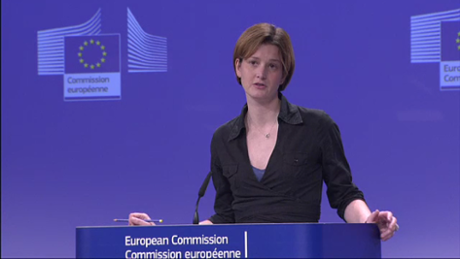
More details on this package will be spelled out in the coming days, Breidthardt explains.
“So stay tuned” adds chief spokesman Margaritis Schinas, in case anyone had missed the nudge.
This aid funding would be used to improve Greece’s infrastructure, and fund projects for long-term growth. But the key issue with such projects is the issue of “absorption” -- ie, getting the money to the right projects on the ground.
European Commission promising €35bn aid package if deal done. How it’s “absorbed" will define #Greece future: oligarchic/corrupt or modern?
— Paul Mason (@paulmasonnews) June 23, 2015
Updated
Will the list of Greek ‘prior actions’ being demanded by creditors include a vote in the Athens parliament before June 30?
Spokesman Margaritis Schinas declines to speculate - that will be addressed in tomorrow’s eurogroup meeting.
Give me strength. Commission still want to see Greek "list of prior actions that are mentioned to be spelled out in the form of a list"
— Mehreen (@MehreenKhn) June 23, 2015
The EC is fielding questions from journalists in Brussels now about the Greek crisis, at the midday briefing.
Was there any discussion about how Greece will pay the IMF on 30 June, as there isn’t time to agree bailout payments in time? And is the IMF fully on board?
Spokesman Margaritis Schinas says that work is taking place between the three institutions and the Greek government to clarify what still needs to be done, including a list of ‘prior actions’ that Greece must take before bailout funds are handed over.
You’ll have to ask the IMF yourself....
Schinas add that there is “no extra time” available for Greece, as Juncker said yesterday (well, he said no ‘prolongation’, which baffled some of us)
Finally, @MargSchinas explains Juncker's "prolongation" thing. It means "extra time" duh
— Mehreen (@MehreenKhn) June 23, 2015
Updated
Encouraging news for Tsipras, as he tries to hold his coalition together....
SYRIZA MP Michelogiannakis says he might vote for agreement if he receives "clarification." Expect more of this in coming days #Greece
— Nick Malkoutzis (@NickMalkoutzis) June 23, 2015
Analysts at UBS warn there’s still a real risk that negotiations flounder. Here’s a section of their latest research note:
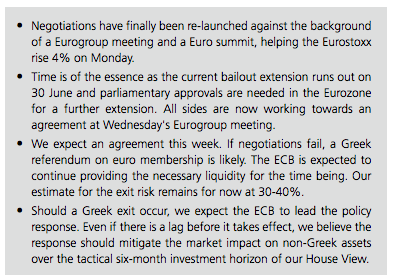
Updated
The threat of Greece leaving the eurozone anytime soon has receded, says Carsten Brzeski of ING.
And the last-minute hiccup with the latest Greek proposals (they sent one version on Sunday night, and other early on Monday) has been smoothed out:
At least yesterday, the blame game was suspended, in favour of a more cooperative approach, even if some Eurozone finance ministers obviously still felt a sour aftertaste.
The late submission of the new Greek proposals did not help to reduce built-up irritations. Technical work will resume under a better omen, sustained by the continued support of the ECB. The next steps will be Wednesday’s Eurogroup meeting and the European summit on Thursday and Friday. Judging from yesterday’s events, it seems as if all players involved have finally started with constructive negotiations. This strengthens our view that a Grexit will be avoided, at least this time around.
Greek government defends bailout compromise

Over in Athens, Greek government officials are insisting this morning that negotiations are still ongoing – the outlines of a cash-for-reform deal may change yet.
Helena Smith reports:
Senior cabinet members this morning were putting on a brave face as Greeks woke up to what awaits them next: proposed reforms worth €8bn mostly in the form of tax hikes [details here].
“The climate has improved, we are closer to a solution. This of course depends on whether the institutions accept the government’s proposal which is the basis for discussion and agreement,” the government spokesman Gavriel Sakellarides told Ant 1 TV.
“We are fully aware that there are in the proposal, measures that are hard and which under other circumstances we would never take.”
“The point of the measures was to transfer the burden from the poor to the rich”, he said. “We are waging battle, there are many proposals that will allow growth and breathing space,” he said singling out the reduction of the primary surplus as a major victory for the government.
“It ensures fiscal benefit.”
Yannis Amanatidis, another prominent Syriza party cadre, said the agreement would end the political uncertainty that has had such a devastating effect on the real economy.
“The agreement as it now stands ends the political uncertainty. It covers our financing needs,” he told Skai TV.
But others in the governing far left movement were less sanguine – and less diplomatic.
“It is worse than the first memorandum,” snapped Syriza MP Yannis Micheloyiannakis, saying that in its present form, the proposal would never be endorsed by the party’s governing bodies. “With these new measures I estimate that Greeks will lose at least two salaries from their pockets,” he added calling on prime minister Alexis Tsipras not to compromise.
Across the political spectrum many bemoaned the fact that the deal was so top heavy on taxes. “It includes recessionary measures and 93% of them are taxes,” said Kostas Hadzidakis, former development minister in the previous conservative-led government. The government, he countered, had been forced to accept such excoriating measures because the negotiations had gone on for so long and deficits in the meantime had grown.
But still, Hadzidakis added:
“It’s a bad deal but I prefer a bad deal than rupture from the EU.”

Updated
Heads-up. ANEL, the junior partner in the Greek coalition, has called a meeting to discuss the situation.
It’s scheduled for 2.30pm Athens time, or 12.30pm BST, according to the To Vima newspaper.
Senior ANEL members are concerned about the Greek plan, particularly the abolition of the reduced VAT rate on Greek islands. Their leader, Panos Kammenos, has made this his own ‘red line’ in negotiations, fearing that a VAT hike would drive islanders in the Aegean Sea to sail to Turkey to shop instead (as we reported yesterday)
Junior Coalition Partner ANEL parliamentary team meets at 14:30 (local time) over yday's updates. http://t.co/MZYRiyS7vm #Greece
— The Greek Analyst (@GreekAnalyst) June 23, 2015
Calmer but important day for #Greece: new technical details are being worked out today ahead of tomorrow's #Eurogroup. Procrastination over.
— Maxime Sbaihi (@MxSba) June 23, 2015

According to Reuters, the ECB has provided Greek banks with another €1bn of emergency liquidity today to keep them afloat while negotiations continue.
That takes the total to €89bn. without which the Greek banks would simply have run out of funds:
#ECB raises emergency funding for Greek banks to around €89bn. http://t.co/mml8EogIlb pic.twitter.com/gBFsfxeo4A
— Holger Zschaepitz (@Schuldensuehner) June 23, 2015
Last night, Greek insiders said that Mario Draghi had promised to keep supporting Greece’s banks while the country was in a bailout programme.
And the promise of extra liquidity should mean less pressure on Greeks to panic about a potential bank run. Not that they’ve been panicking this week. As Angelique Christafis reported from Thessaloniki, many are simply worn out by years of crisis drama:
Updated
Kit Juckes of French bank Société Générale warns that markets optimism can quickly fizzle out, especially where Greece is concerned.
Assuming we do indeed get the last-minute deal everyone expects, then we will simply move on to wondering whether it can be ratified by individual parliaments and then, how long it will last before we need another one.
Austria’s finance minister has warned that Greece won’t get any bailout funds unless it has actually agreed a plan to implement various measures:
Hans Jörg Schelling said (via Reuters):
“If there is no programme for actions that says what measure will be implemented when , we will not agree to it.”
Greek assets continue to rally. FSTE Athex Banks index jump by another 5%. pic.twitter.com/kMkl3xh40s
— Holger Zschaepitz (@Schuldensuehner) June 23, 2015
The Athens stock market is also rising in early trading.
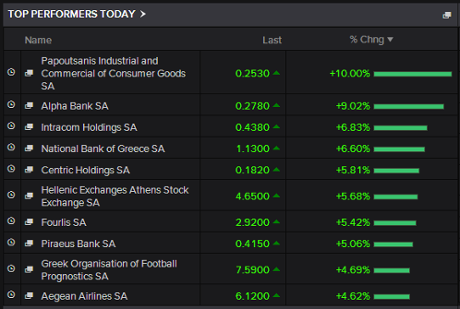
The ATG index had gained 1.5%, adding to yesterday’s 9% surge. Bank shares are among the big gainers:
Newsnight’s economics editor Duncan Weldon agrees that taxes on consumer spending and company profits, and raising pension contributions, will not help the economy return to sustainable growth - as the government had been pledging:
Big issue now... What effects the Greek economy more: reduced uncertainty boosting spending or tax hikes reducing it?
— Duncan Weldon (@DuncanWeldon) June 23, 2015
A lot of mainstream macroeconomists supported Syriza on straight forward Keynesian grounds. This deal ain't very Keynesian.
— Duncan Weldon (@DuncanWeldon) June 23, 2015
Updated
Francesco Papadia, the former director General for Market Operations at the European Central Bank, warns that the Greek proposal fails on two fronts: it doesn’t make the economy more competitive, and it doesn’t deliver debt relief (yet, anyway....)
We are closer to an agreement on #Greece, but what about its quality? All on fiscal correction, nothing on structural and debt alleviation.
— Francesco Papadia (@FrancescoPapad1) June 23, 2015
Updated
Stock markets hit three-week high on Greek optimism
Europe’s investors remain upbeat about the prospect of Greek deal this week.
Stocks have hit their highest level since the start of June in early trading, adding to yesterday’s strong rally.
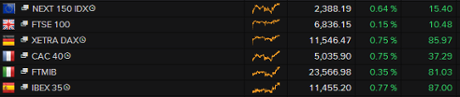
The German DAX and the French CAC are both up 0.8% in early trading, with traders reacting to last night’s upbeat comments from Donald Tusk and Jean-Claude Juncker..
Some caution might be advisable, given the the two sides are still hammering out the details today.
As FXTM Chief Market Analyst Jameel Ahmal puts it:
If recent history is anything to go by, there is likely to be a few more twists and turns before a deal is concluded but this is at least a positive sign.
The strong gains in global markets just shows how much investors want a deal to be reached and everyone would much prefer it to be this way, rather than for the uncertainty over a looming default.
Updated
ECB gives Greece more emergency liquidity
Newsflash: The European Central Bank is rumoured to have agreed to provide more emergency liquidity to the Greek banking sector.
That means the banks can keep running despite suffering a steady outflow of deposits - another €1.6bn is reported to have been withdrawn on Monday.
ECB Said To Raise Emergency Liquidity Cap For Greek Banks- BBG $EURUSD
— Live Squawk (@livesquawk) June 23, 2015
For the 4th time in the past 6 days. #Greece #ecb #ela #banking https://t.co/McsBjRplR3
— Manos Giakoumis (@ManosGiakoumis) June 23, 2015
Warning: VAT hike will cost Greek jobs

The backlash against Greece’s latest proposals is gathering pace this morning.
The head of the association of restaurant chains, Thanassis Papanikolaou, has warned that hiking VAT on food service from 13% to 23% will hurt the service sector very badly.
He told Kathimerini.
“We have the experience from 2011 when the increase from 13 to 23 percent in food service brought the shutdown of 4,500 enterprises and the loss of 40,000 jobs.”
And with one in four adults out of work, this is the very last thing the Greek labour market needs now.
Updated

The prospect of the Greek crisis vanishing off the front pages has also cheered investors in Japan, where the Nikkei index hit its highest level since the year 2000.
After surging yesterday, European stock markets are tipped to keep rising this morning on renewed optimism of a deal this week.
#FTSE100 called +15pts at 6835 as Grelief rally extends. After years of last-minute deals, markets long on optimism, short on time
— Mike van Dulken (@Accendo_Mike) June 23, 2015
Moscovici: I'm convinced we'll get a deal this week

Having slept on it, EU commissioner Pierre Moscovici is still optimistic that Greece and its creditors are on the verge of a breakthrough.
Moscovici has been speaking on the France Inter radio station, and told listeners that he is “convinced” there will be an agreement this week.
Progress was made at yesterday’s “useful” meetings, and the two sides have converged, he added.
Il faut travailler dans la sérénité. Je suis convaincu que nous trouverons un accord cette semaine. C'est vital @franceinter @EU_Commission
— Pierre Moscovici (@pierremoscovici) June 23, 2015
Our long-term goal is growth, job creation, and structural reforms, he adde.d
Il ne faut pas d'austérité en #Grèce. La finalité est plus de croissance et d'emplois, avec des réformes structurelles @EU_Commission
— Pierre Moscovici (@pierremoscovici) June 23, 2015
Introduction: Deal by Thursday?

Good morning.
Greece and its creditors are locked in a race against time to finalise an agreement over its bailout before the end of the week. And the prospects look better than at any time in the last five months.
The latest proposals submitted by Athens yesterday have been broadly welcomed by EU leaders, at last night’s emergency summit.
As European Council president Donald Tusk put it around midnight in Brussels:
Today’s proposals are a positive step....they will be assessed in the coming hours.
And European Commission president, Jean-Claude Juncker, argued that there will a final agreement this week; simply because there has to be.
But IMF chief Christine Lagarde put it best,
We have a huge amount of work to do in the next 48 hours.
Which means we now have only 41 hours to go....
The plan is to get a deal hammered out by Wednesday evening, when eurozone finance ministers will convene for yet another Eurogroup meeting.
If they sign it off, EU leaders could give approval on Thursday, unlocking billions in aid loans and staving off the immediate risk of default.
Technical officials from Greece and its creditors will be working hard today to see whether the proposals satisfy the demands of the IMF, the ECB and the EC.
But there are already worries that Greece’s latest plan is flawed. It includes an €8bn fiscal adjustment by the end of 2016, mainly through higher taxes on consumers and businesses, plus a squeeze on pension payments.
The full scorecard of measures from the Greek reform/bailout proposals today. VAT reform and pensions raise the most pic.twitter.com/FaWo87dYbe
— Ed Conway (@EdConwaySky) June 22, 2015
And those measures could suck growth potential out of an economy that’s already in recession:
As Michael Hewson of CMC Markets puts it:
There does appear to have been some shifting of ground on the Greeks part on pensions and VAT, as well as higher taxes on business, though with unemployment at record levels, increasing the level of taxes on businesses on their profits, as well as their employees does sound rather counterproductive, given that an estimated 8,500 businesses have closed since the beginning of the year already.
And there are already signs that Tsipras will struggle to sell the deal in Athens:
One leading Syriza party MP has already predicted that the Greek government’s proposals will never get through parliament:
Alexis Mitropoulos, vice president of the 300-seat House, told TV last night that:
“My personal view is that these measures cannot be voted, they are extreme and anti-social. I believe that in the end, this package which you have at hand, cannot come to the Greek parliament.”
We’ll be watching all the key developments through the day.....
Updated