Good morning: We’ve now launched a new liveblog covering Thursday’s developments:
Closing Summary: Tsipras says deal close....
And finally, here’s Reuters’ take on tonight’s meeting:
Greece’s Tsipras says deal “close” after meeting EU’s Juncker
Greek Prime Minister Alexis Tsipras said early on Thursday after late-night talks with senior EU officials that Greece was close to a deal with its creditors and that Athens would make a payment due to the IMF on Friday.

Following discussions over dinner at the European Commission in Brussels with its president, Jean-Claude Juncker, and the chair of euro zone finance ministers, Jeroen Dijsselbloem, Tsipras told reporters that an agreement was very close on a target for Athens’ primary budget surplus and that a deal would be close in the next few days.
Asked about a pending payment to the International Monetary Fund, he said:
“Don’t worry about it.”
Noting Greece had made payments in the past, he added:
“We will continue.”
Officials have said creditors and the left-wing Greek government had drafted their own, different, versions of a possible accord. Tsipras said the proposals under discussions would be “the Greek proposals”.
He said discussions must end up with a “realistic point of view”.
Facing bankruptcy, his government has been resisting creditors’ demands for bigger cuts in pension payments and bigger sales tax increases to generate higher budget surpluses before interest payments that would let it to pay off debts. <end>
And with the Commission promising more ‘intense work’, and speculation that snap elections could be called, the next few days could be dramatic.
2am in Athens in a bar full of Syriiza insiders... Everyone glued to SMS as Tsipras speaks. Many ppl expect elections now.
— Paul Mason (@paulmasonnews) June 3, 2015
.@tsipras_eu says agreement on primary surplus very close - but that was always going to be the easy bit tonight. Pensions much tougher.
— Tom Nuttall (@tom_nuttall) June 3, 2015
So that is a good time to stop. We’ll be covering Thursday’s events in a new live blog, in a few hours time. Thanks, and goodnight. GW
Updated
European Commission statement doesn't add much to party, 'progress was made in understanding each other's positions' pic.twitter.com/TcQ6BCGSZY
— Danny Kemp (@dannyctkemp) June 3, 2015
The European Commission has issued its own statement, making light of the lack of a deal.
Here’s the key section:
It was a good constructive meeting. Progress was made in understanding each other’s positions on the basis of various proposals. It was agreed they will meet again. Intense work will continue.
Video: Here’s Alexis Tsipras’s statement (in Greek)
Δηλώσεις του Αλ. Τσίπρα μετά τη συνάντηση: http://t.co/gjmi5LuBqF μέσω @YouTube
— Eφημερίδα Η ΑΥΓΗ (@AvgiOnline) June 3, 2015
Is it bedtime now? Yes, according to Greece’s finance minister himself.
One Thessaloniki resident tweeted that he can’t turn in for the night if Yanis Varoufakis hasn’t tweeted about developments. Quick as a flash, the minister replies - go to bed!
@zouzounakis Να πάτε για ύπνο! (Οκ;)
— Yanis Varoufakis (@yanisvaroufakis) June 3, 2015
Random dude tweets: "if there's no tweet by #Varoufakis, can't go to bed." V responds: "Go to bed! (Ok?)" #Greece https://t.co/RvpczkJm1R
— The Greek Analyst (@GreekAnalyst) June 3, 2015
After all, it is 2.30am in Athens.....
A snap summary from eurocrisis veteran Yanni Koutsomitis:
#Greece meeting recap: - Close to an agreement on fiscal targets - Almost no progress over pension system - Small progress on VAT & taxes
— Yannis Koutsomitis (@YanniKouts) June 3, 2015
Tsipras: Greek proposal is the only realistic one
Alexis Tsipras is refusing to cave in. He says that the Greek proposal is the only “realistic” option.
We still reject some of the creditors’ proposals, he says. And there is no indication of major progress on the pension system, with creditors demanding reforms and Syriza refusing to impose further cuts.
#Greece PM #Tsipras: The only realistic proposal is our proposal. There's willingness 2 come up v soon w/ a realistic solution #ec #ecb #imf
— Manos Giakoumis (@ManosGiakoumis) June 3, 2015
Tsipras cites several areas where the two sides couldn’t agree..
#Greece Tsipras: there wr proposals we agree with & others we can't accept (VAThike in electricity, scrap povbenefit https://t.co/cO0LdeKRv1
— Keep Talking Greece (@keeptalkingGR) June 3, 2015
The Greek PM was also asked about the €305m owed to the IMF on Friday....
Tsipras asked about IMF payment on Friday: "don't worry about that. We already paid 7.5 billion"
— Pablo Rodríguez (@Suanzes) June 3, 2015
Tsipras: A deal is close....
Now Alexis Tsipras is speaking, saying a deal is ‘very close’ on primary surplus targets:
- REUTERS: GREECE’S TSIPRAS SAYS VERY CLOSE TO AGREEMENT ON PRIMARY SURPLUS IN DEAL WITH CREDITORS
Reminder -- we believe the creditors proposed a primary budget surplus of 1% this year, 2% in 2016, 3% in 2017 and 3.5% in 2018.
- REUTERS: GREECE’S TSIPRAS SAYS WE WILL BE CLOSE TO AN AGREEMENT IN THE COMING DAYS
- REUTERS: GREECE’S TSIPRAS SAYS DISCUSSIONS WITH CREDITORS MUST CONCLUDE WITH A REALISTIC POINT OF VIEW
'In a few days' there's an EU-Latin American summit in Brussels on June 10/11... which might provide a good chance for more Greek talks?
— Danny Kemp (@dannyctkemp) June 3, 2015
Dijsselbloem: "it was a good meeting. The talks will continue in the next few days"
— Pablo Rodríguez (@Suanzes) June 3, 2015
I suspect he means talks continue over the next few days....
And here comes Alexis Tsipras....
Meeting is over here in Brussels pic.twitter.com/JLrKXshIUt
— Pablo Rodríguez (@Suanzes) June 3, 2015
Greek media believe Alexis Tsipras will issue a statement too....
#Greece PM #Tsipras will make a statement after the end of the working dinner with #EC & #Eurogroup Presidents, according to @leftgr.
— Manos Giakoumis (@ManosGiakoumis) June 3, 2015
Dijsselbloem: Talks will continue in a few days
Newsflashes from Brussels:
- REUTERS: EUROGROUP’S DIJSSELBLOEM SAYS AFTER MEETING JUNCKER, TSIPRAS “WE WILL CONTINUE TALKS IN A FEW DAYS”
'Very good' Greek talks, will continue in a few says, says Eurogroup's @J_Dijsselbloem via AFP
— Danny Kemp (@dannyctkemp) June 3, 2015
That does not indicate that the two sides have agreed a deal.
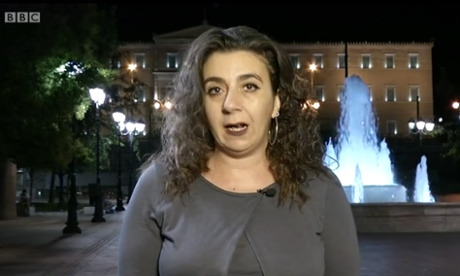
A Syriza spokesperson, Marina Prentoulis, told BBC’s Newsnight that the Greek government is trying to find a solution that is beneficial for both sides, to keep the European Union together.
But if that mutually beneficial deal isn’t possible then “other possibilities” open up, including elections.
She said:
We need an agreement that is beneficial for the people.
If that isn’t reached, then we have a problem. And as a democratic government it will be taken back to the people.
Some Greek media outlets are reporting that Alexis Tsipras was given a five-page list of measures drawn up by the country’s creditors, at tonight’s meeting.
No more details at this stage, I’m afraid, so just flagging it up....
Greek @EFSYNTAKTON reports #Tsipras was presented round 23.30 with 5page text, harsh measures. Negotiations to go on after dinner. #Greece
— Janine Louloudi (@janinel83) June 3, 2015
#Greece According to info, Tsipras was handed out 5-page proposals by Institutions https://t.co/Y9WPuZRVAp
— Keep Talking Greece (@keeptalkingGR) June 3, 2015
"13th floor at the European Commission, lights still switched on. #Tsipras #Greece negotiations > pic.twitter.com/2s3ZQ3sIEh" > v @theEUpost
— Jacek Saryusz-Wolski (@JSaryuszWolski) June 3, 2015
Juncker and Tsipras have now been talking for three and a half hours, and there’s no sign that it’s finishing....
Tick tack tick tack #Greece & caffeine.Tsipras,Juncker,Dijsselbloem's meeting will last "many hours", we've been told pic.twitter.com/CUzqJDBy0D
— María Tejero Martín (@Maria_Tejero) June 3, 2015
Eurogroup president Jeroen Dijsselbloem is playing a ‘notary’, or legal oversight, role at tonight’s meeting, says AFP.
If Greece and the EC can reach a compromise, then he’ll announce a eurogroup meeting to potentially approve it....
.@J_Dijsselbloem playing 'notary' role in Tsipras-Juncker talks-if compromise he'll announce, call Eurogroup meet, sources via @CSpillmann
— Danny Kemp (@dannyctkemp) June 3, 2015
Update: As Helena wrote earlier, a eurogroup meeting probably couldn’t be held this week....
Updated
After one day in Athens, Sky News’s economics editor, Ed Conway, has been buffeted by a swirling gale of rumours and speculation. He’s just blogged about it:
When I touched down yesterday afternoon, I was told by well-placed sources that the Greek authorities were “definitely” going to make this Friday’s €300m IMF repayment; it was “nailed on”, they added.
This evening government officials are saying they will withhold the payment if there is no deal by Friday or Monday. Yesterday it sounded like Syriza was close to a deal with its creditors on what kind of primary surplus they need to aim for in their budgets in the coming years. Today they seem further away. A few hours ago one eurogroup character said he expected a deal “within hours”; then up cropped another to say he was not optimistic.
Now, some of this is certainly negotiation tactics and brinksmanship. But only so much. The real sense you get when you come here to Athens is one of chaos. Even inside the government, at the highest reaches, many ministers simply do not know what their colleagues are doing. No-one really knows what the plan is, when it comes to negotiations with the European institutions — and the more time you spend here, the more it seems that this is because there is no coherent plan.....
Athens: Five minutes to midnight. A quick blog from the eye of the economic storm #Greece https://t.co/uOjz3WLcGP
— Ed Conway (@EdConwaySky) June 3, 2015
No swanky supper for the Brussels press pack, alas:
Greek night in Brussels.Waiting in the Berlaymont.The "dinner" started no so long ago w Juncker-Tsipras+Dijsselbloem pic.twitter.com/EXc1mkT16T
— María Tejero Martín (@Maria_Tejero) June 3, 2015
Sounds like Juncker and Tsipras are now dining, along with Jeroen Dijsselbloem, the Eurogroup chief.
4 whoever still cares: tonight's constellation is Juncker-Dijsselbloem, then Juncker-Tsipras & now dinner Juncker, Tsipras, Dijsselbloem.
— Gabriele Steinhauser (@gksteinhauser) June 3, 2015
Radical plan to reshape the eurozone proposed
While Greece’s debt crisis has dominated the headlines, two European politicians are looking to the long term -- proposing radical changes to the way the eurozone operates.
Germany’s vice-chancellor Sigmar Gabriel and French economy minister Emmanuel Macron have just published a joint letter, arguing for closer ties to make the eurozone stronger and more stable.
German and French ministers call for radical integration of eurozone
Our Europe editor, Ian Traynor, reports:
German and French politicians are calling for a quantum leap in how the EU’s single currency is run, proposing an embryo eurozone treasury equipped with a eurozone finance chief, single budget, tax-raising powers, pooled debt liabilities, a common monetary fund, and separate organisation and representation within the European parliament.....
[Gabriel and Macron] call for the setting up of “an embryo euro area budget”, “a fiscal capacity over and above national budgets”, and harmonised corporate taxes across the bloc. The eurozone would be able to borrow on the markets against its budget, which would be financed from a kind of Tobin tax on financial transactions and also from part of the revenue from the new business tax regime.
They also propose a new system to handle government debt defaults, so the Greek crisis of 2010-2015 (and counting) isn’t repeated.
But could they go even further?....
#euro of course, if they're really serious, gabriel/macron might have suggested eurozone unemployment insurance. no? http://t.co/K1RvQq6y3h
— Ian Traynor (@traynorbrussels) June 3, 2015

Over in Athens our correspondent Helena Smith is hearing that NOT MUCH is going to be resolved at tonight’s talks between Alexis Tsipras and Jean-Claude Juncker.
Perhaps that is why a common statement of intent is not expected to be released afterwards?
At the very most, sources are saying, both sides will settle on a date for negotiations to end. But even that is not sure.
What is certain is that it is practically impossible to have a Eurogroup meeting of euro area finance ministers to approve any agreement before the end of the week - which takes us into next week when Greece must meet another debt repayment (its second of the month) to the IMF on June 12.
The best hope is that a staff level agreement is struck (after consultation with Athens) next week .. slowly but surely much of June will be taken up in negotiations.
Germany’s finance minister Wolfgang Schäuble has repeatedly said that Greece has until the end of the month, when its current bailout expire, to come to an agreement with the bodies keeping it afloat. HS
Hear hear:
Tsipras - Juncker have been talking/negotiating for 90 min till now. they should make a break and tell us what;s going on #Greece
— Keep Talking Greece (@keeptalkingGR) June 3, 2015

The US stock market in New York just closed, with optimism that Greece was close to an agreement pushing shares higher:
The Dow Jones industrial average rose 66.9 points, or 0.37%, to 18,078.84, the S&P 500 gained 4.66 points, or 0.22%, to 2,114.26 and the Nasdaq Composite added 22.71 points, or 0.45%, to 5,099.23 (via Reuters).
More rumours are flying about the compromise plan which creditors are putting to Greece tonight.
The latest is that lenders would agree to halt the deregulation of Greece’s labour market.
That’s on top of the smaller primary surplus budget targets that leaked earlier today (the creditors, though, still wanted a bigger surplus than Athens)
Creditors' proposal includes significantly lower fiscal targets & freeze of labor market deregulation. Still the Greek side's not impressed.
— Yannis Koutsomitis (@YanniKouts) June 3, 2015
Based on reported proposal to #Greece, Tsipras doesn't seem to get anything better than Samaras beyond lower surplus & labour reform freeze
— Nick Malkoutzis (@NickMalkoutzis) June 3, 2015
Alexis Tsipras isn’t alone in Brussels tonight. His delegation includes Euclid Tsakalotos, the ‘alternative foreign minister’ who was recently handed control of the day-to-day negotiations with Greece’s creditors.
Tsakalotos, an Oxford-educated economist, is seen as someone who Greece’s lenders can do business with.
Tsakalotos is now, at least on paper, the guy in charge of the negotiations with the creditors,” said Wolfango Piccoli, managing director at Teneo Intelligence in London. “It’s also useful for the prime minister to have him in Brussels in relation to the next big challenge: selling the deal to the party.”
There’s one obvious absence, though. Yanis Varoufakis, the finance minister, appears to have been left behind in Athens.
At the Brussels mtng: The PM, the DepPM, a State Minister, the Alternate Foreign Minister and a DepStateMin. No one from Finance Ministry!!!
— Yannis Koutsomitis (@YanniKouts) June 3, 2015
The Greek delegation are tweeting too:
Σε εξέλιξη η συνάντηση με τον κ. #Junker. #Greece pic.twitter.com/a2HFXHClAv
— PrimeMinisterGR (@PrimeministerGR) June 3, 2015
If you missed Alexis’s Tsipras’s arrival:
Now it's serious! Greece PM @atsipras meets #EU Com Pres @JunckerEU without saying a word - first time ever http://t.co/6RmOfRF6CO
— Dirk Hoeren (@DirkHoeren) June 3, 2015
Updated
Back in Athens, Newsnight’s Jess Brammar reports that support for Tsipras’s party is still quite robust
We've met many in Athens who say they support Syriza despite not being on left themselves bcos they feel they stand up for Greek interests
— Jess Brammar (@jessbrammar) June 3, 2015
Will be interesting to see how long that sentiment holds.
— Jess Brammar (@jessbrammar) June 3, 2015
A handshake... and like that, they were gone pic.twitter.com/aOPnwiMX2l
— Danny Kemp (@dannyctkemp) June 3, 2015
Tsipras arrives for bailout talks in Brussels
Well, that was quick. Jean-Claude Juncker escorted Alexis Tsipras into the Commission, pausing only for a quick photo-opportunity and a handshake.
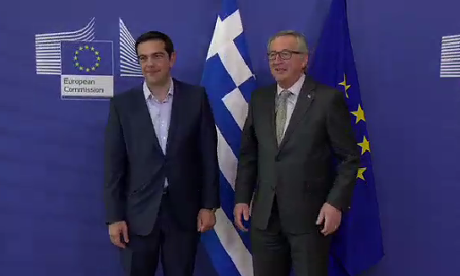
One reported asked the question gripping the eurozone tonight:
Can a deal be done?”
But Tsipras, looking pretty serious, didn’t appear to reply. And then the pair vanished for their meeting, to be followed by a working dinner.
An official statement isn’t expected, but we’ll keep this blog running through the evening, just in case....
Updated
Alexis Tsipras is arriving at the EC right now - here’s a live feed.
While we’re waiting for action in Brussels, check out this piece in Jacobin, the left-leading American magazine:
The Battle in Syriza
In it, Syriza member Dr Stathis Kouvelakis, of Kings College London, responds to Tsipras’s article in Le Monde last Sunday.
That article was seen as a direct challenge to EU leaders -- accusing them of making absurd demands and risking European democracy itself -- but Kouvelakis argues that Tsipras has actually weakened his position since gaining power.
It shows just how challenging it could be to get a compromise agreement through the Athens parliament:
Here’s a flavour:
It is clear that however the question is posed, the framework that Tsipras is proposing here is one of softened austerity, and in no sense a rupture with austerity. The whole edifice of the memoranda is renewed, but just trimmed at the edges. Conversely, not much is left of the Thessaloniki Program, which was, lest we forget, presented as an “emergency program” that would be applied immediately and independently of the outcome of the negotiations.
Even worse, the four red lines that Alexis Tsipras had himself set down on April 16 in a portentous declaration to Reuters (on pensions, VAT, privatization and collective bargaining) have all to some extent been crossed.
Kouvelakis has a solution -- nationalise the banks, tax the rich hard, protect workers’ rights, and default on the national debt.
Better than more austerity, he argues:
The greatest disaster facing Greece would be the imposition of a new memorandum that would signify the end of any hope for an alternative to the neoliberal shock therapy. This development must be avoided, as Malcom X used to say, by any means and sacrifice necessary.
The Battle in #Syriza: #Greek PM Alexis Tsipras and Syriza member Stathis Kouvelakis debate the future of Greece.http://t.co/0vdmqFbmQ1
— Diane Shugart (@dianalizia) June 3, 2015
The tension mounts pic.twitter.com/1Pxgw8nCnT
— Danny Kemp (@dannyctkemp) June 3, 2015
Alexis Tsipras’s meeting with Jean-Claude Juncker is due to start in around 15 minutes.
Our Europe editor Ian Traynor sets the scene:
Alexis Tsipras, Greece’s radical young government chief, is to confront his eurozone creditors in Brussels on Wednesday evening over the terms of his country remaining in the single currency, as the five-year crisis centred on debt and democracy moved towards a climax.
Tsipras will join the president of the European commission, Jean-Claude Juncker, for dinner and a battle of wills over conflicting ideas for resolving Greece’s financial catastrophe, although many believe the best they are likely to agree is a fix to buy more time.
More here:
There is no alternative. There is no Plan B. We need a Greek deal fast.
That was Pierre Moscovici’s message tonight. The European Commissioner for Economic and Financial Affairs told the Paris School of Economics that:
“The aim is to reach an agreement quickly... An agreement is possible and necessary.
“The (European) Commission is not considering another scenario... There is no plan B.”.
Moscovici also suggested that Tsipras won’t be slapped with an ultimatum tonight:
Moscovici states deal that will be offered to #Greece is not "take it or leave it"; says designed to result in a quick deal (@RANsquawk)
— Open Europe (@OpenEurope) June 3, 2015
There’s always a chance that Tsipras might take it and leave it, if political pressure at home is too great.
Updated
Critical meeting for Greece tonight. @J_Dijsselbloem has already arrived. He is expected to join meeting between @atsipras and @JunckerEU
— Georg von Harrach (@yourmeps) June 3, 2015
.@MXafa tells @IanKingSky debt reforms "not an easy sell...#Tsipras could lose his majority and would then have to call an election"
— Ian King Live Team (@SkyIanKingLive) June 3, 2015

Updated
PS: the group accompanying Jeroen Dijsselbloem are (from left to right): Hans Vijlbrief, Dijsselbloem’s deputy in the Dutch finance ministry; Thomas Wieser, chair of the Euro Working Group; Dijsselbloem; and Michel Reijns, Dijsselbloem’s spokesman.
(with thanks to a certain top EU expert....)
Updated
Photo: Dutch finance minister Jeroen Dijsselbloem arriving at EU headquarters in Brussels for tonight’s talks, in his role as head of the Eurogroup of finance ministers.

Updated
There’s a palpable feeling of tension building in Brussels ahead of tonight’s meeting.
Eurogroup president Jeroen Dijsselbloem found himself swamped by eager reporters as he crossed the road to enter the Commission building:
. @J_Dijsselbloem in the Commission building
— Eleni Varvitsiotis (@Elbarbie) June 3, 2015
#Greece talks see @J_Dijsselbloem mobbed as he crosses the street outside the #Berlaymont to meet with @tsipras_eu pic.twitter.com/gCEgpVV9lb
— Jack Parrock (@jackeparrock) June 3, 2015
@jackeparrock I was one of them. Such a fan club he has! ;)
— Esther Herrera (@eherreracaro) June 3, 2015
Here’s Reuters’ report on the conference call:
Greek Prime Minister Alexis Tsipras held telephone talks with German Chancellor Angela Merkel and French President Francois Hollande before meeting EU Commission President Jean Claude Juncker in Brussels, a Greekgovernment official said.
“The three leaders agreed on the need for low primary budget surpluses for Greece and the need for an immediate solution,” the official said.
Greece’s international creditors signalled on Wednesday they were ready to compromise to avert a debt default even as Athens warned it might skip an IMF loan repayment due this week
This looks like one of the optimistic moments:
#Greece PM Tsipras conference call w #Germany Chancellor Merkel & #France president Hollande a few minutes ago ~@skaigr
— Yannis Koutsomitis (@YanniKouts) June 3, 2015
Tsipras, Merkel, Hollande agree lower Greece surplus targets --Skai TV via BBG
— Live Squawk (@livesquawk) June 3, 2015
Updated
Markets move higher on Greek hopes
Despite conflicting signals over any Greek deal and a series of optimistic comments followed almost immediately by pessimistic ones, European stock markets have moved higher ahead of the key meeting this evening between Alexis Tsipras, the Greek prime minister, and representatives of the country’s creditors.
No matter that the French president said a deal might come in hours or days while the German finance minister maintained nothing in the new Greek proposals moved things forward. No matter that the Greeks seem to be saying they haven’t even seen the proposals being made by their creditors yet.
No matter that bond markets were upset by ECB president Mario Draghi telling investors to get used to volatility, implying the bank would not be stepping in every time bonds moved sharply either way. Despite all that, equities seemed to be hoping for the best, and so the closing scores showed:
- The FTSE 100 finished up 22.19 points or 0.31% at 6950.46
- Germany’s Dax was 0.8% better at 11,419.62
- France’s Cac closed 0.59% higher at 5034.17
- The Athens market added 4.13% to 838.22
On Wall Street the Dow Jones Industrial Average is currently 82 points or 0.45% higher.
Updated
No urgency chaps....
Greek govt source - Tsipras' Brussels delegation still has not seen a document from lenders
— Paul Mason (@paulmasonnews) June 3, 2015
More details emerging of tonight’s meeting, and apparently that means no press statements:
EC: Juncker/Tsipras meeting today 19:30, will be a private meeting
— Live Squawk (@livesquawk) June 3, 2015
19:30 London time (20:30 CET)
— Live Squawk (@livesquawk) June 3, 2015
EC: Meeting will be followed by a working dinner
— Live Squawk (@livesquawk) June 3, 2015
EC: No press statements are foreseen
— Live Squawk (@livesquawk) June 3, 2015
Hollande to speak with Tsipras and Merkel in coming hours on Greece deal, AFP reporting
— Danny Kemp (@dannyctkemp) June 3, 2015
Over in Athens there is great hope that German chancellor Angela Merkel will save the day, reports our correspondent Helena Smith.
Greece’s radical left leader Alexis Tsipras may have come to power promising to destroy Merkelism (and its pernicious by-products) but one of the more curious twists in this seemingly never ending drama is that the German chancellor has in fact become one of Tsipras’ closest ‘friends.’ Strangely bonded by the same fate of having to face very hard decisions/policy alternatives over Greece, the two politicians, though still diametrically opposed, have formed what insiders are calling ‘a very honest relationship” based - ahem - on mutual trust. “There is a good chemistry between them,” the government spokesman Gavriel Sakellarides told me not long after Tsipras’ Syriza party assumed power.
Other insiders have said the relationship between the leaders has been more important than widely thought.

Today, Germany’s mass-selling Bild (no fan of German tax payers’ money being wasted on Greece) said Merkel had decided “at whatever cost” to save the debt-stricken country - even if that meant running up against the fury of IMF managing director Christine Lagarde.
The chancellor, who marks her tenth anniversary in office this year, sees Greece’s salvation as “a leadership issue,” the well-informed paper wrote. “In 2012 she decided that Greece should stay in the euro and now she is doing whatever it takes to ensure that that promises stands.”
This afternoon, Merkel herself nixed the idea of an agreement not being sealed by June 30 - when Greece’s €240bn bailout programme expires.
“Germany is working with Greece and the institutions to complete the deal within the timetable that has been defined,” she said during a joint press conference with the president of Egypt. “We are working intensively in order to achieve this.”

Between the lines, that clearly means a Greek default is out of the question.
Senior Greek sources say inevitably Merkel has played “good cop” to her finance minister Wolfgang Schauble’s “bad cop” in recent months.
Back with Draghi, and here is a summary by ING’s Carsten Brzeski:
As expected, the ECB did not announce any new policy measures at today’s meeting. While generally speaking, today’s meeting was one of those meetings which do not necessarily require a press conference, ECB president Draghi sent two main messages: the fragile start of a cyclical recovery does not justify any tapering speculations, and, the ECB will not pull the trigger on Greece.
The ECB’s macro-economic assessment remained cheerful and almost self-congratulating. The tone on the recovery has become somewhat more positive and risks to the outlook for growth were for the first time in a long while described as “more balanced”, though still at the downside...
The positive tone was only slightly offset by Draghi’s remarks that the recovery had lost some momentum in the second quarter, which explained why the ECB currently only expected the recovery to“broaden” but no longer to “strengthen”...
The ECB’s current economic and inflation outlook could give rise to speculations about an earlier-than-expected end of QE. To tackle any of these speculations, Draghi emphasized several times today that the ECB’s macro-economic outlook was conditional on the full implementation of QE...Even possible bubbles or misallocations in financial markets were no reason for the ECB to adjust QE. Draghi clearly stated that any possible negative effects from QE had to be tackled by supervisors but not by monetary policy.
However, despite trying to temper tapering speculations, Draghi is still struggling to give clear guidance. The question on whether QE could be ended before end-September 2016 if inflation expectations are back at where the ECB wants them before, was unanswered.

[On Greece] Draghi – who initially didn’t want to comment on Greece at all – said that the ECB wanted Greece to be in the eurozone but that there was a need for “a strong agreement”. Greece was a viable economy if the right policies wereimplemented. The ECB was in favour of a strong agreement which provided social fairness and economic growth but also fiscal sustainability and financial stability. Answering to questions on ELA and possible additional haircuts on Greek bonds, Draghi remarked tha tthe ECB would stick to its rules-based approach and the different rules applied to ELA and the ECB’s collateral rules. It is obvious that the ECB will not pull the trigger on Greece autonomously.
As long as there is the political will from all sides to find a sustainable agreement, the ECB will continue with its current ELA and liquidity stance.
All in all, today’s press conference showed that the ECB is aware of the upcoming tapering speculations and clearly wants to temper them.However, more forward guidance and communication streamlining will be needed in the months to keep speculations at bay.
Updated
Meanwhile here is Greek prime minister Alexis Tsipras’ full statement prior to his departure for Brussels:
On Monday evening, the Greek government formally submitted its proposal to the institutions, for a fair and mutually beneficial compromise, which will put an end to this crisis in Europe. It will allow Greece to escape financial asphyxiation, as well as provide space for recovery; it will put an end to the Grexit scenarios and, finally, it will put an end to the disaster scenarios.

So far, we have not received any comments regarding our proposal, or about any other document, from the institutional partners.
Last night I received an invitation from the President of the European Commission, Mr. Jean-Claude Juncker to go to Brussels to hold talks. In keeping with this positive development, I responded affirmatively. I am going to discuss the proposal of the Greek Government. To explain to him that, today more than ever, it is necessary for the institutions–and especially for the political leadership of Europe–to accede to the realism that the Greek government has been adhering to for the last three months while negotiating the fair requests of the Greek people for the benefit of a united Europe, and indeed, for the people of Europe. We need unity, we must avoid division. I am confident that the political leadership of Europe will do what needs to be done. It will accede to realism.
Updated
US service sector growth slows in May
Away from Europe for a moment, and the pace of growth in the US service sector slowed in May.
The Institute for Supply Management said its services index fell to 55.7 from 57.8 in April, less than the 57 figure expected by economists. Business activity, new orders and employment all weakened, according to the survey.
Earlier the monthly ADP employment report showed that private sector employment increased by 201,000 jobs from April to May, just slightly ahead of forecasts. The report precedes the non-farm payroll number on Friday, where economists expect around 220,000 jobs to have been added overall.
Updated
Tsipras proposals irreconcilable with Merkel's take-it-or-leave paper, says Brussels source. No common ground on fiscal aim #greece
— Andreas Petzold (@andreaspetzold) June 3, 2015
And here’s the Reuters take on Schaeble’s comments on the latest Greek proposals:
German Finance Minister Wolfgang Schaeuble said on Wednesday that an initial look at Greece’s reform proposals to international lenders indicated that talks aimed at getting a deal to unlock cash for Athens will still take time.
Pointing to comments he made last week that he did not shareGreek optimism about a deal, he said the situation was unchanged after he had seen Athens’ latest proposals.
“I have no information that anything decisive has changed in terms of substance,” said Schaeuble at an event in Berlin.

Meanwhile ECB president Mario Draghi’s comments at the bank’s press conference have send bond yields climbing.
It appears to be Draghi saying he was willing to look through bond market volatility which is doing the damage. He said “one lesson is that we should get used to periods of higher volatility”, suggesting the ECB may not act every time the bond market moves sharply.
The German 10 year bund yield rose to 0.8%, its highest since November 2014. Italian and Spanish yields are also rising.
Updated
French president François Hollande has joined in on Greece, saying “we are a few days or hours away from a possible deal.”
According to Reuters, he added that “one should not ask too much of Greece so as not to stifle growth, but [one] cannot ask too little either.”

Snap summary:
Full #Draghi: - No QE exit discussion, no financial risk - Higher volatility? Get used to it! - No change of attitude vis-à-vis #Greece
— Maxime Sbaihi (@MxSba) June 3, 2015
Draghi: Here's what a strong agreement looks like
And finally, another question on Greece -- can Draghi please explain exactly what his vision of a “strong agreement” looks like?
It should be strong in design and implementation, the ECB president replies.
That means that it should promote growth, and ensure social fairness, and also fiscal fairness.
Draghi then implicitly criticises some of Greece’s previous proposals, saying:
Some of the things discussed in previous months are clearly fiscally unsustainable.
And a strong programme has prior actions. Which means certain things are done soon rather than later.
And if that is agreed, then funding will follow.
Neither the institutions nor the eurogroup members would conceive a programme that is not financed adequately, Draghi concludes.
Draghi says when he says the agreement shd be "strong" he means strong in design and in implementation - ie, things done sooner than later
— Tony Connelly (@tconnellyRTE) June 3, 2015
"Strong agreement". Drink. #Gin @Berlaymonster
— Peter Spiegel (@SpiegelPeter) June 3, 2015
Disappointing -- Draghi says he will not be dropping into the meeting between Alexis Tsipras and Jean-Claude Juncker tonight.
Update: it’s not clear whether this means there won’t be any ECB presence..
#grexit draghi's a royal we, as in 'we are not going to that meeting'. or no ecb at all with tsipras/juncker?
— Ian Traynor (@traynorbrussels) June 3, 2015
Updated
German government debt price are falling sharply as Draghi speaks, pushing up the yield (interest rate) on 10-year bonds to 0.8%, the highest this year.
German 10-year yield rises above 0.8% amid Draghi press conference. http://t.co/mJP44zUs7o pic.twitter.com/kGXYdcBclT
— Bloomberg Markets (@markets) June 3, 2015
How can the ECB claim to be a rules-based institution when it doesn’t impose tougher haircuts on Greek assets used as collateral, in response to the deterioration in the country’s financial sector? Aren’t you taking a political stance?
It’s not true, Draghi replies. We are following the rules.
And because emergency liquidity comes from the national central bank, the collateral rules are different than for other procedures.
Would the ECB be happy for Europe’s stability mechanism (the ESM) to buy the Greek bonds held by the Bank, which mature in July and August?
(That would spare Athens from finding €6.7bn to repay the ECB)
Again, I don’t want to speculate, says Draghi. I take the Greek politicians at their word when they say the bonds will be paid in a timely way.
We’re getting a lot of questions on Greece in Frankfurt.
Mario Draghi says that the ECB does “see the Greek economy as a viable economy”, so long as like all economies the right policies are being undertaken.
And he declines to discuss the chances of Greece defaulting, except to warn that the ECB is a rules-based institution.
Draghi: "I don't want to speculate on likelihood of these events". Question was on Greek default. #Greece
— Open Europe (@OpenEurope) June 3, 2015
Meanwhile, here’s some reaction from German finance minister Wolfgang Schaeuble on the Greek reforms, and it doesn’t look promising:
SCHAEUBLE: OPTIMISM ON GREEK NEGOTIATION PROGRESS NOT JUSTIFIED
— Steve Collins (@TradeDesk_Steve) June 3, 2015
* German Fin Min Schaeuble says first impression of Greek list of reforms confirms view that talks won't be over soon - RTRS
— Fabrizio Goria (@FGoria) June 3, 2015
Updated
Draghi fires another warning shot at Athens, saying the ECB will discuss the haircuts imposed on Greek bonds used as debt collateral at its next meeting.
#ECB Draghi says GovCouncil will see situation on #Greece debt at next meeting; have been considering Greek debt haircuts on for a while.
— Yannis Koutsomitis (@YanniKouts) June 3, 2015
A haircut hike would be a blow to the Greek banks
Perfectly nuanced threat to the Greek gov't by Draghi.
— Yannis Koutsomitis (@YanniKouts) June 3, 2015
Does the ECB have an exit strategy for its QE bond-buying programme?
Draghi sweeps the idea aside, saying eurozone inflation is nowhere near high enough.
Exit strategies are a high-class problem.. we’re not there yet.
Why hasn’t Europe done a better job of fixing this crisis, rather than leaving us facing another make-or-break Greek meeting?
Draghi explains that it’s a question of commitment:
Many programmes have been designed. Some have been implemented. Others have not been implemented.
Draghi declines to comment on the Greek negotiations while they are in a “state of flux”, but repeats that the ECB wants to see a strong agreement.
That should include strong growth, social fairness, fiscal stability.... he adds.
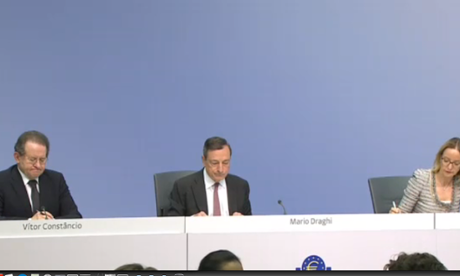
What’s the ECB’s take on the recent bond market volatility?
Draghi explains that investors should get used to it; such volatility is inevitable at times of higher asset prices and very low interest rates, with growth and inflation picking up.
#Draghi: we have to accept higher volatility.
— Francesco Papadia (@FrancescoPapad1) June 3, 2015
So he’s not taking the blame....
#Draghi on market correction: "one lesson is that we should get used to periods of higher volatility". My monetary policy -> your problem.
— Maxime Sbaihi (@MxSba) June 3, 2015
Updated
Draghi admits that the ECB had expected to see stronger signs of economic growth, although the recovery is proceeding as expected.
#Draghi: "recovery is on track exactly according to our projections however we had expected stronger figures" + "slight loss of momentum"
— Maxime Sbaihi (@MxSba) June 3, 2015
Updated
What about the prospect of Greece missing Friday’s IMF repayment?
Draghi sounds unimpressed by this prospect, saying it has happened ‘once in the 1970s’.
Draghi's Zambia monent.
— Yannis Koutsomitis (@YanniKouts) June 3, 2015
Draghi: precondition for Greek T-Bills, there shd be a credible perspective 4 a successful conclusion of current review + plus disbursement
— Tony Connelly (@tconnellyRTE) June 3, 2015
Another question on Greece -- what would it take for the ECB to raise the cap preventing Greek banks buying more short-term Greek government debt?
Draghi: We’d need to see a disbursement of aid in order to consider whether to change the limit for Greek t-bills.
#Draghi says #Greece bailout aid disbursement is pre-condition to lifting t-bill cap. That's a higher bar than most expected.
— Peter Spiegel (@SpiegelPeter) June 3, 2015
#ECB's Draghi on Coeure leak: Soon to come out w/ new rules on speaking engagements. We're aware of code governing board appearances.
— Holger Zschaepitz (@Schuldensuehner) June 3, 2015
Draghi admits that the ECB made a mistake when it didn’t release the text of a speech made by policymaker Benoit Coeure until the next morning.
Draghi: Greek agreement must be strong.
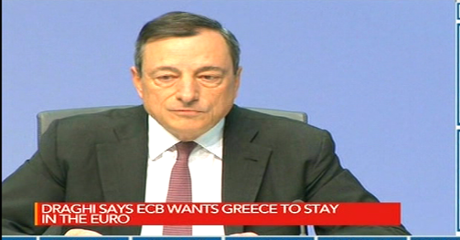
Onto questions -- and Claire Jones of the FT asks Draghi to comment on Monday night’s emergency mini-summit, which he attended.
Draghi initially declines:
Negotiations are proceeding at this point in time, so there is no point on my commenting on various aspects,
Both the Greek government and the institutions have proposals which they are consulting on.
But then, he insists that a “strong agreement” is needed:
The governing council of the ECB wants Greece to stay in the euro, but there should be a strong agreement. One that creates growth, and which is fiscally sustainable and addresses the remaining sources of financial instability.
This will be the component of a strong agreement.
Updated
Draghi concludes his statement with his traditional call to arms.
Politicians should be bold with structural reforms now, to help underpin growth, boost productivity, and encourage firms to invest. That way, the current cyclical recovery becomes self-reinforcing, rather than spluttering out.
This is not a vintage performance from Mario Draghi, yet.
People saying Draghi presser is boring. I prefer my central bankers boring and grey
— World First (@World_First) June 3, 2015
The ECB has revised its forecast for inflation higher this year, from 0% to 0.3%
Draghi: Inflation projected to be at 0.3% in '15, 1.5% in '16 and 1.8% in '17 (March: 0%, 1.5%, 1.8%)
— ECB (@ecb) June 3, 2015
It has also trimmed projected growth in 2017, but no change otherwise.
Draghi: Annual real GDP projected to increase by 1.5% in '15, 1.9% in '16 and 2.0% in '17 (March: 1.5%, 1,9%, 2,1%)
— ECB (@ecb) June 3, 2015
Draghi is explaining that the ECB is doing a rather good job:
Draghi: Monetary policy has contributed to recovery in inflation expectations, better borrowing conditions
— ECB (@ecb) June 3, 2015
Draghi: Full implementation of all monetary policy measures will lead to sustained return of inflation rates towards 2%
— ECB (@ecb) June 3, 2015
Draghi begins by confirming that the ECB left interest rates unchanged today, and says that the new asset-purchase programme (the QE scheme launched this year) is proceeding well.
The governing council will “look through” fluctuations in inflation, and focus on the long-term trends, he adds, when setting policy.
In other words, don’t expect us to react to every month’s inflation data (prices rose by 0.3% annually last month).
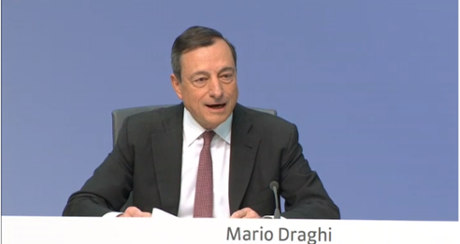
ECB press conference begins
Right, time for a good lunch to watch the European Central Bank press conference. Expect Mario Draghi to discuss the state of the eurozone economy (getting better), and the Greek bailout crisis (getting rather exciting).
It is being streamed live here.
Updated
Lunchtime Summary: Greek PM flies to Brussels for crunch talks
A quick recap, before the European Central Bank’s press conference begins.
Greece’s prime minister Alexis Tsipras is heading to Brussels for showdown talks with European Commission president Jean-Claude Juncker over a possible bailout deal.
In statements made on TV before departing for Brussels, the radical left leader said he had accepted Juncker’s invitation for talks on the basis that he would be discussing the proposal proffered by Athens.
PM Tsipras says agreement with creditors will stop the Grexit scenario and will provide liquidity to #Greece https://t.co/4sJl6hDq1U
— Yannis Koutsomitis (@YanniKouts) June 3, 2015
He told NERIT, the state-run TV channel, that
“Today it is more expedient than ever for the institutions and the political leadership of Europe to accede to the realism with which the government has been moving for the past three months.”
“We have to avoid division ... I am sure that the leadership of Europe will do what it has to.”
Even at this late stage the Greek side is showing little sign of crossing its red lines, insiders say.
It's showdown. #Greek PM #Tsipras airborne for #Brussels to meet @JunckerEU to discuss latest 2-way proposals @PrimeministerGR
— Karl Stagno-Navarra (@ksnavarra) June 3, 2015
Details of the offer put together by Greece’s creditors is starting to emerge. According to the FT, the IMF, ECB and EC are offering lower primary surplus targets -- but still higher than Greece’s own proposals.
#Greece primary surplus proposals: 2015 Creditors 1%, Greek gov't 0.8% 2016 Cred 2%, Grk 1.5% 2017 Cred 3%, Grk ? 2018 Cred 3.5%, Grk ?
— Yannis Koutsomitis (@YanniKouts) June 3, 2015
EC officials have said they don’t expect a deal tonight, but are optimistic that agreement will be reached.
Greek MPs are restive, though. Several members of Tsipras’s left-wing Syriza party have warned that Tsipras must stick to his ‘red lines’.
But optimism has pushed up shares across Europe, with Athens gaining 4%.
Over to America briefly for the monthly ADP employment report.
And it shows that 201,000 new private-sector jobs were created by US firms last month, broadly as expected.
ADP 201k .... v 200k as expected.... prior reading revised 4k lower..... about as in line as it ever gets
— Steve Collins (@TradeDesk_Steve) June 3, 2015
Updated
<applauds>
Last week: Greece "A deal is very close" EU: "No it isn't" Today: EU: "A deal is very close" Greece: "What deal?"
— Lorcan Roche Kelly (@LorcanRK) June 3, 2015
Assuming the FT is right, there’s quite a gap between the creditors’ latest demands and Greece’s own primary surplus targets:
#Greece primary surplus proposals: 2015 Creditors 1%, Greek gov't 0.8% 2016 Cred 2%, Grk 1.5% 2017 Cred 3%, Grk ? 2018 Cred 3.5%, Grk ?
— Yannis Koutsomitis (@YanniKouts) June 3, 2015
@plegrain @SpiegelPeter Even those lower primary surplus targets will be very hard to hit if the economy remains weak pic.twitter.com/zI403gcVHA
— Capital Economics (@CapEconEurope) June 3, 2015
Struggling to keep track of all Greece’s debt repayments in the weeks and months ahead?
Here’s the solution - a handy widget showing the next demand, and all the other looming payments:
Updated
The Athens stock market has jumped by 4% today, driven by optimism that a deal is close.
Bank shares are leading the rally, pushing the main ATG index up by over 4% today.
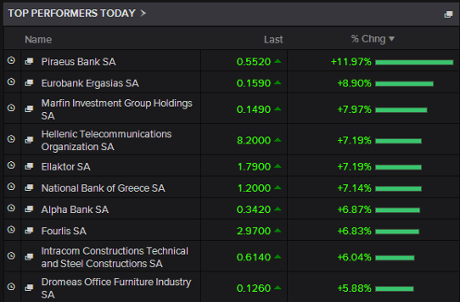
Other European markets are also up, with the French CAC and German DAX gaining 1% each.
Ilya Spivak, currency strategist at DailyFX, says Greece is on everyone’s mind today:
Traders particularly keen to learn the details of a last-ditch funding deal offer made by Athens’ creditors yesterday.
Details start to leak...
Details of the offer being put to Greece are starting to emerge in Brussels.
The FT’s Peter Spiegel says creditors have trimmed their demands for the primary budget surpluses Greece must run. But they still look too high for Greece’s liking.
Peter writes:
In addition to the 1 per cent surplus this year, Greece will be asked to hit a 2 per cent target next year, rising to 3 per cent in 2017 before getting to 3.5 per cent in 2018.
Those numbers are significantly lower than the current bailout programme -- which called for a 3 per cent surplus this year rising quickly to 4.5 per cent next year. But it is also tougher than many in Athens had hoped.
New details on creditors' #Greece proposal: 1% primary surplus in 2015; 2% in 2016; 3% in 2017; 3.5% in 2018 http://t.co/P0RLV9CvDw
— Peter Spiegel (@SpiegelPeter) June 3, 2015
The European Central Bank has left its three interest rate unchanged, at its meeting in Frankfurt today.
That means the benchmark rate is just 0.05%, and banks will have to pay a negative interest rate of -0.2% on deposits they leave in the ECB’s vaults.
ECB leaves rates on hold. Main refi at 0.05, Deposit rate at -0.2% pic.twitter.com/q8PVlYx7PQ
— Holger Zschaepitz (@Schuldensuehner) June 3, 2015
Next up... Mario Draghi’s press conference in just under 45 minutes.
Syriza MPs: Red lines are still important
Over in Athens there is more fighting talk this morning from the ruling radical left Syriza party.
Helena Smith reports
Whatever agreement is eventually reached, it will not be one that cannot be endorsed by Tsipras’ own party, Syriza’s spokeswoman, Rania Svigou, said today. “Of course it will be discussed in the organs of the party and the parliamentary group,” she said.
“The Greek people know very well what the red lines of the Greek government are, they know very well what the Greek government hasn’t accepted in pension [reform] and labour relations and they know that that is what it is negotiating.”
What was now needed, she said, were new “bases” to be produced for a new path for the country, breaking from the previous bailout deal (or memorandum of understanding).
“In order for this to happen, the memorandum has to be put to an end once and for all.”
Speaking to Athens’ municipal radio station this morning, Syriza’s central committee’s general secretary Tasos Karonakis, said the radical left party had to respect the wishes of Greek voters who had given the group its mandate.
“Important steps on our side have taken place, a wealth of proposals and reforms have been submitted. The necessary concessions for negotiations to end in agreement have happened, but as we have said from the beginning, we have limits that are defined by our mandate that the Greek people have given us. The negotiation has moved on two pivots: that we would respect the rules of the euro zone even if we disagree with them and our partners must respect the mandate of the Greek people.”

Curious.... EC spokesman Schinas is being cagey about whether eurogroup president Dijsselbloem will actually meet Alexis Tsipras tonight (as was reported earlier).
As a mere finance minister (for the Netherlands), he’s a little below Tsipras’s pay grade....
Juncker invitation to Tsipras is 'personal invitation', says @MargSchinas, declining to say whether @J_Dijsselbloem will attend
— Danny Kemp (@dannyctkemp) June 3, 2015
Am told @J_Dijsselbloem invited to tonite's meeting w/@atsipras by @JunckerEU, but Tsipras not happy. No @Lagarde or #Draghi.
— Peter Spiegel (@SpiegelPeter) June 3, 2015
Updated
EC: Greek deal unlikely today
The European Commission’s top spokesman, Margaritis Schinas, has just confirmed that Juncker and Tsipras will meet tonight, to discuss the Greek crisis.
He warned, though, that a deal is unlikely to be agreed today.
.@JunckerEU has invited @atsipras personally at 20:30 CET to discuss the state of play on #Greece. No final outcome expected tonight.
— Mina Andreeva (@Mina_Andreeva) June 3, 2015
EU's @MargSchinas says no final Greece deal expected from Juncker-Tsipras talks tonight
— Danny Kemp (@dannyctkemp) June 3, 2015
Alexis Tsipras just gave a brief speech on Greek television. He told the nation that he is heading to Brussels for talks with Jean-Claude Juncker, to encourage Europe’s leaders to “see reason”.
Tsipras added that he has not yet received any information from creditors yet. More to follow....
Tsipras: "I am certain Europe's leadership will see reason" #Greece pic.twitter.com/B3itNUItyO
— Derek Gatopoulos (@dgatopoulos) June 3, 2015
The Economist’s Tom Nuttall reports that optimism is building in Brussels that a deal will be announced on Thursday:
Senior commission official tells me "almost 100% certain" deal between Greece and institutions will be announced tomorrow.
— Tom Nuttall (@tom_nuttall) June 3, 2015
But will it be a deal acceptable to the Greek parliament? MPs from the Syriza party are due to meet tomorrow, and will be briefed by Tsipras. He could face a rough ride, if painful concessions have been made...
Syriza lawmakers meet tomorrow. Alexis has a hard sell ahead of him #Greece #Syriza
— Stelios Bouras (@SteliosBouras1) June 3, 2015
Tsakalotos, Pappas, and Sakellaridis will accompany PM Tsipras to Brussels to meet Juncker/Dijss. #Varoufakis will remain in Athens. #Greece
— The Greek Analyst (@GreekAnalyst) June 3, 2015
Spain’s finance minister, Luis de Guindos, has declared that a Greek deal will be reached in time.
*GUINDOS FEELS `TOTALLY SURE' CREDITORS, GREECE WILL GET ACCORD
— Dealingroom (@Dealingroom_EN) June 3, 2015
Tonight’s Newsnight could be a classic, given their economics editor is already swigging local spirits in the cause of journalism:
"Interview some greek pensioners", I said.They're making @DuncanWeldon drink raki on the job. I am laughing nervously pic.twitter.com/xpFn6eCA5m
— Jess Brammar (@jessbrammar) June 3, 2015
Tsipras’s trip to Brussels today isn’t great timing for UK journalists who have just jetted to Athens to report on the crisis.
Both Sky News and Newsnight have sent crack teams over, anticipating some dramatic days ahead in Greece. Glad to see they’re being well looked after:
Quick bit of tripod surgery for our cameraman Jamie from a friendly Athens hardware shop pic.twitter.com/Id7k92umjd
— Jess Brammar (@jessbrammar) June 3, 2015
Dutch prime minister Mark Rutte has warned that Greece could yet leave the euro, and criticised Alexis Tsipras for making such optimistic promises in his journey to power.
Speaking to Reuters in Paris, Rutte said:
“You can never say it (“Grexit”) is not an option, but it is not the aim. The aim is to come to a common understanding.
And reaching a deal will be tricky, he added:
“I do believe they are working very hard to get somewhere, but at the same time they (the Greeks) have made so many promises in the elections and afterwards in parliament ... that it’s difficult to bridge the gap.”
Double dose of good news for the Eurozone with unemployment falling 130,000 in April and retail sales rising a robust 0.7% month-on-month.
— Howard Archer (@HowardArcherUK) June 3, 2015
Unemployment across the eurozone fell in April, but remains far too high in many members.
Eurostat just reported that the jobless rate across the euro area dipped to 11.1%, down from 11.2% in March. That’s a three-year low.
The lowest unemployment rate in April 2015 was recorded in Germany (4.7%), and the highest in Greece (25.4% in February 2015) and Spain (22.7%).
Euro area unemployment rate at 11.1% and EU at 9.7% in April 2015 #Eurostat http://t.co/jId2QphCYB pic.twitter.com/eMQTVapBbG
— EU_Eurostat (@EU_Eurostat) June 3, 2015
And this recovery may be feeding through to the shops -- retailers reported a healthy jump in trade in April, up 2.2% year-on-year.
Euro area retail trade +0.7% in Apr 15 over Mar 15, +2.2% over Apr 14 #Eurostat http://t.co/w0HLYRAyzk pic.twitter.com/B1yuq7MLjH
— EU_Eurostat (@EU_Eurostat) June 3, 2015
Updated
OECD slashes Greek growth forecasts
Greece’s economy will barely grow this month, and unemployment will be even higher than previously feared.
That’s according to new forecasts from the Organisation for Economic Co-operation and Development this morning.
The OECD has adjusted its expectations downwards, given the events of recent months.
OECD slashes Greek GDP growth estimate to 0.1% in 2015 (from 2.3% before) and to 2.3% in 2016 (from 3.3%). #Greece #OECD #economy
— MacroPolis (@MacroPolis_gr) June 3, 2015
OECD ups Greek debt/GDP forecast to 180% in 2015 (from 174.3% before) and to 178.1% in 2016 (from 171.4%). #Greece #OECD
— MacroPolis (@MacroPolis_gr) June 3, 2015
OECD increases Greek unemployment projection to 25.7% in 2015 (from 25.2% before) and to 24.7% in 2016 (from 24.1%). #Greece #OECD
— MacroPolis (@MacroPolis_gr) June 3, 2015
The previous forecasts were made in November 2014, shortly before the previous Greek government triggered January’s general election.
Updated
The pound just took a tumble after the latest survey of Britain’s service sector missed forecasts.
GBPUSD timberrrrrrrr pic.twitter.com/WJpQvQ5zPf
— Jonathan Ferro (@FerroTV) June 3, 2015
Markit’s monthly PMI data shows that the UK economy only grew by a quarterly rate of 0.4% in May.
It “raises doubts about the ability of the economy to rebound convincingly from the weakness seen at the start of the year,” says their chief economist, Chris Williamson. More on this shortly...
It’s official.... Eurogroup chief Jeroen Dijsselbloem is indeed attending tonight’s crunch meeting in Brussels.
That means the eurozone’s finance ministers will have a presence as the leaders of Greece and the EC debate the crisis.
And with members of the ECB and IMF also turning up, it’s going to be crowded....
So tonight's meeting in Brussels will include @J_Dijsselbloem, @JunckerEU, @atsipras and representatives of ECB and IMF.
— Eleni Varvitsiotis (@Elbarbie) June 3, 2015
Updated

Officials in Athens are calling the latest developments “the most crucial day” since the anti-austerity government launched negotiations with creditors in February.
Our correspondent Helena Smith reports:
Well-placed sources are not ruling out a third teleconference between the Greek prime minister Alexis Tsipras and the German and French leaders after tonight’s meeting at 8pm in Brussels with European Commission president Jean-Claude Juncker.
The radical left leader will be accompanied by the Oxford-educated economist Euclid Tsakalotos, who heads Greece’s negotiating team, his close ally, minister of state Nikos Pappas and the Greek government spokesman Gavriel Sekallarides.
Two texts are still believed to “be doing the rounds” according to officials: the 47-page Greek proposal, and the agreement drafted by officials representing the debt-stricken country’s creditors at the EU, ECB and IMF late last night.
One insider told me:
“The struggle for an honourable compromise is far from over. There are still red lines. This is about the future of Greece.”
Some citizens are still keeping their spirits up, though:
"So, the latest round of talks between #Greece and its creditors is on track?" pic.twitter.com/bljmGNvHhW
— Teacher Dude (@teacherdude) June 3, 2015
Rumour watch: Jeroen Dijsselbloem, the head of the eurogroup (eurozone finance ministers) is planning to meet Alexis Tsipras tonight too, according to Bloomberg.
*DIJSSELBLOEM SAID TO MEET TSIPRAS IN BRUSSELS TONIGHT
— Michael Hewson (@mhewson_CMC) June 3, 2015
Yesterday, Dijsselbloem was quite negative about the prospects of a deal this week, warning that more work is needed and that Tsipras needed to be honest with his electorate.
Updated
Back in Greece, speculation about a snap election is rife.
Dat awkward moment when election-rumors are dominating almost every discussion in TV, cafeterias, workspace & your Facebook inbox. #Greece
— The Greek Analyst (@GreekAnalyst) June 3, 2015
Good news from Italy; the unemployment rate fell to 12.4% in April, down from 12.6% in March (which was revised down from 13%).
With Italy now finally returning to growth this year, there are signs that its lacklustre economy is picking up. Still a long way to go, though.
Greek crisis blamed as eurozone growth slows.
Here comes the first gobbet of economic data....and it shows that growth across Europe’s private sector slowed a little in May.
Markit’s Eurozone Composite Output Index fell to 53.6, down from 53.9 in April, meaning the sector expanded at a slower rate. That suggests the long deadlock over Greece may have sapped confidence.
But on the upside; firms hired workers at the fastest rate in four years, and France’s figures were rather stronger than expected.
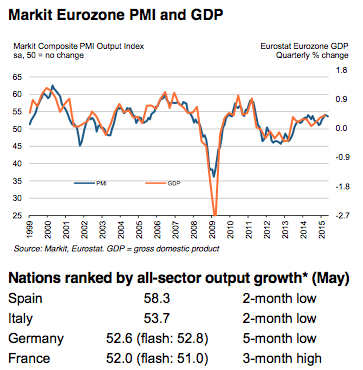
Chris Williamson, chief economist at Markit warned that “any escalation of the Greek crisis could rapidly derail the recovery”.
“The Eurozone recovery lost some of the wind from its sails in May, with growth of output and new orders both slowing to three-month lows.
“The weak euro is boosting manufacturing and households are benefitting from lower inflation, but the region’s high unemployment continues to limit spending on goods and services. Heightened uncertainty surrounding the Greek debt crisis is also acting as a brake on growth.”
Updated
If a deal is reached, then Greek public relief could cushion the blow of making painful concessions, argues George Pagoulatos, professor of European politics and economy at the Athens University of Economics and Business.
“The need for a deal is so big, after such a prolonged liquidity crunch, that the relief for the wider public will eventually trump the cost of compromise.”
Bloomberg also believes that the IMF/ECB/EC proposal focuses on reform policies, not the debt relief that Greece has been pushing for.
No debt relief for #Greece? Hard to be optimistic after this important story from @nchrysoloras @bjennen1 @corinaruhe http://t.co/bw9Z0LS8jC
— HansNichols (@HansNichols) June 3, 2015
We also don’t know much about the rival proposal which Greece has drawn up, and which Alexis Tsipras will take to Brussels today.
But Greek newspaper Kathimerini believes it raises less revenue than lenders demand, and also takes a more gentle approach to pension and labour reform:
According to sources, it proposes a low primary surplus target for this year of between 0.3% and 0.8% of gross domestic product as well as retaining three value-added tax rates – at 6%, 11% and 23% – but varying the goods and services assigned to each rate.
But the Greek proposal for VAT foresees €1bn in revenue being raised, around half of the creditors’ desired target.
Other measures are said to include the gradual abolition of early retirements, from 2020, which is unlikely to be a bold enough intervention to satisfy creditors. A proposal to restore collective labor contracts is unlikely to go down well either.
We don’t yet know what’s in the creditors’ proposals. But the Financial Times believes it may include more onerous budget targets than Greece would like:
It could require Greece to achieve primary budget surpluses — revenues less expenses when debt interest payments are not included — of as much as 3.5% of gross domestic product in the medium term. Athens has demanded a much lower level.
The FT adds:
Another person briefed on the plan said the latest proposals remained closer to the IMF’s stance in several important areas — including requiring Greece to keep its pension fund from running a deficit — than the commission’s more lenient views.
Greek bond yields fall
Greek bonds are rallying a little this morning, as the City shows confidence that a deal will be reached.
The yield on Greece’s benchmark 10-year debt has fallen to 11.2%, from 11.35% last night. That shows the bonds are seen as less risky (although still unsuitable for widows and orphans).
Greece’s two-year bond yields have also dipped, to 23.5% from 23.7%. Encouraging, but that still indicates a high chance the bonds will be ‘restructured’.
#Greece will not pay #IMF on Fri w/o prospect of a deal. Mkts more confident, 2yr yield drops. http://t.co/P83qJ3uy5I pic.twitter.com/IJhdHC3tyD
— Holger Zschaepitz (@Schuldensuehner) June 3, 2015
France’s economy minister, Emmanuel Macron, has predicted success in the talks between Greece and the creditors:
- FRENCH ECONOMY MINISTER MACRON SAYS CONFIDENT A DEAL WITH GREECE CAN BE REACHED
Greece: No deal, no IMF repayment

Greek government spokesman Nikos Filis has raised the states this morning, warning that Greece won’t repay €305m to the IMF on Friday unless it believes a deal is close.
Filis told Mega TV that:
“If there is no prospect of a deal by Friday or Monday, I don’t know by when exactly, we will not pay.”
Missing Friday’s payment wouldn’t be a formal default; but it would still be a serious step for Athens to take. As the WSJ explains:
If after two weeks the debt still hasn’t been repaid, IMF’s management make a direct appeal to Greek finance minister Yanis Varoufakis or his alternate, Yannis Stournaras, making it clear how serious the situation is.
The Agenda: Greece to receive offer; ECB press conference
Good morning. It’s going to be a big day for Greece, and the eurozone.
Efforts to agree a package of economic reforms will step up another gear, as Greece’s three main creditors submit their proposal to break the deadlock.
The International Monetary Fund, European Central Bank and European Commission have drawn up a collective offer to Athens, in the desperate hope that it could be agreed in principle by Friday.
That would pave the way for a proper staff-level agreement a week later, getting vital loans flowing back to Greece.
But with Greece having drawn up its own proposals, senior eurozone officials fear that the creditors’ offer could be rejected. The stakes are desperately high, with Greece due to repay €305m to the IMF in two days time.
As we wrote last night:
The Greek prime minister, Alexis Tsipras, will be presented with what is expected to be a take-it-or-leave-it plan on Wednesday after five months of drama-filled negotiations to keep his debt-stricken country afloat.
“It covers all key policy areas and reflects the discussions of recent weeks,” a senior EU official said on Tuesday. “It will be discussed with Tsipras tomorrow.”
Tsipras is due to fly to Brussels this afternoon for a meeting with Jean-Claude Juncker, in an attempt to get a political deal that he can sell back home. He’ll be carrying Greece’s own plan, one official told my colleague Helena Smith:
“The prime minister will be in Brussels tomorrow with the Greek proposal in his luggage.”
Not sure everyone in Athens agrees #Greece pic.twitter.com/g0lIbINc7z
— Emily Purser (@EmilyPurser) June 3, 2015
Eurozone deputy finance ministers (who form the Euro Working Group) will hold their own teleconference on Wednesday afternoon to discuss Greece.
And if all that wasn’t enough, we’ve got the European Central Bank’s monetary policy meeting this afternoon. Mario Draghi will face the press at 1.30pm, for questions on the European economy, the inflation outlook, and Greece.
There’s also going to be a flurry of economic news today:
- PMI surveys of Europe’s service sectors, from 8am to 9.30am BST
- Eurozone unemployment, at 10am BST
- America’s ADP jobs report (showing how many private sector jobs were created last month) at 1.30pm BST
Today sees the release of Eurozone, UK, US Services PMI, ECB Rate Decision, US ADP Employment Change, Trade Balance, ISM Non-Manf., DoEs!
— RANsquawk (@RANsquawk) June 3, 2015
We’ll be covering it all through the day!