European markets close lower
Mixed company results, uncertainty ahead of the UK general election and - more immediately - the latest comments from the US Federal Reserve on interest rates due on Wednesday combined to send shares sharply lower. So despite some optimism that Greece could resolve its financial crisis, now its negotiating team has been restructured, investors remained cautious. The final scores showed:
- The FTSE 100 finished down 73.45 points or 1.03% at 7030.53
- Germany’s Dax has lost 1.89% to 11,811.66
- France’s Cac closed 1.81% down at 5173.38
- Italy’s FTSE MIB fell 1.15% to 23,532.09
- Spain’s Ibex ended down 0.28% at 11,607.7
- But the Athens market added 1.41% to 806.01
On Wall Street, the Dow Jones Industrial Average has added 50 points or 0.28%.
On that note, it’s time to close up for the evening. Thanks for all your comments, and we’ll be back tomorrow.
Hopes that a deal between Greece and its creditors can be done before the country runs out of cash continue to support the country’s bonds:
Greece 10Y benchmark bond mid-yield: 10.83%; Spread v. 10Y German bund 1066.50; -73.50 bps from prev close #EUGV
— Tradeweb (@Tradeweb) April 28, 2015
Here’s our story on the Iranian ship situation:
And it now appears the ship supposedly seized by Iran was not American after all:
Update: RTRS citing Pentagon spokesperson says detained ship was Maersk Tigris cargo vessel flying under Marshall Islands flag
— Dominic Chu (@TheDomino) April 28, 2015
Back with Greece and the head of the Eurogroup has said that the shake-up of Greece’s negotiating team would not by itself resolve the impasse between the country and its creditors, and it would still need new loans. Jeroen Dijsselbloem said:
Without further loans, Greece won’t make it, that’s the reality.
Reuters has the story:
Dijsselbloem said in a television interview it may be of some help that the Greeks have appointed a single contact person for negotiations, with Greek Finance Minister Yanis Varoufakis apparently sidelined.
But he said there had been little progress in negotiations over the past two months, and signalled he did not think a Greek referendum on a deal with creditors would be a good idea. Tsipras has said he may submit an eventual deal to the Greek people for approval if its terms are contrary to the platform he campaigned on.
“It would cost money, it would create great political uncertainty, and I don’t think we have the time,” Dijsselbloem said. “And I don’t think the Greeks have the time for it.”

The Dutchman said it should not have come as a surprise to Greece’s government that the European Central Bank has not relaxed limits on how much Greek government debt its banks may use as collateral.
“The Greek government gambled that if it negotiated with us the ECB would open its cashier windows, relax its rules,” Dijsselbloem said.
But “there will be no easy access to the ECB’s windows until there’s a solid agreement with the Eurogroup,” he told RTL Nieuws. “That’s been made clear to them time and time again.”
Sentiment in the markets has not been helped by unconfirmed reports that Iran has seized a US ship...
#BREAKING: Iran holds U.S. ship, 34 sailors http://t.co/0S2aWYcLEV
— Al Arabiya English (@AlArabiya_Eng) April 28, 2015
Updated
The disappointing US consumer confidence figures have sent markets sharply lower - even lower than they were.
Worries about the state of the US economy have been revived by these latest figures, another set of weak data. But with the US Federal Reserve still keen to raise interest rates when it can, there are now conflicting views on the way ahead. Dennis de Jong, managing director at UFX.com, said:
Fed Chair Janet Yellen will be slightly dismayed at the lower than expected consumer confidence figures released today.
Most observers had predicted the levels of consumer confidence to rise, but gasoline prices that are steadily ticking upwards appear to have taken their toll. Though an interest rate rise is still on the cards for the world’s biggest economy, US GDP is forecast to have slowed in the first quarter, which is posing more questions than answers. Yellen will have to wait and see before acting on interest rates.
The news has sent the Dow Jones Industrial Average down around 90 points, while the FTSE 100 has dropped below 7000 and is currently around 107 points lower at 6996. Germany’s Dax is down 255 points or more than 2% but the Athens market is holding on to its gains, up 2% on hopes a deal could finally be reached with the country’s creditors.
Much lower than expected US consumer confidence sends #dollar #USD lower. #GBPUSD above 1.5300, #EURUSD at 1.0965
— Angus Campbell (@AngusJMCampbell) April 28, 2015
Fall in US consumer confidence attributed to a lackluster recent labor market and apprehension about the short-term outlook
— Joshua Mahony (@JMahony_IG) April 28, 2015
Updated
US consumer confidence slumps in April
Away from Greece, and as the Federal Reserve begins its two day meeting, US consumer confidence has come in lower than expected.
According to the Conference Board, the confidence index was 95.2 in April, much lower than the forecast of 102.5 and down from 101.4 in March. Inflation rate expectations were the lowest since February 2007.
Conference Board is now the lowest of the 3 US CCI pic.twitter.com/XsGncHm8MF
— Theodore Stanton (@TTStanton) April 28, 2015
Updated
Summary: Deal by May?

A quick recap.
Another day, another deadline... This time analysts are pencilling in May 9th as a crunch day for Greece, after prime minister Alexis Tsipras claimed Athens could reach an agreement with its creditors by the end of next week.
Greek bonds have strengthened today, on hopes of a deal. The yields on its two-year bonds has dropped sharply to 20.3%, from 22.8% last night. The odds of a Greek default have fallen too.
Greek 10 years now down another 72 bp at 11% - lowest for a couple of week as the mkt reacts positive to the sidelining of Varoufakis
— Steve Collins (@TradeDesk_Steve) April 28, 2015
Tsipras has also ignited talk about a possible referendum, after warning that he can’t sign up to a deal that breaches the promises that brought him to power.
Many economists think a deal be reached in time But Wolf Piccoli of Teneo Intelligence explains there’s a 45% that capital controls could be imposed first:
#Greece's options as outlined by Teneo Intelligence's decision tree # lookingahead http://t.co/NG99Ald1hs pic.twitter.com/RjdPR0cI6G
— wolf piccoli (@wolfpiccoli) April 28, 2015
The eurozone has also been digesting yesterday’s reshuffle of Greece’s negotiating team, which has reined in finance minister Varoufakis.
EU Commission spokeswoman Annika Breidthardt told reporters that talks “have intensified” since Friday’s Eurogroup meeting, where Greece was heavily criticised for lack of progress. Negotiations “are being made more productive and efficient”, she added.
Austria’s finance minister has said he hopes the shake-up will spur Greece onto a deal.
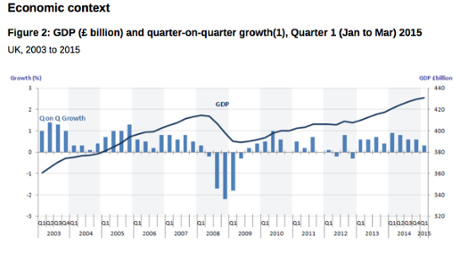
And in the UK, growth has slowed sharply to just 0.3%, weaker than expected:
Updated
Yanis Varoufakis has announced plans to encourage Greeks to declare assets held in Switzerland to avoid tax.
After seemingly having his wings clipped yesterday, Varoufakis been cracking on with the nitty-gritty work of being a finance minister.
This includes a meeting Switzerland’s deputy minister for International Financial Affairs, Jacques de Watteville.


And speaking to reporters afterwards, Varoufakis said the Athens government would launch an amnesty for undeclared foreign assets, reportedly to be taxed at just 15%.
#Greece gov't considers a draft bill for 'voluntary' declaration of Greek deposits in Swiss banks (via @amna_news) #economy
— Manos Giakoumis (@ManosGiakoumis) April 28, 2015
It’s not the first time Greece has tried such a measure, though; success has been limited to date.
There was a similar law for 'asset repatriation' passed in 2004 with a 3% (!) one-off tax and results were meager. #Greece
— Yannis Koutsomitis (@YanniKouts) April 28, 2015
Updated
Could Greece be heading for a referendum?
There’s a lot of chatter today that Greece could be heading towards a referendum.
Alexis Tsipras lit the speculation during last night’s TV interview, when he explained voters had not given him permission to sign up to the old bailout programme.
He said:
“If the solution falls outside our mandate, I will not have the right to violate it, so the solution to which we will come to will have to be approved by the Greek people.”
Since #Tsipras' interview last night the referendum solution is officially on the table #Greece
— Loukia Gyftopoulou (@loukia_g) April 28, 2015
And with Tsipras ruling out fresh elections, and Germany insisting that Greece meets its commitments, a referendum could indeed be needed.
The PM could potentially find that he can’t get a deal past his own Syriza colleagues, if it includes labour market reforms or privatisations that they campaigned against in January’s general election.
2 ways to read Tspiras referendum talk: increase in uncertainty or commitment to appeal to Greek people if Syriza harder edge against deal.
— Duncan Weldon (@DuncanWeldon) April 28, 2015
However, it’s not a simple issue.
The Greece constitution allows referendums for matters of critical national interest, and social issues, but not on fiscal matters.
Scenario: Greece cuts deal that exceeds Syriza mandate, takes it to referendum Question: what result would be required? Majority? Plurality?
— Martin Baccardax (@mdbaccardax) April 28, 2015
@mdbaccardax Plurality. Yet there are constitutional hurdles to such a referendum: Constitution forbids referendums on fiscal issues.
— Yannis Koutsomitis (@YanniKouts) April 28, 2015
And of course, does Greece have time to organise a referendum before running of cash?
Question: What is the "fastest" the Greek govt is legally allowed to conduct a referendum, since the day it is called? #Greece #Syrizanel
— The Greek Analyst (@GreekAnalyst) April 28, 2015
Greek bonds are continuing to rally, on optimism that a deal will be reached to avert the danger of default:
#Greece's 5yr default probability drops below 80% on fresh bailout hopes as majority of Greeks favour agreement. pic.twitter.com/eeiwDnHQso
— Holger Zschaepitz (@Schuldensuehner) April 28, 2015
Just in -- photos of Yanis Varoufakis following a meeting with Alexis Tsipras this morning.
They show Varoufakis still has the ear of the PM (who called him a valuable asset last night)....

...and that Greek citizens are still keen to speak with their ‘rock star’ finance minister.

Austrian finance minister hopes the new Greek negotiating team makes progress, fast.
Reuters has the details:
Hans Joerg Schelling told reporters before a cabinet meeting that he learned of the move only via media reports but that it was “in order” for Tsipras to change the team, adding that “it just has to be quick...I hope we don’t start again at zero.”
“We hope...that the Greek government now gets out of the headlines, that they concretely back up measures with laws, valuations and schedules,” he said.
Updated
Another encouraging sign. The European Commission says that contact between Greece and its creditors have “intensified”, meaning negotiations are progressing.
#EC's spox on #Greece: Contacts have intensified and allowed work to progress
— Elodie Lamer (@ElodieLamer) April 28, 2015
Economist Intelligence Unit: Greek deal still possible
Despite the lack of progress, Joan Hoey of the Economist Intelligence Unit reckons Greece and its creditors can still break the stalemate in time.
That’s partly because Eurozone leaders can’t be certain how serious a Grexit would be....
The modus operandi of the euro zone is to seek compromise and to avoid incalculable risks. Especially after the 2008 global financial and economic crisis, risk aversion is so strongly entrenched in every single international organisation that few political leaders are prepared to gamble on Grexit. Against the backdrop of a fragile euro zone economic recovery and the tense geopolitics over Russia/Ukraine, letting go of Greece would mean stepping into “uncharted waters” as Mario Draghi, ECB president, put it. No matter what they might say about the euro zone being “ring-fenced” against contagion, and no matter how frustrated they are with Mr Varoufakis et al, euro zone political leaders do not want a Grexit.
....and partly because the Greek people want to remain in the eurozone:
Despite deep popular resentment of the austerity policies tied to the bailout programme, the vast majority of Greeks want to stay in the euro zone. This is a constraint on how far the Syriza government can push back in its negotiations with the Eurogroup. As time has gone on and the government’s hardline stance has failed to wring concessions and heightened Grexit risk, popular support for the government’s confrontational approach has ebbed.
The conceit nurtured by Syriza during its election campaign that it could reject bailout conditions but keep the country in the euro zone has been exposed”.
Back in Athens, a senior government MP has criticised the decision to shake up Greece’s negotiating team and sideline finance minister Varoufakis.
Speaking on private ANT1 TV, Alexis Mitropoulos, the Greek Parliament’s First Deputy Speaker, said that “Yanis Varoufakis was the ideal negotiator and we should have backed him up further.”
Mitropoulos further said that will not vote for any austerity measures and that the government should call for a referendum before agreeing on any deal with the creditors.
Updated
Here’s our own Angela Monaghan’s story on the disappointing UK growth figures:
Hello again. While I was off helping with our coverage of the UK growth figures, Yanni Kouts has been monitoring events in Greece:
#Greece PM Tsipras meets FinMin Varoufakis; to brief Syriza parl group later today over state of play with country's creditors.
— Yannis Koutsomitis (@YanniKouts) April 28, 2015
#ECB's Cœuré says #Greece's exit from the #euro zone is not "a scenario that we are working on."
— Yannis Koutsomitis (@YanniKouts) April 28, 2015
Our Politics Live blog is taking the lead on today’s surprisingly weak UK growth figures:
UK Q1 #GDP in detail: Services +0.5% (Q4 +0.9%), Industrial output -0.1% (Q4 +0.2%), Construction -1.6% (Q4 -2.2%)
— Markit Economics (@MarkitEconomics) April 28, 2015
This feels like a big blow to the Conservative Party; economists had expected growth of 0.5%:
Wow ... economic growth slows to 0.3% in 1st 3 months of the year, half what is was the previous quarter and well below expectations.
— Richard Edgar (@ITVRichard) April 28, 2015
UK growth slows
Breaking: The UK economy grew by just 0.3% in the first three months of 2015.
That’s a sharp slowdown on the 0.6% recorded in October-December 2014.
Nearly time to discover how the UK economy fared in the first three months of the year.....
Europe’s major share indices are all in the red this morning, with investors fretting that the rally may have gone too far.
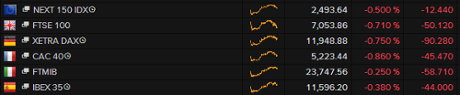
European markets are still close to their highest levels in 14 years, and as Tony Cross, market analyst at Trustnet Direct, says:
Traders are struggling to find the justification to keep pushing stocks at these elevated levels.
Athens is bucking the trend, though -- the main AGT index is up 0.64% in early trading.
Here’s Sean Farrell on BP’s financial results:
Greek bonds are continuing to strengthen (but remain deep in the danger zone)
2-yr Greece Yields 21.08%, Down 107bps
— Katie Martin (@katie_martin_FX) April 28, 2015
Hat-tip to Wolf Piccoli of Teneo Intelligence for producing a detailed ‘decision tree’ that outlines the various paths which Greece could follow in the months ahead.
#Greece's options as outlined by Teneo Intelligence's decision tree # lookingahead http://t.co/NG99Ald1hs pic.twitter.com/RjdPR0cI6G
— wolf piccoli (@wolfpiccoli) April 28, 2015
Updated
Optimism pushes Greek yields lower
Greek bond yields are dropping this morning after prime minister Alexis Tsipras declared that an initial agreement with creditors could be reached by the end of next week.
The yield (interest rate) on Greece’s two-year debt has dipped from 22.8% to below 22.4%, meaning its price has risen slightly.
#Greece's bond yields nudge lower on Greek optimism. 2yr yield drops to 22.4%. pic.twitter.com/CRbAkNZ8Ft
— Holger Zschaepitz (@Schuldensuehner) April 28, 2015
Sentix: 49% of investors expect eurozone to break up
Nearly one in two investors expect Greece to leave the eurozone in the next 12 months, according to a regular survey by German research group Sentix.
Sentix’s Euro Break-up Index jumped to 49.0% this month, from a previous 36.8%, showing a higher risk of Grexit.
That’s the highest since the summer of 2012, before ECB chief Mario Draghi promised to do “whatever it takes” to protect the single currency.
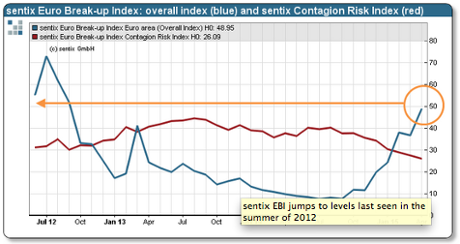
It says:
European politicians’ promises to pursue the scenario of Greece keeping the euro are not taken at face value by about the half of all investors. In 2012 Mario Draghi calmed down investors with his ultimate commitment to the euro.
But is his pledge still valid for Greece today?
One note of caution: the interviews took place between Wednesday April 23 and Friday 25 April, so before Alexis Tsipras appointed new negotiators.
Draghi put to the test: one out of two investors expects a “Grexit” | sentix Euro Break-up Index... http://t.co/VbWWdY59BD
— sentix (@sentixsurvey) April 28, 2015
Updated
Stan Shamu of IG confirms that investors are more upbeat about Greece, thanks to the shake-up of its negotiating team and Alexis Tsipras’s comments overnight:
Europe has led the way this week and this is still on the back of optimism around Greece. There are some interesting developments in Greece at the moment with the country reshuffling its bailout negotiating team and forcing Finance Minister Varoufakis to the sidelines. Mr Varoufakis was seen by some as being part of the problem and as a result news of him being sidelined has been well received.
The bailout negotiating team met in Athens yesterday and is looking at some of the reform measures the Eurozone has been wanting to see.
Prime Minister Alexis Tsipras is also said to be getting ready to suspend the minimum wage plan with an overall comprehensive package expected to be concluded by early May. Clearly Greece is now starting to play ball and it’ll be interesting to see how the population reacts to the developments.
Despite all this, I will reinforce my feeling that the numbers simply do not add up for Greece and we are likely to be back to square one in the not so distant future. The writing is on the wall for Greece and while a last minute deal is likely to be reached, many will be questioning how much longer the Eurozone will be willing to carry a wounded partner through the recovery.
Greece - there was considerable optimism last night as the market reacted positive to the leaks
— Steve Collins (@TradeDesk_Steve) April 28, 2015
Alexis Tsipras: I believe an initial deal is close
There’s a sense of optimism this morning after Greece’s prime minister declared an initial deal with the country’s creditors could be reached by the end of next week.
In a late-night interview with Star TV, Alexis Tsipras said that:
“Our goal... is to reach a first agreement this week if possible, or next week at the latest....I believe we are close.”
Tsipras says he hopes there'll be initial deal at Brussels Group this week/next week at latest. "We're close to a minimum package" #Greece
— MacroPolis (@MacroPolis_gr) April 27, 2015
But...Tsipras did also caution that issues including pension cuts, mass layoffs and VAT increases are all still ‘on the table’, suggesting Greece hasn’t yet compromised.
Tsipras explains resistance to raising VAT on islands is because lower rates are there to balance higher costs faced by islanders #Greece
— MacroPolis (@MacroPolis_gr) April 27, 2015
And while Tsipras said an early election was off the table, he could be forced to call a referendum:
“If I end up having an agreement that puts me outside the limits (of my mandate), I will have no other resort....The people will decide obviously without elections, I want to make that clear.”
#SYRIZA #Tsipras #interview, answering voters questions http://t.co/F3JKkhPhGn #Merkel #Varoufakis #Draghi #Eurogroup pic.twitter.com/oplkoFdT5V
— themanews.com (@themanews) April 28, 2015
In a wide-ranging interview, Tsipras admits that uncertainty this year did mean Greece faces the “danger of recession”
Tsipras also blamed the previous government for creating Greece’s current predicament, and said Europe must share the blame if a deal isn’t reached on time.
He also defended his embattled finance minister, saying Yanis Varoufakis remained a key ‘asset’ for Greece, despite his ructions with fellow finance chiefs.
Tsipras says Merkel has shown intention for deal with #Greece. Failure to reach agreement would be failure for her and Greek gov't #enikos
— MacroPolis (@MacroPolis_gr) April 27, 2015
Tsipras says Varoufakis is a "significant asset" for gov't & #Greece, has full backing #enikos
— MacroPolis (@MacroPolis_gr) April 27, 2015
Tsipras suggests enmity towards Varoufakis from EZ finmins is because they would prefer to deal with someone who is compliant #Greece
— MacroPolis (@MacroPolis_gr) April 27, 2015
The Agenda: Greek talks, and UK GDP

Good morning, and welcome to our rolling coverage of the world economy, the financial market, the eurozone and business.
Coming up today..... Greece’s new bailout negotiating team are getting down to work after yesterday’s shake-up left finance minister Yanis Varoufakis on the sidelines.
There are already signs of progress. Last night, the Greek negotiators agreed to draw up a multi-bill including several reforms to put to parliament.
As we reported last night, Varoufakis paid the price for the lack of progress this year:
Reacting to the news, a senior European Union official confided that it had become “impossible” to do business with Varoufakis. “It had got to the point where eyes roll,” he said.
“People had got sick and tired of being lectured about austerity and the effects of the crisis. Any sympathy for Greece was eroded by his failure to draft concrete proposals.”
Just published: front page of the Financial Times UK edition Tue Apr 28 pic.twitter.com/s10qwPvOPG
— Financial Times (@FT) April 27, 2015
The shake-up has boosted hopes that a breakthough could finally be in sight.
Last night, Greece’s PM claimed that a deal with creditors is “very close”, but also suggested a referendum could be called if the two sides can’t reach agreement (more on that shortly).
We get fresh UK growth figures at 9.30am this morning, showing how the economy performed in the first three months of this year.
Economists expect a slight slowdown to +0.5%, from 0.6% in the last quarter of 2014. It’s the last major piece of economic news before May’s general election, so expect lots of political reaction.....
European stock markets are expected to fall, after yesterday’s rally drove the FTSE 100 to a new record high.
And traders will be digesting results from oil giant BP, which just reported that adjusted profits have slumped by a fifth, to $2.6bn. That’s better than expected.
Those BP first quarter numbers nowhere near as bad as expected. Interesting one to watch at 8 a.m. open. https://t.co/ngsoSsP5We
— David Jones (@JonesTheMarkets) April 28, 2015
I’ll be tracking all the main events though the day....