And finally, over to Ian Traynor in Brussels to sum up tonight’s news:
Greece clinched a three-year bailout worth €86bn (£60bn) after parliamentarians in Athens backed the deal, and Germany backed down on its opposition to the third rescue of the bankrupt country in five years.
A meeting of eurozone finance ministers in Brussels representing the country’s main creditors agreed to launch the new bailout with €26bn being disbursed next week following six months of bitter recrimination that almost saw the country, under the leftwing government of Alexis Tsipras, becoming the first to exit the single currency.
The meeting was upbeat about finalising the bailout terms after Tsipras, secured approval from MPs for a huge package of legislation on Friday morning. The vote committed the indebted country to radical economic and fiscal reforms needed to secure the rescue money.
Wolfgang Schäuble, the German finance minister and critic of the proposed new deal, toned down his reservations at a meeting of his eurozone peers in Brussels several hours after the Athens vote.
Over the past week, Berlin has consistently argued against being rushed into a new bailout, preferring to award Greece a new bridging loan to pay off a debt payment of €3.2bn due to the European Central Bank next week. But the temporary loans scenario was barely mentioned by finance ministers.
“The past six months have been difficult. We have looked into the abyss,” said Jean-Claude Juncker, the president of the European commission. “But today the message of today’s Eurogroup is loud and clear: on this basis, Greece is and will irreversibly remain a member of the Euro area.”
In an abrupt change of tone, the leaders paid tribute to Tsipras, who could only win the vote on the new bailout with the support of the opposition and by splitting his leftwing Syriza movement. It is now likely that Tsipras will call early elections and trigger a realignment of Greek politics......
More here:
And that is a good moment to stop for the night. Thanks for reading and commenting, See you all next week. GW
Tonight’s deal faces a trio of major obstacles - one political, one economic, and one financial.
The Wall Street Journal explains:
Large-scale defections from Syriza party lawmakers during a parliamentary vote on the agreement Friday morning indicate that Prime Minister Alexis Tsipas may soon call new elections.
That could once again delay the implementation of the austerity measures mandated by the deal as well as action by the other eurozone countries to lower Greece’s debt load.
At the same time, the steep budget cuts Greece has to implement in return for the new bailout are bound to cause more pain for its economy and citizens. The rescue program foresees a 2.3% contraction of Greece’s gross domestic product this year, followed by a 1.3% decrease next year.
The deal also expects that shareholders, junior creditors and senior bondholders in Greece’s battered banks will take losses before the lenders will be recapitalized. That will likely cause further uncertainty for a financial sector already reeling from capital controls that are unlikely to be lifted anytime soon.
Greece an irreversible member of euro, says Juncker after Eurogroup nod http://t.co/F6GGec0tkh pic.twitter.com/SzSdPW9RdB
— Kathimerini English (@ekathimerini) August 14, 2015
European Commission President Jean-Claude Juncker must be relieved that the threat of Greece leaving the eurozone on his watch has receded.
Here’s his reaction to tonight’s agreement.
The past six months have been difficult. They have tested the patience of policy-makers and they have tested the patience of our citizens even more. Together, we have looked into the abyss.
But today, I am glad to say that all sides have respected their commitments,”
More reaction to tonight’s agreement:
#greece no phony victimhood from tsakalotos: 'in end, how good this deal is depends on how Gk society, state, economy, social actors respond
— Ian Traynor (@traynorbrussels) August 14, 2015
Shorter Lagarde: no deal without debt relief, redux.
— Frances Coppola (@Frances_Coppola) August 14, 2015
Hollande says Eurogroup deal on Greece is proof EU is capable of going forward; an achievement for Greece which has made expected efforts
— Fabrizio Goria (@FGoria) August 14, 2015
Updated
Summary: what was agreed tonight
Tonight’s deal doesn’t mean the third Greek bailout is totally “in the bag”. Some national parliaments need to give their approval - including Germany’s Bundestag next week.
But short of a major shock, the €86bn bailout package is finally a done deal, after nearly seven months of wrangling, deadlock and drama.
So what are the key points of the deal?
Well, the Memorandum of Understanding (MoU) between Athens and its creditors includes four key elements -- including some very stretching budget targets, unpopular economic reforms. including to pensions,, and sweeping changes to a banking sector that has been battered this year.
Or, in the eurogroup’s words:
- a medium-term target for a primary surplus of 3.5% of GDP by 2018 to be achieved through fiscal reform
- an ambitious reform of the pension system
- key labour and product market reforms to open up the economy to investment and competition
- financial sector measures to safeguard its stability, including a recapitalisation of the banks and urgent steps to tackle the non-performing loan (NPL) problem in the banking sector
There is also a new pledge to privatise Greek state assets, through a new controversial fund that is designed to raise up to €50bn.
In return, Greece gets the promise of new measures to guarantee debt sustainability. Prime minister Tsipras has repeatedly hailed that commitment as a (rare) key victory.
But Europe has not committed to actually cutting Greece’s debt mountain. Instead, it argues that:
debt sustainability can be achieved through a far-reaching and credible reform programme and additional debt related measures without nominal haircuts.
In other words, by giving Greece longer to repay its existing loans and cutting the interest rates charged.
Although ministers have also dangled a carrot:
If necessary, the Eurogroup stands ready to consider, possible additional measures to ensure that Greece’s gross financing needs remain at a sustainable level.
And debt sustainability is vital, to get the IMF on board (as well as to help Greece).
But after two Greek bailouts, the Fund hasn’t yet committed to a third. First, it wants to see proof that Greece has implemented all the fiscal, structural and financial sector reforms on the table. Plus an agreement on possible debt relief to ensure debt sustainability.
It could be a dramatic autumn.....
Main results of today’s #Eurogroup meeting on #Greece http://t.co/cu8tLiq6Qd
— EU Council Press (@EUCouncilPress) August 14, 2015

The success of tonight’s deal depends on Greece’s willingness to embrace tough reforms, Tsakalotos added.
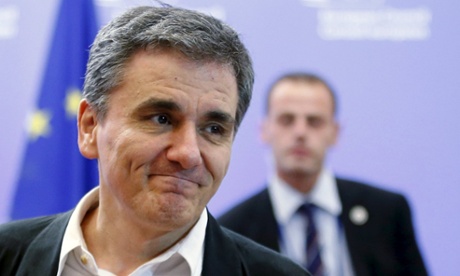
Greece’s finance minister, Euclid Tsakalotos must be cream-crackered this evening.
He spent last night in the Athens parliament, as MPs argued over whether to approve the bailout programme. No sooner was that vote over than he was preparing for the eurogroup meeting, which began after lunch in Brussels.
But he’s still managed to raise the energy to speak with reporters tonight, and argue that tonight’s deal can help Greece recover.
Tsakalotos explained:
“It takes Greece forward in the sense that the financial system should be much more stable from now onwards. There is a promise of recapitalisation of the banks, without any of the depositors having to bail in or anything to worry about.”
If you’ve been following this crisis, you’ll already know that Greece must implement sweeping economic changes in return for this third package of loans.
The broad scope of the plan was agreed a month ago, at the summit of eurozone leaders.
And as we reported earlier this week, the final deal includes “major reforms of health, welfare, pensions and taxation systems, alongside more ambitious privatisation schemes.”
It also awards the troika decisive influence over reforms to Greece’s banks, which have suffered major capital outflows this year, culminating in capital controls since late June.
Some tweaks have been agreed tonight, but this story from Wednesday night still gives the picture:
Like Dijsselbloem, Schaeuble plays down potential political instability in #Greece. Focuses on broad parliament majority, not SYRIZA rebels
— Nick Malkoutzis (@NickMalkoutzis) August 14, 2015
Schäuble denies that the political instability in Greece could doom tonight’s deal.
He points out that prime minister Alexis Tsipras has fought hard to get MPs to approve it:
#Schäuble: When asked the 'trust' question - says, did you not see how #Tsipras has fought in his own parliament for this prog. #Eurogroup
— Open Europe (@OpenEurope) August 14, 2015
(The Greek parliament gave its seal of approval to the deal early this morning - but Tsipras suffered a significant rebellion among his own MPs).
More Schaeuble: Now Greece is making serious effort to embark on a new course "Good day. Good result" #Greece pic.twitter.com/nucS7WyRSU
— Derek Gatopoulos (@dgatopoulos) August 14, 2015
Even Schäuble, one of Greece’s biggest critics, sounds optimistic tonight.
Germany’s finance minister tells reporters that he’s confident that eurozone ministers can agree a “common approach to Greek debt sustainability”in October, which would then bring the IMF on board.
#Schäuble: Always been the case that IMF decides on its own rules. If 1st review is satisfactory in Oct, then Lagarde will request IMF join
— Open Europe (@OpenEurope) August 14, 2015
Wolfgang Schauble, Germany’s finance minister, is briefing the press -- here’s a livefeed.
Eurozone finance ministers are racing to brief the press, and give their verdict on the Greek bailout deal reached tonight.
France’s Michel Sapin has hailed the deal, and applauded the determination shown by the Greek government to carry out reforms (after a shaky start).
France's Sapin: Greek government took responsibility after valuable time was wasted #Greece pic.twitter.com/8AQutvG3ZX
— Derek Gatopoulos (@dgatopoulos) August 14, 2015
Lagarde repeats call for Greek debt relief
With delicious timing, IMF chief Christine Lagarde has just issued a statement welcoming the agreement between Greece and the rest of the eurozone.
But she has also warned that “significant” debt relief is needed before the IMF can join the bailout (as many countries, including Germany and Finland, demand).
Key passage from @Lagarde on #Greece deal: 'significant debt relief needed, well beyond what considered so far' pic.twitter.com/xuDWJ1BWNY
— Alberto Nardelli (@AlbertoNardelli) August 14, 2015
Updated
I’m hopeful that the IMF will come on board in October, Dijsselbloem says.
But he admits that this isn’t guaranteed; it all depends on Greece’s ability to implement the programme, and the eurozone’s progress on debt sustainability.
And that’s the end of the press conference....
Regling clarfying: 1st Installment €26bn _ €10bn for banks & €13bn more paid out immediately, remaining €3 in Sept, Oct #Greece
— Derek Gatopoulos (@dgatopoulos) August 14, 2015
Dijsselbloem repeats that relations with the Athens government has improved in recent weeks.
Greece has been ‘very strong, very organised’, he says, in a clear dig at their former finance minister.
.@J_Dijsselbloem: Cooperation with the "changed Greek govt" has been hugely improved. Translation: Thank god they got rid of Varoufakis.
— Megan Greene (@economistmeg) August 14, 2015
Our Europe editor, Ian Traynor, seeks details about how tonight’s deal differs from the draft proposal drawn up this week.
Jeroen Dijsselbloem confirms that tonight’s statement includes an new, explicit commitment that bank depositors won’t be bailed-in to help pay the cost of rescuing Greece’s banks.
Ministers added that commitment tonight because they want to avoid panic that savers could lose money.
#greece #eurogroup on bank bail-ins - 'we wanted to make sure there would be no unrest among depositors' - @J_Dijsselbloem
— Ian Traynor (@traynorbrussels) August 14, 2015
Updated
Onto questions.
Are the eurogroup concerned by the political instability in Greece, and the prospect of a confidence vote next week?
Jeroen Dijsselbloem says that the Athens parliament has approved the Greek bailout plan by a large majority, showing there is sufficient “ownership” of the plan.
But much of the majority comes from opposition parties, isn’t that a worry?
No, Dijsselbloem replies - it’s an encouraging sign.
Eurozone authorities are aiming to sign off Greece’s first loan tranche, worth €26bn, next Wednesday (19th August).
Then, €13bn will be handed over early on Thursday. That will cover repaying Greece’s existing bridge loan (to meet July’s funding needs) and its bond repayment due to the ECB on the 20th.
Another €3bn will be disbursed during the autumn.
A further €10bn of funds are being set aside to cover the cost of recapitalising Greece’s banks. But that money won’t be handed to Athens, says Klaus Regling, the head of the ESM.
Instead, it will be retained in Luxembourg and handed over when requested.
Updated
Greece’s willingness to reform its pension system will be crucial to the IMF’s decision on whether to take part in the bailout, Dijsselbloem adds.
What about the thorny question of the International Monetary Fund’s involvement in the bailout?
Dijsselbloem says that it is essential that the IMF is involved. That could happen, he says, once the Fund is satisfied by the Greek reforms and the prospects of debt sustainability.
Updated
Eurozone ministers have agreed to consider taking “additional measures” to ensure Greece’s debt sustainability, Eurogroup president Dijsselbloem says.
However, Athens will need to achieve a successful first review of the bailout programme first.
And debt relief may not include haircuts on Greece’s debt pile, he adds.
.@J_Dijsselbloem On debt sustainability, can be achieved thru a far reaching reform program and debt measures "without haircuts"
— Tony Connelly (@tconnellyRTE) August 14, 2015
Updated

The €86bn bailout includes a €25bn buffer to recapitalise the Greek banking sector.
Updated
Dijsselbloem: Greek bondholders face bail-in
Tonight’s deal also tackles issues in the Greek banking sector, Dijsselbloem says, to recapitalise lenders.
And he reveals that senior bondholders could be bailed-in to help pay for the plan, although depositors will be protected.
Dijsselbloem: We have a deal!
We have come to a positive conclusion tonight, says Jeroen Dijsselbloem at the start of the press conference.
We have reached a political deal, and solved the last issues, he tells reporters in Brussels.
That means Greece’s third bailout, worth around 86 billion euros, is agreed!
Dijsselbloem also pays tribute to the Greek government’s recent efforts to help create the deal.
#greece @J_Dijsselbloem thanks greek govt. been a while
— Ian Traynor (@traynorbrussels) August 14, 2015
Watch tonight's press conferences here:
Here’s a livefeed of eurogroup president Jeroen Dijsselbloem announcing the result of tonight’s meeting, starting any moment.....
Updated
Belgium’s finance minister, Johan Van Overtveldt, has told Reuters that the eurogroup have agreed to implement the Greek bailout plan that was drawn up this week, but with some “additional measures”.
Updated
Eurogroup meeting ends
Ian confirms that tonight’s meeting has finished, so we should find out very soon what’s been agreed.
#greece #eurogroup it's over #ohgoody
— Ian Traynor (@traynorbrussels) August 14, 2015
The newswires are reporting that the Eurogroup meeting on Greece has just ended......
Eurozone finance ministers approve new bailout for Greece; first payment will be €26B - DJ
— CNBC Now (@CNBCnow) August 14, 2015
It’s a glamorous gig, covering the biggest financial crisis in generations.....
Summer Friday part ii: eurogroup pizza party, pepperoni edition pic.twitter.com/OHrbXYJphT
— Zeke Turner (@zekeft) August 14, 2015
From Brussels, our Europe editor Ian Traynor sums up the situation tonight:
Greece is close to clinching a three-year bailout worth more than €85bn (£60bn) after parliamentarians in Athens backed the deal and Germany sent conciliatory signals ahead of a crucial meeting of eurozone finance ministers.
Representatives of Greece’s main European creditors were generally upbeat about finalising the bailout terms after the Greek prime minister, Alexis Tsipras, secured approval from MPs for a huge package of legislation on Friday morning. The vote committed the indebted country to radical economic and fiscal reforms needed to secure the rescue money.
Wolfgang Schäuble, the German finance minister and the main critic of the proposed new deal, toned down his reservations at a meeting of his eurozone peers in Brussels several hours after the Athens vote on Friday, voicing optimism that ministers would back a deal.
“I’m actually quite confident that we can reach an agreement,” Schäuble said.

Over the past week, Berlin has consistently argued against being “rushed” into a new bailout, preferring to award Greece a new bridging loan to pay off a debt payment of €3.2bn due to the European Central Bank next week. But the temporary loans scenario was barely mentioned by finance ministers as they arrived in Brussels, including the northern and east European eurozone members who have been reluctant to do a deal....
Here’s Ian’s full story:
Ian’s also heard that the IMF’s managing director, Christine Lagarde, gave an upbeat briefing to the assembled eurozone ministers:
#greece #eurogroup lagarde reported to eurozone ministers by videophone. 'very positively', it is said
— Ian Traynor (@traynorbrussels) August 14, 2015
Here’s a few more photos from inside the Eurogroup meeting:


Eurozone finance ministers are getting closer to a deal on the Greek bailout.
They’ve just taken a short break, and are now hammering out a statement. Officials are briefing that the eurogroup could finish in a little over two hours time, at 10pm (9pm BST or 11pm in Athens).
Eurogroup finance ministers back from a 30 minutes break to draft a statement text. Sandwiches arrived. Finished about 10pm +/-
— Zeke Turner (@zekeft) August 14, 2015
Eurogroup on #Greece is now redrafting conclusions, and should wrap up around 10 pm
— Chiara De Felice (@chiaradef) August 14, 2015
Greek prime minister Alexis Tsipras may try and reinvent himself to win any forthcoming election, says our correspondent Helena Smith.
#Greece heading for more parliamentary drama w confidence vote assured after 20th: debate/vote must take place 2 days after gov request
— Helena Smith (@HelenaSmithGDN) August 14, 2015
#Greece all eyes should now be on new force that will b created by #Syriza rebels who already have support of party's youth
— Helena Smith (@HelenaSmithGDN) August 14, 2015
In the name of #Greece's European destiny, #Tsipras may well try 2 reinvent h/self as leader of the centre left & emerge victorious
— Helena Smith (@HelenaSmithGDN) August 14, 2015
New Greek elections could come as early as next month, if prime minister Alexis Tsipras calls and loses a confidence vote next week, writes Jon Henley. But Tsipras may well win in any new ballot.
Updated
Here’s more on what may be on the table:
#greece bailout first tranche. €26bn in play, say sources - 10bn for banks,7.2 for EFSM, 3.7 for ECB, 1.6 IMF. leaves a 3bn buffer
— Ian Traynor (@traynorbrussels) August 14, 2015
European markets slip back
As the Eurogroup of finance minsters meet to discuss the third Greek bailout proposals, European markets ended the week on a downbeat note. Despite some measure of calm returning following the ructions caused by China devaluing its currency, investors remained nervous. Weaker than expected eurozone GDP data proved a drag on markets, although some positive US industrial production figures provided some support. The final scores showed:
- The FTSE 100 finished down 17.59 points or 0.27% at 6550.74
- Germany’s Dax dropped 0.27% to 10,985.14
- France’s Cac closed 0.61% lower at 4956.47
- Italy’s FTSE MIB fell 0.46% to 23,248.52
- Spain’s Ibex ended 0.63% at 10,879.3
- The Athens market lost 1.85% to 673.93
On Wall Street the Dow Jones Industrial Average is currently 40 points or 0.24% higher.
Updated
Meanwhile here is more from the interview with European Central Bank member Benoît Cœuré, in which he suggests the bank may allow Greek bonds to be accepted as collateral once the new bailout agreement is in place.
Will the Governing Council of the ECB immediately reapply the waiver – i.e. the exemption under which the bonds of a country with a poor credit rating are accepted as collateral if the country is in a programme – once Greece’s third programme is agreed? That would be an enormous help to Greece.
The Governing Council has not yet discussed that.
But it is not automatic?
In order for a country to benefit from the waiver, a programme needs to be in place, and that programme needs to be functioning well. Once we have reached that point, we will discuss it in the Governing Council.
But does the Governing Council not need to wait for the initial assessment by the creditors, which is scheduled for October? That is also relevant as regards the question of when Greece could benefit from the ECB’s bond purchase – i.e. quantitative easing (QE) – programme.
We could potentially act earlier. Greece’s new programme contains a large number of “prior actions”. The question for the Governing Council will be whether these preliminary measures are sufficient to meet our criteria.
Greek officials are saying the Euro Working Group went well and it recommended to the Eurogroup of finance ministers that the country receive €13bn immediately to cover its financing needs, with another €10bn to help support the banks.
Greek FinMin sources say EWG went well, #Greece to receive €13bln now (12.5 for debt, 0.5 for arrears) & €10bln soon after for bank recap
— Nick Malkoutzis (@NickMalkoutzis) August 14, 2015
Greek FinMin sources add there will be efforts to secure soon more "significant" funding on top of €23bln to cover state arrears #Greece
— Nick Malkoutzis (@NickMalkoutzis) August 14, 2015
Updated
Capital controls unlikely until Greek banks recapitalised - ECB's Cœuré
European Central Bank member Benoît Cœuré has expressed optimism about the success of a third bailout deal for Greece.
In an interview with Börsen-Zeitung he said:
This year has seen a lot of trust destroyed, and reforms have been reversed. That has been a real setback. But Greece can build on what it has achieved under the first two programmes, and the new memorandum of understanding has everything it needs to give the Greek economy considerable support. I would like to stress two things in this regard. First, we have the right mix as regards fiscal measures. Ambitious medium-term budgetary objectives have been set, without the economy being strangled in the short term. Second, there is a strong focus on structural reforms. Looking back, one could say that if there had been more focus on structural measures – such as the reform and opening-up of markets, improved tax collection and the fight against interest groups – from the start, that would have reduced the burden that adjustment placed on the most vulnerable in society and speeded up Greece’s recovery.
And in what could be seen as a dig at former Greek finance minister Yanis Varoufakis, he said:
I am grateful for the good spirit and cooperation of the new Greek Finance Minister.
On Greek banks he said it was not clear how much funding they would need:
We believe that the recapitalisation of the Greek banks should take place as soon as possible. The banks’ ability to grant credit is an important precondition for growth. However, first we need detailed information about the situation. For that reason, banking supervisors at the ECB have started a new asset quality review and stress test for Greece’s four major banks. Those credit institutions were adequately capitalised , but they are now operating in an extremely difficult economic environment, and nonperforming loans are likely to increase in the next few years. It is quite clear, therefore, that the banks will require more capital. How much remains to be seen.
He said any decision about lifting capital controls was not one for the ECB, but should not happen until the banks are recapitalised:
It is a matter for the Greek government. As long as there is uncertainty regarding the future of Greece’s banks, the government in Athens should tread very carefully. I do not see scope for substantially relaxing Greece’s capital controls until it is clear how and when the banks will be recapitalised.
He was also asked about whether the diverging views within the eurozone could ultimately lead to it breaking up:
We have to be careful here, as that can quickly become a self-fulfilling prophecy. The more you talk about it, the more people think nationalistically again and stop trusting Europe – and when people do not trust Europe, Europe becomes part of the problem instead of being part of the solution. Europe has always thrived on the diversity of its models, ideas and cultures. We need to prevent economic divergence from becoming so large that it threatens the survival of the euro area. But diversity as such is not a bad thing; it also promotes best practices and competition.
Updated
Away from the eurozone briefly, and US consumer confidence figures have come in weaker than expected.
The University of Michigan’s preliminary consumer sentiment index came in at 92.9 for August, down from a final reading of 93.1 for July and forecasts of a rise to 93.5.
But other data was more positive for economic growth. Producer prices rose for the third month in a row in July while industrial output climbed at its strongest pace for eight months.
Updated
I didn’t spot Greece’s finance minister, Euclid Tsakalotos, arriving at the Eurogroup meeting -- but he is there now.

Tsakalotos can’t have had much sleep, given he spent last night in the Athens parliament arguing over the bailout deal (the vote didn’t end until after 10am local time).
More photos from the meeting:


That’s it. The Eurogroup meeting is now underway, with most ministers expressing confidence that the third Greek bailout will be signed off today.
Summary of doorsteps: Still some issues to iron out, but literally everyone (including Schäuble and Stubb) expects a deal today. #Greece
— Vincenzo Scarpetta (@LondonerVince) August 14, 2015
Stubb: IMF involvment is a Catch-22 problem
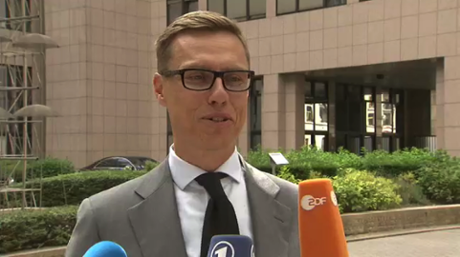
Finland’s Alex Stubb has now arrived at the eurogroup meeting, and told reporters that he would be “very surprised” if a deal isn’t reached to approve the Greek bailout deal today.
There are some ‘nitty gritty issues’ to solve today, including the involvement of the IMF in the Greek bailout, the size of the first bailout programme, and the timing of the financing.
Stubb adds that Finland is “very much” aligned with German on the need to involve the International Monetary Fund -- and puts his finger on the problem:
We should be honest and open that there is a bit of a Catch-22 to solve here.
The IMF will be involved only with debt relief, and we want the IMF to be involved but we don’t want debt relief. So some kind of solution will have to be found.
That solution could be a declaration from the IMF, which also refers to debt relief, he adds.
Updated
Slovakia’s Peter Kazimir adds that Greece must fulfil its commitments before it can get any debt relief:
#greece #€group slovak kazimir says debt relief (no haircuts) can come as a reward for good greek behaviour, not as bailout precondition
— Ian Traynor (@traynorbrussels) August 14, 2015
Slovakia’s finance minister, Peter Kazimir, tells reporters he agrees with Wolfgang Schäuble:
Kazimir: It's "crucial" that IMF is on board. #Greece
— Open Europe (@OpenEurope) August 14, 2015
Updated
Schäuble: IMF must be involved in Greek bailout

Germany’s Wolfgang Schäuble just arrived, giving reporters a cheery smile and a few words in German.
Schäuble says he is confident that a deal will be reached today. But he also warns that the IMF must be involved in the new Greek bailout, otherwise Germany can’t back the plan.
#greece #€group 'at the end of the day (today) we will have a result' - schaeuble
— Ian Traynor (@traynorbrussels) August 14, 2015
#greece #€group schaeuble - imf involvement is a precondition for D. need to hear about IMF's commitment
— Ian Traynor (@traynorbrussels) August 14, 2015
The question of the IMF’s involvement isn’t clear, though, given that the Fund insists that Greece needs serious, and “dramatic” debt relief.
European countries haven’t made such bold commitments yet, and won’t discuss debt relief in detail until October.
As our financial editor Nils Pratley explains:
There will....be heavy pressure from Germany to compromise and dilute the debt relief. It will be hard to get any bailout package through the German parliament but the task might be impossible if the IMF won’t endorse it.
Nevertheless, the IMF should stick to its guns. Greece needs serious debt relief, not token measures. It is about time that lenders accepted the economic reality that piecemeal measures are pointless when debt ratios reach 200%.
Malta’s Edward Scicluna is next to arrive -- he tells the press pack that he favours reprofiling Greece’s debt (eg, extending payback dates) rather than a haircut on the face value.
And do you expect a short meeting, or a long one?
What I wish for, is that it’s not too long, Scicluna smiles hopefully.
Amen to that.
Next up, Pierre Gramegna of Luxembourg, who greets reporters in Brussels with a cheerful “good morning” (?!).
#greece #€group lux's gramegna clearly a lateriser. arrives at 1430 with a 'good morning' greeting
— Ian Traynor (@traynorbrussels) August 14, 2015
Sounding positive, Gramegna says Greece has made more progress in the last month than in the previous six months, and is hopeful that the bailout is approved today.
Gramegna: I think the conditions are there to give the green light to 3rd bailout today. #Greece
— Open Europe (@OpenEurope) August 14, 2015
Updated
Dijsselbloem then vanished into the building, swiftly followed by ECB president Mario Draghi (showing his usual skill at avoiding the press pack)
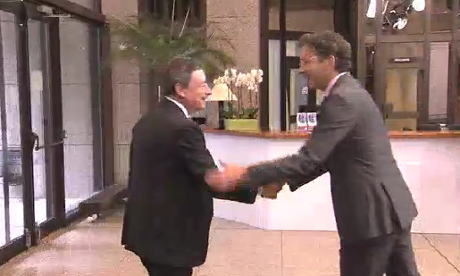
#greece #€group @J_Dijsselbloem said v little in english, in dutch he singled out bank recap, privatisation fund, debt as main problems
— Ian Traynor (@traynorbrussels) August 14, 2015
Dijsselbloem predicts Eurogroup criticism over Greek bailout deal
Eurogroup president Jeroen Dijsselbloem has just arrived at today’s extraordinary Eurogroup meeting.
Like France’s Michel Sapin, Dijsselbloem is looking tanned and cheerful.
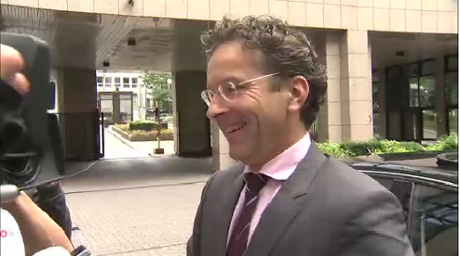
But he warns that today’s meeting won’t be short.
Some ministers will have questions, and criticism, on some issues, he predicts, adding:
Hopefully at the end of the evening we will have a positive outcome.
What about debt sustainability?
Debt sustainability is still a major point of concern, certainly for the IMF, Dijsselbloem replies. We will look at it closely in October.
Hopefully we can make sure that it is sustainable by them, and make further guarantees if necessary, so that the IMF can come on board in October, because that’s very important to all of us.
#greece #€group @J_Dijsselbloem 'imf involvement very important to all of us'
— Ian Traynor (@traynorbrussels) August 14, 2015
IMF involvement is particularly important for Germany, of course.....
Updated
Finnish finance minister Alex Stubb has dropped a hint that today’s Eurogroup meeting will go smoothly:
Beginning #Brussels meetings with #EPP colleagues. Then #Eurogroup. I sense an optimistic atmosphere in town. #AugustInBrussels
— Alexander Stubb (@alexstubb) August 14, 2015
The EPP is the group of centre-right European political parties, so Stubb should be conferring with finance ministers from Germany, Ireland, Portugal and Spain.
Sapin: Greek debt relief will be discussed in the autumn.
And we’re off! The first ministerial car has arrived in Brussels, and a suntanned looking French finance minister has got out.
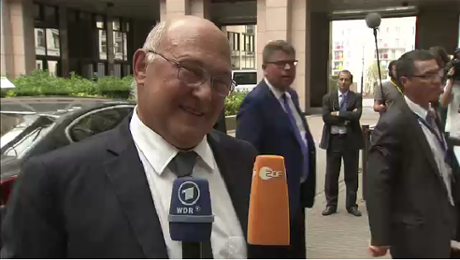
Michel Sapin told reporters that today’s Eurogroup meeting follows “very important” work by Greece and the institutions (the Europe Commission, European Central Bank, IMF and European Stability Mechanism).
Our task today is to decide whether to approve the Greek deal, Sapin adds - the issue of debt reprofiling will be covered in the autumn (ie, not today).
Sapin: We need to respect our timeline. Re-profiling of Greek debt will be discussed in the autumn. #Greece
— Open Europe (@OpenEurope) August 14, 2015
Jeroen Dijsselbloem will speak to the Brussels press in an hour’s time, before the eurogroup meeting gets underway.
Doorstep extraordinary #Eurogroup around 2:30pm #Greece
— Jeroen Dijsselbloem (@J_Dijsselbloem) August 14, 2015
This morning’s weak eurozone growth figures have pushed stock markets into the red today.
The main indices have all lost ground, as investors show disappointment at the slowdown in Germany and France.

Connor Campbell of SpreadEx explains:
A swathe of disappointing GDP figures from across the Eurozone led to a weaker than expected region-wide number this Friday morning. This merely served to compound the current lack of appetite for risk and caused the DAX and CAC to lose their tentative gains in the process.
That could change this afternoon, however, dependent on how swift, and successful, the Eurogroup meeting is. The finance ministers are all on their way to Brussels, so sooner rather than later news should start leaking out about the sentiment of the group.
Big news today is the disappointment across European GDPs http://t.co/xXe9Z7iKkK pic.twitter.com/a2kU2Ws6FM
— Joseph Weisenthal (@TheStalwart) August 14, 2015
Flash crash trader granted bail
Breaking away from the eurozone briefly, the British financial trader accused of helping trigger a multibillion-dollar US stock market crash has, finally, been granted bail.
Westminster magistrates court has ruled that Navinder Singh Sarao should be released from custody, almost four months after being arrested and accused of sparking market turmoil in 2010.
Sarao won’t be allowed to leave the London area, though, reports my colleague Jennifer Rankin from court. He’s fighting efforts to be extradited to the US to face charges.
Navinder Singh Sarao, accused of causing US flash crash, granted bail in extradition hearing at Westminster magistrates court.
— Jennifer Rankin (@JenniferMerode) August 14, 2015
Sarao, who is from Hounslow, must remain inside M25 until full extradition hearing scheduled for 24 Sept.
— Jennifer Rankin (@JenniferMerode) August 14, 2015
Updated

Dutch finance minister Jeroen Dijsselbloem has welcomed the Greek parliament’s vote today.
Dijsselbloem, who will chair this afternoon’s Eurogroup meeting, told reporters in The Hague that the current plan is the “strongest and most concrete” agreed yet.
Eurozone ministers will need to be confident, though, that Greece will meet its commitments, he added (via Reuters).
Those ministers should start arriving in Brussels soon.
Analysts at Capital Economics fear that the eurozone economy will continue to slow through 2015, and only grow by 1% during the year.
They say:
“Looking ahead, business surveys suggest that the euro zone economy will continue to expand, led by strong growth in Spain and a solid German economy. But they offer little hope that the recovery will gain pace.”
“Indeed, we think it is more likely that growth in the region as a whole will slow further in the second half of the year.”
0.3% rise in #euro-zone GDP in Q2 in line with our 2015 forecast of 1% vs consensus of 1.5%. We also expect 1% in 2016 vs consensus of 1.8%.
— Capital Economics (@CapEconEurope) August 14, 2015
Recession in #Finland continues. Only EZ coutry with shrinking GDP in 2Q. Won't help support for 3rd package for #Greece
— Carsten Brzeski (@carstenbrzeski) August 14, 2015
Finland was the worst-performing member of the eurozone in the last quarter; the only country to suffer shrinking GDP.
But it wasn’t the only poor performer, with France stagnating, Austria and the Netherlands growing just 0.1%, and Italy at +0.2%.
Here’s the full details:
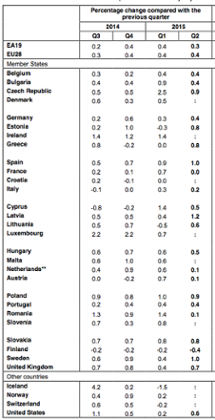
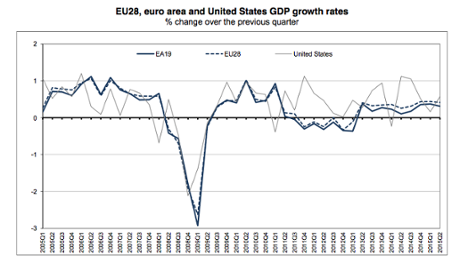
Euro economy grew by 0.3% in the last quarter
The eurozone economy grew by 0.3% in the second quarter of 2015, weaker than the 0.4% expected.
That’s not a surprise, after growth figures from Germany, France, Italy and the Netherlands were all weaker than forecast (as covered earlier in today’s blog).
But it underlines that the eurozone recovery is nothing to shout about, particularly with the French economy dropping back into stagnation.
In contrast, the UK economy grew by 0.7% during the second quarter of the year, while the US expanded by 0.6%.
Readers who missed the all-night drama in the Greek parliament in favour of a good night’s sleep can get a flavour from this video:
Updated
Portugal has outperformed France and Italy, and matched Germany, with growth of 0.4% in the last three months.
Portugal 2Q GDP +0.4% on quarter, +1.5% on year. Same rises as previous quarter.
— Patricia Kowsmann (@kowsmann) August 14, 2015
How the Syriza rebellion gathered pace:
Today’s vote was the third time that Greek MPs have been asked to approve the third bailout, and each time Alexis Tsipras’s majority has been whittled away.
Damian Mac Con Uladh of the Irish Times has been maintaining a spreadsheet showing how the rebellion has gathered pace.
#Greece: Which #Syriza MPs voted No or abstained: spreadsheet showing last three votes. http://t.co/yBtnCByJZw #Vouli pic.twitter.com/hTWoMk6u5l
— Damian Mac Con Uladh (@damomac) August 14, 2015
As you can see, seven previously loyal members decided to abstain today, leaving Tsipras reliant on opposition MPs to get the bailout approved.
And that’s why Greece could be heading into snap elections, unless some of these rebels return to the fold in a confidence vote.
Eurozone finance ministers will soon be heading to Brussels for a eurogroup meeting, to sign off the €85bn Greek bailout deal.
Finland’s Alex Stubb is already on his way:
Wheels up for Brussels. #Eurogroup meeting. Beautiful August morning in #Espoo. #esm #greece pic.twitter.com/VpkIWzOtKL
— Alexander Stubb (@alexstubb) August 14, 2015
Awfully pretty, and still stuck in a pretty awful recession.
Updated
Italian economy grows by just 0.2%

Italy has just provided further confirmation that the eurozone economy has underperformed in the last quarter.
Italian GDP rose by 0.2% quarter-on-quarter in April-June, below the 0.3% which had been expected.
That’s a quartet of disappointment. With Germany, France, Italy and the Netherlands all missing expectations, it’s very hard to see how the eurozone grew by the 0.4% which analysts expected.
Back in Athens, Greek MPs are staggering into the daylight after their marathon session.
It was touch-and-go at one stage, though. After the result was declared, speaker Zoe Konstantopoulou announced that the vote wasn’t legally valid and should be rerun within 24 hours.
It's over, MPs leaving, Konstantopoulou didn't get her wish of making everyone stay on #vouli
— Omaira Gill (@OmairaGill) August 14, 2015
The Netherlands economy has also missed expectations.
Dutch GDP grew by just 0.1% in the last quarter, compared to estimates of 0.3%.
#Netherlands | Q2 PRELIMINARY GDP Q/Q: 0.1% V 0.3%E; Y/Y: 1.6% V 2.2%E pic.twitter.com/6oJee3knAi
— Ioan Smith (@moved_average) August 14, 2015
The prospect of snap Greek elections this autumn will not please German MPs, who must give their approval to the deal next week:
If you’re just tuning in, here’s Jon Henley’s latest news story on the bailout vote:
Tsipras to call confidence vote after bailout rebellion
Skai TV are reporting that Alexis Tsipras will call a vote of confidence sometime after August 20, which would lead to snap elections if he loses.
And that’s because the Greek PM has suffered a significant rebellion among his own MPs at today’s vote.
According to one calculation, just 118 government MPs voted to approve the bailout plan - below the 120 votes needed to maintain Tsipras’s majority.
Looks like confidence vote will take place after August 20, possibly leading to snap elections if #Tsipras doesn’t reach necessary majority
— Janine Louloudi (@janinel83) August 14, 2015
#Greece: 3rd bailout passes; gov't MPs who voted for are 118, below min of 120 required to survive confidence vote. May lead to snap polls.
— spyros gkelis (@northaura) August 14, 2015
Updated
Here’s the voting details:
Voting looks to have finished in #Greece parliament. 3rd Bailout approved by 222 votes to 64 with 11 abstentions. pic.twitter.com/si8un4W4Tz
— Open Europe (@OpenEurope) August 14, 2015
Crisis-watcher Yannis Koutsomitis reckons the Greek government will just retain its majority in today’s vote, but it will be close:
Tsipras survives with up to 42 rebel votes or abstentions. 43 is the lethal number. #Greece
— Yannis Koutsomitis (@YanniKouts) August 14, 2015
Updated
Greece approves third bailout deal
It’s official: a majority of Greek MPs have voted to back the third aid programme.
Bailout bill passes #Greece pic.twitter.com/6e02qkxtD1
— Derek Gatopoulos (@dgatopoulos) August 14, 2015
But more government MPs are defying Alexis Tsipras and voting no -- meaning he could still lose his parliamentary majority.
Updated
it's a given that the bailout deal will pass, the issue is for government to retain at least 120 votes from syriza MPs. #vouli
— Diane Shugart (@dianalizia) August 14, 2015
Halfway through the vote, and 105 Greek MPs have now voted Yes, with 32 voting No and five abstaining.
The Greek parliament is on track to approve the third bailout deal, as the main opposition parties are supporting it:
So far voting in #Greece parliament shows 68 Yes 21 No and 2 abstentions (via Skai TV)
— Open Europe (@OpenEurope) August 14, 2015
Yanis Varoufakis has stuck to his word and voted against accepting the third bailout plan. Other Syriza rebels are also voting ‘No’.
Updated
Finally, Greek MPs are voting on whether to accept the third bailout.
Open roll-call vote underway in #Greece's parliament. #Vouli. pic.twitter.com/UfNW2HeXsV
— Damian Mac Con Uladh (@damomac) August 14, 2015
My colleague in Athens, Jon Henley, has watched the Greek bailout debate - and reports on the serious disunity on display:
The Athens parliament did not start debating the 400-page taxt of the draft bailout plan until nearly 4am after parliamentary speaker Zoe Konstantopoulou, a Syriza hardliner, ignored Tsipras’s request to speed up proceedings and instead raised a lengthy series of procedural questions and objections.
In angry exchanges, the conservative opposition rounded on the government, warning it not to take its support for granted. “If you want to provoke us - and for us to vote for it - you can’t have it both ways,” New Democracy leader Vangelis Meimarakis told finance minister Euclid Tsakalotos.
On the left, former energy minister Panayiotis Lafazanis, who leads a rebel bloc of around a quarter of Syriza’s 149 MPs, pledged to “smash the eurozone dictatorship”, while in her concluding pre-vote remarks, Konstantopoulou announced: “I am not going to support the prime minister any more.”
Earlier, the government spokeswoman, Olga Gerovasili, conceded divisions within the leftist party, which swept to victory in January’s elections on a staunch anti-austerity platform, were now so deep that a formal split was probably inevitable. Tsipras could call fresh elections as early as next month.
And here are some photos from the all-night session:


Updated
Finland's recession continues
There is no end to the economic gloom in Finland, where GDP has shrunk again.
Reuters has the details:
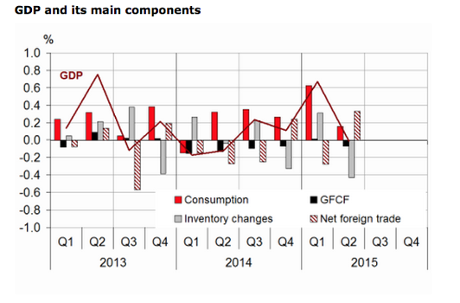
Finland’s gross domestic product (GDP) contracted 0.4% in the second quarter from the previous quarter, preliminary data from the statistics office showed on Friday. GDP fell 0.1% quarterly in the first quarter.
Second-quarter GDP was 1.0% lower than the same period a year earlier.
In June, output fell 0.9% compared with a year earlier, the statistics office said. The Finnish economy has contracted for three years in a row.
Updated
Yanis Varoufakis: I can't back the bailout
More drama in the Athens parliament, as the all-night debate continues.
Former finance minister Yanis Varoufakis has just intervened, telling the chamber that he cannot vote for the bailout deal. But he still supports the government, so suggests that he should resign as an MP to allow Tsipras to appoint a successor.
Varoufakis says he cannot vote for the deal #Greece pic.twitter.com/5LcqRTpPft
— Derek Gatopoulos (@dgatopoulos) August 14, 2015
Varoufakis has offered to resign as MP to help gov't remain above 120 seats, which would be minimum needed in confidence vote #Greece
— Nick Malkoutzis (@NickMalkoutzis) August 14, 2015
Updated
German GDP misses forecasts

Germany’s latest growth figures are also weaker than expected.
The eurozone’s powerhouse economy grew by just 0.4% in April-June, slightly below the 0.5% which economists had forecast.
That, plus France’s disappointing figures, suggests growth in the eurozone will miss the 0.4% which the City expected.
#Germany misses after #France on Eurozone GDP day. German 2Q GDP Adj +0.4% undershooting forecast of +0.5% On Qtr. pic.twitter.com/pweXuGbvZ4
— Holger Zschaepitz (@Schuldensuehner) August 14, 2015
Back in Athens, Tsipras has warned MPs that they must give their approval to the bailout plan today - so Greece can get the money to repay the European Central Bank next week.
#Greek PM tells MPs tt bridging loan (2 cover looming ECB debt) would plunge the country back into crisis
— Helena Smith (@HelenaSmithGDN) August 14, 2015
French economy stagnated in Q2
France has got Eurozone GDP Day off to a bad start, by posting no growth in the last three months.
France’s economic output was unchanged in the April-June quarter, stats body INSEE just reported. That’s weaker than the 0.2% which analysts had expected.
Household spending slowed, while French firm continued to cut investment. On the positive side, exports grew by 1.7%.
Good morning from #Italy on Eurozone GDP day. Data will highlight that end of stagnation not in sight. France misses. pic.twitter.com/DmGQEfdq3a
— Holger Zschaepitz (@Schuldensuehner) August 14, 2015
Tsipras: I don't regret compromising.

Alexis Tsipras is telling bleary-eyed Greek MPs that he doesn’t regret the deal he agreed to in Brussels last month.
Addressing parliament after the all-night session heads (finally) to a climax, Tsipras is insisting that he didn’t have a mandate for Grexit:
"We took a painful decision of responsibility," #Greek PM tells parliament after all-nite debate ahead of vote on latest bailout deal
— Helena Smith (@HelenaSmithGDN) August 14, 2015
Going the drachma route would have been tantamount to committing suicide, #Greek PM Alexis Tsipras tells parliament ahead of vote on deal
— Helena Smith (@HelenaSmithGDN) August 14, 2015
Tsipras: Denouncing the debt is not an alternative solution #Greece pic.twitter.com/Jjm49PJYma
— Derek Gatopoulos (@dgatopoulos) August 14, 2015
Updated
Introduction: Eurozone GDP and Greek bailout deal
Good morning.
Greece’s bailout deal is heading down to the wire today, with Eurozone finance ministers due to sign off the plan today.
But first, Greece needs to give its approve.
And as I type, the country’s MPs are still arguing over whether to back the plan, as the debate which began on Thursday evening drags into Friday morning.
The fragile consensus between the major Greek parties appears to have unravelled overnight, with bitter exchanges between key players.
Addressing #greek parliament this am #Syriza rebel #Lafazanis says he doesn't know whether he "feels pity or sorrow" for the government
— Helena Smith (@HelenaSmithGDN) August 14, 2015
#Greek parliamentary now witnessing extraordinary tirade against PM by his once close friend & top #Syriza cadre Zoe Konstantopoulou
— Helena Smith (@HelenaSmithGDN) August 14, 2015
Alexis Tsipras is on his feet now, telling MPs that the bailout agreement is a “necessary choice”, so the vote may finally come soon.
tsipras: the first cycle of a painful process closes today. #vouli
— Diane Shugart (@dianalizia) August 14, 2015
Eurozone finance ministers are due to meet this afternoon in Brussels, to give their approval for the plan. They can also ponder the latest warning that Greece needs significant debt relief, with borrowing likely to peak at 201% of national output (GDP) in 2016.
Also on the agenda today, we get growth figures from across the eurozone for the second quarter of 2015.
France’s data is coming out now, followed by Germany at 7am BST, The Netherlands at 8.30am, Italy at 9am, and the overall eurozone at 10am BST.
I’ll be tracking all the action through the day.
Updated