Summary: Greece optimistic, creditors not so much
Time for a recap:
Greece’s top negotiator has predicted that political intervention will be needed to finally close a deal with creditors, as time continues to tick away.
In Athens, the Greek government has declared it hopes to get a deal by Sunday.
But creditors have both questioned this optimism; the IMF is insisting on sweeping reforms and credible surplus targets, while the European Commission warns that more work must be done.
In the last few minutes, Christine Lagarde warned that a deal is very unlikely to come soon.
The European Central Bank piled more pressure on, saying that the financial markets could be rocked if the Greek crisis ends badly.
Greece has loomed over a meeting of finance ministers and central bank chiefs in Dresden. Photos here and also here.
Europe’s markets ended the day in the red.
That’s probably all for tonight. Thanks for reading, and for all the excellent comments. See you tomorrow. GW
Lagarde: Little chance of a deal very soon
More cold water -- Christine Lagarde has told the German newspaper Frankfurter Allgemeine Zeitung (FAZ) that there’s little chance of a breakthrough by Sunday
- LAGARDE - IT IS “VERY UNLIKELY” THAT WE WILL GET A COMPREHENSIVE SOLUTION IN THE NEXT COUPLE OF DAYS ON GREECE - PAPER
- LAGARDE - AFTER POSITIVE SIGNALS FROM ATHENS 10 DAYS AGO, WE’VE BEEN SOBERED IN THE LAST WEEK - PAPER
- LAGARDE - THERE IS STILL A LOT TO DO ON GREECE
- LAGARDE - RULES OUT FURTHER GRANTING FURTHER LOANS TO GREECE WITHOUT A CLEAN REFORM AGREEMENT - PAPER
She’s also suggested that Greece could potentially leave the euro:
IMF'S LAGARDE SAYS GREEK EURO EXIT IS POSSIBILITY: FAZ
— Steve Collins (@TradeDesk_Steve) May 28, 2015
Here’s some homework, class:
Your chance to help @George_Osborne out - Treasury is asking for public suggestions of what to put in the Budget: https://t.co/Q5EKCCKzVZ
— Heather Stewart (@heatherstewart3) May 28, 2015
Anyone caught telling Osborne where he can put his Budget can stay behind and clean the erasers...
European markets fall
Concerns over Greece helped to push Europe’s main stock indices mostly into the red.
Trading just ended for the day with the German, French, Italian and Spanish markets all down.
This cancels out Wednesday afternoon’s rally after Greece claimed a deal was close. Shares on Wall Street are also down, but in London the FTSE 100 crept higher.


Jasper Lawler of CMC Markets sums it up:
It was a delayed reaction, but European stocks fell on Thursday once it had been fully determined from new official comments that Greece is still far apart from creditors over conditions for the country’s bailout.
Greece won't join BRICS Development Bank
Over in Athens the Greek finance minister Yanis Varoufakis appears to have doused the idea of Greece turning to BRIC countries for financial assistance anytime soon.
Helena Smith reports
Prime minister Alexis Tsipras may have been intrigued - and pleasantly surprised - when Russia’s deputy finance minister Sergei Storchak invited Greece to become the sixth member of the BRICS Development Bank - but less a month later, the leftist-led government appears to have nixed any notion that Athens is seriously contemplating the offer.
Addressing parliament today, the Greek finance minister firmly ruled out the possibility saying:
“anyone who believes that the Development Bank can replace an agreement with the institutions [EU and IMF] does not know the economic reality of Greece. We are an indivisible part of the European Union. It is an issue [to be dealt with] in our family and we have to solve it in Europe.”
Varoufakis said of negotiations with the EU and IMF to keep the debt-stricken country afloat.
“All our other relations with Russia, China, the USA, Singapore or Japan will develop based on interest but we won’t find a solution to negotiations outside European institutions and the European family,”.
Varoufakis’ intervention draws a line under one of the odder episodes of the debt crisis. Storchak, who heads the New Development Bank, made the offer during a telephone conversation with Tsipras. Shortly after, Tsipras’ anti-austerity coalition appointed former IMF representative Panagiotis Roumeliotis to examine whether Greece should indeed take it seriously.
Operated by Brazil, Russia, India, China and South Africa, the New Development Bank is seen as an alternative to the Wold Bank and International Monetary Fund. Established with the express aim of facilitating financial cooperation among the five emerging markets, some in Athens had wondered whether it could possibly replace Greece’s traditional reliance on Europe as doubts over the country’s ability to stay in single currency also grew.
Finance ministers at the G7 in Dresden have discussed the case for making structural reforms now, according to a member of the German delegation.
Via Reuters:
- GERMAN G7 DELEGATION SOURCE - G7 NOT CONCERNED BY RECENT VOLATILITY ON BOND MARKETS
- GERMAN G7 DELEGATION SOURCE - G7 AGREED VOLATILITY IS A CORRECTION FROM PREVIOUS PRICE MOVES, SHOULD NOT BE SEEN AS UNEXPECTED
- GERMAN G7 DELEGATION SOURCE - G7 PARTICIPANTS AGREED THAT HIGH DEBT, BE IT GOVT OR PRIVATE, COULD BE A BRAKE ON GROWTH
- GERMAN G7 DELEGATION SOURCE -SEVERAL PARTICIPANTS SAID NOW WAS THE BEST TIME FOR STRUCTURAL REFORMS
Update: Has Germany ever felt that it wasn’t a good time for structural reforms, a colleague asks.....
Updated
A few more photos just landed from Dresden, including one showing ECB chief Mario Draghi in a cheerful mood:


The International Monetary Fund has dumped another bucket of chilly water over the suggestion that a Greek compromise deal is imminent.
Bloomberg is reporting that the Fund is sticking to its guns, insisting that Greece commits to ‘credible’ primary budget surplus targets and significant reforms.
IMF Said To Insist On Credible Medium-term Surplus By Greece And Pension Reforms
— Steve Collins (@TradeDesk_Steve) May 28, 2015
IMF said to believe debt relief may be necessary for Greece
— Steve Collins (@TradeDesk_Steve) May 28, 2015
Greece’s government, of course, strongly agrees that its debts need to be shrunk. But this enthusiasm isn’t shared by eurozone governments and the European Central Bank, who own so much Greek debt between them.
Greece says 'high-level' political intervention will be needed

Greece’s lead negotiator, Euclid Tsakalotos, has warned that it will take a “high-level” political agreement to actually drive a deal though.
Speaking to the Guardian from the Belgian capital, where the Brussels Group of technical teams will be resuming talks on Thursday, Tsakalotos told us:
“The [two sides] will never converge completely but the general impression is that they are converging.”
And Tsakalotos, who is Greece’s Deputy Foreign minister, believes that the final push must come from political leaders:
“There is now a reasonable chance that whatever convergence still needs to be done after the Brussels Group will be done at a higher level where politicians will be called in for the final trade-off and will bridge the gap.”
Here’s the full story, in which Tsakalotos also criticises the IMF for being “very, very tough” and not really engaging with Greece’s needs....
In Athens, protesters are holding an anti-austerity rally outside the Ministry of Employment - a sign of the domestic pressure the government faces to get a ‘good’ deal.


The bomb threat that forced the evacuation of the Greek finance ministry this morning was a hoax:
Bomb threat @ Greek FinMin a hoax. But police on alert after jailed terrorist Maziòtis calls for armed uprising+sitins @ Parl/ministries/BoG
— NikiKitsantonis (@NikiKitsantonis) May 28, 2015
Over in America, the number of people signing on for unemployment benefit rose unexpectedly last week.
A total of 282,000 people filed ‘initial claims’ for jobless welfare, up from 275,000 the previous week. And the ‘continuing claims’ total also rose, to 2.222 million from 2.211 million).
That’s pushed the US dollar down, while US Treasury prices (American government debt) are rising.
Here’s a list of Greece’s looming debt repayments, and key eurozone meetings, from Deutsche Bank.
DB: A non-payment to the #IMF does not trigger CDS. pic.twitter.com/Z4KsZtjtMh
— Holger Zschaepitz (@Schuldensuehner) May 28, 2015
It could be helpful for those of you under pressure to book some time off this summer....
Economists reckon there is a 30% chance that Greece will leave the eurozone this year, according to a Reuters poll of 70 City experts.
Has Mark Carney taken an electric handshake buzzer to the G7?


Everyone say käse.....
The so-called family photo. Happy family? Dysfunctional family? #G7dresden pic.twitter.com/gsWuQrUTJD
— Ed Conway (@EdConwaySky) May 28, 2015
G7 finance ministers and central bank chiefs are posing for the traditional ‘family photo’ in Dresden right now.
Lots of smiles and chuckles as finance ministers line up for the family photo #G7 pic.twitter.com/4v8P1gHepa
— Emily Purser (@EmilyPurser) May 28, 2015
EC: We're not there yet with Greece
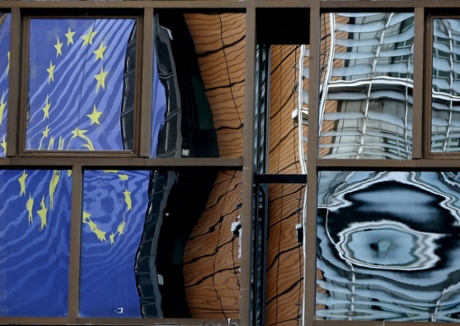
Once again, the European Commission has dampened Greece’s rosy view of the situation.
EC spokeswoman Annika Breidthardt is telling the daily Brussels press briefing that negotiators still have several “open issues” to address before a deal is reached.
Further progress is needed in the talks..... We are not there yet.
Here’s a video clip from outside the Greek finance ministry, following today’s bomb threat (thanks to Enikos)
Updated
Greek media are reporting that the Athens finance ministry was evacuated this morning because of a bomb threat.
According to To Vima, a bomb disposal unit has been dispatched to investigate the threat.
Bomb threat at the Greek MinFin. #Greece https://t.co/af3MFK6NeI
— The Greek Analyst (@GreekAnalyst) May 28, 2015
Updated
Back at the G7, a cheerful-looking Wolfgang Schäuble is looking forward to a jammy dodger.
Hard money men in Dresden. Chilling. Looking intensely relaxed about Grexit, enjoying some biscuits pic.twitter.com/hj0JDV8s9i
— Mehreen (@MehreenKhn) May 28, 2015
#Greece govt spox Sakellaridis: "Now is the time that all of us will be judged - both the institutions and the Greek govt." No kiddin'!
— The Greek Analyst (@GreekAnalyst) May 28, 2015
Greek government spokesman Gabriel Sakellaridis is insisting that Athens is close to a deal with its creditors, and denied that finance minister Yanis Varoufakis could be replaced soon.
Sakellaridis even claims that lenders are sounding pessimistic to pile more pressure on Greece to cave in on the areas where there isn’t agreement.
Reuters has the key points:
- GREEK GOVERNMENT SPOKESMAN SAYS GREEK NEGOTIATING TEAM AT BRUSSELS GROUP AIMS TO CLOSE DEAL HOPEFULLY BY SUNDAY
- GREEK GOVT SPOKESMAN SAYS DENIES ANY PLAN TO BUNDLE IMF PAYMENTS IN JUNE TO PAY IN ONE GO
- GREEK GOVT SPOKESMAN SAYS FINANCE MINISTER VAROUFAKIS HAS THE SUPPORT OF THE GOVT AND PM TSIPRAS
- GREEK GOVT SPOKESMAN SAYS STATEMENTS THAT DO NOT SHARE GREEK GOVT’S OPTIMISM ON A DEAL ARE LINKED TO PRESSURING GOVT
- GREEK GOVT SPOKESMAN SAYS WE BELIEVE WE ARE NEAR A DEAL
Greek bonds are strengthening in value, pushing down the yield on its shorter-term debt to slightly less dangerous levels.
Greek 2yr yields plunge as Greek govt spokesperson says #Greece wants deal by sunday. pic.twitter.com/G1nVirAm91
— Holger Zschaepitz (@Schuldensuehner) May 28, 2015
Greece’s claim that it could get a deal by Sunday had prompted a certain amount of cynicism among financial experts:
Greece wants a deal by Sunday. And a pony.
— Gustavo Baratta (@gusbaratta) May 28, 2015
And I would like a unicorn. https://t.co/SHHAdpvIst
— Lady FOHF (@LadyFOHF) May 28, 2015
Greece hopeful of deal by Sunday
Newsflash from Athens -- Greece is hoping to close a deal by Sunday, ‘hopefully’.
- GREEK GOVERNMENT SPOKESMAN SAYS GREEK NEGOTIATING TEAM AT BRUSSELS GROUP AIMS TO CLOSE DEAL HOPEFULLY BY SUNDAY
Updated
Vítor Constâncio went on to address the elephant in the room - what happens if Athens fails to repay €1.6bn to the International Monetary Fund in June?
He says it would not automatically drive Greek banks into insolvency (so the ECB could keep helping) but it would force a reassessment of the Greek sovereign debt they own.
Interesting: #ECB Constancio sees no direct link btw state default & bank insolvency in #Greece. Remember that's the ELA nerve in #ECB eyes.
— Maxime Sbaihi (@MxSba) May 28, 2015
#ECB's Constâncio: #Greece default to #IMF would impact bank impairments. | ← Ah, alright. Now we're talking
— Yannis Koutsomitis (@YanniKouts) May 28, 2015
If bank impairments rise, it could make it harder for Greek banks to hand over assets as collateral in return for emergency liquidity.
Updated
Despite the lack of a Greek deal, the European Central Bank is working on the assumption that Greece won’t crash out of the single currency.
That’s according to Vítor Constâncio, vice-president of the ECB, speaking in Frankfurt a few minute ago.
Constâncio also told reporters that Greek banks are still seen as solvent, which is why the ECB has been able to provide €114bn of emergency liquidity to prop them up.
ECB: Greek default risk expectations have jumped
The European Central Bank has sounded the alarm over Greece’s escalating crisis.
In its new financial stability review, just published, the ECB warns default risk expectations have “increased sharply in Greece” amid heightened political uncertainty.
Here’s the key section:
Sovereign risks emanating from Greece, in particular, have increased sharply owing to heightened political uncertainty over the past six months, while the banking sector in Greece has witnessed substantial deposit outflows, a loss of access to the wholesale funding market and deteriorating asset quality.
Financial market reactions to the developments in Greece have been muted to date, but in the absence of a quick agreement on structural implementation needs, the risk of an upward adjustment of the risk premia demanded on vulnerable euro area sovereigns could materialise.
The report is online here (pdf), and packed full of charts showing the state of the euro economy.
For example, this one shows just how badly the eurozone has lagged behind the US and the UK since the crisis blew up.
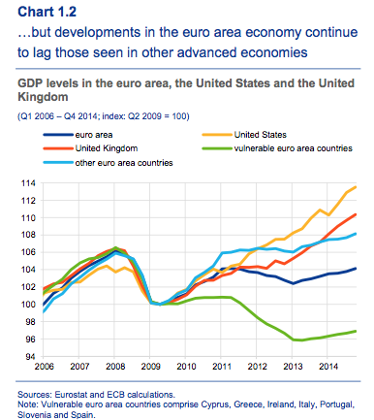
Vulnerable countries are Spain, Italy, Portugal, Greece, Cyprus and Slovenia.
Such divergent growth underlines the challenges of bundling 18 countries into a single currency union....
Updated
Economists had hoped that the ONS would raise its estimate of UK growth today, from 0.3% to 0.4%, but alas not.
On a positive note, the ONS has decided that Britain’s industrial sector grew by 0.1%, rather than shrinking by 0.1%. It also now believes that construction only contracted by 1.1%, not by 1.6%.
But these improvements were wiped out by the downward revision to the services sector (from 0.5% to 0.4%).
GDP increase confirmed (for now) at 0.3% in Q1. Stronger production and construction numbers offset by downward revision to services.
— David Smith (@dsmitheconomics) May 28, 2015
The ONS also warns that Britain’s current account deficit was a drag; net trade knocked a chunky 0.9% of GDP growth in the last quarter.
Updated
UK growth confirmed at 0.3%
The UK economy grew by 0.3% in the first three months of 2015, according to the Office for National Statistics’ second estimate.
That’s in line with the first estimate, released last month.
The ONS also confirmed that UK GDP grew by 2.8% in 2014, compared with 2013.
The ONS has revised down its estimate for UK service sector growth, but revised up its estimate of production and construction sector.
Breaking down the UK Q1 GDP figure, services output revised DOWN to 0.4% from 0.5%.
— Joshua Raymond (@Josh_CityIndex) May 28, 2015
Updated
Europe’s stock markets have dropped in early trading, as traders fret about the lack of progress over Greece.
Shares jumped yesterday, after Greek officials claimed a deal was close, but sceptical creditors have now dented the optimism:

As Mike van Dulken of Accendo Markets comments:
Greece’s debt deadline is looming large and it remaining unclear whether an agreement can be reached.
The Athens stock market is up 0.6% this morning, though, suggesting Greek investors are still upbeat.
Photos: G7 finance ministers and central bank chiefs meet
Finance ministers from the world’s advanced nations, and the world’s top central bank chief, are gathering in Dresden now to discuss the world economy.
Here’s some new photos:


And here’s British Chancellor of the Exchequer, George Osborne, speaks at a welcome reception at the Frauenkirche, or cathedral, last night.

G7 finance chiefs need to work together, tweets UK chancellor George Osborne from Dresden:
In Dresden with other #g7finance ministers. Serious challenges facing global economy: we need to tackle them together.
— George Osborne (@George_Osborne) May 28, 2015
Lagarde: Still lots of work to do with Greece

Back to the G7 meeting....and Christine Lagarde has told a German TV station that Greece and its lenders must keep working hard to get a deal.
The head of the IMF says:
“We are all in the process of working towards a solution for Greece and I would not say that we already have reached substantial results.
“Things have moved, but there is still a lot of work to do.”
That doesn’t really match the optimism we keep hearing from Athens. But Lagarde did say she has a “good feeling” that Greece will meets its commitments (including the €1.6bn it owes the Fund in June).
Updated
Chinese stocks now -6.5%. They've fallen more than that on only 7 occasions in the past 15 years.
— Jamie McGeever (@ReutersJamie) May 28, 2015
Chinese stock market tumbles 6.5%
Has the Chinese stock market bubble just started to burst?
Shares in Shanghai have tumbled today, dragging the main index down by 6.5% by the close of trading.
More than 1.2 trillion yuan of shares changed hands, which is an all-time record, according to Reuters data.
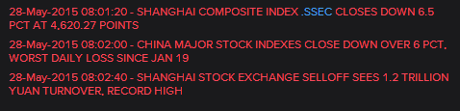
The Shanghai Composite index has soared by over 140% in the last year, a quite remarkable rally. Analysts have been warning for months that small investors have been fuelling the boom, often with borrowed money.
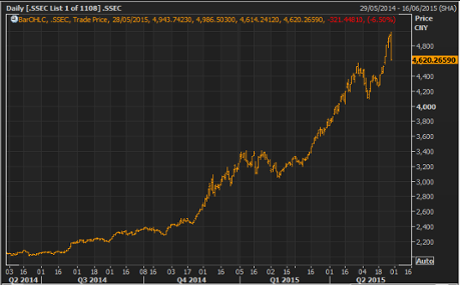
Financial news site Ransquawk says today’s selloff was triggered by rumours that the Chinese central bank was trying to drain liquidity from the market. More here.
There’s a lot of talk about Lehman Brothers at the G7 meeting of finance ministers in Dresden, says Bloomberg’s Hans Nichols.
And that because those with long memories recall how the US investment bank was allowed to fail in September 2008, triggering the near-meltdown of financial system.
America is particularly concerned that the Greek crisis could spiral out of control. As we covered yesterday, US Treasury secretary Jack Lew is warning European government that it’s wrong to assume that a Greek default would be easily contained.
Larry Summers, the top US economics professor and former US Treasury secretary, has urged eurozone leaders to compromise with Greece.
He argues that Europeans “need to recognise there are limits” to the amount of austerity that can be imposed on the Greek economy.
Ultimately, debt problems are resolved by growth, not just by austerity.
Both Greece&creditors "have to move" .Debt limits get solved by growth, not just austerity Larry Summers tells @HansNichols #G7
— Caroline Hyde (@CarolineHydeTV) May 28, 2015
Greece crisis looms over G7 finance ministers meeting

Good morning, and welcome to our rolling coverage of the world economy, the financial markets, the eurozone and business.
The world’s top finance ministers are fretting about the Greek bailout, as pressure mounts on Athens and its creditors to reach a compromise deal.
German finance chief Wolfgang Schäuble is hosting his counterparts from Britain, Canada, France, Italy, Japan and the United States in Dresden, at a two-day G7 meeting. Central bank chiefs are also there.
Officially they’re talking about the global economy and tax evasion; Greece isn’t on the agenda, but there is no escape from it. The American delegation are expected to push hard for a compromise.
Yesterday, we were treated to flurry of optimism from Greece, with prime minister Alexis Tsipras claiming that a deal was very close.
That confidence, though, is not shared by its creditors.
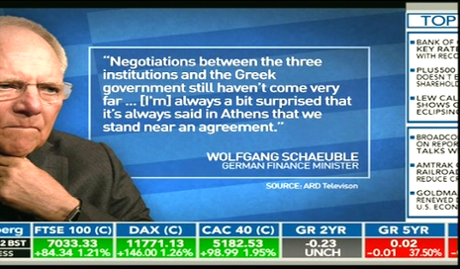
Last night, Schäuble told German TV that talks really haven’t progressed far, admitting he is “also a bit surprised” when hears the Greek government claiming a deal is imminent.
Time really is running out now. Greece must pay June’s public sector wages and pension bills in a few days, and then is expected to hand €305m to the International Monetary Fund a week tomorrow.
Eurozone deputy finance ministers will assess the situation today, on a Euro Working Group teleconference. Athens must be hoping that the EWG see signs of progress.....
Also coming up today...
We also get a second estimate of Britain’s economic growth in the first three months of this year, at 9.30am. Economists predict the growth rate could be raised from 0.3% to 0.4%.
The latest eurozone economic confidence data is released at 10am BST.
Weekly US jobless data is published at 1.30pm BST.
And European stock markets are expected to be calm, as investors in the City are digesting financial results from DIY chain Kingfisher, and food group Tate & Lyle.
#FTSE100 called flat ahead of UK GDP, EZ Sentiment and US Pending Home Sales, oh and of course another round of Greek 'deal or no deal'
— Mike van Dulken (@Accendo_Mike) May 28, 2015
Updated