While the talks continue in Brussels, Angela Merkel is winning praise at home for her work on the Ukraine ceasefire.
Days of shuttle diplomacy finally brought the Minsk meeting — and buckets of praise at home for the dogged chancellor.
“Merkel: the world chancellor” ran a headline in Bild, the tabloid.
Even Gregor Gysi, leader of the far-left Linke party and who has fought Ms Merkel for years, allowed himself to say: “If the chancellor succeeds, I will find the words to praise her.”
And no wonder Merkel looked tired (see earlier photos), after this itinery:
- Berlin-Kiev-Berlin-Moscow-Munich- Berlin-Washington-Ottawa-Berlin-Minsk-Brussels.
Updated
Here’s a “family photo” as the EU puts it, ahead of the day’s meetings:
For the first time, @europeanleft is represented at the EU Summit #EUCO pic.twitter.com/yjT1Bb8PXz
— Alexis Tsipras (@tsipras_eu) February 12, 2015
And with the discussions in Brussels continuing, perhaps going on until midnight or later, we’ll bring this to a close for the moment.
Here’s a bit more on the “technical discussions” courtesy EUObserver:
Greek PM Tsipras and Eurogroup president Dijsselbloem agreed Thursday that Greece and the troika of international lenders would start talks “at a technical level” Friday, “to assess the common ground between the current debt programme and the plans of the Greek government”, according to one EU diplomat.
More meetings apparently:
Greek officials are to meet representatives of Troika tomorrow (Friday 13) to prepare for Eurogroup meeting on Monday
— Live Squawk (@livesquawk) February 12, 2015
Dijsselbloem and Tsipras agree that technical discussions with EC, ECB, IMF to start ahead of Monday #Eurogroup @tsipras_eu @J_Dijsselbloem
— James Kanter (@jameskanter) February 12, 2015
Updated
European markets close higher
Hopes of a resolution to Greece’s financial woes - despite Wednesday’s late night failure to reach an agreement - lifted stock markets higher, writes Nick Fletcher. The prospect of a ceasefire in Ukraine helped matters, as did news that Sweden was beginning a programme of quantitative easing. The final scores showed:
- The FTSE 100 finished up 9.94 points or 0.15% higher at 6828.11
- Germany’s Dax added 1.56% to 10,919.65
- France’s Cac closed 1% better at 4726.20
- Italy’s FTSE MIB rose 2.13% to 21,002.91
- Spain’s Ibex ended up 1.9% at 10,562.2
- As previously mentioned the Athens market jumped 6.73% to 846.48
In the US, the Dow Jones Industrial Average is currently up 72 points or 0.41% despite weak retail sales and an unexpected rise in weekly jobless claims.
European Parliament President @MartinSchulz giving a press conference after speaking with #EUCO leaders pic.twitter.com/t88Vi2946n
— Dave Keating (@DaveKeating) February 12, 2015
Updated
Headline of the day - *DIJSSELBLOEM, TSIPRAS TALKED ABOUT GREECE TODAY: EU OFFICIAL
— Michael Hewson (@mhewson_CMC) February 12, 2015
It was a good day on Athens’ stock market, with investors apparently optimistic that a bailout deal will be agreed.
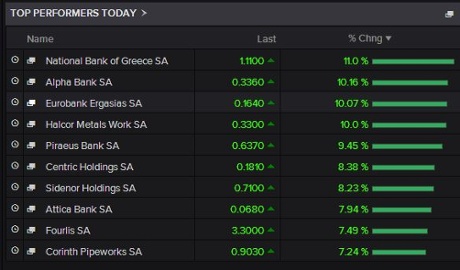
#Greece Athens stock exchange ended +6.73, banks +14.10% (NBG +18%, Alpha Bank +14.75%, Eurobank +12.75%, Piraeus Bank +9.97%)
— Efthimia Efthimiou (@EfiEfthimiou) February 12, 2015
It’s always interesting to see who chatted to whom at the start of these EU summits, especially as leaders know the cameras are on them.
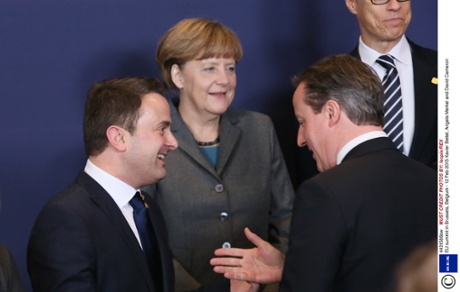
This time, Angela Merkel (looking a little tired after her gruelling Ukraine peace talks) grabbed a serious word with David Cameron...


Greece’s PM spoke with French president Francois Hollande, perhaps about last night’s eurogroup setback?

While Italy’s Matteo Renzi shared a joke with Luxembourg’s Xavier Bettel -- looks like quite a corker too.

Here’s a better photo of the moment that Alexis Tsipras met Angela Merkel:
"Guten Abend, Frau Kanzlerin. Ich heiße Alexis". Tsipras has clearly taken a crash course in fake smiles. #EUCO pic.twitter.com/cjqaoLuggd
— Vincenzo Scarpetta (@LondonerVince) February 12, 2015
We have confirmation that David Cameron pushed Alexis Tsipras over the eurozone crisis today, from his official twitter account.
PM has held his first meeting with Greek PM @atsipras. Focus was on the Eurozone and the need to find a solution. #EuCo
— UK Prime Minister (@Number10gov) February 12, 2015
Tsipras and Merkel have had a chat, though, according to this screengrab:
Hollande presenta Tsipras alla Merkel #euco pic.twitter.com/Q3Xiq6uK8f
— Paola Tamborlini (@PTamborlini) February 12, 2015
The Summit seating plan
Here’s the seating plan for the EUCO meeting. You’ll note that Alexis Tsipras and Angela Merkel are some distance apart....
#EUCO begins with a promise to end before midnight. Two new collegues: @atsipras and President Iohannis. Welcome. pic.twitter.com/1XyIJKI25G
— Alexander Stubb (@alexstubb) February 12, 2015
Updated
Summit begins
The European Council Summit is finally underway...
Informal #EUCO has now started. #Ukraine, fighting #terrorism and improving #EMU on the agenda pic.twitter.com/V85SsOolNI
— Preben Aamann (@PrebenEUspox) February 12, 2015
The Bank of England is very keen to hammer home that Britain is not entering deflation, just because the tumbling oil price is dragging the CPI rate below zero.
— Bank of England (@bankofengland) February 12, 2015
ECB "raises Greece's liquidity allowance'
The euro has surged higher in the last couple of minutes, following a report that the European Central Bank has raised the amount of liquidity available to Greek banks.
That’s according to Germany’s Frankfurter Allgemeine Zeitung newspaper (FAZ to its friends)
- ECB RAISES GREECE ELA ALLOWANCE TO €65BN: FAZ
- ECB DECIDED ON GREEK ELA ALLOWANCE IN TELEPHONE CONFERENCE: FAZ
This pushed the euro up by 0.5%, to $1.1383.
Greek banks are using the ELA to keep afloat, as they risk being locked out of the financial markets if other banks aren’t prepared to lend to them. Banks who suffer an outflow of deposits would also need more help from the ELA.
This chart suggests Greek banks are extremely reliant on the ELA:
Greek banks ECB/ELA funding based on recent press reports. pic.twitter.com/zLB8Nkdivd
— Frederik Ducrozet (@fwred) February 12, 2015
Photos: Cameron and Tsipras meet in Brussels
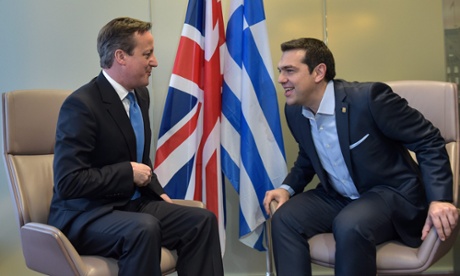
David Cameron and Alexis Tsipras’s meeting in Brussels looks to be a pretty cheerful affair, with the UK PM joking that these summits can drag on....


But as Nick Watt reported earlier, Cameron was planning to give Greece the ‘hurry up’, to get a resolution with the rest of the eurozone.
Greek roller coaster update! Stocks now up 4%, bond yield down to 18% from 20.5%. To be continued... #Greece pic.twitter.com/TlMUDgvQXX
— jeroen blokland (@jsblokland) February 12, 2015
Merkel: Important to stick to the rules
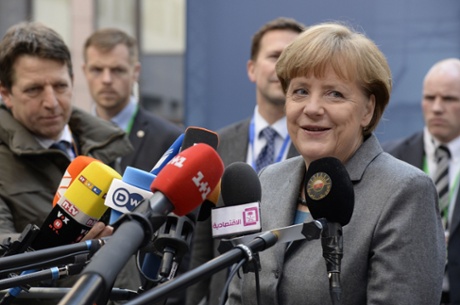
It’s one crisis meeting down, one to go, for Angela Merkel today.
Arriving at the Summit meeting from the Ukraine talks in Minsk, the German chancellor said she was looking forward to welcoming Alexis Tsipras.
She also dampened hopes of a breakthough, saying that the Greek crisis would only be discussed on the margins.
And Merkel didn’t hint at a change of policy, stating that Germany is always willing to show solidarity as long as rules are followed.
#grexit #merkel germany ready for compromise but rules are rules and partners need to be reliable. looking forward to welcome tsipras to eu
— Ian Traynor (@traynorbrussels) February 12, 2015
#Merkel: We will discuss #Greece today on sidelines of the meeting
— Nektaria Stamouli (@nstamouli) February 12, 2015
Don’t blame Greece for last night’s stalemate, argues the cartoonist at the Kathimerini newspaper:
Ilias Makris's cartoon of the day @ekathimerini pic.twitter.com/CFITw87H3R
— Kathimerini English (@ekathimerini) February 12, 2015

David Cameron has warned Greece’s new prime minister that these summits can drag on a bit (reinforced his reputation for disliking European bureaucracy).
Press Association has the details:
Mr Tsipras, who has made refusing to wear a tie a key part of his image, once again went open-necked for the high-level meeting.
The Prime Minister warned him the meetings “can go on all night and in to the next day”.
Mr Tsipras arrived in Brussels this morning after his finance minister was involved in lengthy talks which ended in stalemate with European counterparts last night.
Mr Cameron told him the summit would focus on “that subject” but also “Ukraine and terrorism, so it’s quite a full agenda”.
How much progress might be made on the Greek crisis at today’s European Council summit?
Wolf Piccoli of Teneo Intelligence reckons not much:
No official talks between Greek PM Alexis Tsipras and German Chancellor Angela Merkel have been planned, although the possibility of an informal meeting between the two should not be discarded.
Despite the setback, an agreement remains the most likely outcome on balance. However, the conclusion of an interim deal may be delayed beyond Monday, given the vast ground to cover. Therefore, a further extraordinary Eurogroup meeting is likely to be required before the current bailout expires on 28 February and as a result, talks are still expected to go down to the wire.
But if nothing is achieved, the risks of Greece stumbling out of the euro would rise, according to Germany’s Bereberg bank.
Berenberg: The risk of #Greece exit remains at 35%. If today’s EU summit ends without any sign of progress, the risk could rise further
— Efthimia Efthimiou (@EfiEfthimiou) February 12, 2015
Updated
Informal #EUCO today will start at 16h. Early dinner rather than late lunch.
— Preben Aamann (@PrebenEUspox) February 12, 2015
The start of the European Council summit has delayed until 4pm local time (3pm GMT), due to the late arrival of Merkel, Hollande and Poroshenko.
UKR pres @poroshenkoeng is in Brussels talking to @eucopresident Tusk ahead of #EUCO delayed summit, starting at 4pm pic.twitter.com/T11QPXN1kW
— M_Bos-Karczewska (@BosKarczewska) February 12, 2015

Greece’s prime minister has also arrived at the summit meeting.
Alexis Tsipras told reporters outside that he’s “very confident” that a solution can be found to “heal the wounds of austerity” and stimulate growth in Europe.
There’s also optimism on the floor of the Greek stock market today.
The main ATG index has risen by over 4%, clawing back yesterday’s losses. Bank shares have gained around 10%, continuing their roller-coaster ride since the election.
Despite last night’s deadlock, some Greek bonds have actually strengthened in value today.
The yield on Greece’s 10-year debt has dropped from 11% to 10.5% today, showing investors see it as slightly safer (yields fall when prices rise). But that’s still alarmingly high.

Cameron: Standoff is bad news for Britain
David Cameron has now arrived in Brussels for the EU summit.
He confirmed that he’s meeting Greek PM Tsipras soon (as Nick Watt flagged up earlier), and warned that Britain’s economy could suffer if the deadlock drags on.
Cameron: I'm looking forward to my first meeting with Tspiras, British economy affected by the stand-off between Greece & Eurozone #EUCO
— Open Europe (@OpenEurope) February 12, 2015
Cameron: longer stand off goes on the worse it could be for Britain #EUCO
— Open Europe (@OpenEurope) February 12, 2015
#Eurogroup president @J_Dijsselbloem will update #EUCO on talks on financial assistance to #Greece.
— Donald Tusk (@eucopresident) February 12, 2015
European leaders at the Summit will discuss last night’s (rather unsuccessful) eurogroup meeting on Greece, says Council president Donald Tusk:
Tusk: I will ask chairman of #Eurogroup to inform us about results, also interested in what #Tsipras has to say about this #EUCO
— Open Europe (@OpenEurope) February 12, 2015
More European leaders have arrived in Brussels:


French president Francois Holland has just arrived in Brussels from Minsk, where a Ukranian ceasefire was hammered out during overnight talks.
Hollande komt aan op Europese top, na nachtje onderhandelen in Minsk #euco pic.twitter.com/oTPVeksM0b
— rob heirbaut (@heirbar) February 12, 2015
Hollande on Ukraine: Next few hours will be decisive. Everything can still go one way or another. #EUCO
— Open Europe (@OpenEurope) February 12, 2015
UK pushing for swift resolution to Greek crisis
Alexis Tsipras is also sitting down with UK prime minister David Cameron for talks today, before the EU Summit begins.
Cameron is expected to urge Tsipras to reach a deal with its international creditors over its bailout programme,
My colleague Nick Watt reports:
A British official said: “This is a useful opportunity to hear Tsipras’s plans. The prime minister’s point to him will be: ‘We want to see a swift resolution of this standoff between you and the eurozone partners. And you all need to come together and come up with a plan.’”
adding:
“We are not seeking to take sides beyond the point of: ‘You need to get on and sort this out. You have done your 10 days of going round and having talks. You were at the eurogroup [meeting of eurozone finance ministers] and there is another one next week.
When are we going to see some resolution and some agreement on a way forward?’”
Here’s Nick’s full story: David Cameron to hold first meeting with Greece’s Alexis Tsipras
PM David Cameron @Number10gov in Brussels today for informal #EUCO to discuss #Ukraine, terrorism, and economy. pic.twitter.com/UxumeN8cB5
— UKREP (@ukineu) February 12, 2015
This Reuters newsflash suggests the political upheaval in Greece has hit government revenues:
-
GREEK JANUARY BUDGET SHOWS ABOUT €1bn REVENUE SHORTFALL BECAUSE OF DELAYS IN TAX PAYMENTS - DEPUTY FINANCE MINISTER TO REUTERS
Updated
The tale of the eurogroup statement that never was has taken another twist.
Channel 4’s Paul Mason has heard that Greece had agreed a version, before Germany refused to agree to amending the bailout programme, causing the deadlock.
Greek source: doc they agreed to said "amending and extending and successfully concluding" program. Schauble nixed "amending". (1/2) so...
— Paul Mason (@paulmasonnews) February 12, 2015
(2/2) after 2 hours they cd not agree, and the unagreed draft, without "amending", got leaked to press. This from authoritative Greek source
— Paul Mason (@paulmasonnews) February 12, 2015
Reminder, that leaked copy was published overnight by the FT.
Updated

After speaking with Tsipras, Belgium prime minister, Charles Michel, told reporters he’s optimistic the eurozone’s 19 members could find a solution to the Greek crisis, even if this required a special effort.
“The solution is delicate and difficult. We need determination and will.
“The magic of Europe has always been to find solutions even when we thought it impossible. I am convinced that this magic will end up working.”
(quotes via AFP - correction, sorry for the confusion)
Updated
Prime Minister, Charles Michel, welcomes Alexis #Tsipras and Yanis #Varoufakis #Belgium #Greece pic.twitter.com/YI2AWwzLsH
— ☠ GcRap ☠ (@RaptisCG) February 12, 2015
Greek PM: "critical turning point for Europe"
Back in Brussels , Greek prime minister Alexis Tsipras has declared that “we are at a critical turning point for Europe”.
Speaking after a meeting with Belgian counterpart, Charles Michel, Tsipras said:
“We have to prove that Europe can find a solution, respect the positions that the parties take, and combine respect for democracy with European rules.”
Finance minister Yanis Varoufakis was also there (second photo):


The Bank of England has raised its forecast for household consumption, but cut its forecast for exports and business investment. So, how worried are you about the balance of the recovery?
It’s not yet impacting monetary policy, Mark Carney replies, but it’s something we talk about.
Are you worried about the impact of uncertainty around the UK general election on the economy?
We are picking up signs of economic uncertainty, but we’ve not seen it translated into companies’ investment plans, says the governor.
Chris Giles of the FT asks whether today’s forecasts may have leaked, given recent moves in the financial markets.
Carney looks genuinely surprised, and reckons there’s no reason to believe this has happened.
Interesting: @ChrisGiles_ from FT asks whether market moves suggest there's been a leak of the Inflation Report. Carney, taken aback sez"no"
— Richard Edgar (@ITVRichard) February 12, 2015
Updated
My colleague Larry Elliott points out that history shows that the BoE’s forecasts are rarely completely accurate (diplomatically put, Larry!).
So does the governor reckon we’re more likely to overshoot, or undershoot, its inflation and wage forecasts?
Carney reiterates that we are starting to see real wage growth turn upwards; but otherwise doesn’t stick his neck out.
Updated
Has Mark Carney had much feedback to his recent attack on eurozone austerity and call for more constructive fiscal policy?
The governor replies that yes, he’s had discussions with policymakers before and after the speech.
These issues are well-appreciated, he says. There is much more general recognition than you might expect.
And he also points out that almost all currency unions allow fiscal transfers within them. In the UK, for example, it means the impact of the low oil price on Scotland is only one tenth as great as it would be if it were independent.
So if inflation is so weak, should Britons be preparing for interest rates to be raised, or cut?
Mark Carney: The most likely next move is an increase in interest rates.
Mark Carney: Greece is less of a threat than last time
The first question at the Bank of England’s press conference is on Greece -- what effect would a Greek “dirty exit” from its bailout programme have on the UK?
Mark Carney says that an escalation of the Greek crisis would have an impact on the British economy, but not as much as in 2012 (when Grexit fears were at their height).
He cites three reasons
1) the changes in the institutional set-up in the eurozone, such as the European Central Bank’s promise to buy unlimited government bonds of a country if it hit problems (the OMT programme).
2) Eurozone bond yields are much lower than three years ago (so countries are not at risk of being locked out of the markets).
3) The scale of private sector exposure to Greece, in both the euro area and the UK, is lower.
The Bank of England has “direct line of sight into the exposure of Britain’s largest banks, he explains. “The level of that exposure in the UK banking sector [to Greece] is less than 2% of common equity”, he concludes.
Updated
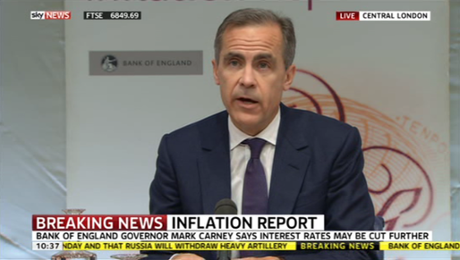
From the Bank of England, my colleague Angela Monaghan writes:
Mark Carney has warned interest rates may rise earlier than the City expects, despite Bank of England expectations that inflation will turn negative for the first time in more than half a century.
The slump in oil prices and falling food prices is likely to push inflation to zero in the second and third quarters, probably dipping into negative territory for one or two months, the Bank said in its February inflation report.
However Mark Carney, the Bank’s governor, said negative inflation in the UK would not lead to the dangerous deflationary spiral feared in the eurozone.
UK inflation was 0.5% in December, well below the Bank’s 2% target.
Updated forecasts in the Bank’s latest inflation report suggested lower oil prices - which have more than halved since last summer - will significantly boost consumer spending, in turn boosting growth and pushing up inflation higher over the medium term.
In a letter to the Chancellor, George Osborne, published alongside the inflation report and explaining why inflation was more than one point below the 2% target in December, Carney said:
“Inflation pressures could be greater if lower oil prices were to provide greater stimulus to global and domestic growth or if slack in the economy were to be absorbed more quickly than in the central projection.
“If these risks materialise, it would be appropriate to for Bank Rate to increase more quickly than embodied in current market yields but the likelihood is that those increases would still be more gradual and limited than in previous tightening cycles.”
The Bank of England sounds determined to look through the impact of falling oil prices - which, as Carney says, is a net positive for the UK economy.
Mark Carney says that UK take-home pay is going to grow at its fastest pace in a decade, thanks to lower inflation.
Bank of England: UK inflation will turn negative soon
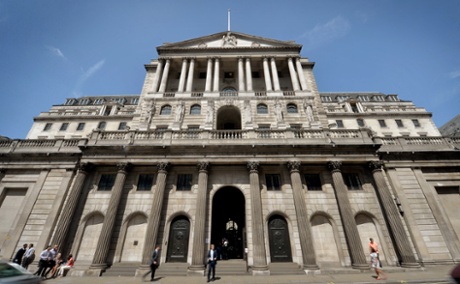
Breaking: The Bank of England has just predicted that Britain’s inflation rate will turn negative in the spring, and remain low through 2015.
The BoE also suggests that it could cut interest rates, if inflation falls faster than expected.
But the Bank insists that Britain is not entering deflation (a protracted period of falling prices). And Mark Carney, the governor, is arguing that the underlying economic picture is positive.
The Bank, indeed, has raised its forecasts for GDP growth compared to November’s estimates.
Heads-up: the Bank of England is about to publish its quarterly inflation report. I’ll cover the main points, and also mop up any comments about the eurocrisis.
The Greek PM has been sighted in Belgium:
Greek PM Tsipras arrives Brussels for summit. Speaks of ending corruption and tax evasion. Interesting to see what reception he gets.
— Gavin Hewitt (@BBCGavinHewitt) February 12, 2015
And earlier today, Greek government spokesman Gavriil Sakellaridis told Greek media that Athens refused to sign the eurogroup statement because it referred to an extension to complete the current bailout program. More here.
#Greece govt spox Sakellaridis confirms it was PM Tsipras' decision to block draft Eurogroup statmnt http://t.co/PQFWV7DVcx ~@kathimerini_gr
— Yannis Koutsomitis (@YanniKouts) February 12, 2015
Updated
Just to add to the fun, Greece’s government now denies ever receiving the precise text leaked to the FT (there were various versions being drafted and redrafted last night)
We've updated our post on last night's #eurogroup to reflect #Greece denial. Plus, more shenanigans! http://t.co/YxlJwvLELu
— Peter Spiegel (@SpiegelPeter) February 12, 2015
In case you missed it last night, the head of Spain’s Podemos party has warned that the Greek bailout crisis is putting the European project at risk.
"Do not reject the Greek olive branch."The leader of Podemos writes for the Guardian http://t.co/jYmN2cAV62
— Jonathan Freedland (@Freedland) February 12, 2015
Greek insiders: We will stand our ground
In Athens, Greek government insiders are hinting strongly that prime minister Alexis Tsipras put the kibosh on the eurogroup statement last night, telling our correspondent Helena Smith that “We can’t go back on the memorandum.”
But there was also hope – and satisfaction - that mention of a bridging facility was also made in the joint statement that was eventually scuppered.
One official says:
“Little Greece has managed to change the discussion in Europe,”
“We are going to stand our ground.”
The first reaction from Athens’ new left-wing government came within minutes of the stalemate in Brussels becoming apparent. The minister of state Nikos Pappas tweeted: “I laugh at those who are dreaming of U-turns. A little patience.”
Pappas, who was educated at the university of Glasgow, is among Tsipras’ closest friends and foremost advisers.
Greeks officials contacted by the Guardian on Thursday also confirmed mounting speculation that another emergency meeting would very probably be held to discuss the Greek crisis after euro zone finance ministers meet again next Monday.
“It is highly likely that there will be another meeting,” one confided. “In fact there may very well be many. It would be far too dangerous to leave this just hanging in the air without resolution, don’t you think?”
The delays to the start of the EU Summit gives Greek PM Alexis Tsipras more time to meet other world leaders (although not Merkel or Hollande, of course).
He’s due to see Belgian premier Charles Michel, Latvia’s PM Laimdota Straujuma and the British premier David Cameron on the sidelines of the summit meeting.
Puting announced Ukraine ceasefire to begin Sunday http://t.co/DI0yTu4nHp
— Stuart Millar (@stuartmillar159) February 12, 2015
Finland’s prime minister remains confident that Greece and its creditors will reach a deal in time:
The Press Association has the story:
Finnish prime minister Alexander Stubb warned that failure to reach an agreement would result in “financial mayhem”, but insisted he was confident a deal could be struck.
He told BBC Radio 4’s Today programme.
“I understand the suffering, I understand the pain, but equally we have shown a lot of solidarity throughout this process and now we expect Greece to keep its bargain regardless of the election result,”
Asked whether Mr Tsipras was really going to break his promise to the Greek electorate, Mr Stubb said it was “up to him”. “At the end of the day there has been a commitment,” he said, adding:
“I was given and we were given a promise, that for the loan of one billion euros certain conditions shall be met. It is like any kind of international agreement or contract.
“I would not be so sure that we are not going to find a solution on this. The euro group of financial ministers are meeting and I think we are all expecting Greece to give a proposal by Monday next week. We will see what they come up with.
“I am sure a solution will be found at the end of the day.”
Mr Stubb said:
“There are basically two options here. Number one is that Greece continues the programme and we give an extension to that programme. The other option, which I don’t like personally, would be a so-called ‘dirty exit’, where Greece would be on its own trying to claw its way back to the markets.
“I think Greek banks would have great troubles, I think a lot of the deposits would flee the country and it would cause general financial mayhem, especially in Greece, with a slight ripple effect.
@EfiEfthimiou Stubb is always optimistic
— Lorcan Roche Kelly (@LorcanRK) February 12, 2015
The euro is flat this morning, at $1.1334 against the US dollar.
David Papier, market analyst at ETX Capital, says:
Markets are erring on the side of caution over the ongoing Greek debt negotiations amid conflicting headlines on progress in the talks.
Even world leaders can’t be in two places at once. And with Angela Merkel and Francois Hollande stuck at the Ukraine peace talks, the European Council summit will probably be delayed:
Start of informal #EUCO today likely to be delayed due to Minsk talks
— Preben Aamann (@PrebenEUspox) February 12, 2015
Leaders are due to discuss the EU security agenda, Greece and Ukraine.
Make that 4%:
#Greece Athens market up 4.0%, banks +10.4%
— Yannis Koutsomitis (@YanniKouts) February 12, 2015
The Athens stock market is calm in early trading, despite last night’s deadlock.
The main stock index has risen by 2.5%, with bank shares leading the way:
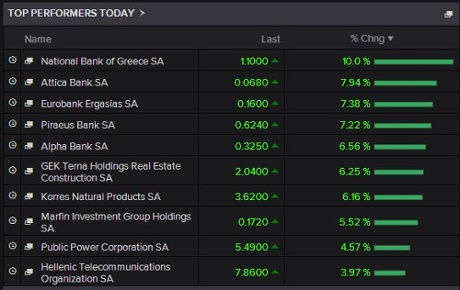
Greek bond yields remain at alarmingly high levels this morning, but at least they haven’t deteriorated much further:
Greek Bond yields open mixed amid debt standoff. 2yr Yield 15bps higher at 21.4%, 5yr Yield at 16.7%, 10yr at 10.4%. pic.twitter.com/ayW0xVapQm
— Holger Zschaepitz (@Schuldensuehner) February 12, 2015
Updated
Sweden’s central bank just surprised the markets by cutting interest rates into negative territory, from 0% to -0.1%.
The Riksbank also announced it will buy 10bn krona of government bonds, to further ease monetary policy.
Swedish QE!
— World First (@World_First) February 12, 2015
IMF provisionally agrees new funding for Ukraine
Back in Brussels, Christine Lagarde has just announced a new bailout facility for Ukraine, and a four-year reform programme.
Lagarde is telling reporters that the International Monetary Fund has provisionally agreed a $17.5bn extended fund facility, three weeks after president Petro Poroshenko made the request at Davos.
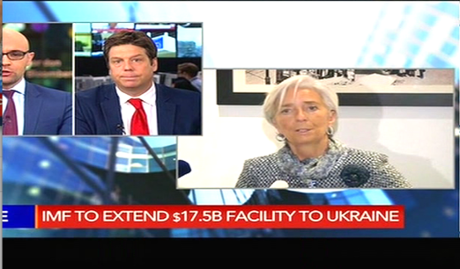
It’s part of a $40bn package, Lagarde says, with more funds coming from other institutions and countries.
In return, Ukraine has agreed to various reforms, including bank restructuring and shaking up the energy industry. Poroshenko’s government is showing an unprecedented determination to reform, she adds.
The news comes as peace talks continue in Minsk. The signs aren’t good.
Ukraine has played down speculation about a possible ceasefire agreement over the conflict in the east of the country on Thursday, accusing Russia of imposing “unacceptable” conditions as marathon talks continued in Minsk.
More here: Ukraine crisis: Poroshenko declares Russia conditions ‘unacceptable’
The European summit in Brussels is due to start in three hours but the leaders of France and Germany are still in Minsk.
— Gavin Hewitt (@BBCGavinHewitt) February 12, 2015
Updated
Greek journalist Katerina Paraschou of euro2day confirms that Alexis Tsipras’s government blocked last night’s eurogroup draft statement because it referred to an “extension”.
Lost in translation... Varoufakis and Dragasakis signed the draft and the Government vetoed. It mentioned the hated word "extension"
— Katerina Paraschou (@KParaschou) February 12, 2015
After last night's uproarious Eurogroup, it's obious that Tsipras needs to deal with all the components of his party..
— Katerina Paraschou (@KParaschou) February 12, 2015
Other media commentators are also alarmed by the lack of progress:
Last week President Holllande urged Tsipras to meet Merkel asap. Yet Tsipras won't even have formal meeting at Brussels summit. #gametheory
— Simon Nixon (@Simon_Nixon) February 12, 2015
Irreconcilable breakdown? Greece and eurogroup need a mediator and shrink http://t.co/Kxjwi8mNKG
— Robert Peston (@Peston) February 12, 2015
Last night’s talks failed because neither side would give ground, says Gary Jenkins of LNG Capital.
That’s why the prepared statement was seemingly torpedoed by Athens:
‘Extending and successfully concluding the present programme...’ Is not the deal that Mr Tsipras has been telling the people of Greece he would achieve.
But a deal is still doable, Jenkins reckons:
The real agreement would appear to be that the EU will reduce the level of the primary surplus required and allow Greece to spend the money saved as they wish.
There might well be some kind of side agreement that if the Greek government does exactly what it says it will do regarding tax collection etc. and sticks to the terms of the deal then maybe the EU will revisit the idea of linking all or some of the debt to growth.
Finland’s prime minister, Alex Stubb, is maintaining a hard line on Greece, according to quotes hitting the news wires.
Stubb has warned that Greece faces a “dirty exit’ unless it continues its bailout programme, which expires in under three weeks:
*STUBB: GREEK `DIRTY EXIT' WOULD CAUSE MAYHEM, RIPPLE EFFECTS
— Dealingroom (@Dealingroom1) February 12, 2015
He has elections in April RT @lemasabachthani: *FINNISH PM: GREECE CONTINUES PROGRAM OR FACES `DIRTY EXIT'
— Yiannis Mouzakis (@YiannisMouzakis) February 12, 2015
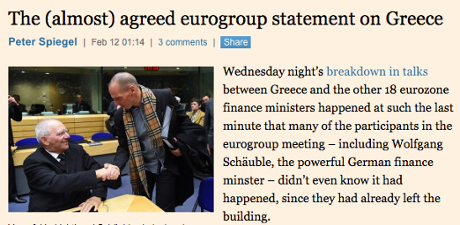
Financial Times: The eurogroup statement that wasn't

Now this is fascinating. The eurogroup ministers did apparently agree a statement last night... only for the Athens government to reject it at the last minute.
Most finance ministers left the room believing a deal was done, only for Greece’s Yanis Varoufakis to phone home with the details -- and be vetoed -- according to the Financial Times’ Peter Spiegel.
The (almost) agreed eurogroup statement on Greece
He’s also got hold of the statement <applause>, and here it is:
Today the Eurogroup took stock of the current situation in Greece and the state of the current adjustment programme. In this context, the Eurogroup has engaged in an intensive dialogue with the new Greek authorities.
The Greek authorities have expressed their commitment to a broader and stronger reform process aimed at durably improving growth prospects. At the same time, the Greek authorities reiterated their unequivocal commitment to the financial obligations to all their creditors.
On this basis, we will now start technical work on the further assessment of Greece’s reform plans. The Greek authorities have agreed to work closely and constructively with the institutions to explore the possibilities for extending and successfully concluding the present programme taking into account the new government’s plans.
If this is successful this will bridge the time for the Greek authorities and the Eurogroup to work on possible new contractual arrangements. We will continue our discussions at our next meeting on Monday 16 February.
So, nothing too inflammatory.
Perhaps the reference to “extending” the programme was too unpalatable to Greece, even though the word “bridge” did hint at Varoufakis’s goal of a new bridging programme.
Anyway, Peter earned a sharp rebuke from Varoufakis for his leak:
@SpiegelPeter @ftbrussels Might I suggest that you refrain from dubious claims based on even more dubious leaks? It's rather unseemly
— Yanis Varoufakis (@yanisvaroufakis) February 12, 2015
That’s not exactly a denial....
Updated
Nervous investors have driven the price of Germany’s two-year bonds to a record high.
That means they are paying even more for the privilege of holding German debt; the yields (or interest rates) on its two, three and five-year bonds are already negative, and have hit new record lows this morning.
#German two-year yield drops to record-low (to -0.225%) after Greek Talks, CPI pic.twitter.com/Xuck70KVEz
— Francine Lacqua (@flacqua) February 12, 2015
Updated
Last night’s debacle is a reminder that Greece could be forced to implement capital controls if a deal isn’t reached, warns Robin Bew of the Economist Intelligence Unit:
#EU and #Greece can’t even agree talks about talks. Real risk of bank runs forcing capital controls. We rate exit chances at 40%
— Robin Bew (@RobinBew) February 12, 2015
Disappointment after Greek talks break up
Good morning, and welcome to our rolling coverage of the Greek bailout crisis, and other key events across the world economy, the financial markets, the eurozone and business.
The Greek crisis has taken a disappointing turn overnight, after yesterday’s eurogroup meeting in Brussels failed to agree a blueprint for future talks.
As we covered overnight in yesterday’s blog, the meeting dragged on late, only for eurogroup chief Jeroen Dijssesbloem to admit that the two sides hadn’t reached common ground after seven hours of negotiating.
This failure means that eurozone officials will not, as had been hoped, now start working on a plan ready for next Monday’s eurogroup meeting.
It raises the dangers that Greece and its creditors won’t reach a deal before the end of February, when the current financial programme expires.
As Dijssesbloem told a brief press conference:
Will people be starting work in Athens or elsewhere? Not between now and Monday, because we need to have common ground on the process forward.”
Greece’s Yanis Varoufakis was slightly more optimistic, telling reporters:
I was given a wonderful opportunity and a very warm welcome to present our views, our analysis, our proposals both regarding the substance and regarding the road map.”

The eurogroup’s failure escalates the crisis, as European leaders gather in Brussels for an EU Summit -- Greek prime minister Alexis Tsipras’s first.
He’ll be meeting several leaders before the summit starts this afternoon, including Britain’s David Cameron. However, he’s not expected to hold formal talks with Angela Merkel.
#Greece spokesperson: No Scheduled Meeting Between Greek PM Tsipras & German Chancellor Merkel Scheduled Today, Informal Meet Possible ~RTRS
— Yannis Koutsomitis (@YanniKouts) February 12, 2015
The Greece crisis may also feature at the Bank of England this morning, at the quarterly inflation report - from 10.30am GMT.
Today's economic news: Bank of England publishes Inflation Report - its outlook for UK economy - at 10.30am
— Richard Fletcher (@fletcherr) February 12, 2015
We’ll be tracking all the main events, and reaction to last night’s meeting.
Updated