It’s all kicking off, even before finance ministers arrive in Brussels.
Greece’s government has hit back at Wolfgang Schäuble’s claim that Greece’s government is behaving irresponsibly, arguing that Berlin is just as culpable for the current deadlock.
#Greece govt spox Sakellaridis re Schaeuble's comments: Well, I could say #Germany's behaviour is irresponsible too
— Efthimia Efthimiou (@EfiEfthimiou) February 16, 2015
The scene is set for another tough eurogroup session.
#Eurogroup mood music: "I'm sorry for Greeks. They elected a govt which is behaving rather irresponsibly." -Schäuble http://t.co/fFBS8nmX36
— Peter Spiegel (@SpiegelPeter) February 16, 2015
Just in. The eurozone’s trade surplus has widened again.
The single currency region exported €24.3bn more goods than it imported in December, up from a €13.6bn surplus in December 2013.
While exports rose by 2% during the year, imports were flat; reflecting a trend since the start of the debt crisis:
Euro area international trade in goods surplus €195bn in 2014, €24bn surplus for EU #Eurostat http://t.co/KAcSeplYDl pic.twitter.com/GtNfPZKXCb
— EU_Eurostat (@EU_Eurostat) February 16, 2015
London newspaper CityAM has published a handy breakdown of the new deal which Greece is seeking; and the likelihood of each part being agreed:
Nice @CityAM graphic highlighting @OpenEurope assessment of #Greece position at #Eurogroup http://t.co/5d4E0oFVGH pic.twitter.com/6fZM8XW4Wh
— Open Europe (@OpenEurope) February 16, 2015
The uncertainty over Greece hasn’t hurt the euro today, which is up around 0.2% against the US dollar at $1.1408.
But the single currency could weaken if there’s no progress in Brussels. Susanne Galler, a strategist with Jefferies in London, told Reuters:
“The market consensus is for them to do a deal by the end of this week. But we think that if there’s no deal today and the clock starts ticking then the euro will look increasingly vulnerable.”
German finance minister Wolfgang Schäuble also accused the new Greek government of behaving ‘irresponsibly’ during this morning’s radio interview, reports Agence France-Presse.
AFP reports:
Schäuble, who was recently caricatured in the Greek press as wearing a Nazi-era army uniform, hit out at the insults Greece has dealt to its eurozone partners.
“I feel sorry for the Greeks at the moment. They’ve elected a government which is currently acting irresponsibly,” Schäuble said.
Updated
Marc Ostwald of ADM Investor Services is also downbeat about how much progress we’ll see today:
“It appears unlikely that there will be even a short-term ‘bridge’ agreement between Greece and the Euro group at today’s meeting, but it is to be hoped that some further common ground can be found.”
I’m en route to Brussels for what was billed as the crunch eurogroup meeting on Greece. It looks increasingly like ending in discord (again)
— Ed Conway (@EdConwaySky) February 16, 2015
Greek bonds weaken amid pessimism
Another worrying sign: Investors are selling out of Greek bonds this morning.
The yields (or interest rate) on Greek debt has risen, indicating that it’s seen as riskier.
- GREEK THREE-YEAR BOND YIELDS RISE 140 BPS TO 17.15% AHEAD OF EUROGROUP MEETING - TRADEWEB
- GREEK 10-YEAR YIELDS UP 23 BPS AT 9.74%, FIVE-YEAR YIELDS UP 72 BPS AT 13.98%
Athens stock market slides
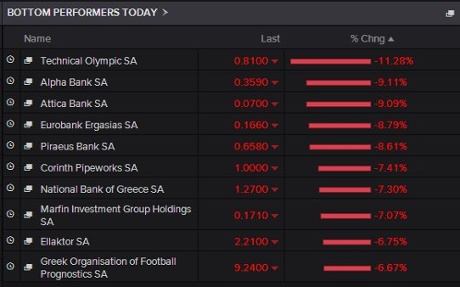
Fears that this afternoon’s eurogroup meeting won’t break the deadlock between Greece and its creditors have hit shares in Athens.
The main ATG stock market fell over 4% in early trading, with the banking sector falling over 8%.
#Greece Athens stock excange -4.33%, banks -8.58% after minutes in session
— Efthimia Efthimiou (@EfiEfthimiou) February 16, 2015
The FT’s Peter Spiegel also fears today’s meeting won’t deliver a break-through deal.
All signals seem to suggest no #Greece deal tonight at #Eurogroup. So next question is: how hard a deadline is today, really?
— Peter Spiegel (@SpiegelPeter) February 16, 2015
And that’s really a question for Mario Draghi, I guess. What would it take for the European Central Bank to withdraw emergency liquidity from Greece’s banking sector?
“It’s a day ending in ‘y’ so it must be another crucial day for the Greek debt crisis,” says a weary-sounding Jeremy Cook of World First.
He explains why it’s important that some progress is made today:
Alexis Tsipras and Yanis Varoufakis have until the end of the month to negotiate an extension of credit terms for Greece. The current bailout package expires on February 28th. A deal today would give other European parliaments just less than a fortnight to vote on the extension and form some kind of consensus and agreement around the rehabilitation of the Greek state.
Late on Thursday the European Central Bank extended the amount of money it was willing to provide to Greek banks in a bid to shore up liquidity within the country. Reports over the weekend suggest that the pace of withdrawal from Greek banks has increased in the past week to around EUR200m a day.
As we have said previously we are still optimistic that a ‘fudge’ deal will occur by the end of the month but, as we all know, European politicians need to be horizontal over the precipice for deals to be actually made. I’m cancelling any plans I had for Feb 27th just in case a 13th hour meeting is called to avert a disaster.
You and me both, Jeremy...
Europe’s stock markets are dipping in early trading, as traders react to the generally negative comments from finance ministers this morning.
The FTSE 100 is down 15 points, or -0.23%, at 6857, while Germany’s DAX has dropped by 29 points, or 0.3%.
Mike van Dulken, Head of Research at Accendo Markets, writes:
Investors are waiting for proof of real progress on both the Greek debt negotiations (extended talks expected, still significant gaps between both sides) and the ceasefire in Ukraine (tentative at best).
Photos: Sunday's pro-government demos
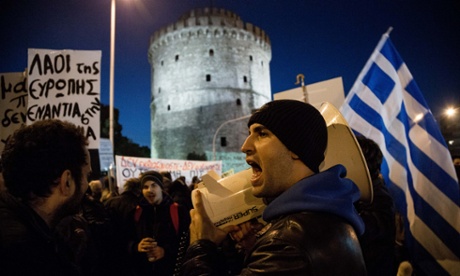
Thousands of Greek citizens took to the streets last night to show their support for Greece’s negotiators in Brussels today:


There were also demonstrations in support of Greece in other European capitals, including Paris and London:


#Greece today Trafalgar Square was yours; Our solidarity with you #Syriza pic.twitter.com/KFXUJ44rwm
— Rodhy Psychology (@Rodhypsychology) February 15, 2015
Updated
The finance ministers of Austria and Malta have also been speaking this morning, and neither sound keen to grant Greece much help:
Austrian MinFin on German tv: if you need a loan, don't go to your bank, insult the director and then try to re-negotiate conditions
— Carsten Brzeski (@carstenbrzeski) February 16, 2015
*MALTA FIN MIN SAYS GREECE ASKING FOR `IMPOSSIBLE FAVORS'
— Dick Darlington (@Darlington_Dick) February 16, 2015
French finance minister warns of 'huge dangers' of Grexit
France’s finance minister, Michel Sapin, has also hit the airwaves this morning to argue that Greece must respect European rules.
Speaking on France 2 television a few minutes ago, Sapin warned that Greece would face “huge dangers” if it left the eurozone.
Athens cannot simply abandon its commitments, he added; before acknowledging that Alexis Tsipras’s new government does have a mandate to push for changes:
“The Germans are right from a certain point of view. Greece, not the government of today, the country, signed a number of agreements. They must respect those agreements independently of the change of government.
But the Greeks say, and they are right, I support them, ‘we have just changed government, so we are not going to do everything as before.”
(quotes via Reuters)
More optimistically, Sapin also suggested there’s a chance of a breakthrough at today’s talks.
#Greece | *FRANCE'S SAPIN SAYS THERE'S A `CHANCE' OF ACCORD ON GREECE TODAY ...Schauble not on same page clearly
— Ioan Smith (@moved_average) February 16, 2015
Schäuble 'very sceptical' of a deal today

Germany’s finance minister, Wolfgang Schäuble, is not optimistic that Greece and its creditors will reach a deal today.
Schäuble told German radio that:
“From what I’ve heard about the technical talks over the weekend, I’m very sceptical, but we will get a report today and then we’ll see.”
Schäuble added that Germany does not want a Greek exit from the euro zone, but reiterated that the new government in Athens must meet the core of its existing commitments.
Not an encouraging sign for today’s talks, as ABN Amro’s Nick Kounis says:
Neither side optimistic on #Eurogroup. Schaeuble: very pessimistic on quick result. #Greece: it will be difficult, decision not certain.
— Nick Kounis (@nickkounis) February 16, 2015
Updated
Eurogroup to discuss Greece debts again
Good morning.
It’s another crunch day in the battle between Greece and its creditors over its bailout programme.
Eurozone finance ministers are heading back to Brussels today for another eurogroup meeting. Top of the agenda, Greece’s bailout programme.
Monday’s #Eurogroup agenda includes #Greece, #Cyprus, #Portugal: http://t.co/0SaoqOBFEb.
— EU Council Press (@EUCouncilPress) February 13, 2015
Prime minister Alexis Tsipras struck a confident tone yesterday, saying:
“I expect difficult negotiations on Monday. But I am full of confidence.
“I am in favour of a solution where everyone wins. I want a win-win solution. I want to save Greece from tragedy and Europe from a split.”
“I promise you: Greece will, in six months’ time, be a completely different country.”
Full story: Syriza leader confident ahead of eurozone crunch talks in Brussels
Technical officials from both sides have been working over the weekend, in an attempt to bridge the gap between the two sides. That will give ministers something to work with today.
But it will be hard to make progress. Athens insists it will not stick to its existing bailout, while eurozone governments insist its debts cannot be written it off.
It’s possible that some kind of compromise will be hammered out; solving Greece’s immediate funding needs once its existing financing ends in just two weeks.
Most likely outcome Monday: A typical Euro fudge formula that the creditors will call 'extension' &the Greek govt will call 'transformation'
— Yannis Koutsomitis (@YanniKouts) February 15, 2015
But a repeat of the deadlock at last Wednesday night’s emergency eurogroup meeting can’t be ruled out.
And that’s why one former UK finance minister, Kenneth Clarke, reckons the “latterday Trotskyites” of Syriza will trigger Grexit.
Full Story: Kenneth Clarke says Syriza victory risks Greek exit from eurozone
The meeting is scheduled to start at 3pm Brussels time (2pm GMT or 4pm EET). So if all sides embrace the concept of European friendship and partnership, it could be wrapped up by tea time. A late-night marathon feels more likely, though....
We’ll be tracking all the build-up to the meeting, and the action once it kicks off, along with other key developments in the world economy, the financial markets and business.
Updated