Closing summary
OK, that’s all for tonight. A very quick recap of this afternoon’s developments.
The US government has increased the pressure on Athens tonight, by warning finance minister Yanis Varoufakis that he needs to reach a ‘constructive deal’ soon.
The ECB has thrown Greek banks a lifeline, by increasing the amount of emergency liquidity available to them by around €3.3bn
Athens is expected to submit his proposal for a loan extension tomorrow. Varoufakis remains confidence; predicting that an agreement could be reached on Friday, on a teleconference with other finance ministers.
But Germany’s Wolfgang Schauble has warned there is little “wriggle room”, and there’ not been many supportive noises from other eurozone members today.
And the Open Europe thinktank has warned there are big divisions between the two sides, on crucial issues such as economic reform and the sale of state assets.
Has anyone other than Varoufakis - who has to sound upbeat to avoid causing panic - said anything positive today about latest Greek offer?
— Simon Nixon (@Simon_Nixon) February 18, 2015
Rating agency Fitch also weighed in, warning that the risks of the talks completely collapsing has risen.
The Greece government has one success, though; MPs have elected a new president.
Not that Prokopis Pavlopoulos lacks baggage.....
SYRIZA managed to elect as president somebody who embodies much of what his wrong w/ #Greece's politics. Truly auspicious for the future
— wolf piccoli (@wolfpiccoli) February 18, 2015
And the European financial markets remained calm; most rose today, on hopes of a deal.
If you missed this morning’s action, check out the lunchtime summary.
Otherwise, cheers, and goodnight all. GW
Reuters’ Athens bureau is now reporting that the ECB’s liquidity increase might give Greek banks a week’s grace, assuming savers don’t withdraw funds at a faster rate:
- GREECE HAD ASKED THE ECB TO RAISE THE ELA CAP BY €5BN - SOURCES
- THE ACTUAL €3.3BN EUR INCREASE IN THE ELA CAP IS ENOUGH TO MEET GREEK BANKS’ LIQUIDITY NEEDS FOR ANOTHER WEEK IF CURRENT DEPOSIT OUTFLOW TRENDS PERSIST -SENIOR BANKER
- THE INCREASE IN ELA IS TO COVER GREEK BANKS’ NEEDS, NOT THE GREEK STATE’S SHORT-TERM BORROWING NEEDS -BANKING SOURCE
Updated
Our Athens correspondent, Helena Smith, points out that Prokopis Pavlopoulos is a controversial choice as Greece’s new president.
#Greece has got its most controversial president in recent history: and that title goes to Prokopis Pavlopoulos tonight
— Helena Smith (@HelenaSmithGDN) February 18, 2015
He was interior minister when riots erupted in Athens for days running, in an orgy of violence after the police shot dead a teenaged boy, Alexandros Grigoropoulos, in December 2008, Helena reminds us.
As we wrote then: How police shooting of a teenage boy rallied the ‘€700 generation’
Helena adds:
Pavlopoulos was also in government during the record growth of Greece’s public finances with profligate practices that included rampant public sector hiring.
The white-haired Pavlopoulos was among the worst offenders hiring almost everyone there was to hire in his local constituency in central Greece.
Kostas Karkagiannis of the Kathimerini newspaper makes the same point:
@graemewearden @LorcanRK Sure, you see Mr Pavlopoulos is the patron saint of the Greek clientele system. Hired 850K people in 5 yrs for 11bn
— Kostas Karkagiannis (@KKarkagiannis) February 18, 2015
More reaction.....
@graemewearden that's pittance if €500M is flowing out over span of a few days
— econgirl (@raluca3000) February 18, 2015
ECB's decision practically means that if no agreement reached with the Eurozone until Tuesday, capital controls in #Greece are imminent.
— Yannis Koutsomitis (@YanniKouts) February 18, 2015
Back to the ECB’s decision to give more emergency liquidity to Greece’s banks tonight.
Reuters’ Frankfurt bureau is reporting that the Greek central bank actually asked for the cap to be raised by €10bn, but only got €3.3bn. That does suggest it wanted significant protection against deposit outflows.
RTE’s Tony Connelly reckons there wasn’t a formal vote:
No vote taken on ELA increase for Greek banks but Jens Weidmann Bundesbank prez thought to have objected - source familiar with #ECB talks
— Tony Connelly (@tconnellyRTE) February 18, 2015
Updated
There’s not much “wiggle room” for a deal with Greece, according to Germany’s finance minister:
- GERMANY’S SCHAEUBLE SAYS EVERYONE NEEDS TO KEEP IN MIND IN TALKS WITH GREECE OVER THE COMING DAYS THAT WE HAVE A COMMON RESPONSIBLITY TO STABILISE EUROPE
- SCHAEUBLE SAYS THERE IS LIMITED WIGGLE ROOM IN THE LOOMING NEGOTIATIONS WITH GREECE
Wiggle room is such a great term, although not very encouraging. Wonder if Schäuble actually used a German term -- Spielraum perhaps?
Updated
Α €3.5bn increase in #Greece's ELA is just peanuts. The Greek banking system will suffer dire concequences if no deal reached until Tuesday.
— Yannis Koutsomitis (@YanniKouts) February 18, 2015
Hang on....make that a reported €3.3bn increase in Greek bank liquidity -- today’s rise to €68.3bn would be on top of the surprise €5bn rise last week (from €60bn to €65bn).
So, not as big a move as thought, but better than a poke in the eye with a draft eurogroup statement.
AFP: European Central Bank has extended and increased the emergency funding to Greek banks #Greece
— Sky News Newsdesk (@SkyNewsBreak) February 18, 2015
Updated
Varoufakis: Confident of a deal on Friday
Greece’s finance minister has declared that he’s confident that eurozone finance ministers will approve his request for a loan extension on Friday, via a teleconference.
Reuters has the details:
- GREEK FINMIN VAROUFAKIS SAYS I BELIEVE ON FRIDAY VIA A EUROGROUP TELECONFERENCE THE GREEK PROPOSAL WILL BE APPROVED
- GREEK FINMIN VAROUFAKIS SAYS I BELIEVE THE PROPOSAL WILL SATISFY THE GREEK SIDE AND THE EUROGROUP PRESIDENT
Correction.... just seeing reports that the ECB has also voted to give Greek banks more emergency liquidity.
A helpful move under the circumstances, which might calm fears over the health of the Greek banking sector in the coming days.
Updated
Brace yourselves for a flurry of news flashes.
First up: Dow Jones are reporting that the ECB has agreed to extend liquidity to the Greek banking sector for another two weeks.
No word on whether they’ve raised the limit -- as we mentioned earlier, the ECB was apparently split on this issue, with Germany’s Jens Weidmann taking a hard line.
BREAKING: ECB approves 2 week extension of emergency liquidity for Greek banks, DowJones reports, citing source » http://t.co/5pymyTWddh
— CNBC Now (@CNBCnow) February 18, 2015
Looking like a landslide for Tspiras' man in Greek presidential election pic.twitter.com/5gpq1mOCFU
— Lorcan Roche Kelly (@LorcanRK) February 18, 2015
Greece elects new president.
It’s official. Alexis Tsipras has succeeded where his predecessor Antonis Samaras failed, and persuaded MPs in the Greek parliament to elect a new president.
#Greece Habemus President, Prokopis Pavlopoulos
— Efthimia Efthimiou (@EfiEfthimiou) February 18, 2015
Prokopis Pavlopoulos reaches 3/5 majority votes to become #Greece's new Preseident.
— Yannis Koutsomitis (@YanniKouts) February 18, 2015
There are two candidates in tonight’s presidential vote. Greece’s To Potami party weren’t happy with the government’s candidate, so proposed Nicos Alivizatos, a Professor of Constitutional Law, instead.
He’s not got a chance, though -- Prokopis Pavlopoulos can rely on the votes of the opposition New Democracy party (in which he served as a minister), as well as the Syriza-led government
Current Greek presidential candidate votes: #pavlopoulos 169 #alivizatos 25, 27 abstaining #greece #president #greekpresidentialvote
— Omaira Gill (@OmairaGill) February 18, 2015
Updated
Greek Prime Minister Alexis Tsipras and finance minister Yanis Varoufakis spoke during the first round of the presidential vote....

Updated
Giovanna Pancheri, Europe correspondent at Sky Tg24, has heard the ECB probably won’t released a statement tonight (which fits with what Bruno was told earlier)
#Ecb sources: a Press release on today board is "most unlikely". #ela
— Giovanna Pancheri (@giopank) February 18, 2015
Nearly time for that vote in Athens....
entering parliament, 20 mins late, lafazanis says there won't be leaks from syriza side in parliament's presidential ballot
— Diane Shugart (@dianalizia) February 18, 2015
(that’s energy minister Panagiotis Lafazanis)
Updated
This is a little worrying.... Reuters is reporting that the European Central Bank is split tonight on whether to give Greek banks access to additional liquidity.
Germany is not keen to offer extra help to the banks, who have suffered from deposit outflows since the crisis escalated, it says:
Bundesbank chief Jens Weidmann, who has warned against the misuse of the emergency funding to indirectly finance the Greek state, opposed any increase in the cap, the sources said.
But while some governors share his reservations, others want more leniency.
One eurozone central bank official forecast a “slight increase” in ELA for Greece, stressing that the ECB “has to try to preserve financial stability” and “its role is not to teach Greece some kind of lesson”...
More here: ECB divided over extra emergency funds for Greek banks
So it might all come down to a vote. To turn off the ELA altogether would take a two-third majority....
If the #ECB is equally divided we don't have a problem yet but if it's 67/33... Athens we have problem.
— Yannis Koutsomitis (@YanniKouts) February 18, 2015
Varoufakis responds....
Greece’s finance minister has just confirmed that Jack Lew did indeed warn him that Greece will suffer without a deal (and also confirmed that he ‘gets’ Twitter like few other politicians):
US Treasury Sec did indeed tell me that nonagreement would damage Greece. He added that it would also damage Europe. Advice to both sides!
— Yanis Varoufakis (@yanisvaroufakis) February 18, 2015
Heads up: the Greek parliament is convening to vote on whether to appoint Prokopis Pavlopoulos, a former interior minister, as President.
#Greece parliament convenes to [finally] elect country's new President. Pavlopoulos vs Alivizatos. Livestream ► http://t.co/yqwSoNmFzg #PtD
— Yannis Koutsomitis (@YanniKouts) February 18, 2015
Sounds like the eurogroup of finance ministers could be meeting again on Friday (assuming Greece submits its proposal in time)
EZ working group meeting of officials still scheduled for tomorrow. Based on how that goes, a Eurogroup meeting will be held Friday - source
— Tony Connelly (@tconnellyRTE) February 18, 2015
Europe’s stock markets closed higher tonight, apart from the FTSE 100 which finished flat.
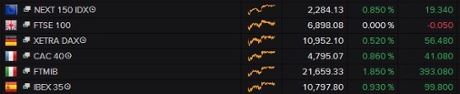
CMC analyst Jasper Lawler says City traders are still hoping for an agreement whenGreece returns to the negotiating table:
There is optimism that permission will be granted by Greece’s EU creditors to extend its loan program beyond February and keep the country from defaulting and falling out of the Eurozone.
The EU appears generally agreeable to a six-month extension of Greece’s loan agreement. The major sticking point is whether over that 6 months Greece will be beholden to the same bailout terms as the current agreement.
The new government in Athens has been given the mandate by Greek voters to undo austerity measures imposed in the existing program. To extend the bailout program after just a few weeks in power would be politically untenable for the Greeks.
Documents from Monday’s meeting indicate Greece’s FinMin Varoufakis has proposed that the Greek government be allowed to run a budget surplus of just 1.5% instead of the current 3% and that the privatisations of public assets be reduced. This does not appear to be to the liking of European commission VP Valdis Dombrovakis who has said Greece must stick to the conditions of its existing bailout package.
Tonight the ECB will decide whether Greek banks will maintain access to the ELA.
Greek bonds have strengthened through the day, too, although prices are still show a high danger of default.
It’s 10-year debt is trading around a yield of 10.4% currently, down from 10.6% on Tuesday evening.

Back in Athens, the main share index closed 1% higher as traders clung onto hopes that a deal will be reached.
Financial stocks all rallied; Attica Bank gained 7.6%, National Bank of Greece finished 6.7% higher and Eurobank rose 6.1%.
Treasury Sec. Lew spoke with Greek finance minister this morning, urged Greek PM to find constructive path forward with EU & IMF - Reuters
— CNBC Now (@CNBCnow) February 18, 2015
US urges Greece to find 'constructive path' to a deal

The United States has waded into the deadlock gripping the eurozone, by giving Greece a clear nudge to find a “constructive” path towards a deal with its creditors, quickly.
US Treasury secretary Jack Lew spoke with Greek finance minister Yanis Varoufakis today. He warned him that Greece would face “immediate hardship” without an agreement, and that the current deadlock is “not good” for Europe..
A Treasury official said that Lew:
....noted that failure to reach an agreement would lead to immediate hardship in Greece, that the uncertainty is not good for Europe, and that time is of the essence.”
That’s quite an intervention from Lew, showing the concern in America that Europe’s debt crisis is flaring up again.
The U.S. is pushing Greece to work it out: @USTreasury Secretary Lew warns @yanisvaroufakis of "immediate hardship in Greece" without a deal
— Sudeep Reddy (@Reddy) February 18, 2015
Jack Lew called @yanisvaroufakis this AM to gently lean on him in the way @USTreasury does so well. Basic message: behave, and hurry up!
— Robin Harding (@RobinBHarding) February 18, 2015
Updated
Fitch: Brinksmanship could do lasting damage

Greece could be dragged back into recession by the uncertainty over its bailout programme, rating agency Fitch has just warned.
The risks of a policy mistake that sinks the chances of a negotiated agreement have risen, it believes, and predicted that Greece’s government will probably have to compromise.
In an article called “Greek Brinkmanship Could Do Lasting Economic Damage”, Douglas Renwick and Mark Brown warned that it will lower its forecast for real GDP growth in 2015 again.
The damage to investor, consumer, and depositor confidence is increasing downside risks to growth and Greece’s incipient economic recovery. It may take time to repair even if agreement with official creditors is reached in the coming days or weeks.
This echoes 2012, when around 30% of deposit outflows from Greek banks in May and June were not recovered in the second half of the year, even as fears that Greece would leave the eurozone receded. The private sector also experienced a long period of limited or costly access to market financing.
My colleague Alberto Nardelli has crunched the numbers, to work out when Greece’s coffers might actually run dry without a new bailout deal.
It’s a tricky question. By one measure, Greece might have to start tapping emergency reserves on 24th February, to tide it into mid-March before it faces repayments to the IMF, and then other creditors.
But the real crunch will be whether the European Central Bank keeps providing liquidity:
If, and it’s a big if, the ECB were to ever pull the plug on Greek banks, the country’s financial system would collapse, and Greece itself would de facto lose its last line of credit.
It is hard to see how the house of cards would not then come tumbling down. Simply put, Mario Draghi, the ECB president, holds a sword over Greece’s head.
When will Greece run out of money? It's complicated http://t.co/n80ByOid7C
— Alberto Nardelli (@AlbertoNardelli) February 18, 2015
Open Europe, the think tank, has helpfully broken down the differences between Greece’s position and the eurogroup.
What deal could be struck to keep Greece in the Eurozone?
They reckon that the two sides are nowhere near agreement on pension reforms, or labour market reforms, or privatisations.
But there is a good chance of agreement on Greece’s fiscal surplus targets, changes to public administration, and a renewed crackdown on tax evasion.
Diffs btwn #Greece & #Eurogroup go beyond words. We lay out, in each policy, what they are & chance for agreement http://t.co/uHW3LreN5r
— Open Europe (@OpenEurope) February 18, 2015
Bruno Waterfield of the Telegraph reckons we won’t hear anything from the ECB about Greek liquidity until late tonight, if at all....
I hear from Brussels sources that ECB statement on Greece & ELA is highly unlikely today. If it comes it'll be late evening...
— Bruno Waterfield (@BrunoBrussels) February 18, 2015
Updated
The early optimism in the financial markets is evaporating, after Greece revealed it will not submit its request for a loan extension until Thursday.
Wall Street has opened lower, the FTSE 100 is now down 15 points, or 0.2%, and the Athens stock market is up just 0.8% (having jumped 2.7% at the open)
Summary: Greece's loan application coming soon....

A quick recap:
Greece has confirmed that it will apply to extend its loan arrangement, to avoid running out of funds by the end of February with potentially disastrous results.
However, the request is now not expected to arrive in Brussels until Thursday morning. That’s a day later than planned, as the government fine-tunes its proposal.
Government spokesman Gabriel Sakellaridis insisted that Athens will not cave in to demands to extend its existing bailout:
We believe the terms of the bailout cannot continue by any means.”
But Germany’s finance ministry has warned that Greece cannot separate its loan from its bailout commitments.
And European commission vice-president Valdis Dombrovskis was adamant today that Athens must stick to the conditions of its existing bailout.

Dombrovskis also warned that he sees “worrying tendencies’ in Greece’s economic and financial situation, and urged Athens not to make ‘unilateral’ moves to unravel its austerity programme while negotiations are ongoing.
Asked 3x, @VDombrovskis makes it pretty clear: no loan available to #Greece w/out it meeting conditions of current bailout programme
— Peter Spiegel (@SpiegelPeter) February 18, 2015
And a hard-left group have blasted the new government for caving into pressure from Brussels, arguing that Greece should quit the “reactionary, undemocratic and authoritarian” EU instead.
Over in Brussels, technical officials are expected to hold a Working Group tomorrow. And another Eurogroup meeting could be called on Friday.
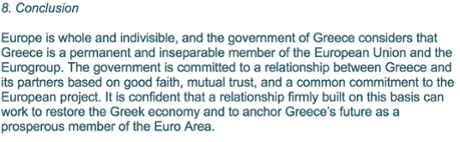
They show how Yanis Varoufakis promised to work with fellow finance ministers, but also insisted that Greece’s new government cannot stick to the mistakes of the past. The files also outline Athens’ proposal to run a smaller budget surplus, and to renegotiate its bailout targets on privatisations and reforming its public sector and labour markets.
Varoufakis also committed to keeping Greece in the eurozone.
Coming up later...
The ECB will rule on whether, or not, to maintain the emergency liquidity assistance that is keeping Greek banks afloat.
And the Greek parliament will decide whether to elect Prokopis Pavlopoulos, the former Conservative minister, as their new president.

Updated
Greek minister: We might seek EU summit
Greece’s minister of state Alekos Flamboraris, a close aide of prime minister Alexis Tsipras, has stirred the waters this morning saying Greece may request an emergency EU summit is held because the Greek crisis is as much political as economic, Helena Smith reports.
Speaking to the local radio channel Parapolitika, the minister said in the event that an extraordinary eurogroup wasn’t called by the end of the week, Athens would request that EU leaders convene for an extraordinary summit “as the issue is political.”
He told the radio station:
“Athens is not requesting an extension of the memorandum as the vote of the Greek people has abolished the memorandum.....
“Our country is asking that the extension of the loan agreement be agreed so that we can resolve a few things that are still outstanding.”
Such an extension would allow the Greek economy “to breath” he said “as we will get some money.” “We should meet [each other] mid-way in the road,” he said adding that the German finance minister Wolfgang Schauble’s tough stance was purely motivated by the ongoing negotiations.
[On Monday night, eurogroup chief Jeroen Dijsselbloem said European Council president Donald Tusk had no intention of calling a summit]
The Greek finance minister Yanis Varoufakis, speaking to Germany’s public television network ZDF, said Athens planned to ask for an extension of European financing “for a few months” so that stability was achieved to enable both sides “to negotiate a new agreement.”
French finance minister Michel Sapin hopes that a Greece deal will be hammered out by the end of the week:
AFP reports that Sapin told a cabinet meeting that:
“Talks have not yet been successful. France’s objective is for a deal to be reached with Greece by the end of the week.”
Loan request delayed until Thursday morning
It’s official: Greece’s application is going to land in Brussels inboxes tomorrow morning, not today as the government said early this morning:
Greek govt spokesman Gabriel Sakkelarides tells @SkyNews the official request for loan extension will be sent to Eurogroup on Thurs morning.
— Robert Nisbet (@RobNisbetSky) February 18, 2015
So why the change? Apparently the request still being polished
Little bird tells me delay of submission of bailout xtension request til Thurs involves crucial finetuning both in wording &essence. #Greece
— Yannis Koutsomitis (@YanniKouts) February 18, 2015
In Athens the battle lines are being drawn.
The ultra-left anti-capitalist Antarsia party has fired off an excoriating statement following the new government’s decision to request an extension of its loan agreement last night.
Under the headline “It is time to break away from the European Union” Antarsia (which is to the left of Syriza and has strong representation on Greece’s powerful trade union of civil servants ADEDY) has blasted the euro group and the Syriza-led government for its handling of the Greek crisis.
“What has happened has proved yet again that the EU is the most reactionary, undemocratic and authoritarian construct in Europe after Nazism,” it announced today.
“We have a Greek government that in reality accepts the overwhelming debt and the immediate obligations that derive from this, commits itself to [pulling off] a primary surplus (that is to say austerity) has asked for an extension of the current loan agreement and declared that it accepts 70 % of the memorandum.”
Even if the government pulls off its ultimate goal of coming up with “a bridging agreement” in the months ahead, the party warned that ultimately it will amount to kicking the can down the road.
“The same problems will crop up again with the same result of austerity, privatisations and changes in the [domains of] labour and pension reforms,” the ultra-leftists said.
“The European Union’s blackmailing is not the exception but the rule. There is no democratic EU, nor is there an EU of the people.”
(via Helena Smith in Athens)
Crumbs. And the eurogroup think Yanis Varoufakis is hard work?....
One the culture clash between Greek Finance Minister Yanis Varoufakis and his eurozone peers: http://t.co/Vuvc1YFl9k pic.twitter.com/7itzVYibNN
— WSJ Europe (@WSJeurope) February 18, 2015
The head of Greek opposition party To Potami (The River) has said Athens will file its application for a loan extension on Thursday, not today as expected.
Stavros Theodorakis was speaking to reporters after a meeting with Greek prime minister Tsipras, where he learned that the proposal will include some costed economic reforms.
Potami leader Theodorakis says PM Tsipras told him Greek proposal for loan extension will included reforms & their fiscal impact #Greece
— MacroPolis (@MacroPolis_gr) February 18, 2015
Potami leader Theodorakis says has been briefed by PM Tsipras on #Greece's loan extension request; to be sent Thurs pic.twitter.com/OBtl4Lwt5x
— Yannis Koutsomitis (@YanniKouts) February 18, 2015
Updated
Rumours are swirling that eurozone technical officials are going to hold talks tomorrow at a Working Group.
They would lay the groundwork for a full eurogroup on Friday to discuss Greece’s bailout.
BREAKING: officials from eurozone fin ministries to meet in Bxl tomorrow (eurogroup working group), eurogroup expected Friday - srce #Greece
— Tony Connelly (@tconnellyRTE) February 18, 2015
Crystal clear. @VDombrovskis says Greece well aware that way forward is to extend the existing programme with conditions
— Bruno Waterfield (@BrunoBrussels) February 18, 2015
Valdis Dombrovskis, European Commission vice-president for the Euro, is discussing the Greek situation in Brussels now.
There’s a livefeed here.
Dombrovskis is telling reporters that he sees “worrying tendencies’ in Greece’s economic and financial situation.
He’s arguing that Greece should stick with its existing programme, and then both sides can look at the flexibility that is available.
.@VDombrovskis "Under the Greek program there are funds available, if Greece wants to tap those funds it has to complete the program"
— Tony Connelly (@tconnellyRTE) February 18, 2015
.@VDombrovskis: if #Greece wants funds of existing programme, Athens has to close succesfully review (i.e: pension reform, labour market..)
— Jorge Valero (@europressos) February 18, 2015
What do you think about the vote on social reforms scheduled for a vote in Athens on Friday?
Dombrovskis replies that the eurogroup believes that Greece should refrain from unilateral action while negotiations are underway.
Updated
Good news for UK holidaymakers (and eurozone exporters); sterling has hit a seven-year high against the euro this morning.
One euro is now worth 73.67p, down from 74.3p last night, following today’s strong UK unemployment report.
EUR/GBP HITS 0.7366, LOWEST SINCE 2008; BREACHES 200-MONTH MA
— Jonathan Ferro (@FerroTV) February 18, 2015
The euro has also dipped by 0.36% against the US dollar, to $1.136. That’s still higher than the 11-year low plumbed in January.
Updated
Insiders in Athens say much of the focus now will be on the wording of whatever document is drawn up to keep debt-stricken Greece afloat, our correspondent Helena Smith says.
Former minister for international economic relations, Constantine Papadopoulos, says although the new government is now focusing on the loan agreement it is fully aware that it will have to keep “to the general spirit” of the conditions on which rescue funds have been given Greece.
Speaking to the Guardian Papadopoulos, who was responsible for the country’s international economic relations when the crisis first broke, said:
“What we are hearing is that the government is making a tremendous effort to reach an agreement in order to ensure there is no abrupt break in our relations with our euro zone partners. It will request a sixth-month extension of the loan agreement which underpins the memorandum of understanding.....
[That MoU is the €240bn bailout accord Athens has signed with creditors at the EU, ECB and IMF.]
....“but will do so avoiding the term memorandum of understanding which it cannot be seen to be adopting.”
Papadopoulos said negotiations in the coming days would inevitably focus on the terms of the agreement the Syriza-dominated government would sign with creditors.
“They will focus on the conditions Greece must meet to have the funds released. They cannot be identical to what we had before but Athens also understands they cannot digress too much from the general spirit of [previous] conditions.
“Greece is is prepared to make commitments on a number of controversial issues,” he added saying taxation and privatisation would be among them.
Back in Berlin, German economy ministry has also warned that Greece’s loan agreement cannot be separated from its reform commitments.
In other words, no money without austerity. The battle lines are being drawn, even before Athens submits its request.
Updated
European commission chief Jean-Claude Juncker has told Germany magazine WirtschaftsWoche that he’s helping to craft a deal.
In an interview published this morning, Juncker says:
“I am working together with Eurogroup President Jeroen Dijsselbloem to achieve an extension of the existing programme, in order to bridge the time until summer.”
Juncker added that “It goes without saying that all the financial obligations to the European and international partners must be respected”.
Germany’s government has welcomed the news that Athens is applying for a loan extension today:
* German economy minister gabriel says welcomes signal from Greek government that it is ready to negotiate - RTRS
— Fabrizio Goria (@FGoria) February 18, 2015
Dan Davies, senior research advisor at Frontline Analysts, is tweeting as he reads though the Greek negotiation papers released a few minutes ago.
He reckons the documents suggests that there could have, and should have, been more progress:
Bottom line - there is lots of common ground here between YV and €group. If it was just his statements we'd have a deal
— Dan Davies (@dsquareddigest) February 18, 2015
The question in my mind is - why don't we have a deal, and why is the stuff coming out of Athens so incoherent and combative?
— Dan Davies (@dsquareddigest) February 18, 2015
And where’s the detail which eurozone finance ministers will have expected?
yes, YV's remarks to the feb 16 €group weren't bad, but the accompanying technical paper was just ghastly; no specifics, lots of bull.
— Dan Davies (@dsquareddigest) February 18, 2015
p16, YV has suddenly discovered the foreclosure rules as a red line - this must surely have been driven by Athens & internal politics
— Dan Davies (@dsquareddigest) February 18, 2015
p21 the stuff on privatisations is desperately unconvincing. the "avoiding fire sales" stuff will have gone down very badly
— Dan Davies (@dsquareddigest) February 18, 2015
Dan also spotted that Greece talks about writing off around €70bn of tax arrears:
p15 - EUR70bn for writeoffs of tax arrears wtff???
— Dan Davies (@dsquareddigest) February 18, 2015
(I think that’s penalties for unpaid tax; which is owed by bankrupt firms, criminals, etc, and arguable unrecoverable).
... lots of €group finmins are going to be kinda horrified that there was 28% of GDP in outstanding tax nonpayment fines in the first place
— Dan Davies (@dsquareddigest) February 18, 2015
This lack of detail from Greece must have made it harder for the eurogroup to assess the concessions which Varoufakis was promising. But I’m not sure it’s a reason to have ditched the Moscovici compromise altogether.
The immediate impression from these documents is that Yanis Varoufakis talks a pretty good game at the eurogroup, but Greece’s proposals are rather short of actual numbers.
@dsquareddigest they brought an MSWord doc to an Excel fight..
— Lorcan Roche Kelly (@LorcanRK) February 18, 2015
Updated
Greek government releases its eurogroup proposals
Classy move from the Greek government. It has published the proposals which Yanis Varoufakis took to the two eurogroup meetings of finance ministers, on 11 and 16 February.
It is online here in English (via the invaluable Yannis Koutsomitis), and here in Greek (on Capital.Gr).
Greek FinMin has published file with Varoufakis's proposals to the Eurogroup #Greece
— Kathimerini English (@ekathimerini) February 18, 2015
It shows that at the first meeting, Greece’s new finance minister promised to cooperate in good faith, to deliver economic reforms, and to fight corruption, while also ending Greece’s debt trap.
As we thought, he proposed running to a surplus of 1.5% of GDP (rather than 4.5%); more support for Greece’s financial sector; the release of €1.9bn of funds to help with Greece’s financing needs, plus an agreement to issue more short-term loans to cover looming bills.
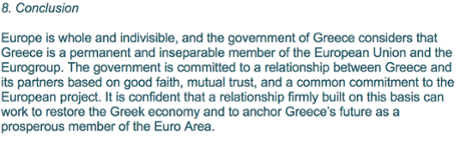
Then at the meeting on the 16th (which collapsed amid much rancour), Varoufakis insisted that Greece was “ready and willing” to apply for an extension to its loan agreement, with various “sensible conditionalities”.
He argued that he could not simply agree to “extend the current programme”, having been elected on a promise to change it:
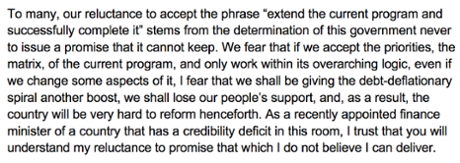
He called on finance chiefs to agree to a three-to-six month agreement to explore the “common ground” between the two sides, and provide the short-term funding Athens needs.
And a second ‘non-paper’, Greece said the technical work with eurogroup ministers had achieved “some progress”:
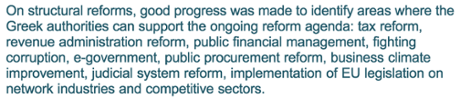
But it also said there were “real differences in logic” on some issues, including labour market reform, public sector reform, and privatisations.
They’re all central to Greece’s bailout programme, suggesting common ground was scarcer than hoped....
Reaction, and more highlights, to follow
Updated
Greek government: Loan request will come today
Greece’s government spokesman Gabriel Sakellaridis has confirmed that Athens will formally ask for an extension to its loan agreement today, but not the austerity measures which it has vowed to reverse.
Sakellaridis told Greece’s Antenna TV that:
“We believe the terms of the bailout cannot continue by any means.”
That appears to confirm that Greece may be trying to revive the compromise proposal pulled together by the European Commission earlier this week. That may well open up a new clash with some fellow eurozone members, including Germany [see our opening post for an explanation].
Sakellaridis also declined to give details of exactly what Greece will be asking for:
“Let’s wait today for the request for an extension of the loan contract to be submitted by Finance Minister Varoufakis.”
“All along deliberations are going on to find common ground. We want to believe that we are on a good path. We are coming to the table to find a solution.”
(quotes via Reuters and AP)
No reaction from other €-countries yet....
Updated
In other UK economic news, the Bank of England has revealed that one policymaker believes the BoE it is as likely to loosen monetary policy as tighten it.
The minutes of the BOE’s last meeting also show that all policymakers voted 9-0 to leave interest rates unchanged at 0.5% this month.
Minutes of the MPC Meeting held on 4 & 5 February http://t.co/KQ3cCIIJqS
— Bank of England (@bankofengland) February 18, 2015
UK avg earnings +2.1% 3mth yy above f'casts but ex-bonus +1.7%, below @ReutersPolls median. Still a long way to go pic.twitter.com/0tLGkBLyUk
— Ross Finley (@rossfinley) February 18, 2015
UK unemployment, the key charts
Today’s UK unemployment report looks pretty decent.
The number of people out of work fell by 97,000 in the October-December quarter, lowering the jobless rate to a new six-year low of 5.7%.
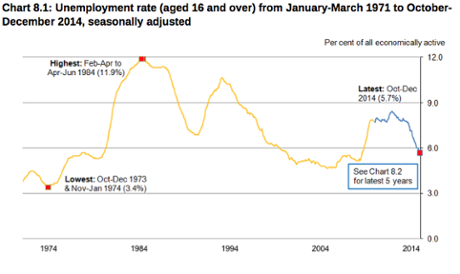
And the number in work rose by 103,000 to 30.896 million, driving the employment rate up.
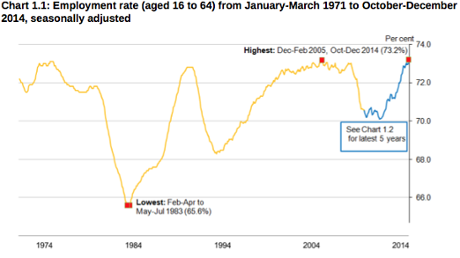
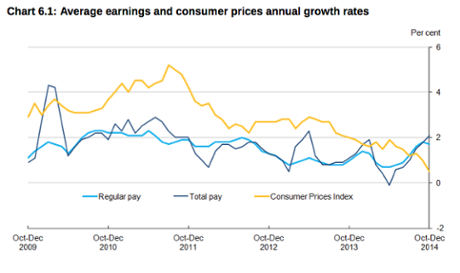
So with wages picking up too, it’s a nice pre-election gift for UK PM David Cameron
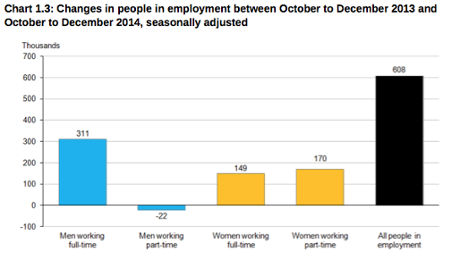
Updated
UK unemployment rate hits 5.7%
Just in: Britain’s unemployment rate has fallen to 5.7%, a new six year low.
And average earnings, excluding bonuses, rose by 1.7%, year-on-year, in the last three months of 2014. Including bonuses, they were up by 2.1%.
That’s ahead of inflation, showing that real wages are accelerating.
Analysts at French bank BNP Paribas warns that the next few days will be lively:
“The tone between Greece and other European partners (is) less harsh but an agreement is still far from being reached. We still expect an agreement will be reached before the end of February, but we also see room for volatility until that time.”
It’s business as usual outside the Athens parliament today:

Greek government bonds are continuing their recovery – the yield on its three-year debt has dropped to 17.6%, from 18.8% last night.
Newsflashes from Athens: Greece’s government has just confirmed that it will submit a request to extend its existing loan today.
#Greece government spokesman confirms Athens will submit request for loan extension today
— Joshua Raymond (@Josh_CityIndex) February 18, 2015
No details yet on what conditions Greece will offer in return; as explained in the opening post we think Athens wants to reheat the “Moscovici compromise”.
That puts the ball firmly back into the eurogroup’s court. Will Jeroen Dijsselbloem now call a eurogroup meeting on Friday to consider the plan?
Updated
In other news... Swiss prosecutors have just said they’re probing a local subsidiary of HSBC for suspected money laundering, according to AP:
BREAKING: Swiss prosecutors say they're probing local HSBC subsidiary for suspected money laundering
— The Associated Press (@AP) February 18, 2015
Greek government bonds are recovering this morning.
The yield (effectively the interest rate) on its 10-year debt has fallen from 10.6% to 10.4%, meaning it is seen as slightly safer. The Greek three-year bond is also rallying a little.
Greek ASE +0.4% and Greek 3 year bonds are down 90bps following source comments Greece could request a 6m extension to its loan program
— RANsquawk (@RANsquawk) February 18, 2015
Greek stocks rise
The Greek stock market is also enjoying a relief rally, with the ATG index up 2.7% in early trading.
Optimism abounds, even though a) Athens hasn’t submitted an application yet, and b) eurozone finance ministers may not accept a loan extension if it’s not tied to bailout targets.
Updated
Other European markets are also rising in early trading, with Germany’s DAX gaining 0.5% and the French CAC up 0.7%.
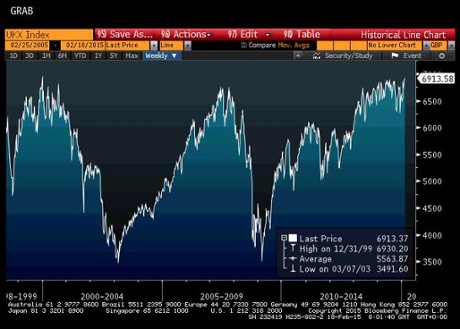
In London, the FTSE 100 index has hit its highest levels in 15 years, and is closing in on its record peak.
The blue-chip index has gained 20 points to 6920, not far from the 6930-point level it closed at back in December 1999.
Mike van Dulken, head of research at Accendo Markets, says Greek optimism is pushing shares higher:
The positive open comes as talks between Greece and the Eurogroup continue this week with PM Tsipras indicating yesterday that, while he remains absolutely committed to forging an agreement with the creditors, the two parties remain far from striking a deal.
Nonetheless, it is reported that the Syriza government may request a 6-month extension of its bailout today and that will no doubt calm the waters slightly.
Updated

Eurozone ministers have another incentive to get a deal done quickly – it will spare them from any more lectures from George Osborne.
Britain’s chancellor raised hackles at yesterday’s Ecofin meeting in Brussels, by asking fellow European Union finance ministers what alternative arrangements were being drawn up in case Greece ran out of funds.
Bloomberg reports that this went down rather badly:
“There was a minister this morning, a non-euro-zone member, who asked if we had thought about what would happen if Greece left the euro,” French Finance Minister Michel Sapin told reporters. “Frankly, it’s indecent.”...
Jeroen Dijsselbloem, the Dutch finance minister who presided over Monday’s negotiations, also told Osborne at Tuesday’s gathering that there was no alternative to Greece staying in the euro area, one of the people said.
Other ministers reacted with anger to Osborne’s intervention, the person said.
Europe shares open higher; Greece negotiations still in focus. http://t.co/FMK3gG0k3w $FTSE $DAX pic.twitter.com/MJNFbrkfmh
— CNBCWorld (@CNBCWorld) February 18, 2015
European stock markets are inching higher at the start of trading:
Stoxx Europe 600 index opens 0.3% higher at 378.32
— Sara Sjölin (@sarasjolin) February 18, 2015
One crucial point: Any Greek deal would need to be approved by other eurozone governments.
And Germany is very likely to oppose a mere loan agreement, rather than a formal extension of the current bailout + conditions.
lias Siakantaris, columnist at Greece’s Kathimerini newspaper, tweets:
1/3 By publicly slaying Dijssel-draft, #Greece prepared internally the ground for a deal on the Moscovici one. But a huge snag remains: ...
— Ilias Siakantaris (@iliassiak) February 18, 2015
2/3 "Greece is *also* insisting that the bailout extension would be in the form of a “loan agreement” rather than the current programme”(FT)
— Ilias Siakantaris (@iliassiak) February 18, 2015
3/3 ..."German officials say there is no legal means for making such a loan”. http://t.co/QoXsLuEWZc
— Ilias Siakantaris (@iliassiak) February 18, 2015
Japan's Nikkei hits seven-year high on Greek hopes
Hopes that Greece might make a breakthrough with its creditors today drove Japan’s stock index to its highest level since the financial crisis struck.
The Nikkei gained 1.2%, or 212 points, to close at 18,199.17. That’s the highest point since July 2007.
Other Asian markets also picked up. Trading was thin because of Lunar New Year celebrations; the Manila stock exchange was the place to be:


Updated
Greek loan application may come today

Good morning.
The deadlock between Greece and its creditors could be broken today, if Athens bows to pressure and applies for a loan extension. But it may not be as simple as that.
Greek government insiders revealed last night that they are poised to ask for an extension to its existing bailout, which runs out in just 10 days.
However, it may not request an extension of all its bailout conditions - a crucial distinction.
The proposal is due to be sent to Eurogroup chief Jeroen Dijsselbloem this morning; he’ll then decide whether to call an extraordinary meeting of eurozone finance chiefs on Friday. The third in under two weeks...
The Tsipras government doesn’t appear to be caving in completely. Instead, based on the rumours floating around overnight, it appears to be attempting to revive the compromise plan pulled together on Monday by European Commissioner Pierre Moscovici.
One source told us last night:
“We are not going to ask for an extension of the programme or memorandum. The Greek government won’t accept ultimatums.”
Greece to seek loan extension under pressure from eurozone
And as the Financial Times explains, under this proposal:
Greece would not roll back economic reforms; it would continue to run a primary budget surplus; it would pledge to pay its creditors in full. In exchange, Athens would be given leeway in deciding which reforms it would agree to.
But it’s far from certain that Dijsselbloem will accept the Moscovici deal being retrieved from the wastepaper basket. Monday night’s meeting, you’ll recall, collapsed when the eurogroup presented Greece with another proposal, to basically stick with its bailout.
Meanwhile, the European Central Bank will decide today whether to keep granting Greek banks access to its Emergency Liquidity Assistance programme. They are unlikely to turn off this life-support right now, though.
As Michael Hewson of CMC Markets puts it:
ECB President Mario Draghi is unlikely to want to go down in history as the man who pulled the plug on Greece and undermine the “irreversible” nature of the euro.
Also, the Greek parliament should be voting on its new president tonight. Prokopis Pavlopoulos, the former conservative minister nominated yesterday, is likely to be approved by MPs.
And if that’s not enough drama, we get the latest UK unemployment data at 9.30am GMT, and also the minutes of the Bank of England’s most recent meeting.