Some more tasty lines from Yanis tonight:
#Varoufakis in Berlin: We need banks - but it's one thing to save banks& quite another to save bankers. Live here: http://t.co/A0uhKMigKZ
— Open Europe (@OpenEurope) June 8, 2015
#Varoufakis: "It would be an announcement to the world if our interest payments were linked to nominal GDP growth." #Eurozone #Greece
— Open Europe (@OpenEurope) June 8, 2015
And there is sympathy for Greece’s plight in the hall:
Gerhard Schick MP of the Greens: We have to think about how awful it is for #Greek citizens - it's not only about budgetary consolidation.
— Open Europe (@OpenEurope) June 8, 2015
(and that probably is all from me until the morning....)
Updated
LIVE Varoufakis: "Greeks need a missing ingredient _ Hope" #Greece pic.twitter.com/AtvQCSUKeP
— Derek Gatopoulos (@dgatopoulos) June 8, 2015
Varoufakis then outlines how Greece needs a Speech of Hope, comparable to the address given by US Secretary of State James F. Byrnes in Germany in 1946.
Byrnes’s speech signalled the rebirth of Germany’s economy after the second world war; now, Greece looks to Angela Merkel to give a new version, outlining a bold future.
And in a nice touch, he offers the services of Jamie Galbraith, the US economist who advises Greece, to help write it. His father, JK Galbraith, helped write Byrnes speech, after all.
This speech would be a sea change in European politics, Varoufakis argues, paving the way to closer integration and closer bonds.
This is a theme he outlined in a blog post last weekend:
A Speech of Hope for Greece – a Project Syndicate Op-Ed
#Varoufakis invites #Merkel to speak in #Greece, in a speech which would signal a change in European politics, if I got it correctly
— Daphne Papadopoulou (@daphnenews) June 8, 2015
A deal is within reach, Varoufakis tells his audience. It could be hammered out in one evening, one long night. Leaders could just work until 4am and get a deal done.
And it would have some key elements.
1) An independent tax authority, free from interference from politicians or corporations
2) Debt relief, to give Greece room to breath and return to growth. He cites Greek debt held by the ECB which matures this summer; if Europe’s bailout funds stepped in and bought the bonds, it would spare Athens from borrowing more money simply to repay creditors.
This could also include growth bonds, where repayments would be linked to GDP.
3) A debt brake, a pledge that Greece would never fall back into the primary deficits that caused the crisis in the first place.
And he then outlines how the eurozone needs deep reforms, to finally complete the monetary union. We would sign up for that, he says, to avoid a repeat of the last few years.
Varoufakis speaks about building bridges and quotes Kohl, Delors even Schäuble who spoke of need to complement economic with political union
— Daphne Büllesbach (@piavonhier) June 8, 2015
Updated
Varoufakis: We need a deal soon to avert accident
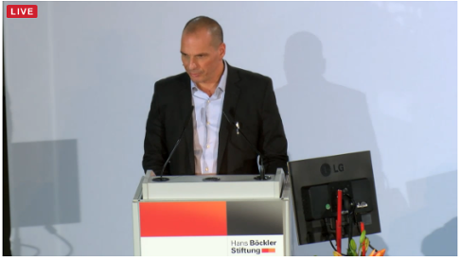
Yanis Varoufakis is now giving a familiar critique of the proposals from Greece’s creditors.
He says they prevented Greece’s current government from making small reforms, insisting on a single big package agreed with lenders.
And he argues that the budget surpluses being pushed by creditors are unreasonable, and would make it so much harder to return to growth.
On pensions.... he agrees that the pension system in Greece isn’t sustainable, but how can it be when a third of work is undeclared and the labour market is imploding?
Of course the pension system is unsustainable, we want to reform it....Is cutting further a reform? I don’t think so. Any butcher can chop something down.
He also criticises the idea of hiking the tax on Greek electricity from 13% to 23% in a country beset by energy poverty, and to hike pharmacy costs.
Imagine if I went to my parliament and said the way out of this crisis is cut a €350 pension by 40%, while raising the VAT on pharmaceuticals.....
If you continue to squeeze our population into misery, we will not be reformable ever.
We can carry the people , but not if we are made to force more austerity on them.
We need an agreement quickly to avert an accident..... which history will take down as a failure of the political class of the European Union, including myself, Alexis Tsipras, Angela Merkel, Dr Schäuble, Mr Juncker...
We have an historic duty not to allow this to happen.
Updated
Yanis Varoufakis live in Berlijn: nazis are coming out of the woodwork to flood our cities. pic.twitter.com/Oodf5eh7pj
— Giel (@GieltenBosch) June 8, 2015
Don’t believe the idea that the eurozone is a story of hard-working ants in the north, and lazy grasshoppers in the south, Varoufakis says.
There were hard working ants in Greece, just as in Germany, and they all suffered badly when the debt crisis began.
Varoufakis also gives his audience in Berlin a chilling warning of the impact of the depression - a slump comparable with John Steinbeck and The Grapes of Wrath, he says
Children are fainting from malnutrition in their clasrooms, and “Nazis, yes Nazis” are coming out of the woodwork and onto the streets, he says.
Varoufakis: Lenders must share blame for the crisis
Yanis Varoufakis is explaining to his audience in Berlin how the creation of the eurozone created a ‘tsunami of debt’ from banks in Frankfurt, Paris and Amsterdam to Athens, Dublin and Madrid.
This is the theory of ‘surplus recycling’, where cheap credit flowed to the eurozone periphery to create unsustainable borrowing levels.
And the Greek finance minister insists that both sides are to blame.
For every irresponsible borrower....there was an irresponsible lender.
Varoufakis: every irresponsible borrower has an irresponsible lender - asymmetries hunting the EMU #Varoufakis #Berlin @boeckler_de
— Stylia Kampani (@StyliaKampani) June 8, 2015
You can see Yanis Varoufakis’s speech in Berlin live here. It’s good stuff.
One more thing to watch out for tonight: Yanis Varoufakis is now giving a speech in Berlin, at the Boeckler Foundation.
Now the floor is Yanis. Varoufakis starts his keynote. pic.twitter.com/L21oJWxSTs
— Holger Zschaepitz (@Schuldensuehner) June 8, 2015
Yanis’s rock star persona hasn’t been dented by the last five months; a group of anti-austerity protesters gathered outside the event:
Yanis popstar! pic.twitter.com/M8nhPaxu3D
— Holger Zschaepitz (@Schuldensuehner) June 8, 2015
Summary: Obama leads chorus telling Athens to act
Time for a recap.
A series of world leaders have piled pressure on Greece to make compromises to secure bailout funds from its creditors, as the eurozone enters one of its most crucial weeks in years.

President Obama told world media at the G7 summit that Greece must show it is serious, adding:
“The Greeks are going to have to follow through and make some tough political choices that will be good for them long-term.”
Obama did also urge the international community to recognise “the extraordinary challenges” that Greece faces, but made it clear that prime minister Alexis Tsipras must implement economic reforms.
The Greek crisis loomed over the G7 summit in Germany, three days after prime minister Tsipras blasted creditors for trying to force Greece into unacceptable measures.
German chancellor Angela Merkel warned that time is running out for Greece, and cautioned that the country must implement measures sought by lenders.
Importantly, Merkel also confirmed she would speak with Tsipras at the EU-Latin American summit on Wednesday
Despite Tsipras’s tough talk in parliament on Friday night, there were signs today that Athens was softening. It sent two top ministers to negotiate in Brussels today, as a government spokesman pledged that Greece wants a solution that suits both sides.
Greek media are reporting that Athens is rejigging its 47-page list of reforms, but remains opposed to making significant changes to VAT and pensions.
Finance minister Yanis Varoufakis also tried to mend relations with Germany, on a visit to his counterpart Wolfgang Schäuble for a “very helpful” chat.

Varoufakis told reporters in Berlin that:
“Dr Schäuble and I had a long productive conversation....We were not negotiating, we were establishing common ground.”
Varoufakis also warned that policymakers have a ‘historic duty’ to solve the crisis:
“These are difficult moments for the European Union and the euro zone in particular and it is the duty of elected politicians to take their responsibility to a higher level in order to try to achieve an agreement that is absolutely essential for the integrity of the euro zone, absolutely essential for the European Union and it is a historic duty which we cannot abrogate.”
But this didn’t stop the Athens stock market hitting a six-week low tonight.
That’s probably all for today, but I’ll pop back into the blog if there are any major developments.... GW

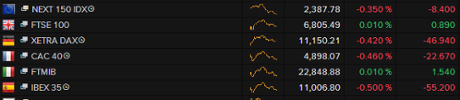
Europe’s stock markets just closed with losses across the board.
The German DAX, French CAC, Spanish IBEX and Italian FTSE MIB all fell around 1%, which confirms that the DAX is now in ‘correction’ territory (down 10% on April’s record high).
Analysts believe the selloff is partly due to Greek angst, and partly due to other factors such as the rising euro and bond market volatility.
CMC’s Michael Hewson says:
European markets have continued where they left off at the end of last week, as rising bond yields and the continued impasse over a new Greece deal keep investors cautious.
Updated
The absence of a Greek deal is fuelling fears over the stability of its banking sector.
Rating agency Moody’s warned today that bank deposits must have fallen again in May, on top of the €4.9bn that fled the sector in April.
And this “significantly increases the risk” that capital controls will be imposed, they say in a new report [on the very day that Iceland announces plans to lift its own controls].
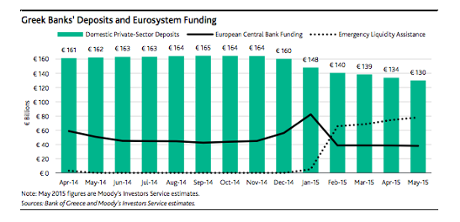
As Moody’s explains:
Such capital controls could be in the form of restrictions on deposit withdrawals, such as imposing a daily limit on how much cash depositors can withdraw and on money transfers abroad.
This could even by triggered by the European Central Bank, which is providing over €80bn of emergency liquidity:
The ECB may indirectly prompt capital controls by limiting the extension of ELA to Greek banks, with an aim to exert pressure on the Greek government to come to an agreement with its official lenders regarding its financing programme.
And as our Athens correspondent Helena Smith reports, savers are on edge....
Deposits last week dropped below €130bn euro – effectively wiping out the savings of the last 11 years, according to officials in the sector.
At the height of the crisis in mid-2012, when scenarios of euro zone exit were at their loudest and withdrawals dramatic, deposits stood at €150bn. In April, alone, companies and households withdrew almost €5bn from the system – reinforcing fears of a full-scale bank run if Greece doesn’t manage to seal a deal with the EU and IMF before its bailout expires on June 30.
And Greece’s minister of labour, Panos Skourletis, told Mega TV this morning that some bank officials are apparently advising savers to withdraw holdings from account.
He referred to:
...what we are all hearing of banks advising [savers] to withdraw money abroad through mutual funds.”
Non-performing loans have also skyrocketed – peaking at €80bn last week an all time high.
Bank officials this morning were cautioning against being overly pessimistic. One insider at the Bank of Greece told us:
“Everything is going swimmingly. People are very calm and actually cautiously optimistic”
That’s hard to believe however when you look at the figures......
Christian Noyer of the European Central Bank has made some eye-catching comments on Greece, at an event in Montreal today.
On the one hand, a Grexit wouldn’t be a disaster for Europe:
- ECB’S NOYER: GREEK EXIT, IF IT WERE TO HAPPEN, WOULD NOT CAUSE INSTABILITY FOR EURO ZONE; SITUATION IS MUCH DIFFERENT THAN SEVERAL YEARS AGO
- ECB’S NOYER: FIREWALLS THAT HAVE BEEN PUT INTO PLACE ARE EXTREMELY POWERFUL, EUROPEAN ECONOMIES ARE ON THE RISE
On the other...we really do need a deal soon!
- ECB’S NOYER: PROBLEM OF GREECE IS A PROBLEM FOR GREECE ITSELF; “I AM ANXIOUS FOR GREECE”; PROBLEM IS FOR GREECE TO RESTART THEIR ECONOMY AND PURSUE REFORMS
- ECB’S NOYER: IT’S EXTREMELY URGENT FOR GREECE TO REACH A SETTLEMENT; “IT’S A MATTER OF DAYS”
And thus, it’s Greece that needs to compromise....
- ECB’S NOYER: HAVEN’T SEEN CONVINCING SET OF PROPOSALS ON GREECE
(thanks to Reuters for the news flashes)
Obama: G7 supports efforts to find path enabling Greece to carry out key reforms & return to growth within strong stable & growing Eurozone
— Katerina Sokou (@KaterinaSokou) June 8, 2015
Investors in Athens are feeling the heat.
The main ATG index slid 2.7% today, closing at its lowest level in six weeks.
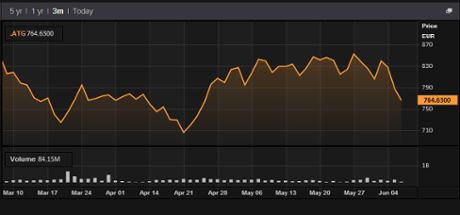
Financial stocks were hit, again, with Piraeus Bank shedding 7.3% and Alpha Bank down 5.3%.
Obama is also touching on data hacking and the Middle East:
Obama on cyber hacking: We have known about vulnerabilities for long time, vulnerabilities will accelerate over time pic.twitter.com/y7YSA8UPuN
— CNBC Now (@CNBCnow) June 8, 2015
Pres. Obama on fight against ISIS: We must improve the speed of training Iraqi forces. http://t.co/KXWKKJFejI pic.twitter.com/QvgKdDMOsz
— CNBC Now (@CNBCnow) June 8, 2015
Obama: Greece must get serious and take tough choices
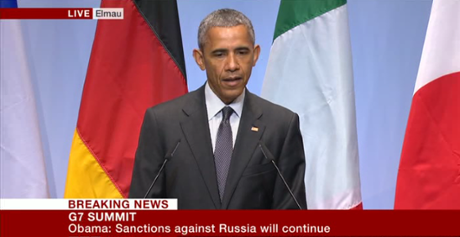
President Barack Obama is also taking questions at the G7 now, and the first question is on the Greek crisis.
Are European governments being too tough on Greece?
Obama replies that he believes the G7 partners, the IM and other institutions feel “a sense of urgency” towards finding a path to resolve the situation.
“It is going to require Greece being serious about making some important reforms”, says Obama, adding:
Not only to satisfy creditors, but also to create a platform where the Greek economy can start growing again and prospering.
And Obama then gives Athens a clear nudge:
The Greeks are going to have to follow through and make some tough political choices that will be good for them long-term.
But the institutions also need to do their bit and recognise the “extraordinary” challenges Greece faces, Obama adds.
In conclusion:
If both sides show sufficient flexibility, we can get this problem resolved....but it will need tough decisions from all involved.
Can we get a deal before the deadline?
Obama says he believes there is a real desire for progress:
I think that everyone wants to make it happen and they’re working hard to get it done.
So, a clear signal from Washington that this deadlock needs to be broken.
Obama also denies that he told other world leaders he was worried about the strength of the US dollar (as one newswire reported this morning).
Updated
Here’s Francois Hollande’s warning about on the urgent need to get a Greek deal, from Reuters:
“There is an end-June deadline.....
“This is the latest possible deadline but nothing stops us from going faster and I think it is in Greece’s interest to go faster to avoid doubts or speculations. If we want - and all of us, Greeks and Europeans, have said we do - Greece to stay in the euro zone, we must go towards a solution in a timeframe that is not (as late as) the end of the month.”

Across the G7 summit, French president Francois Hollande has just told reporters that there is still time to reach a deal with Greece.
Reuters has the details:
- FRANCE’S HOLLANDE SAYS WE NEED TO HAVE IN COMING HOURS OR DAYS TECHNICAL DISCUSSIONS ON GREECE TO MAKE PROGRESS
- FRANCE’S HOLLANDE SAYS END-JUNE IS THE LAST POSSIBLE DEADLINE ON GREECE
French Pres Hollande: ECB, IMF, EU Could Make Alternative Proposals To Greece - #BBG
— Live Squawk (@livesquawk) June 8, 2015
A second reporter asks Angela Merkel about Greece -- are G7 leaders worried that the country might default soon?
The German chancellor insists that “Everyone around the table wants Greece to say in the euro….but we have rules.”
Merkel cites the recovery in Ireland, and the progress in Cyprus, as proof that reform measures pushed by Greece’s lenders can work.
"The measures proposed by the troika have led to success elsewhere." #Merkel in full trolling mode on #Greece?
— Peter Spiegel (@SpiegelPeter) June 8, 2015
She also points to Ukraine, which faces extremely taxing structural reforms in return for its IMF bailout.
Some early reaction to Merkel’s comments on Greece:
Merkel makes it clear that the creditor proposals (dismissed by Tsipras as absurd) are the only ones on the table
— Bruno Waterfield (@BrunoBrussels) June 8, 2015
#Merkel repeats the obvious: there is not much time left for #Greece . Who wants could hear a slight tone of impatience in her words.
— Carsten Brzeski (@carstenbrzeski) June 8, 2015
#Merkel confirms she will meet with @atsipras on Wed in Brussels, but suggested it may not be decisive. #Greece #G7Summit
— Peter Spiegel (@SpiegelPeter) June 8, 2015
Merkel: Not much time left to reach Greek deal
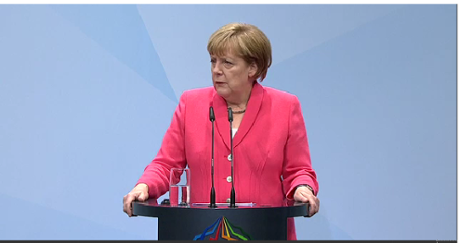
Angela Merkel has warned that “every day counts” in the race to finalise a deal with Greece.
She is asked whether the Greek crisis was debated at the G7 summit, with reference to American worries that a Grexit could prompt a Lehman Brothers-style crisis.
The German chancellor replied that Greece was discussed - although not for very long -- with regards to the state of the eurozone.
Those G7 members who are not in the eurozone also wanted to know the score, she said.
She downplayed the comparison with Lehman Brothers, and explained:
“All I can say now is that we want Greece to remain part of the eurozone”....but “solidarity between European countries and with Greece means Greece will have to implement measures”.
There is a common position between the three Institutions (the IMF, ECB and EU), and discussions are based on that, she says.
And then Merkel warned that “there isn’t much time left” to get a deal.
The day after tomorrow we can discuss this with the Greek prime minister at the EU summit with Latin American countries...
Every day counts to complete the necessary job.
Updated
The G7 summit has broken up, and leaders are speaking to the media now. Angela Merkel’s press conference is being streamed here.
Iceland’s government insists that its plan to relax capital controls is sensible.
Officials at today’s press conference are stressing that it will bring “stability”, and allow money to move freely again without drastic moves that hurt the economy.
The plan is part of the Icelandic governments plan to move on from the financial crisis, which saw its over-leveraged banking sector collapse once the credit crunch struck.
At first glance, there are two key elements to the plan:
- Investors with assets in its failed banks must pay a 39% tax to access the funds (which are currently locked down).
- Overseas investors who hold króna can exchange them for other currencies through an auction, or buy long-term Treasury bonds, or put the money into “locked non-interest-bearing accounts”.
Anyone choosing to swap their króna for foreign currencies must pay a premium, to prevent a surge of money that could destabilise the currency.
No fewer than 21 mentions of 'stability' in Icelandic govt's announcement of how it'll end capital controls. http://t.co/krwUGsYDjp
— Joseph Cotterill (@jsphctrl) June 8, 2015
Updated
Despite Jean-Claude Juncker’s criticism of Greece yesterday, the Commission hasn’t given up hopes of a Greek deal either.
Spokesman Margaritis Schinas explained told a press conference today that the EC will “continue working on a solution”....but with its own proposals as the starting point.
Schinas said:
“The proposal submitted by the institutions last week was a good basis for discussion provided that all sides are dedicated to finding a solution to the open issues.”
Over in Reykjavik, the Icelandic authorities are announcing plans to lift capital controls imposed after the financial crisis.
I’ll summarise the key points shortly....
Two senior Greek ministers to lead negotiations today
Greek government spokesman Gavriil Sakellaridis also revealed this morning that two senior ministers are heading up negotiations in Brussels today. Another sign of compromise?
State Minister Nikos Pappas and Alternate Foreign Minister Euclid Tsakalotos are leading the government’s delegation to the Belgian capital.
#Greece Tsakalotos, Chouliarakis, Pappas fly to Brussels to seek agreement (options?). First two part of BrusselsGroup negotiations team
— Keep Talking Greece (@keeptalkingGR) June 8, 2015
Pappas is a close ally of prime minister Tsipras, while Tsakalotos has day-to-day charge of the negotiations.
There’s a rumour that they could see Pierre Moscovici, commissioner for economic and financial affairs, this afternoon, reports Kathimerini’s Elena Varvitsiotis.
Brussels source: unconfirmed meeting of Pappas and @tsakalotos with @pierremoscovici today at 16.15
— Eleni Varvitsiotis (@Elbarbie) June 8, 2015
I flagged up earlier that Greece is reportedly revising its proposal to creditors, although perhaps not giving much ground on the crucial issue of pensions.
Greece: We want a solution that satisfies both sides

Greece is determined to keep negotiating with its creditors over the the next few weeks to get a deal, says government spokesman Gabriel Sakellaridis.
While Varoufakis was speaking with Schäuble, Sakellaridis was striking a conciliatory tone with reporters in Athens.
“Definitely our proposal is the starting point,” Sakellaridis told a news conference, adding:
“The mission of the Greek delegation is to explore the possibility of a solution that satisfies both sides.”
According to Sakellaridis, Greece’s is committed to having “a lot of political negotiations” through June to ensure a “positive outcome” to talks.
And he suggested that Greece’s negotiators in Brussels could make progress this week:
Greek gov't spokesman Sakellaridis says Tsipras has informed Merkel, Hollande & Juncker that Athens is updating proposals #Greece
— MacroPolis (@MacroPolis_gr) June 8, 2015
Greek gov't Sakellaridis says delegation in Brussels has authority to negotiate changes to proposals Athens submitted to lenders #Greece
— MacroPolis (@MacroPolis_gr) June 8, 2015

Meanwhile in the UK, rating agency Moody’s has warned that David Cameron’s plan for an in/out referendum on EU membership could hurt Britain’s credit rating.
In a new report, Moody’s said that an early vote would raise the chances of Brexit. It says:
“In Moody’s view, a shorter time frame increases the risk that the UK government will not manage to secure the changes that it is seeking, which in turn may negatively influence the government’s willingness to support remaining in the EU,” the agency says in an update on the UK.
“While the outcome of the referendum remains uncertain, Moody’s believes that a withdrawal from the EU would have negative implications for the UK’s growth prospects and – in the absence of an alternative trade arrangement with the EU that at least partly replicates the current access to the EU’s single market – would likely put pressure on the UK’s sovereign rating.”
Full story:

Updated
Yanis Varoufakis also told reports that the meeting with Wolfgang Schäuble was helpful, and held in an “extremely friendly” manner (Dow Jones reports).
Varoufakis: We had constructive talks
Yanis Varoufakis has just emerged from his meeting with Wolfgang Schäuble.
He tells reporters that they have held “friendly and productive” talks this morning.
But were any concessions made, the press pack ask.
We didn’t negotiate, Varoufakis says (via Natalie Bachmayer of Germany TV channel ARD)
#Varoufakis nach Treffen mit #Schäuble: "freundlich und produktiv." Zugeständnisse? - "We did not negotiate." pic.twitter.com/dJd5HVFs6g
— Natalia Bachmayer (@nbachmayer) June 8, 2015
Europe’s stock markets remain edgy this morning, as Brenda Kelly of London Capital Group explains:
With Greek worries still haunting investors with the European Commissioner stating that alternative proposals must be found if a deal is to come to fruition.
It’s the last day and yet the G7 leaders have yet to reach a compromise that unlocks bailout aid for Greece. and until accord is reached we can expect market jitters to continue.
Greek Finance Minister @yanisvaroufakis in Berlin meeting w/ German counterpart #Schaeuble. Had nothing to say going into the talks.
— Nina Schick (@NinaDSchick) June 8, 2015
Yanis Varoufakis has just been sighted in Berlin, arriving for his talks with Wolfgang Schäuble (preview here)
#Varoufakis auf Geldsuche: Gerade in Berlin bei #Schäuble. Ob's hilft? pic.twitter.com/ETcugBQOGY
— Philipp Menn (@PhilippMenn) June 8, 2015
Christine Lagarde, the head of the International Monetary Fund, has arrived at the G7 summit.

According to one official, she’s likely to discuss the Greek crisis during today’s session (which will also cover global security threats from ISIS to the Ukraine conflict)
*FRENCH OFFICIAL: LAGARDE TO HAVE MEETINGS ON GREECE AT G7 TODAY
— Dealingroom (@Dealingroom_EN) June 8, 2015
US President Barack Obama and French President Francois Hollande have already held a bilateral meeting:

Greek newspaper Kathimerini is reporting that the Athens government is redrafting its own bailout proposals today, in the hope of cracking a deal soon.
However, it’s only inching towards a compromise, rather than swallowing its creditors demands (not surprising, given the way Alexis Tsipras dismissed them on Friday night).
Here’s a flavour:
Kathimerini understands that Athens is focussing its attention on adjusting the fiscal measures it proposed with the aim of getting closer to the revenue target set by lenders. However, the coalition is reluctant to adjust its VAT proposal, which sees three brackets (6, 11 and 23 percent) rather than the two proposed by lenders (11 and 23).
Greece also seems prepared to raise slightly its primary surplus proposals from 0.6 percent of GDP this year and 1.5 percent next year. The institutions proposed 1 percent for 2015 and 2 percent for 2016. The updated suggestion from the Greek side is not expected to reach these targets.
While Athens is prepared to change the law regarding early retirement, saving 100 million euros, it does not seem willing to go as far as lenders are demanding in terms of pension reform. There are also substantial differences between Greece and its creditors on the issue of labour market regulations.
More here: Greece updating proposals it sent to lenders in hope of clinching deal
German stock market falls into correction territory
The Greek crisis continues to drag on European stock markets this morning, pulling the German DAX and French CAC down by over 0.6%.
And that means the DAX is officially in ‘correction territory’; having shed more than 10% since hitting a record high on 10 April.
Germany's DAX falls 10% from April high, enters correction pic.twitter.com/ysrzkteevO
— Francine Lacqua (@flacqua) June 8, 2015
It’s not all Greece’s fault; German shares had soared as the euro weakened earlier this year, but that’s been reversed as the eurozone emerged from its brief dose of negative inflation. Recent volatility in the bond markets has also hit shares.
But German investors ought to be feeling more confident this morning. Factories orders have risen for the second month running, 1.4% in April, as demand from other eurozone nations picks up.
Greek TV stations are reporting that relations between Berlin and Washington have turned increasingly frosty, as Barack Obama pushes fellow G7 leaders for a quick solution to the crisis.
From Athens, Helena Smith reports
Citing a senior German official, Greek television channel Mega TV described how US Treasury Secretary, Jack Lew had implored his German counterpart Wolfgang Schauble to “support Greece” -- only to be told: “give €50bn yourself to save Greece.
Mega’s Berlin-based correspondent told the station that:
“Whereupon the US official said nothing because, as if always the case according to German officials when it comes to the issue of money, the Americans never say anything”.

Meanwhile, negotiations between Greece and Berlin are expected to intensify Monday when the Greek finance minister Yanis Varoufakis meets Schauble in the German capital.
The Greek politician, who will be in Berlin to give a speech, requested the meeting late Friday and is expected to try and smooth over some of the fall-out from what Athens’ leftist led government regards as “incendiary” remarks by the Grecophile EU president Jean-Claude Juncker.
But government ministers remain defiant.
“The lenders are trying to rip Greece apart,” said the hardliner energy minister Panagiotis Lafazanis adding that while it was not the choice of the governing far left Syriza party to take the country out of the euro zone, neither could it allow “the extinction of Greece” within the euro zone.
France's Sapin: Grexit would be "no drama"

France’s finance minister, Michel Sapin, has fired a warning shot at Athens this morning by claiming the impact of Greece leaving the eurozone would be pretty trivial.
Speaking on RTL radio, Sapin said he expects a deal in time - but appeared sanguine about the prospect of failure.
“It would be no drama for us to see Greece leaving the euro. It would not be serious from a financial or economic point of view”
“However, it would be a blow to the European project, because the European project is not to shrink but to enlarge, not to see members excluded but to welcome more.”
(quotes via Reuters)
#France #Sapin pense qu'un accord sera trouvé mais considère qu'une sortie de la #Grèce de la zone euro ne serait pas un drame
— IG France (@IG_France_) June 8, 2015
Today’s meeting was requested by the Greek side; Yanis Varoufakis is in Berlin to attend another event this evening, so decided to take advantage of this opportunity to visit Schäuble at the same time.
It’s an opportunity to repair relations between Greece and the creditors after Tsipras’s defiant speech to MPs on Friday night.....

...Varoufakis, though, has already echoed his leader’s attack on the creditors this weekend, as AFP explains:
Greece’s Varoufakis to meet German finance minister Monday
Germany’s Finance Minister Wolfgang Schaeuble will meet Monday in Berlin with his Greek counterpart Yanis Varoufakis, amid contentious negotiations between Greece and its creditors, the German ministry said.
A ministry spokesman told AFP the meeting would take place “in the morning” and that no press conference was planned.
Varoufakis is in Germany to take part in a debate Monday evening in Berlin organised by Hans-Bloeckler foundation, close to the German union confederation DGB, while a summit of G7 leaders wraps up in Bavaria in southern Germany.
On Sunday Greece and the European Union traded barbs over Brussels’ latest demands for economic reforms by Athens, with EU commission chief Jean-Claude Juncker accusing Greece’s premier of misrepresenting the proposals that Athens has termed “absurd”.
Varoufakis was quoted in the Greek press calling the proposals “borderline insulting”.
“It was an aggressive move designed to terrorise the Greek government,” Varoufakis told Proto Thema daily.
Greece’s radical-left government and its creditors - the International Monetary Fund, the European Union and European Central Bank - have been negotiating for five months on reforms needed to unlock 7.2 billion euros ($8 billion) in remaining rescue funds that Athens desperately needs to meet a series of debt repayments to the IMF this month.
France wants Greek deal by June 14th
We have a new deadline to aim for: France wants a Greek deal by Sunday.
#GREECE: GREEK ACCORD NEEDED SOON TO END UNCERTAINTY -FRENCH OFFICIAL - BBG
— macrobrief (@macroandfinance) June 8, 2015
*FRENCH OFFICIAL: GREEK SOLUTION WANTED BEFORE JUNE 14
— Dealingroom (@Dealingroom_EN) June 8, 2015
That would give enough time for eurozone finance ministers to rubber-stamp a plan at their next eurogroup meeting, on June 18th. But after so many deadlines, can we put much faith in this one?
I remember when we thought we'd have a deal by June '14 https://t.co/63qG5Aoh5U
— Lorcan Roche Kelly (@LorcanRK) June 8, 2015
The Agenda: Varoufakis meets Schäuble this morning
Good morning, and welcome to our rolling coverage of the world economy, the financial markets, the eurozone and business.
Fears over Greece’s financial plight are building this morning, as we enter a crucial week for Athens and the rest of Europe.
Greece now has barely three weeks to strike a deal with creditors, and get it agreed, before its bailout extension expires on 30 June.
Greek finance minister Yanis Varoufakis is due to meet with his Germany counterpart, Wolfgang Schäuble, in Berlin this morning to discuss events, at the start of a period of urgent diplomacy.
But relations between Greece and its creditors look increasingly strained, after Alexis Tsipras’s performance in parliament on Friday night. European Commissioner Jean-Claude Juncker tore into Tsipras yesterday, saying the Greek PM was wrong to tell his MPs that creditors had imposed ‘absurd’ ultimatums.
Instead, Juncker told reporters at the G7 summit that lenders were disappointed in the Greek side, saying:
Alexis Tsipras promised that by Thursday evening he would present a second proposal. Then he said he would present it on Friday. And then he said he would call on Saturday. But I have never received that proposal, so I hope I will receive it soon. I would like to have that Greek proposal,.
And in a sign that Tsipas’s speech has backfired, Juncker criticised him for failing to mention the EC’s willingness to negotiate over Greek pensions:
“I do not have a personal problem with Alexis Tsipras. He was my friend. He is my friend … But frankly, in order to maintain [the friendship], he has to observe some minimum rules.”
The G7 summit continues today, so we may hear more about Greece.
Also coming up....
Iceland is expected to announce the end of capital controls today, almost seven years after imposing restrictions on the flow of money when the financial crisis erupted. An announcement is due at 1pm BST.
And Turkey’s financial markets are in some turmoil after yesterday’s shock general election result:
The lira slumped 5% to a new record low this morning, and shares in Istanbul tumbled 8% in early trading.
Lira falls to record as Turkey voters end AK’s single-party era. Borsa Istanbul drops 8.2%, most since June 2013 pic.twitter.com/U5Y4Jk7g2F
— Francine Lacqua (@flacqua) June 8, 2015
We’ll be tracking all the main events in Greece and beyond through the day....
Updated