

Closing summary
OK, that’s all for tonight. A quick reminder of the key points.
Greece’s government is racing to put together a comprehensive reform plan to satisfy its creditors. The government says it should have it ready by Monday at the latest.
Analyst fear that Greece could run out of cash on April 20, without a deal.
Greece’s prime minister, Alexis Tsipras, has met with left-wing opposition leaders on the second day of his visit to Berlin. He also visited the Holocaust Memorial.
meeting with @tsipras_eu . #Greece needs space to breathe and ownership for reforms that go to the roots pic.twitter.com/tI1XHuAZZK
— Ska Keller (@SkaKeller) March 24, 2015
There are signs that relations with Germany are thawing; foreign minister Frank-Walter Steinmeier says the atmosphere has improved “significantly”.
George Osborne, though, has told MPs that the ill-feeling between Greece and its eurozone neighbours is “palpable’, making Grexit more likely.
And George Soros has claimed there’s a 50% chance that Greece leaves the euro.
In other news...
Supermarket price wars and falling petrol prices have helped pull the UK inflation rate down to 0.0%.
It’s a cost of living boost, but may make it harder for workers to get sizeable pay rises after years of wage squeezes. Here’s Larry Elliott’s analysis.
US inflation has also come in at zero.
And there is hope that Europe’s economy is recovering, after private sector growth hit a near four-year high.
We’ll be back tomorrow. Goodnight all. GW
Back to the Athens courtroom....
And a court official told Helena that:
“This is as close to a acquittal as would be possible in the circumstances,”
The one-year sentence handed down to George Papaconstantinou was suspended for three years.
Papaconstantinou, in a dark suit, has told friends he is “relieved.”
The former finance minister had always protested his innocence and said he had been framed by a political establishment bent on finding convenient scapegoats to distract public attention from the crisis Greece was enduring.
One other piece of news....The Financial Times is reporting that the European Central Bank is set to make it illegal for Greek lenders to add to their holdings of government debt.
That would appear to make it impossible for Greek banks to provide Athens with extra funding to tide it through its cash flow crisis.
The governing council of national central bank governors and top ECB officials have waved through a proposal tabled by supervisors at the central bank to make legally binding their recent warnings to Greek banks against loading up on their sovereign’s short-term debt, or t-bills, according to two people familiar with the matter.
#ECB getting TOUGHER on Greek banks. Warnings to stop loading up T-Bills are now legally binding, according to @FT: http://t.co/JuyWs2by26
— Maxime Sbaihi (@MxSba) March 24, 2015
Papaconstantinou receives one-year suspended sentence
Athens special court has just handed down a one year suspended sentence to former finance minister George Papaconstantinou, reports Helena Smith.
Court sources have told Helena that of the 13 judges, five (including the presiding judge Nikos Passos) were in favour of acquitting Papaconstantinou over charges that he had tampered with the list of Swiss bank account holders.
#Greece Special tribunal in Athens has handed ex fin min #GeorgePapaconstantinou a one-year suspended sentence
— Helena Smith (@HelenaSmithGDN) March 24, 2015
Updated
#Greece court has adjourned 2 deliberate over sentencing of former finance minister #GeorgePapaconstantinou; prosecutor proposed 4 ys
— Helena Smith (@HelenaSmithGDN) March 24, 2015
The court (still deliberating over the sentence) accepted George Papaconstantinou’s “prior life” as a mitigating factor.
Addressing the wood-panelled court, the prosecutor proposed a sentence of four years.....
Court officials say it is almost certain that George Papaconstantiniou will not “spend a night” in jail, despite being convicted tonight of tampering with the Lagarde List.
Helena Smith our correspondent says the former minister smiled when the presiding judge read out the judgement.
Associated Press also believes Papaconstantiniou will avoid a custodial sentence.
@AP BREAKING: Ex-FinMin Papaconstantinou found guilty of misdemeanor in Swiss bank case, will not serve jail time #Greece HT @ElenaBec
— Derek Gatopoulos (@dgatopoulos) March 24, 2015
Updated
Greek Court officials have now adjourned to deliberate on sentencing, following George Papaconstantinou’s conviction a few moments ago.
Our Helena Smith has been told that as the tampering charge is a misdemeanour and not a felony, it will be regarded as a lighter crime. Papaconstantinou is the first cabinet minister to be brought before a special tribunal in more than two decades.
Updated
Former Greek finance minister convicted over Lagarde List

Breaking News! Former Greek finance minister George Papaconstantinou has been found guilty of tampering with the infamous “Lagarde list” of suspected tax evaders by special criminal court.
But Athens correspondent Helena Smith also reports that Papaconstantinou was exonerated of another charge, of breach of duty for not acting on the list handed to him by Christine Lagarde, the current IMF chief, who was then finance minister of France.
Papaconstantinou was in power when country’s debt crisis erupted and widely regarded as the architect of Greece’s first EU-IMF bailout programme.
He was accused of removing the names of three of his relatives from the list of some 2062 wealthy Greeks with Swiss bank accounts.
Papaconstantinou faces up to 5 years in jail but will probably not serve any time behind bars. Sentence to be announced soon.
— Yannis Koutsomitis (@YanniKouts) March 24, 2015
Updated
After a few days out of the spotlight, Yanis Varoufakis surfaced at the presidential palace in Athens today for talks with Prokopis Pavlopoulos.
Pavlopoulos said he plans regular meetings with Greece’s finance minister. That may dampen media chatter that Varoufakis is been sidelined after not joining Tsipras on his Berlin trip.


What better way to mark your birthday? (many happy returns of the day, Mr Varoufakis!).

The atmospherics may have improved dramatically after last night’s talks but the Greek prime minister’s still faces the enormous challenge of “changing the narrative” among his own constituency, writes Helena Smith.
Officials hope that some of last night’s feel good politicking will rub off on relations between German finance minister Wolfgang Schauble and his Greek counterpart Yanis Varoufakis.
“In terms of atmospherics the [Merkel-Tsipras] meeting went very well. Both countries can now return to the substance of the matter at hand rather than reciprocal finger-pointing,” said the economics analyst Jens Bastian, a former member of the EU task force for Greece, speaking from the German capital.
“The hope is that both [Schauble and Varoufakis] can follow suit so that a constructive dialogue can return to the euro group of finance ministers instead of the bitterness and wrangling that we have seen during the past weeks.”
Bastian, who is German but lives in Greece, said the Tsipras government had had a “harsh meeting” with reality. “It is gradually starting to govern driven not by ideology but the institutional requirements of such a reality check.”
“Dissent within Syriza is going to be the big challenge for the Greek prime minister. The leadership he has shown in Berlin will have to be repeated in terms of explaining the reality on the ground in Athens, the need for structural reforms, to his own rank and file.”
Tsipras’ meeting with Merkel marked the first time a Greek prime minister had said openly in Berlin that the Germans weren’t responsible for the crisis, he said.
“That is important for the narrative both between the two countries but also in terms of domestic politics in Greece, in particular inside the governing Syriza party.” Bastian told the Guardian.
DIJSSELBLOEM SAYS PROCESS WITH GREEKS SLOWLY ’SPEEDING UP’; DIJSSELBLOEM SAYS GREECE IS ABLE TO FUND ITSELF NOW
— Francine Lacqua (@flacqua) March 24, 2015
Another Reuters newsflash, suggesting signs of progress...
- EUROGROUP HEAD DIJSSELBLOEM ASKS EURO ZONE BAILOUT FUND TO ANALYSE POSSIBLITY OF REFUNDING €1.2bn TO GREECE - FUND’S SPOKESMAN
Speaking of Greece.... a verdict is expected soon in the trial of former finance minister Giorgos Papakonstantinou.
Papakonstantinou is accused of removing the names of relatives from the Lagarde list of suspected Greek tax evaders, a charge he denied.
A Greek government insider has told Reuters that the country would run out of funds on April 20th without additional help from its lenders.
That suggests Greece can handle the next hurdle; the €467m due to the IMF on April 9th. but would then be close to the brink.
- GREECE TO RUN OUT OF MONEY BY APRIL 20 WITHOUT FRESH FINANCIAL AID - SOURCE FAMILIAR WITH MATTER
- GREECE HOPES TO GET €1.9bn IN ECB PROFITS ON GREEK BONDS, €1.2bn OF BANK RESCUE FUNDS IF EUROGROUP APPROVES REFORMS LIST-SOURCE
Greece To Run Out Of Money By April 20 Without Fresh Financial Aid - Source Familiar With Matter
— Steve Collins (@TradeDesk_Steve) March 24, 2015
Osborne: Grexit risks are rising
The Chancellor of the Exchequer, George Osborne, has warned MPs that the risk of Greece leaving the euro is rising.
Testifying to the Treasury committee, Osborne claimed that the “ill will” around the table at recent EU meetings has been palpable.
Osborne: Risks of Greece leaving [euro] is rising because the ill-will around the table is palpable pic.twitter.com/HTz6nzLTTb
— Chris Giles (@ChrisGiles_) March 24, 2015
@George_Osborne "Greece shouldn't have joined the euro" #Grexit
— Guy Harding (@GuyHardingSky) March 24, 2015
Osborne also warned, though, that a Grexit could cause severe disruption. He cited the example of Black Wednesday when Britain was driven out of the European Exchange Rate Mechanism.
Once you have established the fact that a pegged currency can be broken….. the markets and others will seek to test that.
Greece is not the only weak economy in the eurozone.
Osborne is also discussing last week’s Budget -- you can follow the action in our Politics Live blog.
New home sales rise to seven year high http://t.co/xEiOvdbXsK pic.twitter.com/SCP6DVU9ev
— Bloomberg Markets (@markets) March 24, 2015
More US data just hit the wires.... and it’s encouraging.
New home sales have jumped by almost 8% to 539,000, the most in almost seven years.
New home sales hit 539,000 in February, versus 470,000 estimate: http://t.co/Nd3TJ9vkoZ
— CNBC Now (@CNBCnow) March 24, 2015
Fastest new home sales since March 2008 in US
— Steve Collins (@TradeDesk_Steve) March 24, 2015
Updated
Two pieces of new economic news have given rather different views of the US economy.
First, growth in America’s factory hit a five-month high, echoing the strong data from the eurozone this morning.
Markit’s US manufacturing PMI jumped to 55.3 this month from 55.1 in February, with new orders rising at the fastest rate since last October.
At 55.3 in March, U.S. Flash Manufacturing PMI hits five-month high http://t.co/xrXKxVPsDC http://t.co/Fo9NCEzrmz
— Markit Economics (@MarkitEconomics) March 24, 2015
But then..... the Richmond Federal Reserves’s measures of manufacturing activity in its region tumbled to -8, from zero last month.
Cue another ripple through the foreign exchange markets....
Richmond Fed: Mar Manufacturing Index -8 Vs Feb 0. The dollar is, like, pic.twitter.com/mxOTdXH3Bh
— Katie Martin (@katie_martin_FX) March 24, 2015
Greek media are reporting that a Euro Working Group [made up of technical officials] will assess the country’s situation on a conference call tomorrow morning.
#Eurozone officials confirm to @euroinsight: EWG deputies to assess #Greece's liquidity situation Wednesday https://t.co/NiSMPxLx3M
— Yannis Koutsomitis (@YanniKouts) March 24, 2015
Euro Working Group (EWG) on Wed morning, according to MoF sources (via @capitalgr) #Greece #economy #ec #ecb #imf #eurogroup
— Manos Giakoumis (@ManosGiakoumis) March 24, 2015
And.....the euro is continuing to slide.
EURUSD today is a fun one. pic.twitter.com/JTJuiVfFGZ
— Joseph Weisenthal (@TheStalwart) March 24, 2015
The US dollar experienced dramatic swings as traders digested the news that US inflation rose to zero last month.
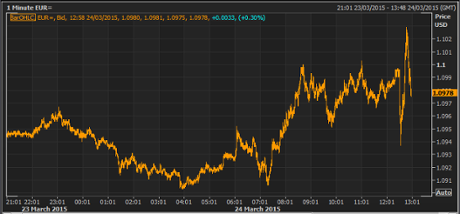
As Ashraf Laidi, Chief Global Strategist at Cityindex.com, it’s still not clear whether the Federal Reserve will feel confident to raise interest rates soon:
The fact that core CPI (excluding volatile food and energy items) edged up to 1.7% from 1.6%, helps explain that the disinflation-bound trend in US retail prices is largely driven by the oil declines, which suggests that a continue stabilization in energy prices could lift headline CPI back towards the 1.0% level.
Yet, it would take an unlikely sharp and prolonged rally in oil prices in order for headline CPI to approach the Fed’s 2.0% objective and pave the way for a lift off in US interest rates.
Updated
Yesterday’s Merkel-Tsipras meeting makes the front pages in Germany too:
#Greece Tsipras-Merkel meeting on the front pages in #Germany pic.twitter.com/1ITRFThwfl
— Yannis Koutsomitis (@YanniKouts) March 24, 2015

Over in Greece, the media reaction to last night’s meeting between Alexis Tsipras and Angela Merkel is generally positive.
But behind the scenes, some members of Tsipras’s government aren’t happy.
Helena Smith reports from Athens:
Greek newspapers this morning may have seen prime minister Alexis Tsipras’ visit to Berlin as a much-needed ice-breaker – with the government friendly Efimerida ton Syntakton hailing it as a “civil partnership”– but in Athens the battling lines are being drawn within the leader’s Syriza party.
Panagiotis Lafazanis, the energy minister who as head of the party’s militant wing, the Left Platform is effectively the number three in the government, reacted with fury this morning to the prospect of the national electricity company DEH, being privatised.
A united and public DEH was non-negotiable, he says.
“To privatize it would be a catastrophe for the economy,” he said adding that the leftist-led government’s goal was an exit from the crisis by pursuing policies of job-creating growth.
Lafazanis insisted:
“The government is trying to open positive paths for the people so that their income can return to pre-memorandum levels. It’s a titanic quest and it will be achieved whatever the pressures, threats, blackmailing and difficulties.”
The intervention underscored the difficulties the ruling coalition is likely to face when it is forced to vote legislation through parliament.
Speculation in Athens is rising that Tsipras may have to dump his far left comrades and seek backing from other pro-reform parties – but we are a long way off from that yet. HS
US inflation rises, to zero
Just in: US inflation was zero on an annual basis last month, matching the UK’s reading this morning.
But in America’s case, that’s actually an increase from the -0.1% CPI recorded in January.
Headline inflation rate now the same in US and UK
— MineForNothing (@minefornothing) March 24, 2015
Prices increased by 0.2% on a month-on-month basis, reversing a 0.7% tumble in January, as fuel prices picked up.
And core inflation, which strips out volatile elements, has risen to 1.7%. That suggests inflationary pressures may be increasing - putting a summer interest rate rise back on the agenda, perhaps.
Dollar index shoots higher after that CPI report pic.twitter.com/9MFDvzYmeE
— Joseph Weisenthal (@TheStalwart) March 24, 2015
Alexis Tsipras has also visited the Holocaust Memorial in Berlin today, as part of his first visit as Greek prime minister.


The FT’s Gideon Rachman has heard that Germany could provide some financial aid to Greece, in recognition of the horrors of the second world war.
German official tells me reparations to Greece are possible. But must be targeted at communities that suffered, not general govt budget
— Gideon Rachman (@gideonrachman) March 24, 2015
That may be related to the Future Fund, which was set up last year to address the issue.
Greece’s prime minister tweets that he’s met with the leaders of Germany’s left-wing opposition parties, a day after his talks with Angela Merkel.
Meeting earlier today in Berlin w/@katjakipping @GregorGysi of @dieLinke @europeanleft #Greece #Syriza pic.twitter.com/j2gNcxoGYw
— Alexis Tsipras (@tsipras_eu) March 24, 2015
Germany: Relationship with Greece has improved
Time to turn back to the Greek debt crisis.
And German foreign minister Frank-Walter Steinmeier has told reporters in Berlin that relations between the two counties have improved.
Steinmeier (who has met with Alexis Tsipras today), said:
“I’m pleased that the atmosphere in German-Greek talks in recent days has changed and improved significantly.
And that warming of relations should help “serious talks” begin about Greece’s debts, he added.
Meeting earlier today with the German Foreign Minister, Frank-Walter Steinmeier #Greece pic.twitter.com/Q81pbl9yGj
— Alexis Tsipras (@tsipras_eu) March 24, 2015
Here’s Angela Monaghan’s news story on UK inflation:
And here’s Larry Elliott’s full analysis:
Updated
The TUC is also concerned about the underlying state of the UK economy.
General secretary Frances O’Grady said:
“Zero inflation is a reminder of how fragile the economy remains. Stagnating prices are not a sound foundation for the strong and sustained pay rises that workers have waited so long for.
“With deflation on the horizon, the Chancellor’s plans for extreme cuts after the election look more and more like a suicide note for the UK economy.”
Worth remembering that the Bank of England’s task is to keep inflation at 2% in the medium-term, not at zero....

With the election just 44 days away, the opposition Labour party isn’t giving the government much credit for Britain’s inflation data.
Cathy Jamieson MP, Labour’s Shadow Treasury minister, says:
“Inflation is falling around the world because global oil prices have plummeted, yet in Britain wages continue to be sluggish.
“Working people are £1,600 a year worse off under this government. And another Tory VAT rise if David Cameron wins the election will hit living standards and send prices rising again.
“A few months of falling world oil prices won’t solve the deep-seated problems in our economy. We need Labour’s better plan to build a more productive economy so we can earn our way to sustained rises in living standards and so get the deficit down too.”
Updated
Some historical context:
Updated
The prime minister and chancellor shouldn’t be too complacent about the dangers of deflation, argues Ranko Berich, Head of Market Analysis at Monex Europe.
He points to the fact that price rises have slowed, or started falling, across the economy (see earlier chart).
George Osbourne and David Cameron have been quick to write off the ‘noflation’ as purely a symptom of lower fuel prices, pointing to the positive aspects of low inflation for British households.
While this argument certainly has some weight, today’s data also showed year-on-year deflation in five categories, including food, as well as slower price increases across many others. This suggests that the UK could well be succumbing to the wave of low inflation that has swept the eurozone, and a sustained period of deflation remains a key risk.
Inflation to fall into negative territory
David Kern, Chief Economist at the British Chambers of Commerce, also predicts that Britain’s inflation rate will fall below zero:
“These historically low figures reinforce our belief that inflation will fall into slightly negative territory in the coming months, before returning to a positive trend before the end of the year. However, we remain convinced that there is very little risk of a long period of deflation.
“Inflation in the service sector, which accounts for 80% of the UK economy, remains firmly above the government’s 2.0% target, and core CPI inflation in February was 1.2%. Together with higher earnings, lower inflation is boosting people’s spending power, and will contribute to economic growth in the year ahead.
“To sustain business confidence we need a firm commitment from the MPC to keep interest rates on hold until at least early 2016.”
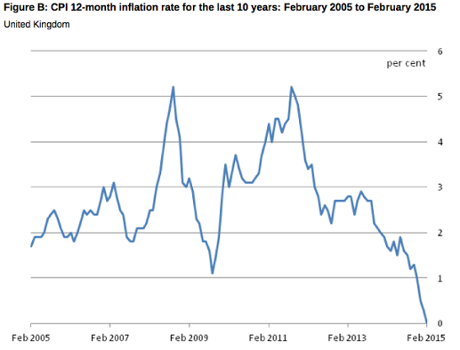
Here's a chart showing CPI inflation over the last 10 years . It hit a record low of zero in February. pic.twitter.com/94fLg0Pmrl
— Julia Kollewe (@JuliaKollewe) March 24, 2015
Danielle Haralambous, UK analyst at the Economist Intelligence Unit, agrees that we should welcome this period of no-flation.
“The likelihood that we are on the verge of a period of deep and prolonged deflation in the UK remains slim.
Recent deviations in inflation from target have been largely driven by lower food and energy costs, which will provide a welcome boost to real household incomes and support prospects for the demand-driven recovery.”
Spot the pattern:
The CPI figures: it is not just energy, IMHO. Everything appears to be <2% pic.twitter.com/rwLZtIGYnQ
— Giles Wilkes (@Gilesyb) March 24, 2015
A wider measure of inflation, the retail prices index, also fell last month.
But unlike CPI, RPI showed that prices rose by around 1.0% annually. That’s the lowest since November 2009.
Updated
The drop in inflation has driven the London stock market to a new record high.
The FTSE index has jumped by another 24 points, or 0.35%, to 7062.
The pound has weakened, hitting a one-month low against the euro at €1.36, down from €1.365 yesterday.
Both moves show that traders believe UK monetary policy will remain extremely loose for some time. Last week, indeed, the Bank of England’s chief economist Andy Haldane suggested that an interest rate cut is as likely as a rise.
Updated
The elimination of inflation, however temporarily, is simply good news for the UK, argues Rob Wood of Berenberg Bank:
Cheaper imports, petrol and food are unmitigated good news for consumers and growth, which shows up in high consumer confidence.....
He reckons there’s little danger of Britain suffering full-blown deflation - a protracted period of falling prices, when people are reluctant to spend.
The UK can sit back and enjoy the purchasing power boost that low inflation today is bringing without fearing any of the sillier claims of what ‘deflation’ might bring, like households delaying purchases on the expectation that prices will be even lower tomorrow.
Larry Elliott: What zero inflation means for you

The drop in inflation to zero means that living standards are going up, and interest rates are going nowhere soon. And it may mean that pay rises will be less generous.
Our economics editor Larry Elliott explains:
Britain is on the cusp of a period of deflation. It is the first time on record that inflation, measured by the consumer prices index, has hit zero, since the measure was created in 1989. This has three implications, two of them obvious, one less easy to assess.
The first is that living standards will rise. Average earnings are growing by just less than 2% a year, so with prices not rising at all people will find their wages and salaries go further.
The second implication is that there is likely to be a further delay before the Bank of England raises interest rates. The latest fall in inflation came as no surprise to Threadneedle Street but its nine-strong monetary policy committee is going to be in no hurry to raise the cost of borrowing.
That’s because it will want to see what zero inflation does to wage bargaining. At the moment, it is assumed that the fall in the cost of living is temporary and that inflation will pick up later this year. But it would be a different story if low inflation led to less generous pay settlements. If that were to happen, deflation could become tough to shift, as has been the case in Japan.
“We are looking for a couple of months of deflation in the UK”, predicts Jeremy Cook, chief economist at the international payments company, World First.
Enjoy no-flation while you can.
The CBI’s director of economics, Rain Newton-Smith, reckons it’s a temporary situation:
“Despite inflation dropping to zero, it is unlikely we will see falling prices for a prolonged period, particularly as the pressure from lower oil prices fades.
There’s little chance of the Bank of England raising interest rates anytime soon, Newton-Smith adds.
Chancellor George Osborne gives some of the credit to the falling oil price.....
Inflation at zero is a first for the British economy. Low inflation due to falling oil prices is good news for family budgets
— George Osborne (@George_Osborne) March 24, 2015
...before following up with another of his witty puns.
Prices are frozen & as the recovery from Labour's Great Recession strengthens, their economic argument has literally come to nought
— George Osborne (@George_Osborne) March 24, 2015
Cameron: Zero inflation is good news for families
The drop in inflation means that real incomes in the UK continues to rise, after declining for several years.
British pay packets are rising by 1.8% annually (or 1.6% excluding bonuses) according to the latest data. So with inflation at zero, so are real incomes.
The prime minister has leapt on the news:
Inflation is running at 0% - the lowest on record. It's good news for family budgets and a sign our long term plan is working.
— David Cameron (@David_Cameron) March 24, 2015
Updated
Economists reckon that the UK is now heading into a period of negative inflation:
Inflation at 0%. But it's not so much the level as the trajectory that's striking. #noflation pic.twitter.com/I6eIZuEjLT
— James Plunkett (@jamestplunkett) March 24, 2015
Zero inflation in February is lower than the markets expected and virtually guarantees a period of temporary deflation in coming months.
— David Smith (@dsmitheconomics) March 24, 2015
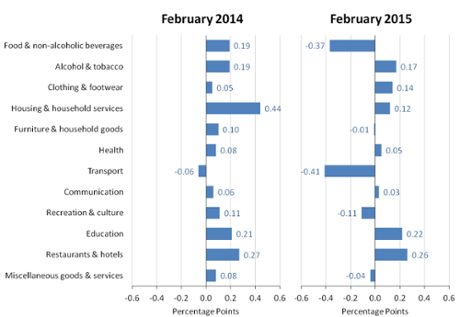
Inflation: the key charts
This table confirms that food and transport costs dragged inflation down to zero:
And this chart is a reminder that inflation spent most of the last seven years above the official target of 2%, before its recent slide:
Updated
The last time UK CPI was this low, Lonnie Donegan was number 1 with "My Old Man's a Dustman". March 1960.
— Duncan Weldon (@DuncanWeldon) March 24, 2015
This is the first time on record that the consumer prices index has hit zero, according to figures going back to 1989.
The ONS suggest that inflation may have been lower in 1960, though, according to Reuters.
Updated
UK food prices fall 3.4%
The drop in inflation was caused by a big drop in food prices, which fell by 3.4% in the year to February.
Motor fuels tumbled by 16.6%, due to the sharp fall in oil prices in recent months.
The Office for National Statistics also attributes the fall to:
“price movements for a range of recreational goods (particularly data processing equipment, books and games, toys & hobbies), food and furniture & furnishings.”
This is a bigger fall in inflation than expected.
Economists had predicted that the consumer prices index would slide to just 0.1% in February, down from 0.3% in January. But instead, CPI has come in at exactly zero.
UK inflation falls to 0.0%
Breaking: The UK inflation rate has fallen to zero for the first time on record.
More to follow.....
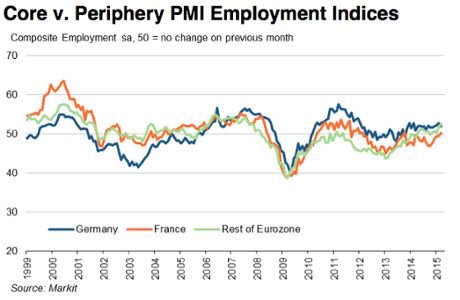
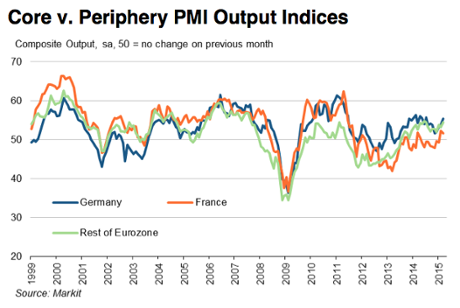
France is lagging behind the rest of the eurozone for job creation, and output growth, according to Markit’s new PMI survey.
Eurozone recovery: what the experts say
Economists are cheering the news that the eurozone private sector is growing at the fastest rate since May 2011:
Strong PMIs in Eurozone and Germany indicate that QE is working.
— Carsten Brzeski (@carstenbrzeski) March 24, 2015
CHART: Euro-area Q1 #PMI suggest fastest growth in 15 quarters. New orders/stock ratio highlights recovery momentum. pic.twitter.com/npQJaVcz03
— Maxime Sbaihi (@MxSba) March 24, 2015
FYI, today's decent #Eurozone #PMI and solid #Germany data point to beneficial combined impact of weaker #oil ,depreciated #Euro & @ECB #QE
— Mohamed A. El-Erian (@elerianm) March 24, 2015
Eurozone private sector growth hits near four-year high
The eurozone recovery is alive and well.
Firms across the euro are growing much faster than expected this month, according to Markit’s latest survey of the sector.
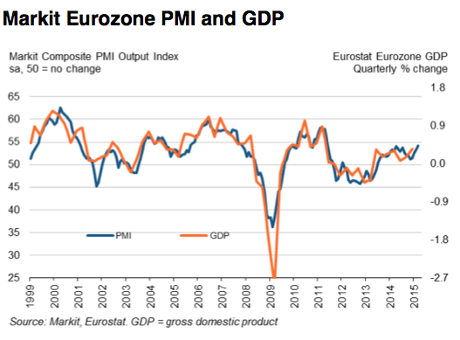
The eurozone composite PMI, just released, smashed expectations by jumping to 54.1 this month, up from 53.6 in February. That’s the highest reading since May 2011, driven by a recovery in the service sector.
As mentioned earlier in the blog, Germany is growing at its fastest rate for 10 months, while growth in France eased back.
But importantly, the rest of the eurozone is enjoying strong growth; new order growth and job creation was both the strongest since mid-2007.
It suggests the eurozone economy is picking up pace, and should get another boost from the European Central Bank’s new quantitative easing programme.
Chris Williamson, chief economist at Markit said:
“The eurozone’s economic recovery gained further momentum in March, with the PMI hitting its highest for almost four years. The improvement provides welcome news to a region awaiting signs that the ECB’s quantitative easing is stimulating the real economy.
Deflationary pressures ‘eased’ this month, Williamson says, suggesting the eurozone will avoid a deep deflationary spiral. He adds:
The survey data therefore indicate that the ECB’s quantitative easing has been started at a time when the eurozone’s economic upturn is already starting to gain traction. This augurs well for the region to enjoy further improvements in business conditions as the year proceeds, helping drive greater business investment and hiring, and thereby ensuring that the recovery becomes sustainable.
Eurozone PMI data better then expected. ThanQE Draghi
— Mike van Dulken (@Accendo_Mike) March 24, 2015
Updated
The euro has jumped half a cent against the US dollar on the back of the news that the German economy is accelerating.
#Euro nudges to fresh day high $1.0998 after upbeat German PMIs. German Mar Composite PMI Flash 55.3 vs 55.0 expected pic.twitter.com/GIdS4b3QyE
— Holger Zschaepitz (@Schuldensuehner) March 24, 2015
Not that it’s a huge shock.
Very strong German composite PMI. Don't act as you're surprised.
— Frederik Ducrozet (@fwred) March 24, 2015
Strong economic data from Germany - its private sector is growing at the fastest rate in eight months.
The German composite PMI has risen to 55.3, from 53.8 in February - meaning 23 months of consecutive growth. Manufacturing and services both grew at a faster rate.
Germany is entering the “domestic fast lane again”, says Markit economist Oliver Kolodseike.
The composite #PMI of #Germany rises to 55.3 proving that it's economy is in rude health and does not need #ECB #QE
— Shaun Richards (@notayesmansecon) March 24, 2015
Updated
Hopes that France’s economy was recovering have just taken a knock.
Markit’s monthly healthcheck of the sector shows that growth in France’s private sector slowed this month.
The French composite PMI fell to 51.7 this month, down from 52.2 in February [where any reading over 50 = growth]. Service sector expansion slowed, while factory output continued to fall.
The data implies a ‘modest’ rise in GDP this quarter, Markit says.
CHART: France struggling to catch euro-area recovery wave as March #PMI disappoint. Still, growth accelerated in Q1. pic.twitter.com/IF05nBkTdA
— Maxime Sbaihi (@MxSba) March 24, 2015
Soros: 50% chance Greece will quit the euro

Billionaire philanthropist George Soros has declared there’s a 50:50 chance that Greece will leave the eurozone, due to the mistakes of the past.
Soros made the comments in an interview with Bloomberg, being broadcast later today.
In it, he warned that:
“It’s now a lose-lose game and the best that can happen is actually muddling through....Greece is a long-festering problem that was mishandled from the beginning by all parties.”
The 84-year old, who famously beat the Bank of England on Black Wednesday, also said that the deadlock between Greece and its creditors is hurting its economy badly. As a result, “Greece is going down the drain.”
More details here: Soros Says Greece Is Now ‘Lose-Lose Game’ After Being Mishandled
Greece’s three-year government bonds are strengthening, a little, on the back of today’s comments from Athens, and from Martin Schulz:
#Greece's yields drop as EU's Schulz sees deal with #eurozone likely this week. http://t.co/8m2gsl6YDh pic.twitter.com/XiXoBTvVdD
— Holger Zschaepitz (@Schuldensuehner) March 24, 2015
Yields are still very high, around 21%, implying a high risk of default.
Updated
Schulz: Deal could come this week
Another optimistic sign - European Parliament chief Martin Schulz has predicted that Greece and its creditors could secure a breakthrough this week.
He told Italy’s La Repubblica that:
“I think by the end of this week a new deal will be reached that should be sufficient to release the most urgent financing,”
Greece would then have “not more than three months” to present a “credible, detailed and definitive” plan, Schulz added.
That makes sense; Greece’s current bailout extension runs until the end of June.
Alexis Tsipras is still in Berlin, and due to meet with the leaders of Germany’s opposition Left and Green parties.
Germany’s Deutsche Welle newspaper reports that Angela Merkel and Alexis Tsipras spoke until almost midnight about the situation in Europe, at their ‘working dinner’
Chancellor Merkel’s spokesman Steffen Seibert told reporters late last night that:
“The chancellor and the Greek prime minister had a comprehensive discussion in a good and constructive atmosphere about the situation in Greece, the procedures of the European Union and future German-Greek cooperation,”
Greece: We'll present reform package by Monday
News from Athens: Greece will present a new reform programme to its creditors by next Monday, potentially unlocking bailout funds and averting the risk of bankruptcy.
The news comes less than 12 hours after prime minister Alexis Tsipras and Angela Merkel ended their talks in Berlin.
Reuters has the details:
Greece will present its proposed package of reforms to its euro zone partners by next Monday in hopes they will release much needed cash, its government spokesman said on Tuesday.
“It will be done at the latest by Monday,” government spokesman Gabriel Sakellaridis told Mega TV.
Greek Prime Minister Alexis Tsipras met with German Chancellor Angela Merkel in Berlin on Monday but it was unclear if they had narrowed differences on economic reforms Athens must implement to win urgently to get fresh aid from its creditors.
Sakellaridis said the package of reforms Athens will propose will not contain recessionary measures but structural changes.
He said Tsipras and Merkel on Monday discussed the outline of the reforms but did not go into depth.
“I believe points of convergence were found,” Sakellaridis said.
Time is short; on April 9th , Greece must repay €467m to the International Monetary Fund.
If it does convince its creditors next week, then they could unlock some of the €7.2bn bailout tranche which is being withheld.
This could call for another crunch meeting in Brussels.....
Greece plans present its proposed package of reforms to the eurogroup on Monday. So, see everyone in Brussels for a late night Tuesday? Mon?
— HansNichols (@HansNichols) March 24, 2015
The Agenda: Greek developments and UK falling inflation
Good morning, and welcome to our rolling coverage of the world economy, the financial markets, the eurozone and business.
Today we’ll be assessing the situation in Greece after yesterday’s visit by Alexis Tsipras to meet Angela Merkel.
The two leaders struck a fairly conciliatory tone during last night’s press conference [even though Tsipras mentioned the war reparations], but there’s no sign yet of a breakthrough deal to unlock fresh funds for Greece.
In the UK, we get the latest inflation data at 9.30am – and economists reckon it could fall to just 0.1% as low energy costs ripple through the economy.
On the economic side, the latest PMI surveys are being released this morning (from 8am to 9am GMT) They are expected to show the eurozone’s manufacturing and service sectors continuing to expand this month as the slow recovery continues.
We’ve already had downbeat news from China -- its factory activity has fallen to an 11-month low, suggesting its economy is slowing down. More stimulus could be needed....
China HSBC PMI 49.2 adds to jan/feb soft data. Suggests gdp below 7pct. Ditto Q2, and of course, rate and RRR cuts soon, infra sp later
— George Magnus (@georgemagnus1) March 24, 2015
European stock markets are expected to dip this morning.
Our European opening calls: $FTSE 7021 down 16 $DAX 11863 down 33 $CAC 5042 down 12 $IBEX 11446 down 7 $MIB 23049 down 8
— IGSquawk (@IGSquawk) March 24, 2015
I’ll be tracking all the main events through the day....
Updated












