European markets close higher with FTSE breaking 7000
Hopes that Greece can resolve its financial crisis following Thursday’s late night mini-summit gave markets a lift, while the US Federal Reserve’s comments this week on interest rates also helped sentiment. The FTSE 100 finally breached the 7000 barrier, with European markets and Wall Street all moving higher. The final scores showed:
- The FTSE 100 finished 60.19 points or 0.86% higher at 7022.51
- Germany’s Dax added 1.18% to 12,039.37
- France’s Cac was 1% higher at 5087.49
- Italy’s FTSE MIB climbed 1.63% to 23,176.68
- Spain’s Ibex ended up 2.96% 11,419.6
- The Athens market added 2.87% to 744.42
On Wall Street the Dow Jones Industrial Average is currently 227 points or 1.26% higher.
And on that note, it’s time to close up for the evening. Thanks for all your comments, and we’ll be back next week.
Over in the US, Wall Street is now 180 points higher on hopes that any US interest rate rises will be gradual. The move higher in the US was the final push needed to see the FTSE 100 safely over 7000, with the UK index also helped by the more encouraging prospects for Greece after the summit.
Meanwhile it appears the June, July and September Federal Reserve meetings are all under consideration for a US rate rise. That comment has come from Atlanta Fed president Dennis Lockhart. He said the economy was still giving off mixed signals, and he expects slower growth than he did before, but mid-year is still a good time for an increase in borrowing costs.
Fed’s Lockhart: Says June, July & Sept Are All Possible Dates For FOMC Lift-Off
— Live Squawk (@livesquawk) March 20, 2015
Fed’s Lockhart: Could Delay Lift-Off If Economy Proves Weak
— Live Squawk (@livesquawk) March 20, 2015
Fed’s Lockhart: Recent Data Softness Seen As 'Transitory'
— Live Squawk (@livesquawk) March 20, 2015
Fed’s Lockhart: Cuts Forecast For 2015 Growth, Maintains 2016-2017 Outlook
— Live Squawk (@livesquawk) March 20, 2015
Fed’s Lockhart: Mid-Year Or Some Time After Is An Appropriate Time For Lift-Off
— Live Squawk (@livesquawk) March 20, 2015
Updated
Here’s the Reuters take on the press conference given by Greek prime minister Alexis Tsipras after the Euro summit in Brussels:
The prime minister underlined that the so-called fifth review does not exist anymore and that the Greek authorities will have the responsibility to draw up and implement the list of reforms.
He also said that in the summit meeting it was reaffirmed, on the highest possible level, that Greece is faced with a humanitarian crisis that will have to be addressed jointly.
The prime minister underlined that there is no problem of short-term liquidity for the Greek economy, adding that “our obligations to the citizens and the European institutions will be met, while bank deposits are secure.”
He called on the Greek citizens to be calm and noted that “we will not be overcome by the atmosphere of insecurity,” warning that those who want to play with the stability of the Greek economy and the banking system try in vain.
The recession measures are over, Tsipras repeated.

Updated
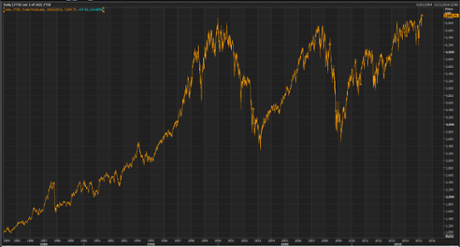
FTSE hits 7000 for the first time
Meanwhile in the UK, the FTSE 100 has hit 7000 for the first time, 17 years after reaching 6000.
Updated
Despite the positive aspects of last night’s mini-summit, leaks out of Greece suggest the meeting was not all smiles, reports Helena Smith:
Greek media are reporting that while prime minister Alexis Tsipras got to sit at high table with Europe’s power brokers last night, he also came under immense pressure from the German chancellor Angela Merkel and EU commission chief Jean-Claude Juncker. Both expressed their frustration with Athens’ perceived foot-dragging with Merkel making clear that she wanted specifics on what reforms would be brought to parliament and what privitizations the government would proceed with. “The prime minister emphasised that he was not opposed to privatizations but on the condition that they were supported by international cooperation and would help spur jobs and growth,” the well-briefed news portal Newsit reported.
Juncker voiced his irritation at the way technical teams representing creditors had been treated in Athens in recent weeks. The EU commission chief also expressed displeasure with statements made by the Greek finance minister Yanis Varoufakis. “Neither the scene nor the dialogue was laid with rose petals for the Greek prime minister,” wrote Newsit.gr.
And with that, it’s over.
On tax evasion, Tsipras said there was a total of €2bn worth of which he believed €800m was accessible.
“Next week we will welcome a minister from Switzerland to have a discussion about the Greek depositors and to get an agreement with [the Swiss]”.
GREEK PM TSIPRAS: DRAGHI SAID THAT HE IS MORE OPTIMISTIC AFTER TALKS - MNI
— Fabrizio Goria (@FGoria) March 20, 2015
He brushed off suggestions finance minister Varoufakis was a source of problems with its partners, and also said it was not a clash between Greece and Germany, but an EU situation.
“I cannot say to Chancellor Merkel you should change your ministers, it is a sovereign issue.”
#Tsipras: sovereign rights of the member states are and should be respected #EUCO
— Open Europe (@OpenEurope) March 20, 2015
Updated
On the summit he said he thought there was a common understanding, there was an opportunity to build up a relationship and restore confidence.
But he criticised people trying to undermine the February 20 agrement: “we can’t accept people trying to terrorise the Greek people.”
And he mentioned - unflateringly - the comments by Eurogroup head Jeroen Dijsselbloem that capital controls like those used in Cyprus could be used in Greece.
#Tsipras: because former govt didn't deliver on its commitments, we have to make some tough payments
— Open Europe (@OpenEurope) March 20, 2015
#Tsipras: previous govt's were tied to vested interests, we are accountable only to the Greek people #Greece
— Kathimerini English (@ekathimerini) March 20, 2015
He admitted they were in uncharted waters. “with our own lack of experience.” But “we have been negotiating effectively. We are open to receiving advice and so on, but we have our own opinions.”
GREEK PM TSIPRAS: POLLS SHOW LARGE MAJORITY OF GREEKS SUPPORT SYRIZA - MNI
— Fabrizio Goria (@FGoria) March 20, 2015
Updated
EU offers Greece 2 bln euros in unused development funds http://t.co/6YEDg9ZNEf
— Kathimerini English (@ekathimerini) March 20, 2015
GreeceTsipras says agreed with Merkel that suitable primary surplus, not pvs target will be used, and recessionary measures are over - RTRS
— Fabrizio Goria (@FGoria) March 20, 2015
RT @MacroPolis_gr: Greek PM @atsipras says gov't still aiming for primary surplus of 1 to 1.5 pct of GDP this year #Greece #EUCO
— Efthimia Efthimiou (@EfiEfthimiou) March 20, 2015
GREEK PM TSIPRAS SAYS BOTH US AND GERMANY'S MERKEL AGREED TO FORGET COMMITMENTS OF THE PREVIOUS GREEK GOVT
— FxMacro (@fxmacro) March 20, 2015
Not sure Merkel has confirmed that yet...
If Greek PM & Merkel have agreed "to forget" previous agreements, then that's a huge development...!
— Joe Bond (@Joe_Trading) March 20, 2015
Updated
* Greek PM tsipras says having put Feb accord back on track, we can move fast to decisions that will resolve funding problems - RTRS
— Fabrizio Goria (@FGoria) March 20, 2015
GREEK PM TSIPRAS: SUMMIT WAS POSITIVE FOR GREECE; WE'LL GET EU FUNDS - MNI
— Fabrizio Goria (@FGoria) March 20, 2015
GREEK PM TSIPRAS: CRUCIAL TO IMPLEMENT AGREEMENTS; WE'LL BE VIGILANT - MNI
— Fabrizio Goria (@FGoria) March 20, 2015
Updated
Greek PM Tsipras: No Immediate Liquidity Problem In Greece, Bank Deposits In Greece Are Secure
— Live Squawk (@livesquawk) March 20, 2015
#Greece PM: There’s absolutely no problem with the short term liquidity in Gr economy
— Efthimia Efthimiou (@EfiEfthimiou) March 20, 2015
Updated
Tsipras: Greece won't implement recessionary measures
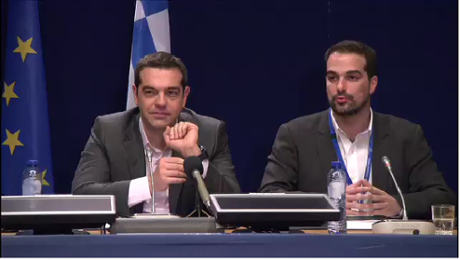
Alexis Tsipras has begun speaking:
Greek PM Tsipras: Says There Will Be No Implementation Of Recessionary Measures
— Live Squawk (@livesquawk) March 20, 2015
Tsipras: Says There Wonts Be 5th Review Of Previous Bailout
— Live Squawk (@livesquawk) March 20, 2015
Tsipras: Greece To Implement Own Reforms
— Live Squawk (@livesquawk) March 20, 2015
Updated
Heads-up. Greek PM Alexis Tsipras is about to brief the press in Brussels. I think it will be streamed live here.
Tusk: Treaty change is Mission Impossible....
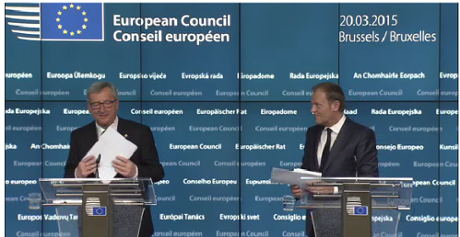
European Council president Donald Tusk has been asked whether David Cameron might be able to renegotiate Britain’s position in Europe if he wins May’s general election.
Tusk replies that achieving Treaty changes are almost like Mission Impossible -- a point he made to The Guardian in an interview a week ago.
But he then explains that Mission Impossible is a film with a happy ending. Tusk wants to find a solution that addresses the UK’s concerns, while keeping the “fundamental values” of the EU. [he doesn’t elaborate, but I guess this includes movement of labour].
We need to find good solutions for the United Kingdom under current treaties...But if necessary we can talk about Mission Impossible with goodwill to win in the end.
He’s sure that David Cameron understood that.
#Greece In game of pride & impressions, Merkel's pt that Athens "will own reforms" is hugely significant
— Helena Smith (@HelenaSmithGDN) March 20, 2015
The Greek message has got through:
EU's Juncker: #Greece is going through a 'humanitarian crisis' (DJ)
— Holger Zschaepitz (@Schuldensuehner) March 20, 2015
Angela Merkel adds that she may discuss Greece’s reform plans with Alexis Tsipras on Monday, when he visits Berlin.
Merkel: Tsipras's visit to Berlin Mon not the time for a list of reforms - they must go to institutions. But we may discuss bilateral help
— Tom Nuttall (@tom_nuttall) March 20, 2015
But she won’t be drawn on Greece’s demands for WW2 reparations:
Merkel: won't comment on whether war reparations issue will come up in Monday's meeting w @atsipras.
— Tom Nuttall (@tom_nuttall) March 20, 2015
Merkel: Greece will own its reforms
Angela Merkel is fielding questions on the Greek bailout talks now.
She’s insisted, several times, that Greece will only get its bailout funds if its lenders are satisfied that it has met the terms of its aid programme.
Merkel also pledged that Athens will have ‘ownership’ of the reforms, and denied that she considered that Greece might leave the eurozone.
Tom Nuttall of The Economist has won himself a bottle of Guardian whisky by tweeting the details:
First question is about Greece: when exactly can bailout disbursements take place, on presentation or review of reform list?
— Tom Nuttall (@tom_nuttall) March 20, 2015
Merkel: we adhere to.Feb 20 statement, any disbursement is only possible.on.conclusion of the.review by the institutions.
— Tom Nuttall (@tom_nuttall) March 20, 2015
Merkel: Greek govt will have ownership of reforms and will present list in coming days. Ireland was able to replace some proposed reforms.
— Tom Nuttall (@tom_nuttall) March 20, 2015
Asked if accidental Grexit possible, Merkel says she has never discussed it and will not do so now.
— Tom Nuttall (@tom_nuttall) March 20, 2015
Merkel: overwhelming agreement among Council members that this is the right course on Greece.
— Tom Nuttall (@tom_nuttall) March 20, 2015
Tusk: Greek talks helped rebuild trust
In the main press conference room, European Council president Donald Tusk says it was useful to have a ‘reality check’ on the Greek situation.
Last night’s talks were an important step towards rebuilding trust, he adds, before a technical gremlin strikes:
#eu council president Donald Tusk is having some problems with his speech#euco press conference pic.twitter.com/UQWSsygOXg
— Ewelina Kawczynska (@ewelinanews) March 20, 2015
What the fuck was that? Tusk seems to have run out of notes and he seemed completely lost. #euco
— Adam Malczak (@Adam_Malczak) March 20, 2015
If I’m reelected, I’ll have a powerful mandate to deliver change in our relationship with Europe, says David Cameron.
David Cameron also touches on the issue of a referendum on Britain’s EU membership.
The most important thing is to change Britain’s relationship with Europe once and for all, he says.
Updated
#EUCO is over. PM Cameron @Number10gov press conference shortly. @Number10press pic.twitter.com/VzNVmJji78
— UKREP (@ukineu) March 20, 2015
Cameron gives press conference
David Cameron is giving a press conference too - at what might possibly be his last European Council summit.
With the general election looming, the PM declares Britain has made strong progress since his first EUCO in 2010.
We have created more jobs than the rest of the eurozone and indeed Yorkshire has created more jobs than France (that’s a reheated line from Wednesday’s budget)
Cameron also says that Eastern Ukraine was also on the agenda. He’s pleased that leaders have agreed that Russian sanctions will not be eased until the Minsk agreements have been implemented in full.
Angela Merkel is telling reporters that Mario Draghi urged Eurozone countries to continue with their economic reforms. They must not slacken, just because the low oil price is providing a stimulus.
And she pointedly points out that Ireland, the austerity poster-boy, is now growing strongly.
Merkel: interesting to hear.from taoiseach that Ireland has Europe's best growth rate. Spain and Portugal also briefed us on their success
— Tom Nuttall (@tom_nuttall) March 20, 2015
And she cites Middle Eastern terrorism as a major concern:
Merkel: influence of IS is growing perceptibly in Libya, this is a huge problem for Europe.
— Tom Nuttall (@tom_nuttall) March 20, 2015
Angela Merkel waits for no man, not even if he’s struggling with his headphones...
And we're off. pic.twitter.com/UHfbhmzDNu
— Tom Nuttall (@tom_nuttall) March 20, 2015
Angela Merkel will give a press conference soon too:
Summit over. Now #WaitingForMerkel. pic.twitter.com/sBhhDmQ2Qv
— Tom Nuttall (@tom_nuttall) March 20, 2015
But will foreign journalists know what she says?
Have the #Germans given up? Translation headphones a complete mess...never seen that before. #BadOmen? pic.twitter.com/1u4rnCPEK9
— Peter Spiegel (@SpiegelPeter) March 20, 2015
Brace yourselves; we’re about to get a flurry of press conferences in Brussels.
With any luck, the press pack will tweet the key points from the various briefings (thanks in advance!).
Donald Tusk and Jean-Claude Juncker are going to speak to the press now; there’s a live stream here.
The Brussels summit is over.
The EC’s top spokesman tweets that that progress has been made on several issues.
#EUCO over. Good progress on all fronts: #EnergyUnion, #InvestEU, economic governance, #TTIP, #Ukraine, #Tunisia, #Libya.
— Margaritis Schinas (@MargSchinas) March 20, 2015
Not Greece? That’s because its bailout wasn’t officially on the EUCO agenda, despite last night’s meeting on the ‘sidelines’
Finland’s PM confirms that the lid is on.
Conclusions done. #EUCO ends. Have a nice weekend.
— Alexander Stubb (@alexstubb) March 20, 2015
Lunchtime summary: Optimism for Greek progress
A quick recap, while we wait for EU leaders to finish their summit in Brussels
An uneasy calm has descended on the eurozone, following last night’s meeting on the Greek bailout in Brussels.
Greek bonds are rallying, following reports that €1.9bn of bailout funds could be handed over to Athens soon, if it delivers an updated reform plan to its creditors.
#Greece ripping tighter on conciliatory headlines.... pic.twitter.com/59fjC0mSA3
— Credit Macro PM (@lebullmarche) March 20, 2015
The Greek government is upbeat, vowing to work in a ‘constructive spirit’ with lenders.
Greece hopes that it might receive much-needed funds once it has presented credible reforms.
Finance minister Yanis Varoufakis hopes it can be a watershed moment in eurozone relations, saying:
Let us implement it immediately, as our leaders have urged in yesterday’s informal Brussels meeting.
Looking ahead, and beyond current tensions, our joint task is to re-design Europe so that Germans and Greeks, along with all Europeans, can re-imagine our monetary union as a realm of shared prosperity.
There’s talk that eurogroup finance ministers could meet again soon, possibly on Friday. That’s pushing down the yield on Greek bonds:
#Greece govt bond yields fall 37 bps. Earlier: Eurogroup may meet as soon as March 27 to approve EUR1.9B SMP aid: BBG pic.twitter.com/vq0XQBG19a
— Richard Bravo (@richbravo2) March 20, 2015
Analysts, though, warn that relations between Berlin and Athens remain poor.
Germany has pointed out that nothing has fundamentally changed; Greece must still deliver concrete reforms.
It’s not clear what reforms Greece will now present; hard-line left-wingers in the Greek government could block new austerity measures.
And don’t forget that any deal only gets Greece to the end of June. A third bailout may still be needed:
Capital Economics - 'Greece still hanging by a thread' pic.twitter.com/UeDQftnVtp
— Mike Bird (@Birdyword) March 20, 2015
Updated
The word in Brussels is that Greece could (finally) receive €1.9bn from its bailout funds soon, if it pleases its creditors.
*EUROGROUP COULD GIVE #GREECE EU1.9B SMP PROFITS: OFFICIAL
— Credit Macro PM (@lebullmarche) March 20, 2015
That’s the profit that creditors made on their holdings of Greek bonds which, not unreasonably, is due to be returned to Athens.
Updated
As well as building bridges with Germany Greek prime minister Alexis Tsipras must also handle his own Syriza party.
As Helena Smith explains, diehard leftists will simply not accept new austerity measures:
Any suggestion of a “new memorandum” being passed by the government will almost certainly be rejected by Syriza’s militant wing. The government’s assertion in recent days of “a lack of clarity” surrounding the February 20 agreement extending Greece’s bailout accord, has been dismissed as smoke and mirrors by opposition politicians who accuse the media-savvy administration of playing a “game of impressions.”
“There is, in contrast to the assertions of Varoufakis, nothing unclear about the 20 February deal,” the political commentator Ioannis Pretenderis writes in Ta Nea today.
“It is most clear … that in all processes, the “institutions,” that is to say the troika, have a central role. They [the government] understand very well what they agreed but now they are making out that they didn’t understand … and that is how we have arrived where we are today, up against the wall. In a situation that Varoufakis would call in game theory a “lose-lose situation.” Because whether it clashes or compromises, there will be a huge cost for the government.”
The communication’s strategy is aimed squarely at dampening dissent within Syriza, analysts say. “Tsipras desperately needs a face-saving deal and last night was all about him seeking one that he can sell to voters back home,” the political scientist Dimitris Kerides tells Helena.
“The Europeans clearly refused to give him one so now he is faced with a hard sell. On Monday he will plead with Merkel for flexibility but beyond a few consoling words she won’t give him it because public opinion in Germany is now so against Greece.”
Updated
#Griechenland will Reformliste in den nächsten Tagen vorlegen http://t.co/c6z0cIeski pic.twitter.com/QIcMluimOa
— Germany in Greece (@GermanyinGreece) March 20, 2015
Speculation is growing in Greece that eurozone finance ministers could meet in a week’s time.
Greeks media are citing a EU commission source as saying the euro group will meet in urgent session next Friday, March 27, to debate whether to release funds from the €7.2bn still pending for Greece, Helena Smith adds.
“All will depend on Greece delivering a detailed list of reforms,” the source is quoted as saying.
Hard to have a eurogroup meeting otherwise....
The good news for Alexis Tsipras is that Angela Merkel doesn’t expect him to present his new reform plan on Monday, when he visits Berlin.
That’s according to government spokesperson Christiane Wirtz, at a press conference in Germany, who said:
There is no date, not even Monday, on which this concrete reform list has to be presented but these reform suggestions must of course be presented relatively soon.
Wirtz added that Germany still wants Greece to stay in the eurozone, but it must deliver those reforms.
- GERMAN GOV’T SPOKESWOMAN SAYS ESSENTIALLY NOTHING HAS CHANGED IN THE PROCESS REGARDING GREEK BAILOUT
- GERMAN GOV’T SPOKESWOMAN SAYS IT IS NOW UP TO GREECE TO COME UP WITH CONCRETE PROPOSALS
(via Reuters)
Despite the relief this morning, the bottom line is that Athens still has to satisfy its creditors:
Tsipras' only real victory last night was he got to sit at the big kids' table. Time to come up with some actual reforms.
— Megan Greene (@economistmeg) March 20, 2015
It will take more than a Yanis Varoufakis blogpost to rebuild relations between Greece and Germany.
Joan Hoey, regional editor at the Economist Intelligence Unit, says last night’s talks may have averted a complete meltdown in relations:
The early-hours talks resulted in a commitment by Mr Tsipras to come up with a new reform package within days and provided a breathing space for the beleaguered Greek government.
But the political goodwill needed to get a compromise has been eroded...
The Syriza-IG government has antagonised the euro zone’s most powerful member by focusing on Germany’s brutal occupation of Greece during the second world war.
Chancellor Merkel has invited Mr Tsipras to Berlin on Monday March 23rd, but it may be difficult now to repair the damage that has been done. German public opinion has turned decisively against Greece and senior members of the German government, notably the minister of finance, Wolfgang Schäuble, appear to have lost patience with their counterparts in Athens.
The EU’s institutional bias toward compromise is very strong, but there is now so much bad blood between Germany and Greece that relations are becoming intractable.
Varoufakis: Let's build a better Europe together

Greek finance minister Yanis Varoufakis has called for an end to the, err, finger-pointing that had hurt relations between Greece and Germany.
In a new blogpost, Varoufakis argues that both countries must put the mistakes of the past behind them. We can’t undo the Greek bailouts of 2010 and 2012 (which he opposed), but we can make Europe better.
First, we should work towards ending the toxic ‘blame game’ and the moralising finger-pointing which benefit only the enemies of Europe.
Secondly, we need to focus on our joint interest: On how to grow and to reform Greece rapidly, so that the Greek state can best repay debts it should never have taken on while looking after its citizens as a modern European state ought to do.
In practical terms, the 20th February Eurogroup agreement offers an excellent opportunity to move forward. Let us implement it immediately, as our leaders have urged in yesterday’s informal Brussels meeting.
Looking ahead, and beyond current tensions, our joint task is to re-design Europe so that Germans and Greeks, along with all Europeans, can re-imagine our monetary union as a realm of shared prosperity.
Of Greeks and Germans: Re-imagining our shared future http://t.co/OZptMdgpFE
— Yanis Varoufakis (@yanisvaroufakis) March 20, 2015
Updated
Iran’s nuclear programme is also in focus today, with the leaders of Germany, France and the UK holding a meeting with Europe’s foreign policy chief Federica Mogherini this morning:
According to Reuters, the 40 minute meeting focused on “exchanging information on the state of negotiations on Iran’s nuclear program”.
Good meeting on #IranTalks with Merkel, @fhollande and Cameron at the margins of European Council this morning pic.twitter.com/EDC854F7By
— Federica Mogherini (@FedericaMog) March 20, 2015
Eurogroup meeting next Friday?
Journalists in Brussels have stopped squinting at the sun, to report that eurozone finance ministers might meet in a week’s time to discuss Greece’s new reform plans.
Buzz that if #Greece does indeed step up cooperation w/institutions on ground in #Athns after @atsipras summit, #eurogroup could be held Fri
— Peter Spiegel (@SpiegelPeter) March 20, 2015

Greek officials say that the famous list of reforms agreed to overnight will almost certainly be compiled before Easter.
The big question, of course, says Helena is which Easter?
Catholic Easter, celebrated by most Europeans, and certainly Germany, falls on April 5th this year. Greek Orthodox Easter falls on April 12.
Updated
Grizzled #Brussels press corps tries to get view of #eclipse in #EU summit building atrium pic.twitter.com/lZpFd2TTux
— Peter Spiegel (@SpiegelPeter) March 20, 2015
In the new spirit of being nice to one another the finance ministry has released a statement welcoming moves by technical teams representing creditors at the EU, ECB and IMF.
Our correspondent in Athens, Helena Smith, reports:
Under the title “discussions with the technical teams” it describes the auditors’ preparation of a list of requirements as a “constructive development” which will bring clarity to further negotiations.
“We have learned that the technical teams are preparing a detailed list of their requirements for fact-finding about the operations of the Greek government and plans for ongoing reforms. This is a constructive development, which the Ministry of Finance welcomes, as it will bring clarity to the Brussels Group deliberations and allow them to proceed in an orderly and effective way, consistent with the February 20th agreements.
We look forward to receiving the document when it is ready, and will review and respond to it in the same constructive spirit.”
But seasoned crisis watchers in Athens are also signalling caution with many pointing out that last night’s mini-summit has simply marked the “end of the beginning.”
As one put it to Helena:
“In many ways we are back where we started, promising a detailed list of reforms, in preparation of another emergency eurogroup meeting that might, or might not, release funds.”
However, analysts are also saying that Greece’s liquidity problem has added a new element to the drama: one that could force Athens’ new government to stop foot-dragging and finally implement reforms.
Photos: Leaders gather for more talks
Over in Brussels, European leaders have returned for the second day of the European Council summit.
The main topics on the agenda are the EU’s economic situation and the current happenings in Libya.
I imagine leaders will also discuss last night’s mini-summit meeting on Greece. Smaller nations, such as Belgium, were upset that they weren’t also included.


Updated
Greek stock market up 3%
Last night’s agreement has brought some cheer to Greece’s financial markets.
The Athens stock market has jumped by 3% in early trading, with bank shares surging by up to 7%.
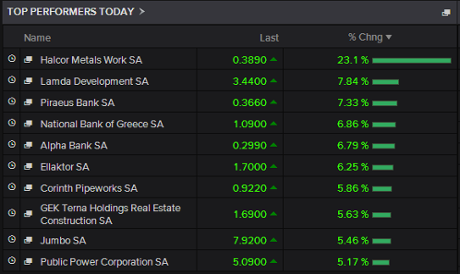
Greek government bonds are also recovering, a little, but remain at dangerous levels.
The yields on Greece’s two-year sovereign bond has dropped from 25% to 23.5% last night; encouraging, but still showing a high danger of default.
And the 10-year bond yield has fallen too, from 12.28% to 12.02% yesterday.
In #Greece bailout talks, it’s 18 versus one. Greek 10yr yields remains near 12%. http://t.co/sKMK3Bcvdh pic.twitter.com/c3QpQIwMFo
— Holger Zschaepitz (@Schuldensuehner) March 20, 2015
Leaders are gathering in Brussels for day 2 of the summit.
Finland’s prime minister Alexander Stubb told reporters outside that progress has been made on the Greek crisis :
Finland's Stubb unusually positive on Greece - saying y'day's meeting was positive and confidence building .... ball now in Greece's court.
— Steve Collins (@TradeDesk_Steve) March 20, 2015
Greece’s finance ministry says that progress has been made towards reaching a deal wiih its creditors:
#Greece FinMinistry: Technical teams are preparing a detailed list of their requirements 4 fact finding about the operations of the Gr govt
— Efthimia Efthimiou (@EfiEfthimiou) March 20, 2015
#Greece FinMinistry: This is a constructive development, which the Ministry of Finance welcomes
— Efthimia Efthimiou (@EfiEfthimiou) March 20, 2015
#Greece FinMInistry: It will bring clarity to the Brussels Group deliberations & allow them 2 proceed in an orderly and effective way
— Efthimia Efthimiou (@EfiEfthimiou) March 20, 2015
(the Brussels Group = technical officials from the IMF, the ECB, the EU and Greece)
Britain’s FTSE 100 has hit a new record high at the start of trading in London, up 0.3% at 6987 points.
Greece: We'll get funds when reforms are submitted
A Greek government spokesman has said Athens expects to receive desperately needed funds once it presents a new list of detailed economic reforms.
Gabriel Sakellaridis explained a few minutes ago that:
“What was discussed was that once the reforms are submitted, and in a detailed manner, to the Eurogroup when that happens ... then the funding will be unlocked towards the Greek economy.”
Sakellaridis added that Athens intended to progress fast with implementing such proposals (via Reuters).
There was speculation overnight that the eurogroup (the gathering of eurozone finance ministers) could meet next week to discuss these new reforms, but nothing official yet:
#EU official sees new #Eurogroup meeting on #Greece soon /via @tsigouriX
— Yannis Koutsomitis (@YanniKouts) March 19, 2015
Extra #Eurogroup meeting still not confirmed by all parties.
— Yannis Koutsomitis (@YanniKouts) March 20, 2015
The statement
Here’s the official statement issued after the meeting (for any readers who weren’t awake at 2am):
Statement by the Presidents of the European Council, the Commission and the Eurogroup on Greece
We fully adhere to the agreement of the Eurogroup of 20 February 2015.
In the spirit of mutual trust, we are all committed to speed up the work and conclude it as fast as possible.
Within the framework of the Eurogroup agreement of 20 February 2015, the Greek authorities will have the ownership of the reforms and will present a full list of specific reforms in the next days.
We reconfirmed the practical agreement on the process: The policy talks take place in Brussels. The fact-finding missions take place in Athens.
The Eurogroup stands ready to reconvene as soon as possible.
The Agenda: Greece told to deliver reforms fast

Good morning.
Seasoned Eurozone crisis watchers got a taste of the old days last night, as key European leaders met in Brussels to discuss Greece’s financial plight.
And after talks that dragged on beyond 2am Brussels time, Greece’s prime minister was urged to deliver detailed reforms very quickly in return for the aid needed to avoid defaulting on its debts.
As we covered in our earlier live blog, bleary-eyed leaders emerged blinking from the talks after three hours to announce that, well, there wasn’t a big breakthrough. But Greece has agreed to present “a full list of specific reforms” soon.
There is hope that the talks between the main powerbrokers in the Eurozone can break the deadlock with creditors.
As one official explained to the BBC:
The message to Greece was simple - “give us a list fast, then you can get the money fast”.
And Athens needs the money. Fears of a liquidity crisis is growing, with Athens due to repay €350m to the International Monetary Fund today.

After the meeting broke up, Angela Merkel told reporters that Alexis Tsipras had agreed to present reforms:
The Greek prime minister declared he is willing to submit such a list and do so quickly....That is needed urgently, and it is needed to focus minds.
Chllr #Merkel after meeting in small group: Greek gov't has pledged to present reforms very quickly. pic.twitter.com/HNtC6O1ZRa MT @RegSprecher
— GermanForeignOffice (@GermanyDiplo) March 20, 2015
An upbeat-looking Tsipras, though, told journalists that Greece is not caving in:
As Reuters put it:
“It is clear that Greece is not obliged to implement recessionary measures,” the 40-year-old Greek premier told reporters, referring to previously agreed reforms.
“Greece will submit its own structural reforms, which it will implement.”
After a short sleep, leaders should be returning for the second day of the summit.
Here’s my colleague Ian Traynor’s latest dispatch from Brussels:
We’ll be tracking the main events in Brussels, and across the world economy and financial markets, through the day......