And finally, I think, here’s our account of the rather chilly reception dished out to Hungary’s leader in Riga today.
'Hello, dictator': Hungarian prime minister faces barbs at EU summit http://t.co/c0JF7X4qB2
— The Guardian (@guardian) May 22, 2015
France’s finance minister, Michael Sapin, also rules out a parallel currency for Greece.
france's sapin says there is no plan b for greece, no parallel currency planned...only currency for ez is the € and it's shared by friends
— Maria Tadeo (@mariatad) May 22, 2015
Europe’s stock markets didn’t like the news that German finance minister Wolfgang Schaeuble had apparently mentioned the option of a Greek parallel currency such as IOUs.
It caused jitters, even though it was denied quite swiftly, says Jasper Lawler of CMC Markets:
The idea of a parallel currency is not without precedent but the news really just reflects Germany’s willingness to take the game of chicken to the very edge, taking any opportunity to show its not worried about a Grexit. Earlier in the month, Greece officials said Athens is not considering a parallel currency.
Tsipras may have been all smiles at the EU summit in Riga.
But the tough work begins this weekend when he is likely to face a groundswell of opposition at a two-day meeting of Syriza’s central committee.
Earlier today, the energy minister Panagiotis Lafazanis who heads Syriza’s hardline faction, the Left Platform, told parliament that the governing party could not endorse anything that ran counter to its pre-election programme.
Releasing a copy of the speech he will give before the central committee, the increasingly vociferous Syriza MP, Yannis Micheloyiannakis, let it be known that he, too, will not condone concessions that go against the spirit of the leftwing party. “This is what we were elected on and with this we will struggle and we will win,” he will tell his comrades.
“Any going back on the above will be a distortion of the party’s physiognomy.”
The meeting will start at 1.30pm local time on Saturday with an address from Tsipras.
The Greek government has released a statement following prime minister Alexis Tsipras’ meeting with European Commission chief Jean-Claude Juncker.
Our correspondent in Athens, Helena Smith, reports:
Once again, the Greek government is sounding a note of optimism - one that does not appear to be shared by debt-stricken Athens’ creditors.
In a statement that smacked more of spin than substance, the government’s tireless press office announced:
“Prime minister Alexis Tsipras held a meeting with the president of the EC, Jean Claude Juncker, in a very good climate in which they had a very constructive discussion.
The Greek prime minister informed Mr Juncker of the progress in negotiations and expressed the need for a mutual effort by both the Greek government and the institutions so that a mutually beneficial agreement can be found soon within the framework of realism and shared responsibility.”
Tsipras will have an uphill struggle to explain some of the concessions he will almost certainly sign up to in the coming days. His anti-austerity Syriza party has gone into overdrive in recent weeks trying to drive home the point that it is doing its best to put up a robust defense of Greece’s interests in a bid to clinch the best possible deal for the country.

The head of the International Monetary Fund has also warned against a “quick and dirty” deal for Greece.
Speaking in Rio, Christine Lagarde said:
“I know there is a lot of work to be done. Parties are now working, receiving proposals, working in cooperation and we will continue to do so as fast as we can.”
“It has to be a comprehensive approach, not a quick and dirty job.”
IMF head Christine Lagarde states that Greek review cannot be a quick and dirty job, more work needs to be done.
— Katerina Sokou (@KaterinaSokou) May 22, 2015
FT: Greece won't get deal without IMF support
The Financial Times has the inside line on last night’s three-way meeting between the leaders of Germany, France and Greece.
That is a blow to hopes of a swift deal, or a partial disbursement; Greece, for all its optimism, might not get any funds for some time.
Here’s a flavour:
The message, delivered by Angela Merkel, the German chancellor, to Alexis Tsipras, her Greek counterpart, at a private meeting in Riga, Latvia’s capital, as well as by lower-level European officials to their Greek interlocutors, comes as the IMF has been weighing whether to withhold its €3.6bn portion of the €7.2bn bailout tranche Athens needs to avoid default.
Eurozone and Greek negotiators have been pushing to complete a deal by the end of the month to free up bailout funds before the first in a series of loan repayments owed the IMF totalling €1.5bn falls due June 5. But securing IMF approval for a bailout deal significantly complicates that timeline.
Eurozone tells Greece no deal without IMF http://t.co/x55iExxpMQ
— Financial Times (@FT) May 22, 2015
Germany denies raising prospect of new Greek currency
Just in: Germany has officially denied that Wolfgang Schäuble has speculated that Greece will need a parallel currency, if talks with its creditors fail.
The German finance ministry tweeted the denial at Bloomberg, which made the claim this morning.
@markets Report is inaccurate. This sort of scenario is not up for debate.
— BMF (@BMF_Bund) May 22, 2015
My summary of PM David Cameron's Riga press conference, which finished moments ago: "The more he spoke the less he said".
— Christopher Hope (@christopherhope) May 22, 2015
Will Cameron recommend Brexit if negotiations fail? 'If I don't get what I want I'll rule nothing out'. Fudge
— Danny Kemp (@dannyctkemp) May 22, 2015
Cameron: We've had a number of Treaties since last time British people had their say, I want to give them proper choice on EU membership
— Open Europe (@OpenEurope) May 22, 2015
What happens if you can’t get agreement on issues which you say must change?
Cameron says he rules nothing out, but he’s confident that he’ll get a deal.
I feel I’ve got the British people at my back - let’s get this referendum and decide. It’s a matter of trust for the British, he argues. We’ve seen all these changes through Treaties, in Nice, Lisbon....those who are younger than 58 never got a chance to have a say on our EU membership.
Cameron’s repeating that the rules on free movement need to be changed, to clamp down on Europeans coming to Britain looking for work, rather than having already found a job.
Isn’t Britain going to irritate the rest of Europe by demanding changes at this busy time? Might we end up with even fewer friends?
I’m not going to say I was met with a wall of love when I arrived, Cameron smiles, but a lot of people were excited about our election victory and keen to work together again.
We have serious problems to address...such as the impact of migration, ever closer union.
On welfare....It’s common sense to pay into a system before you take out of it. And if you come here to work but leave your family at home, you shouldn’t qualify for child benefit in Britain.
Europe must be able to address our “common sense” issues, Cameron adds.
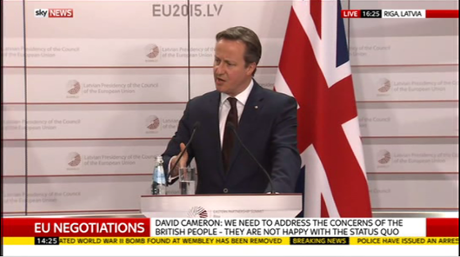
Are you in a hurry to get this referendum next year? Is that why you raised these issues at a summit about the EU’s links with the former Soviet member states?
Our deadline is the end of 2017, but it will be good if can make progress before then.
The Eastern Partnership is an important issue, says Cameron, citing the need to protect Ukraine.
But it was good to make a start today.
Will other European leaders really make concessions, though?
We are one of the largest economies in the world, we’re the biggest military power in Europe, replies Cameron.
The British people aren’t happy with the status quo with Europe now, and neither am I. I believe I can get a better deal.
Cameron gives grimmest possible warning for those covering summits to 2017: EU reforms 'will be discussed whenever we're gathered together'
— Danny Kemp (@dannyctkemp) May 22, 2015
Cameron Q&A in Latvia
David Cameron is giving a press conference in Riga now.
He’s explaining that his push for a new deal with EU will be a feature at several summits going forward.
What about comments from fellow leaders that Treaty change is impossible?
You are doing to hear loads of noises in the coming weeks - people saying that the French say no or the Italians say yes.
I’m going to get my head down and deliver. It’s like the general election - wait for the result and see, Cameron smiles.
The Greek PM has now met with Jean-Claude Juncker....
Meeting earlier with European Commission President @JunckerEU. #euco #Greece pic.twitter.com/v6kLDMak2C
— Alexis Tsipras (@tsipras_eu) May 22, 2015
Donald Tusk’s team just uploaded his statement following the Summit - here’s the conclusion:
The European Union is a partner for the long-haul.
Our partnership, as well as the Riga Summit itself, are not about dramatic decisions or taking giant steps forward. No, our relationship is built on free will, respect and equality. And our partnership will go forward step-by-step, just as the European Union has been built.
Through concrete progress on matters such as trade, energy, transport, mobility and reforms our partnership will grow increasingly closer and offer by far the best prospects for Europe as a whole.
The EU is a trusted partner for the long-haul. My remarks following the #RigaSummit: http://t.co/LTczQY1MbE. #EaP pic.twitter.com/WQQvSMU4Bt
— Donald Tusk (@eucopresident) May 22, 2015

David Cameron is going to have a busy week; after hosting Jean-Claude Juncker on Monday, he will jet to Paris and Berlin for talks with Francois Hollande and Angela Merkel.
A couple of photos of David Cameron leaving the summit just landed:


Here’s the official statement:
Joint Declaration of the Eastern Partnership Summit (Riga, 21-22 May 2015)
And that’s it. Not a humm-dinger of a press conference.
I think I once went to a press conference even more boring than that but I'm not sure.
— Shaun Walker (@shaunwalker7) May 22, 2015
Why does the declaration only talk about the European aspirations of Armenia, Azerbaijan, Belarus, Georgia, Moldova and Ukraine?
No-one promised that the Eastern Partnership would be a route all the way to EU membership, Tusk says. This is a long-term alliance, and we have gone as far as we could today.
.@Straujuma: #RigaSummit confirmed EU's stable and irreversible relations with #EaP countries - https://t.co/9qL29jbDnA
— Latvian Presidency (@eu2015lv) May 22, 2015
You promised good news for Georgia at this meeting - where is it?
Latvian prime minister Laimdota Straujuma replies that Georgia, and Ukraine, could be included in the visa-free programme next year, if enough progress is achieved.
Juncker adde that he is “very optimistic” about liberalising the Visa regimes of both countries.
It will require support from all 28 members of the EU, though.
“Georgia and Ukraine might enjoy a visa-free regime” next year says Latvian PM. Juncker says he's given them a list of issues to work on.
— Shaun Walker (@shaunwalker7) May 22, 2015
Updated
I see @JunckerEU & @PrebenEUspox wearing #eu2015lv ties on stage. Good good good! pic.twitter.com/h5h7HcMzuB
— Jānis Bērziņš (@BerzinsJ) May 22, 2015
Onto questions.
Was the statement held up because Azerbaijan initially refused to sign up, because of the wording on Crimea?
Tusk says the EU had anticipated this problem. But he insists Azerbaijan is determined to strengthen its co-operation with the EU.
And are you worried that David Cameron has put the UK on a path out of Europe?
Juncker says he doesn’t really understand the question. But he confirms that he will be visiting the UK next Monday - we will consider all the elements that could have been part of your question then, he adds.
Updated
We have agreed that Energy and Transport policies will be key priorities in the years ahead, says Tusk.
On mobility issues... we welcome the impact that Moldova’s visa-free programme has had, says Tusk.
But what about Georgia and Ukraine, who both want their citizens to be able to enter the EU without a visa?
Tusk says he and Juncker are determined to be “as ambitious as possible”, but it is up to Georgia and Ukraine to also make progress.
So no big progress on that issue.
Joint Declaration on the Eastern Partnership released
The leaders have agreed a 10-page declaration: my colleague Shaun Walker just got his hands on it:
Riga summit declaration. To summarise: We reaffirm our commitment to declare the commitment to European affirmations pic.twitter.com/jjJWLKizKv
— Shaun Walker (@shaunwalker7) May 22, 2015
The press conference is underway now in Riga -- this live feed is running translations in English, French and Latvian.
European Council president Donald Tusk is explaining that all parties reaffirmed their joint interest in strengthening links between the EU and the six former Soviet states.
Those countries must be free from intimidation and conflict, and able to exercise their sovereign rights, Tusk says.
Hmmmm. Bloomberg is reporting that Germany’s finance minister, Wolfgang Schaeuble, has raised the issue of a parallel currency for Greece:
Schaeuble said to raise possibility of Greek parallel currency. http://t.co/reZvdaq9eF pic.twitter.com/9Zko8c7jlX
— Bloomberg Markets (@markets) May 22, 2015
It’s attributed to “people familiar with his views”. And mentioning it exactly a ringing endorsement......
#Greece: "Schaeuble mentioned the idea of parallel currencies at a recent meeting WITHOUT ENDORSING IT" says the article. Quite a nuance.
— Maxime Sbaihi (@MxSba) May 22, 2015
Tick tock...
Waiting in Riga. At least when you wait ages for Putin you get an earthy animal metaphor at the end of it. Less sure about Tusk & Juncker
— Shaun Walker (@shaunwalker7) May 22, 2015
Politico is reporting that Jean-Claude Juncker will be dining at the UK prime minister’s country retreat, Chequers, next week, as Cameron pushes his renegotiation strategy.
Scoop: David Cameron will host private dinner Monday w/ Commission Prez Juncker at Chequers in England http://t.co/XofLXpXOKj #eureferendum
— Tara Palmeri (@tarapalmeri) May 22, 2015
The summit is wrapping up.....
#EaP #RigaSummit drawing towards an end. Press conference of @Straujuma @eucopresident @JunckerEU soon - http://t.co/6m5LNFJyxt
— Latvian Presidency (@eu2015lv) May 22, 2015
French President Hollande told French journalists that the PMs Brexit agenda was not discussed at summit, not on agenda, or bilaterals
— Faisal Islam (@faisalislam) May 22, 2015
Jean-Claude Juncker is also expected to meet with Alexis Tsipras in Riga today.
@EU_Commission chief @JunckerEU to meet with @PrimeministerGR #Tsipras on sidelines of #Riga @eu2015lv meeting to 'take stock' of progress
— Karl Stagno-Navarra (@ksnavarra) May 22, 2015
As flagged up this morning, Juncker has warned that Greece can’t just be “thrown out” of the euro.
He told German news magazine Wirtschaftswoche that:
[the euro’s] not just about monetary policy and economic reasons, but also the dignity of the Greeks”.
We’re expecting a press conference soon with Donald Tusk (President of the European Council), Laimdota Straujuma (Latvian Prime Minister) and Jean-Claude Juncker (President of the EC) in around 10 minutes.
Reporters in Riga are tucking in:
Dill for lunch at Latvia's Eastern Partnership summit. Looks like shameless post-Crimea appeasement of the Kremlin pic.twitter.com/gOyTuqJHWo
— Shaun Walker (@shaunwalker7) May 22, 2015
Updated
AFP are reporting that European Commission president, Jean-Claude Juncker welcomed Hungarian Prime Minister Viktor Orban to the summit with the words “Hi, dictator!”
'Hello dictator,' says @JunckerEU to Viktor Orban via @lesoir http://t.co/CHRDj1xYqY pic.twitter.com/elbepbtkdU
— Bruno Waterfield (@BrunoBrussels) May 22, 2015
Updated
From Riga, my colleague Rowena Mason writes that Cameron will be pushing his reform agenda at the sidelines of today’s summit - particularly with smaller countries whose leaders he meets less often.
I'm meeting EU leaders at the #RigaSummit today. I plan to deliver EU reform before holding an in/out referendum by the end of 2017.
— David Cameron (@David_Cameron) May 22, 2015
Tsipras: Optimistic of deal soon

Despite the cautious statements of German chancellor Angela Merkel this morning, her Greek counterpart is still saying he is “optimistic” a deal will be found that would unlock bailout funds “ soon,”
Helena Smith reports:
The Greek government has just released the statement Alexis Tsipras made as he arrived at the EU summit.
Echoing earlier pronouncements by Gavriel Sakellarides, the Greek government spokesman, Tsipras said a “long-term, viable solutions” was visible.
“Discussions last night with Chancellor Angela Merkel and President Francois Hollande were constructive and [held] in a very good and friendly atmosphere.
I am optimistic that we can soon arrive at a stable, long-term and viable solutions with the mistakes of the past - and that Greece will return with cohesiveness to growth. I am optimistic.”
“Without the mistakes of the past” would refer to the debt-deflationary spiral that Greece says it is determined to avoid - and there is not sign of that yet.
The European Union and Ukraine have signed a Memorandum of Understanding in Riga, that paves the way for €1.8bn of aid. That’s on top of the €1.61bn already paid in earlier assistance.
The EU says it’s a sign of solidarity with Kiev:
Today we send the signal to the world - #Ukraine cares about reforms and #Europe cares about Ukraine #EUUkraine #Riga pic.twitter.com/VqvkUo8HAE
— Valdis Dombrovskis (@VDombrovskis) May 22, 2015
This signature is an important milestone in the relationship between #EU and #Ukraine #EUUkraine #RigaSummit & #EaP pic.twitter.com/2Pvfg5zjuG
— Valdis Dombrovskis (@VDombrovskis) May 22, 2015
Ukraine wants more than that, though. It is pushing for a path towards joining the European Union, and hopes to negotiate a deal to allow its citizens to visit the EU without a visa.
The Wall Street Journal explains:
Coming into the summit, which ends Friday afternoon, Ukraine, Georgia and Moldova were all pushing for language in the summit conclusions that would allow them to tell their citizens that painful reforms at home could eventually lead them into the European club. Ukraine and Georgia also had hoped for a clear signal that EU leaders would approve their bids for visa-free access to the bloc, a prize Moldova won last year.
The draft summit text though, which makes no promises on EU membership.
Photos: Leaders in Riga


Updated
Draghi demands progress on structural reforms
ECB president Mario Draghi is urging eurozone governments to implement structural reforms, in a speech in Sintra, Portugal.
It’s not a new theme - Draghi acknowledges that he has raised this issue at every single ECB press conference since he took office. But he’s producing some compelling graphs to show why government need to reform labour markets to boost productivity and get Europe’s potential growth closer to America.
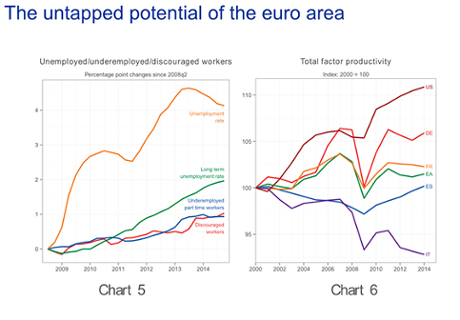
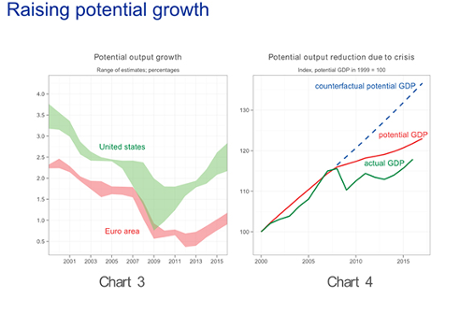
But aren’t these political issues outside the remit of a central banker? Draghi argues not:
For members of monetary union resilience is crucial to avoid that shocks lead to consistently higher unemployment, and over time, permanent economic divergence. It therefore has direct implications for price stability, and is no less relevant for the integrity of the euro area.
This is why the ECB has frequently called for stronger common governance of structural reforms that would make resilience part of our common DNA.
After all, not even Mario Draghi can save the eurozone alone:
Monetary policy can steer the economy back to its potential. Structural reform can raise that potential,
Here’s the speech: Structural Reforms, Inflation and Monetary Policy
Updated
German business morale has fallen slightly this month, in the latest sign that Europe’s largest economy is in a soft patch.
The business climate index calculated by IFO, the Munich-based research institution, fell to 108.5 from 108.6 in April.
Economists reckon we shouldn’t panic:
Given the long recovery the German economy has already gone through, it is only more than normal that growth rates at some point in time will be lower than in the rest of the Eurozone, which in turn has been suffering from weak growth now for several years.
CHART: Today's IFO completes picture of euro-area business surveys for May. Don't panic, levels remain high. pic.twitter.com/iWteoxYV7S
— Maxime Sbaihi (@MxSba) May 22, 2015
David Cameron began his push for EU reform with a meeting with Poland’s PM, Ewa Kopacz.
It was a “friendly but tough’ chat, according to the Polish side - a taste of the reception Cameron will get in Riga?
"PMs #Kopacz-#Cameron talks at #RigaSummit - main topic: EU single market - friendly, but tough" via @trzaskowski_ pic.twitter.com/1iXFPFSTYd
— Poland in the EU (@PLPermRepEU) May 22, 2015
The financial markets are getting tired at the apparent lack of progress towards a Greek deal, says Jeremy Cook, chief economist of World First:
Despite the Greek government’s constant assertions that a deal is just around the corner it is looking like they may have been kidding themselves as well as the markets.
We can but hope for some positive noises from the non-Greek participants later in the day. For now, they are the only ones to believe.
After staying up till 1am talking last night, Angela Merkel and Alexis Tsipras are seated side-by-side again this morning:
Alphabet (#Germany #Greece) bringt sie zusammen: #Kanzlerin #Merkel + #MP @Tsipras sitzen b #Rigasummit nebeneinander pic.twitter.com/GuRECElAlb
— Dirk Hoeren (@DirkHoeren) May 22, 2015
When he took office, Alexis Tsipras vowed that he wouldn’t wear a tie to these events until he’d secured a new Greek deal.
Five months on, he’s sticking to his guns - despite the risk of being grappled by EC president Juncker.
Στυλιστικά tips από τον Ζαν Κλοντ Γιούνκερ στον Πρωθυπουργό κατά την προσέλευση στη Σύνοδο Κορυφής #Tsipras #Juncker pic.twitter.com/CGltiNWGUS
— naftemporiki.gr (@naftemporikigr) May 22, 2015
Donald Tusk doesn’t look terribly amused....
No pressure, Mr Cameron:
PM starts Renegotiation: We need immigration control, to return powers to Westminster from fishing to energy, & cut £60m a day cost, or Out
— David C Bannerman (@DCBMEP) May 22, 2015
The summit is getting underway.
European Parliament president Martin Schulz says it’s a “crucial” opportunity to bring more stability to the former Soviet states.
#EasternPartnership Summit about to start. Crucial meeting for better, safer & more predictable future for the region & all continent
— EP President (@EP_President) May 22, 2015
Our Europe editor, Ian Traynor, doesn’t share his optimism:
#RigaSummit last one was a disaster (vilnius). this one just depressing. an exhibition of fear weakness timidity
— Ian Traynor (@traynorbrussels) May 22, 2015
#EaP #RigaSummit HoD familyphoto with @alexstubb representing Finland pic.twitter.com/YAByfgZ3qM
— Olli Kantanen (@OlliKantanen) May 22, 2015
PM will visit Paris and Berlin next week to meet Chancellor Merkel and President Hollande to kickstart EU renegotiation process in earnest
— Faisal Islam (@faisalislam) May 22, 2015
Cameron: I'm determined to reform the EU
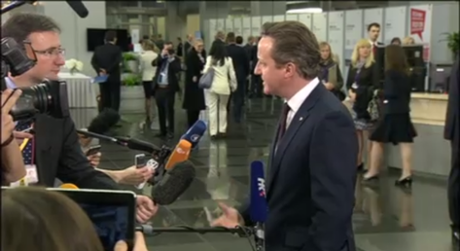
David Cameron arrived in Riga, banging the drum for a renegotiated settlement with the EU.
There will be lots of noise and ups and down in the months ahead, the UK prime minister predicted.
“You’ll hear one day this is possible, the next day something else is impossible...
“But one thing throughout all of this will be constant and that is my determination to deliver for the British people a reform of the EU so they get a proper choice in that in/out referendum that we’ll hold before the end of 2017.
This is Cameron’s first chance to lobby EU leaders face-to-face about reforms since winning the general election a fortnight ago.
This referendum will now dominate UK politics, as my colleague Martin Kettle explains:
This will be a parliament of two halves: before the EU referendum and after it. Everything in British politics now hinges on the European issue, including the union with Scotland. But Europe’s hour has now arrived. Europe will be the centrepiece of the speech from the throne on Wednesday.
The referendum bill will be published within hours. Cameron and his negotiators are in Riga talking to EU leaders this week. Germany is signalling cooperation within bounds. And all the signs are that the government wants the referendum early, possibly as soon as September 2016 – which is only 16 months away. All other legislative and political business, with the exception of the Scottish devolution plans, will be fitted around the needs of the referendum.....
David Cameron faces sudden death over Europe. He cannot fail | Martin Kettle http://t.co/pgGyI2fqID (@martinkettle)
— Comment is free (@commentisfree) May 22, 2015
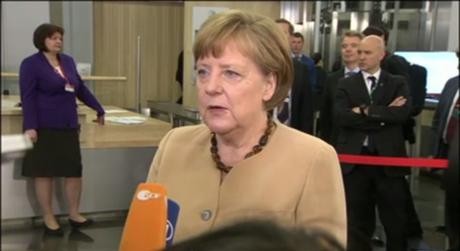
Merkel: Still a lot of work to do
Angela Merkel has arrived at the EU summit in Riga, and made it clear that last night’s meeting with Alexis Tsipras did not deliver a big breakthrough.
Greece must keep working “very, very intensively” with its creditors, she told reporters when asked about the three-way meeting with Francois Hollande.
“It was a very friendly, constructive exchange, but it’s also clear that there must be more work with the three institutions. There is a lot to do.”
“France and Germany have offered Greece and the Greek Prime Minister that whenever there are questions to be discussed, whenever there is help to be given, to do so but the conclusion needs to be found with the three institutions and there needs to be very, very intensive work.”
So once again, Athens’ optimism isn’t really shared by the rest of the eurozone.
Europe would be riven with currency wars if it wasn’t protected by the euro, says European Commission president Jean-Claude Juncker as he arrived at the Riga summit.
*JUNCKER SAYS CAN'T SIMPLY THROW GREECE OUT OF EURO: WIWO
— lemasabachthani (@lemasabachthani) May 22, 2015
If we didn't had the #euro, there'd be currency wars in Europe: Juncker ~@wiwo
— Yannis Koutsomitis (@YanniKouts) May 22, 2015
Dombrovskis: Greece Must Present Comprehensive Reform Package
The Greek negotiations must speed up, declared Valdis Dombrovskis, European commissioner for the euro, as he arrived in Riga.
Dombrovskis put the onus on Greece to show its creditors a proper, detailed, reform plan.
EU’s Dombrovskis Says Progress In Greece Talks Needs To Step Up -- BBG - Greece Must Present Comprehensive Reform Package
— Live Squawk (@livesquawk) May 22, 2015
EU’s Dombrovskis: Not Discussing Debt Writeoff For Greece
— Live Squawk (@livesquawk) May 22, 2015
Meeting yesterday with Chancellor #Merkel and President @fhollande. #Greece pic.twitter.com/pjhz0SLkc0
— Alexis Tsipras (@tsipras_eu) May 22, 2015
Greek spokesman: Deal can be sealed in 10 days

There’s a mood of optimism from Athens this morning following last night’s meeting between Tsipras, Merkel and Hollande.
Government spokesman Gabriel Sakellaridis has just declared that the Greek administration expects to reach a cash-for-reforms deal with its creditors in the next 10 days.
“We think conditions have matured for (talks) to progress further and in the next 10 days, in May, for the deal to be sealed”.
That would take us to the end of May; when Greece must pay pensions and wages.
Sakellaridis told Skai TV that this would allow Athens to meet all its payments in June (it also faces €1.5bn in repayments to the IMF next month), and even join the new eurozone QE programme.
“Inclusion in this European Central Bank quantitative easing programme falls within the framework of priorities of the Greek government.”
But first they need that deal -- and Greece says it isn’t caving in on its “red-lines”...
GREECE WON'T COMPROMISE ON LABOR REFORMS, PENSIONS: SPOKESMAN
— MineForNothing (@minefornothing) May 22, 2015
Updated
The Agenda: EU leaders gather in Riga
Good morning, and welcome to our rolling coverage of the world economy, the financial markets, the eurozone and business.
We’re watching events in Latvia today, where EU leaders are attending the Eastern Partnership summit Riga.
Officially, the meeting is meant to build closer ties between the EU and Armenia, Azerbaijan, Belarus, Georgia, the Republic of Moldova and Ukraine, and make progress towards de-escalating conflict in the region.
Eastern Partnership summit, Riga, 21-22/05/2015
But two issues are casting a shadow -- Greece’s bailout talks, and Britain’s push for renegotiation.
The summit is starting now, following yesterday’s working dinner -- which preceded a meeting between Greek PM Alexis Tsipras, German chancellor Angela Merkel and French president Francois Hollande.
En marge du Sommet du Partenariat Oriental à Riga, @fhollande s'est entretenu avec A.Merkel et A.Tsipras #Riga2015 pic.twitter.com/jxmG6DMhhf
— Élysée (@Elysee) May 21, 2015
As we covered last night in yesterday’s liveblog, the talks were apparently ‘friendly and constructive’, but without a major breakthrough.
AFP explains:
After almost two hours of talks the three “agreed on the need for the Greek authorities to keep working with the three institutions”, the aide said, referring to Athens’ “troika” of creditors - the European Union, the European Central Bank, and International Monetary Fund.
A Greek government source added that Merkel and Hollande “understood the need for a long-term deal” and said they were prepared to “personally contribute, if needed, to conclude the agreement soon.”
EU leaders will be meeting all morning in Riga, with a press conference at 1.45pm local time or 11.45am BST.
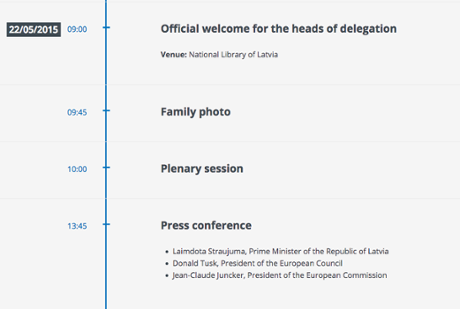
We’ll be watching Riga, and tracking all the main events through the day...