Closing summary
As the Greek parliament prepares to vote on the terms of the third bailout, the country’s creditors have expressed serious concerns about the sustainability of its debt.
But they believe a haircut is not necessary and believe that extending debt maturities and easing terms will bring borrowings back to a sustainable level.
The report came shortly after Greece surprisingly revealed that its economy grew at a quarterly rate of 0.8% in the second quarter, following zero growth in the first three months of the year. Analysts had expected a 0.5% contraction, and there was much scepticism about the figures, which after all are only an initial estimate.
Meanwhile, as the Greek parliament discussed the bailout, current finance minister Euclid Tsakalotos urged MPs to quickly approve the deal, while his predecessor Yanis Varoufakis claimed the agreement was not viable.
There are also growing splits within the governing Syriza party, with former energy minister Panagiotis Lafazanis leading a group calling for an anti-bailout movement.

The Eurogroup of finance ministers is due to examine the bailout deal tomorrow, following the vote in the Greek parliament which is expected later tonight after parliamentary committee passed the agreement.
Earlier, markets welcomed a calmer period for China’s currency after days of turmoil following its devaluation, as Beijing said there was no need for any further depreciation in the yuan.
But much of the gains evaporated after strong US retail sales figures prompted renewed talk of a Federal Reserve rate rise next month.
On that note, it’s time to close up. Thanks for all your comments, and we’ll be back tomorrow for the result of the Greek vote, the Eurogroup meeting and eurozone GDP.
#Greece parliament committees pass #ESM loan, MoU & prior actions bill. Plenary debate & vote later tonight.
— Yannis Koutsomitis (@YanniKouts) August 13, 2015
European shares end on mixed note
Much of the early gains made by stock markets evaporated by the close. Initially, the fact that some stability had returned to China’s currency after several days of turmoil after its surprise devaluation helped push global shares sharply higher.
But strong US retail sales revived talk of a rate rise in September by the Federal Reserve and took off some of the gloss. A strong dollar helped knock back oil prices and also undermined share prices. So the closing scores showed:
- The FTSE 100 dipped 2.86 points or 0.04%, but part of the fall was due to a number of major companies seeing their shares go ex-dividend
- Germany’s Dax added 0.82% to 11,014.63
- France’s Cac closed up 1.25% at 4986.85
- Italy’s FTSE MIB added 1.56% to 23,356.01
- Spain’s Ibex ended up 0.62% at 10,947.9
- The Athens market slipped 0.69% to 686.65
On Wall Street, the Dow Jones Industrial Average is currently up 23 points or 0.13%.
Oil is on the slide again
Partly due to a rise in the dollar in the expectation of a US rate rise next month, Brent crude has fallen 1.25% to $49.04 a barrel. On top of that, there were reports of stockpiling, fuelling fears once more of oversupply and weak demand. According to Reuters, market intelligence company Genscape reported an increase of more than 1.3m barrels at a key delivery point in Oklahoma.
Greek parliamentary speaker Zoi Konstantopoulou had delayed today’s proceedings by moving committee debates on the bailout from Wednesday to Thursday morning.
Now things are underway she had taken the opportunity for a pop at Germany. According to Greek newspaper Kathimerini she has said parliament does not exist solely to rubber-stamp orders from German finance minister Wolfgang Schäuble.

Ex FinMin #Varoufakis tells Parliament Greek bailout deal is not viable, IMF will not contribute to new loan #Greece
— Kathimerini English (@ekathimerini) August 13, 2015
Varoufakis says deal is not sustainable
Former Greek finance minister Yanis Varoufakis has been speaking in parliament about the bailout and - predictably - he is not too happy.
varoufakis, in parliament, says tsakalotos et al did their best in the circumstances but agreement is not sustainable #greece
— Diane Shugart (@dianalizia) August 13, 2015
varoufakis: you restructure debt so you need to borrow less and measures follow. here we have the opposite. #vouli
— Diane Shugart (@dianalizia) August 13, 2015
varoufakis: the text is a landmine of euphemisms. we should write a glossary of troika-speak. #vouli
— Diane Shugart (@dianalizia) August 13, 2015
varoufakis says reduction of defense spending is a good opportunity to demand eu guarantee greek borders
— Diane Shugart (@dianalizia) August 13, 2015

Updated
And the diplomatic moves continue. Greek president Prokopis Pavlopoulos had a telephone conversation with European President Jean-Claude Juncker earlier today about the Eurogroup meeting. On Wednesday Pavlopoulos talked to both French president Francois Hollande and European Central Bank president Mario Draghi.
Greece’s main opposition party New Democracy looks like it will support the bailout in tonight’s parliamentary vote, although not without some misgivings.
New Democracy MPs meet for 7 hrs, decide to vote for 3rd bailout although 7 of 76 deputies proposed abstaining, reports @samaravicky #Greece
— Nick Malkoutzis (@NickMalkoutzis) August 13, 2015
New Democracy leader Evangelos Meimarakis had earlier indicated he'd oust any MPs who don't toe party line of backing 3rd bailout #Greece
— Nick Malkoutzis (@NickMalkoutzis) August 13, 2015
Back with Greece:
#Greece MPs will vote on a new €86bn loan tonight without having seen the Institutions' Debt Sustainability Analysis. Not fair. #justsaying
— Yannis Koutsomitis (@YanniKouts) August 13, 2015
US market slips on rate talk
Wall Street has taken some of the shine off European markets, which had earlier been boosted by signs of stability in China after the dramatic moves in the yuan this week.
With strong US economic data, including retail sales, analysts have begun talking about a rate rise from the Federal Reserve next month, something which the Chinese turmoil had started to put in doubt.
So the Dow Jones Industrial Average is down around 32 points, knocking the FTSE 100 back from its earlier highs to a gain of just one point. But Germany’s Dax is up 1.11% ahead of the Greek vote on the latest bailout plan and Friday’s Eurogroup meeting, while France’s Cac has climbed 1.43%.
Among the documents sent from the European Commission to the Eurogroup, there is one on a bridging loan as a contingency plan.
EC spokeswoman Annika Breidthardt said:
Submitting the documents (on a bridging loan) was only as a contingency. It is now in the hands of the eurozone finance ministers to take a final decision.
It is not a decision for the Commission to take.
(Quotes from AFP)
More on the backing for the Greek bailout from Finland - which last month had suggested it preferred that Greece temporarily leave the eurozone.
The Finnish parliament’s grand committee voted by 18 to 4 to allow finance minister Alexander Stubb to approve the deal at Friday’s Eurogroup meeting. Stubb said (quotes from Reuters):
We have come a long way during the summer. The future of the euro was at stake...but now we’ve got a solution and will live with it.
But he added that it was important for the International Monetary Fund to stay involved in the bailout process.

Another step towards a Greek agreement: a statement from the European Commission.
Following the technical agreement on a Memorandum of Understanding between the Institutions and the Greek authorities, the Commission this morning adopted the necessary draft Council decisions for a three-year programme under the European Stability Mechanism (ESM). These documents were transmitted to the Council ahead of the Eurogroup meeting on Friday.
President Juncker has spoken to President of the Eurogroup Dijsselbloem to inform him of this and to prepare tomorrow’s Eurogroup, where the Commission will be represented by Vice-President Dombrovskis, responsible for the Euro and Social Dialogue.
All documents for #ESM programme for #Greece now sent to @EUCouncil ahead of Friday's Eurogroup http://t.co/0W6gUNO6s1
— Jean-Claude Juncker (@JunckerEU) August 13, 2015
Statement on latest steps towards an ESM programme for #Greece http://t.co/5T9hmkeHKr
— European Commission (@EU_Commission) August 13, 2015
Updated
Analysts agree the US retail sales figures could presage a rate rise next month despite this week’s Chinese moves. Rob Carnell at ING Bank said:
US retail sales for July were good enough not to damage September Fed rate hike prospects further, following the jitters in the aftermath of China’s recent devaluations.
The headline rate rose 0.6% month on month, but there were strong upward revisions to the previous month’s data, and taken together, the outcome should be seen as stronger than the prevailing consensus view. Auto sales were strong, as expected, but the core figures weren’t bad either, with the 3 month annualised “control” sales group rising at a chunky 5.2% annualised rate.
The only disappointments in the sales figures came from electronics and general merchandise, of which department store sales are a key element. Food and beverages sales were flat, but there were gains in all other subcomponents, so the gains were widely spread – which always looks more convincing than a few huge increases.
With external developments taking a more prominent role in considerations of Fed policy as far as markets are concerned, this release does not seal a September rate hike, which markets continue to view as a marginal call. But it does shift the balance back to September, and we continue to think September will mark lift-off for the Fed.
Dennis de Jong, managing director of broker UFSX.com, said:
Every piece of data coming out of the US in the next couple of weeks has extra significance as it could be the difference between an interest rate hike in September or December.
Janet Yellen and her Fed colleagues will be poring over everything ahead of their meeting in September and she will be encouraged that retail sales have bounced back slightly from a disappointing performance in June.
Consumer confidence isn’t quite where the Fed would want it to be, although the labour market is looking fairly resilient and today’s figures are unlikely to make Yellen delay any longer.
Updated
US retail sales rise in July
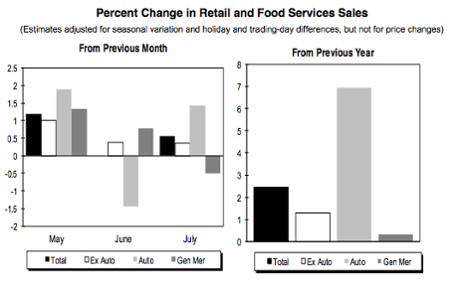
In the US, retail sales rose in July by slightly more than expected, adding some fuel to those expecting the Federal Reserve to raise interest rates in September.
The turmoil caused by China’s devaluation of the yuan could yet affect the mood of the Fed. But these latest figures show a rebound to a rise of 0.6% from a flat performance in June (itself revised up from an initial 0.3% fall).
Economists had expected an increase of 0.5%.
The figures were boosted by a revival in car sales, up 1.4% after falling 1.5% in June, with clothing, furniture and restaurants also recording increases.

Meanwhile weekly jobless claims rose unexpectedly by 5,000 to 274,000. But the previous week was revised down to show 1,000 fewer claims, and despite rising for three straight weeks, the claims number has remained below 300,000 - seen as a sign of a firm jobs market - for 23 weeks in a row.
Updated
Finland is ready to participate in Greece’s latest rescue package, its finance minister Alexander Stubb said.
Our economics editor Larry Elliott looked at the debt analysis drawn up by Greece’s European creditors. You can read the full story here.
Greece’s European creditors have underlined the temporary nature of the country’s surprise return to growth by warning that they have “serious concerns” about the spiralling debts of the eurozone’s weakest member.
The three European institutions negotiating a third bailout package with the government in Athens said that the Greek economy had plunged into a deep recession from which it would not emerge until 2017.
According to an analysis completed by the European commission, the European Central Bank and the eurozone bailout fund, Greece’s debts will peak at 201% of its national output (GDP) in 2016.
The study says that Greece’s debt burden can be made more bearable by waiving payments until the economy has recovered and then giving Athens longer to pay. However, it opposes the idea of a so-called “haircut” – reducing the size of the debt, a course of action the International Monetary Fund thinks may be necessary for Greece’s debts to become sustainable.”
And if you are wondering what exactly Greece has signed up for in the new memorandum of understanding struck with its creditors in exchange for an €86bn bailout, take a look at this analysis from our economics correspondent Heather Stewart.
After EU's terrible Greek DSA: will IMF's be even worse? Can IMF & Germany agree on much-longer maturities? http://t.co/SqFqfKdUGb via @WSJ
— Marcus Walker (@MMQWalker) August 13, 2015
German deputy finance minister Jens Spahn said earlier on Thursday that both Berlin and Paris want further information on Greece’s plans to privatise parts of its economy before approving a third bailout package. He told Deutschlandfunk:
Germany is not the only country that still has questions at the moment. We still need to talk with each other on a few issues. That is why we have a Eurogroup meeting on Friday in Brussels.
We need more details in some areas. That is what we need to talk about - by the way we have a joint proposal from France and Germany.”
But he paid tribute to Alexis Tsipras’ government, saying it was clear that it had “come a long way” and been “very constructive” during the negotiations, with a “high degree of willingness to reform”. “There is a clear recognition that Greece needs to change if it wants to stay in the eurozone,” he said. “You have to acknowledge that. A lot has been achieved.”
Greece will receive the first tranche of the new bailout, of €23bn, later this month, Reuters reported, citing an anonymous source, assuming the package is approved by the Greek and other national parliaments and a meeting of eurozone finance ministers on Friday.
The source said the package consists of €85.5bn of aid and an estimated €6.2bn of privatisation revenues through 2018.

Updated
And here is the Wall Street Journal’s take:
A new assessment says there are serious concerns about the sustainability of Greek government debt and that it will require mitigating measures—a step many eurozone governments have been reluctant to take.
The three-page document, which has been seen by The Wall Street Journal, was prepared by the European institutions that have been negotiating a new bailout program, including the European Commission, the European Central Bank and the eurozone bailout fund.
The document doesn’t mention the views of the International Monetary Fund, suggesting that there are once again differences between the Washington-based fund and its European partners. The four institutions earlier this week agreed on a new bailout program with the Greek government, which includes sharp spending cuts and strict policy overhauls.
Even if Greece implements the full bailout program and manages to raise €13.9bn ($15.45 billion) from privatizing state assets, its debt is expected to remain at 159.7% of gross domestic product in 2022, the document says.
The 2022 level is important because eurozone finance ministers had previously promised to bring Greece’s debt to below 110% of GDP by then, in an effort to keep the IMF involved in saving the country from default and an exit from the euro.
If Greece only partially implements the program, its debt would be at 173.7% of GDP in 2022, the document says. If Greece achieves better than expected growth and privatization receipts its debt could fall to 148.2% of GDP in 2022.
The document doesn’t say what would happen to Greece’s debt if the government fails to implement the program—a scenario the IMF had found the most likely in a previous version of the debt sustainability analysis prepared before capital controls were introduced in late June.
Because of the deterioration the Greek economy, which the institutions expect to shrink 2.3% this year and 1.3% next year, there are now “serious concerns” about whether the country will be able to pay back its debts, the document says.
To help ensure debt sustainability, the document suggest that eurozone governments should once again agree to transfer to Athens central banks’ profits from their holdings of Greek government bonds. In addition, they would have to give Greece more time to pay bailout loans and interest on those loans, the document says. This way, governments might be able to avoid a reduction to the nominal value of the debt, known as a haircut, the document adds.”
Updated
It appears that the International Monetary Fund, which has been pushing for a debt write-off for Greece, was not involved in this analysis.
Despite citing “serious concerns” about Greece’s debt, the country’s European creditor institutions do not see the need for a haircut, but argue that extending debt maturities and easing terms will bring the country back to a sustainable level of debt.
This is what Germany has proposed – see the comments from deputy finance minister Jens Spahn earlier.
Here is the Reuters story in full:
The creditor institutions which have agreed a draft third bailout for Greece have “serious concerns” about the sustainability of Greek public debt although they believe a nominal haircut can be avoided, a debt sustainability analysis seen by Reuters on Thursday showed.
“The high debt to GDP and the gross financing needs resulting from this analysis point to serious concerns regarding the sustainability of Greece’s public debt,” said the analysis, adding far-reaching reforms were needed to address the worries.
“In sum, an appropriate combination of extension of maturities and grace periods for principals and interests would allow to bring Greece debt back to a sustainable level in gross financing needs terms without the need for a nominal haircut as stated by the Euro Summit of 12 July,” it added.
The analysis saw privatisation proceeds, excluding those from banks, of €13.9bn through 2022. The institutions expect the Greek economy to shrink by 2.3% this year and by 1.3 percent next year, before returning to 2.7% growth in 2017.”
According to the report, Greece will only return to economic growth, of 2.7%, in 2017 following two more years of recession this year and next.
Creditors' analysis sees Greek debt rising above 200% of GDP
According to a series of flashes on Reuters, a new debt sustainability analysis from Greece’s institutional creditors projects debt to GDP rising to 201% in 2016, 175% in 2020, 160% in 2022 and 122% in 2030.
The analysis cites “serious concerns” about the sustainability of Greece’s public debt.
Updated
Marcos Casarin at Oxford Economics has looked at the potential implications of China’s yuan devaluation for the world economy.
We simulate an “other things equal” 10% yuan depreciation against the US dollar on our global economic model. It has a small positive effect on Chinese GDP, but is deflationary for other countries. Other things are not exactly equal of course, and we also provide a reminder of the more powerful simulated impact on the global economy of a sharp China slowdown to 4.4% growth over the medium term.
The “naïve” simulation of a 10% renminbi depreciation (holding other things constant) would reduce inflation in some countries (the German CPI is 0.3pp lower by 2017). The Fed would most likely delay its first rate hike beyond September and global bond yields would remain lower for longer. There are some negative output implications, particularly for China’s competitors in Asia. The global recovery would be a bit slower than we currently forecast, with growth of 2.9% in 2016 rather than 3%.
Other things are not equal of course, and in the context of the broader Chinese slowdown, the impact is much stronger. In such a case, our modelling work suggests Fed tightening would be delayed and slower, with US 10-year yields dropping back below 2% in 2016-17.”
Here is our full story on the strong GDP figures for Greece.
Demand for gold weakened in the second quarter as China and India, key consumers, cut back, the World Gold Council said in its quarterly update.
Total demand fell by 12% from a year earlier to 915 tonnes. The WGC added:
However, demand in Europe and the US grew, driven by a mixture of increasingly confident jewellery buyers and strong demand for bars and coins.
Looking ahead, there are encouraging signs moving into what are traditionally the busiest quarters for gold buying in India and China.”
However, the price of gold plummeted in July, the start of the third quarter, hitting its lowest level in more than five years, at $1,072.35 an ounce. Since then it has recovered to above $1,100 an ounce.
Gold prices have been hurt by the strong dollar, which makes commodities priced in dollars more expensive for investors who hold other currencies.

The WGC expects gold demand in China to hold up this year, coming in at similar levels as last year, despite the yuan’s devaluation this week.
Roland Wang, managing director, told Reuters:
We still have the confidence that consumption of gold in China will remain at similar levels as last year.”
China consumed 973.6 tonnes of gold last year and the WGC has forecast demand of 900 to 1,000 tonnes this year.
Spot gold touched a three-week high of $1,126 an ounce on Thursday.
Updated
Q2’s Greek GDP figures brought some rare good news. But they relate to an entirely different economy than the one currently being strangled by capital controls, says Jonathan Loynes, chief European economist at Capital Economics.
- The 0.8% rise in Greek GDP in Q2 came as a pleasant surprise after the 3.2% quarterly contraction in industrial production seen in the quarter and the generally downbeat message from business surveys seen over recent months. We had feared a big contraction, though note that the figures may well be revised in later releases.
- We have no breakdown at this stage. But monthly retail sales figures suggest that stronger household spending - perhaps in anticipation of capital controls - may have contributed to the expansion. Investment may also have rebounded after a steep (7.5%) quarterly drop in Q1.
#Greek economy surprisingly expanded by 0.8% q/q, 1.4%y/y in Q2. But activity has collapsed in Q3 under cap controls. pic.twitter.com/qFlpdRBjev
— Capital Economics (@CapEconEurope) August 13, 2015
- The figures may provide some hope that the underlying state of the economy is rather healthier than has been generally perceived. But the key point, of course, is that the numbers relate almost entirely to the period before the imposition of capital controls at the end of June. Survey indicators such as the EC’s measure of economic sentiment suggest that activity has since collapsed dramatically.
- Activity will presumably rebound when the capital controls are lifted. But it is not clear that will be very soon, despite the recent progress towards a third bailout. And the apparent extent of the damage points to lasting effects on growth and employment.
- Accordingly, Q2’s figures do not change our view that the economic assumptions built into the bailout plan are likely to prove far too optimistic. Barring revisions to the Q2 data, this year’s forecast of a 2.3% drop in GDP might now be just about achievable. But the projections for a smaller decline of 1.3% next year and strong growth thereafter look hopeful given Greece’s lack of competitiveness and the additional austerity required by the bailout conditions.
- Overall, for once some good news from Greece. But the economy has changed dramatically since.
One of our readers, IfigEusLannuon, has commented:
On the good Q2 numbers for Greek GDP (+0.8%). They can be explained by the fact that Greek GDP were on a growth trend before the elections announcement, so the Q4 2014 and Q1 2015 that were negative numbers were maybe outliers numbers. In Q2, the February 20th agreement was reached, so you can say April-May-June was a relative stability period that helped the growth. Another phenomenon that can have played is that a lot of people withdrew money from their accounts when they started being afraid of Grexit in Q2, and some of this money surely went into consumption and not under mattresses. I do remember excellent numbers for car sales at the period for example; new cars being good for storing wealth.”
The latest GDP figures mean Greece did not slide back into recession at the start of this year as previously thought, in a boost to Alexis Tsipras’ government.
Analysts say some sectors of the Greek economy, such as tourism, have proven surprisingly resilient, despite the country’s near-bankruptcy. Nikos Magginas at National Bank told Reuters:
Some economic activity indicators in the second quarter, including consumption, industrial production and tourism, had shown particular resilience. This explains the surprising second quarter GDP reading.”
He said the data point to a better outlook for the Greek economy this year, making an overall contraction of less than 2% “realistic”. Under the baseline scenario used in Greece’s new bailout agreement, the economy is projected to shrink by 2.1% to 2.3%.

Updated
Ireland’s annual EU harmonised inflation rate has come in at 0.2% for July, down from 0.4% in June, as prices fell by 0.3% month-on-month.
President of German Bundestag Nobert Lammert: if #Eurogroup agree tomorrow then he will call Bundestag vote for Tuesday or Wednesday (@dpa)
— Nina Schick (@NinaDSchick) August 13, 2015
Of course, the Greek GDP figures are a flash estimate and subject to revision. The statistics office notes:
Users should note that the present flash estimates are expected to be revised when provisional estimates are produced and disseminated on 28/08/2015 on the basis of updated primary data that will have become available at that point.”
Weird https://t.co/zJn2YYR26f
— Joseph Weisenthal (@TheStalwart) August 13, 2015
If anyone wants to stick their neck out and say Greece's GDP jump *isn't* some sort of statistical fillip, that'd be great.
— Mike Bird (@Birdyword) August 13, 2015
The Greek statistics office ELSTAT has not given further details on the intriguing GDP figures, but it has published this table:
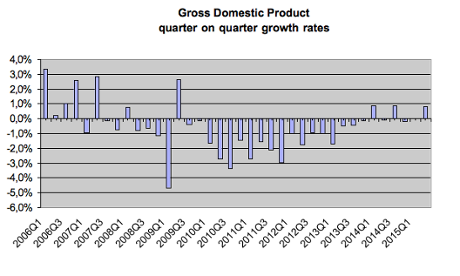
The GDP figures are for the period before Athens introduced capital controls and shut the Greek stock exchange for five weeks and the banks for three weeks. Even so, they are hard to believe...
We saw a freak result for #Greece #GDP like this back in 2010 and the reason then was a sharp fall in imports which boosted the numbers.
— Shaun Richards (@notayesmansecon) August 13, 2015
Greece GDP higher by 0.8% in Q2. Majority of activity coming from ballot-printing industry and cafes around Syntagma Square?
— World First (@World_First) August 13, 2015
Updated
Greek economy rebounds with 0.8% growth in Q2
Greece’s economy grew at a quarterly rate of 0.8% in the second quarter, following zero growth in the first three months of the year, according to statistics service ELSTAT. This came as a complete surprise to economists who had expected a 0.5% contraction. The first quarter was revised higher from a 0.2% decline.
The figures put Greece ahead of the UK, which expanded by 0.7% between April and June.
Updated
Oil prices rise above $50 a barrel
Oil prices continue to recover, with Brent crude rising above $50 a barrel this morning. Data showed US stockpiles of crude oil and gasoline fell last week, easing concerns over a global glut of supply.
Brent was up 1.1% at $50.22 while New York light crude climbed 0.4% to $43.49 a barrel.
China’s devaluation of the yuan is a storm in a teacup, argues Mike Sell, head of Asian investments at Alquity.
This week’s fall has generated headlines, but pales into comparison with other emerging market currencies. The Brazilian Real is down 31% against the dollar since the start of the year, Indonesia’s Rupiah is down 11%, and the Malaysian Ringgit down 15%. The Euro itself is down 9% since January.
We do not see this as either the start of a “currency war” or a concerted policy to boost exports. The Chinese government is perfectly aware it will not be able to devalue its way to competitiveness with the likes of Vietnam and Cambodia, where labour costs are half those in China.
Instead, China’s actions are motivated as much by politics as economics. The government resisted devaluating the yuan during the Asian financial crisis in 1998, in large part due to their desire to be seen as Asia’s regional leader. Similar concerns are at play today.
At the same time, Beijing is pushing for the yuan’s entrance into the basket of currencies which provide the value for the IMF’s Special Drawing Rights (SDR) – effectively its reserve assets. Acceptance would establish the yuan as an internationally recognised reserve currency.
However, inclusion requires the yuan to be recognised as “freely usable”. The move towards a more market-oriented means for determining the currency’s exchange rate is a clear step in that direction, and a signal of intent in the direction of the IMF, which has welcomed the move.
These events reinforce our conviction investment in China is best achieved through targeting sustainably run, well governed companies with exposure to the country’s long term development trends, such as urbanisation and the country’s growing consumer class. These trends have proven largely resistant to market disruption. At the same time, focusing on equities with high ESG scores has provided protection against both short term volatility and tail risk.”
Wall Street Can Barely Keep Up With the Selloff in the Brazilian Real http://t.co/lNf0YG38OI via @business pic.twitter.com/CCEFbBvXZe
— John Fraher (@johnfraher) August 13, 2015
Updated
The Greek parliament is gearing up for another all-nighter.
bill containing 3rd bailout agreement will likely go to parliament floor around 5pm, culminating w/vote, probably at midnight. #vouli
— Diane Shugart (@dianalizia) August 13, 2015
Greek Fin Min. Tsakalotos: Greece to receive 1st loan tranche by 20th Aug
— Live Squawk (@livesquawk) August 13, 2015
It'd be daily if Germany had its way https://t.co/Y4zOWhLzMr
— Mike van Dulken (@Accendo_Mike) August 13, 2015
Updated
But a spokeswoman for the Syriza government, Olga Gerovasili, warned the Syriza rebels that a government without a majority “cannot go far” and raised the possibility of early elections.
She told Greece’s Mega TV:
It is known that some Syriza lawmakers will not vote in favour of the accord. A government that does not have a governing majority cannot go far.”
#Tsakalotos says Greek banks will receive €10bn for recap #Greece - is that all?
— Michael Hewson (@mhewson_CMC) August 13, 2015
tsakalotos says compromise w/creditors to be sought in october on issue of bad loans [my note: options are 'bad bank' v distress funds]
— Diane Shugart (@dianalizia) August 13, 2015
In written statement, ex-Energy Minister Lafazanis announces intention to form anti-memorandum movement t #Greece
— Nick Malkoutzis (@NickMalkoutzis) August 13, 2015
Updated
The new rescue package for Greece contains further draconian measures and will give the country’s eurozone creditors powers over vast areas of Athens’ policymaking, as we reported on Wednesday.
As the debate in the Greek parliament gets under way, Greek actress, playwright and director tweeted:
I am so utterly disgusted by the government of the party I supported six months ago. #syriza
— Zoe Mavroudi (@zoemavroudi) August 13, 2015
Back to Greece... the finance minister, Euclid Tsakalotos is speaking.
tsakalotos: anyone who votes against the urgent procedure risks taking us to bridge loan.
— Diane Shugart (@dianalizia) August 13, 2015
tsakalotos asked to offer reasons why bill is being considered under urgent procedures. #vouli
— Diane Shugart (@dianalizia) August 13, 2015
#greece merkel says IMF has to be in bailout. ergo, merkel must ok debt relief, says juncker's chief of staff https://t.co/85O9iQXxoa
— Ian Traynor (@traynorbrussels) August 13, 2015
Updated
Copper rises, dollar recovers
Some calm has returned to commodity markets, with copper rising for a second session. Copper on the London Metal Exchange climbed 0.7% to $5,224.50 this morning. Copper on the Shanghai Futures Exchange closed 1.7% higher at 39.580 yuan a tonne.
The dollar has also recovered somewhat, rising from a one-month low against a basket of major currencies as the yuan’s slide slowed. The greenback has lost about 3% since China started devaluing its currency on Tuesday, taking markets off guard.
Angus Campbell, senior analyst at online broker FxPro, says:
Today the key event is the release of US retail sales data at 13.30 UK time and if this is softer than the expected month on month figure of 0.5% then this could cause the dollar to have another leg downwards.”
Updated
Spain escapes deflation
Inflation figures out for Germany, France and Spain this morning showed all stayed out of deflation territory in July on an annual basis – but inflation is low or even non-existent and far below the European Central Bank’s target of 2%.
Spain’s EU harmonised annual inflation rate remained at zero, while economists had expected a fall to -0.1%. Germany, Europe’s largest economy, recorded inflation of 0.1%, a five-month low.
France’s annual inflation rate dipped to 0.2% from 0.3% – a touch weaker than expected – with prices falling 0.5% month-on-month in July.
Updated
#Greece's MPs to vote for 3.bailout. Judgement - Day for SYRIZA
— Keep Talking Greece (@keeptalkingGR) August 13, 2015
Greek E-banking users increased fivefold in July amidst capital controls, a shift for an economy that is cash centric - Bloomberg/Eurobank
— Joe Bond (@Joe_Trading) August 13, 2015
Germany open to debt relief for Greece, but no haircut
Germany’s deputy finance minister Jens Spahn has signalled that Germany is ready to talk about debt relief for Greece, by extending the maturity of loans or easing the terms – although he ruled out a haircut.
He told the German radio station Deutschlandfunk:
A so-called haircut is not legal, where you give up some debt ... but under the term debt relief you can also talk about extending maturities, having a period without making interest payments or redemption payments and we can talk about that, we have always said that.”
Spahn played down any differences within the German government on the new rescue package for Greece, saying the Berlin government is “pulling together” in getting a deal with Greece that fulfilled certain conditions.
The whole German government .. acknowledges that the Greek government has shifted a good deal. There is a constructive attitude, a willingness to (undertake) reforms, there is a recognition that Greece must change if it wants to stay in the eurozone.”
He said some outstanding questions, such as on privatisations and bank recapitalisation, have to be addressed this week and reiterated that it is important for Germany that the International Monetary Fund stays involved in the process.
Maybe China doesn't have a master plan http://t.co/N9Ad0iCCuw
— Bloomberg Business (@business) August 13, 2015
Travel group Tui is the top riser on the FTSE, with its shares jumping 7.7% after the company said it sees annual profit growth at the top end of its targeted range. The world’s largest leisure tourism group said strong summer bookings offset the impact of the Tunisian beach gun attack. Recruitment firm Michael Page is up 4% after the firm announced a special dividend.

Updated
European shares bounce back after China hit
European stock markets have opened higher following Wednesday’s rally on Wall Street, and as Beijing pledged there would no further weakening of the yuan. The FTSE 100 index in London is up 0.8% to 6623.53. Germany’s Dax has risen 1.6%; France’s CAC has gained 1.7%; and Spain’s Ibex and Italy’s FTSE MiB are both up 1.5% in early trading.
Updated
Internal German government documents seen by the Guardian revealed several major objections to the draft package, including questions about Greece’s debt sustainability, the International Monetary Fund’s support for the deal, and delays in planned privatisations.
Jürg Weißgerber, spokesman for the German finance ministry, said on Wednesday:
Bridge financing is not off the table. We’re still taking bridge financing into consideration if it’s not possible to pay out a first tranche in August to meet the outstanding obligations.”
China devalues yuan for third day
Good morning, and welcome to our rolling coverage of the world economy, the financial markets, the eurozone and business.
Another day, another yuan devaluation: China’s central bank has cut the reference rate for its currency for the third day, by a further 1.1%. Global financial markets have been unsettled since its surprise move to devalue the yuan by a record 1.9% on Tuesday. The move will benefit Chinese exporters and sparked fears of a global currency war.
In an attempt to reassure markets, the People’s Bank of China said there is no basis for further depreciation in the yuan, arguing that the country’s strong economic environment, trade surplus, sound fiscal position and deep foreign exchange reserves provide “strong support” to the exchange rate. The central bank said it would monitor “abnormal” cross border flows.
A deputy central bank governor, Zhang Xiaohui, said at a press conference there is “no basis for persistent and substantial devaluation”.
Did China say "one-off" devaluation? It meant "three-off"
— zerohedge (@zerohedge) August 13, 2015
In Greece, parliament is holding an emergency session to debate and ratify the new bailout package, worth €85bn in fresh loans in return for reforms.
The 400-page deal is likely to be approved with the support of opposition parties, despite rebellion within prime minister Alexis Tsipras’ own leftist Syriza party. A vote is not expected until the early hours of Friday. The other eurozone member states will then vote on it at a meeting of finance ministers in Brussels on Friday afternoon.
But it is unclear whether the rescue package will get backing from Germany. It has to be ratified by a number of other national parliaments, including the Bundestag.