Markets mixed ahead of Easter
On the last full trading day before the break, stock markets had a cautious air about them. There was not much in the way of economic news - a slowdown in growth in UK construction, better than expected US weekly jobless claims - but there were plenty of other things to cause concern. A resolution to Greece’s financial problems is still elusive as time runs out, the European Central Bank said it was concerned geopolitical risks could derail the recovery, and a nuclear deal with Iran was yet to be agreed. The final scores showed:
- The FTSE 100 finished 23.96 points or 0.35% higher at 6833.46
- Germany’s Dax dipped 0.28% to 11,967.39
- France’s Cac closed up 0.24% at 5074.14
- Italy’s FTSE MIB slipped 0.22% to 23,308.53
- Spain’s Ibex ended up 0.55% at 11,634.0
- The Athens market closed up 0.78% to 771.32
On Wall Street the Dow Jones Industrial Average is currently 38 points or 0.21% higher.
On that note, it’s time to close up for the evening. Thanks for all your comments, as always. No blog tomorrow, but we’ll be back next week.
Over in Athens finance ministry officials are categorically denying any suggestion that Greek representatives said the country would run out of cash by April 9, reports Helena Smith:
Denying reports citing European officials privy to Wednesday’s Euro Working Group teleconference, Greek insiders insisted that cash-strapped Athens would be able to cover its €450m loan to the IMF on April 9. “Such reports undermine the European Union institutions and are simply not true,” one official said. “A deliberate rumour campaign is being waged against us.”
Officials also rejected reports that international creditors had advised the Greek government to continue dipping into pension funds and pther public assets to keep the debt-stricken economy afloat.
Prime Minister Alexis Tsipras’ leftist-led coalition has been forced to make use of state finances - sequestering the funds of public corporations such as the Athens Metro and Greek Water Board - to cover government expenditure including salaries and pensions in recent weeks.
Over in Italy:
*ITALY GOVT SEES 0.7% GDP GROWTH THIS YEAR, OFFICIAL SAYS
— lemasabachthani (@lemasabachthani) April 2, 2015
*ITALY TO KEEP 2015 DEFICIT-TO-GDP TARGET AT 2.6%, OFFICIAL SAYS
— lemasabachthani (@lemasabachthani) April 2, 2015
US markets are moving higher in early trading, with the Dow Jones Industrial Average currently up around 100 points after two days of decline.
The rise follows better than expected weekly jobless figures, a day ahead of the non-farm payroll numbers.
Goldman: "We expect nonfarm payroll job growth of 220k in March, below the consensus forecast of 245k"
— zerohedge (@zerohedge) April 2, 2015
Greece will run out of cash on April 9 - Reuters
Reuters is reporting that Greece told creditors on a conference call on Wednesday that it would run out of cash on April 9:
Greece has told its creditors it will run out of money on April 9, making an appeal for more loans before reforms on which new disbursements hinge are agreed and implemented, but the request was rejected, euro zone officials said.
The appeal was made by Athens at a teleconference of euro zone deputy finance ministers on Wednesday organised to assess how far Athens still was from meeting the conditions for unlocking new financial aid.
Greece’s appeal echoed remarks by Interior Minister Nikos Voutsis on Wednesday that the country would have to choose whether to pay back €450m to the International Monetary Fund on April 9th or pay salaries and pensions. He said it would choose the latter.
A government spokesman later denied that Greece would miss the IMF repayment deadline. But the choice Athens said it would face was repeated at the closed teleconference with creditors.
Greece can get €7.2bn of new loans from the euro zone and the IMF if it imple€ments reforms that the previous government agreed would be the condition for disbursement.
The new government does not want to implement most of these measures because they go against its election promises of ending budget consolidation policies. It is now negotiating a new list of steps that would keep both sides satisfied.
The Greek representative on the call said that a deal on the reforms should not be a “post mortem” for the country as “there is no way we can go beyond April 9th”, euro zone officials said.
He added that holding off with new loans until a deal with creditors can be reached was unrealistic.
But others on the call, including Germany, reiterated that for Greece to get the reminder of the €240bn bailout, Athens would have to agree on the reforms and implement them and there was no chance of releasing the funds on April 9.
Updated
Next week, Greece is due to make a debt payment to the IMF, which the country says it will not miss. But there is much more to come after that .....
@lindayueh And here the view of BofA-ML pic.twitter.com/EhGlhJ6xph
— Fabrizio Goria (@FGoria) April 2, 2015
The link to the full interview with Bundesbank president Jens Weidmann is here:
“Time is running out”
More from Weidmann:
Don’t you think that it would be wise to impose capital control measures now?
The Greek government should stick to what has been agreed. That would be wise.
But that is precisely what Greece isn’t doing.
That still remains to be seen. Otherwise, Greece will have to live with the consequences.
And what are the consequences exactly? Bankruptcy and then being thrown out of the euro? It is looking ever more likely that Greece’s solvency is no longer guaranteed.
If a euro-area member state decides that it no longer intends to fulfil its obligations and ceases to make payments to its bondholders, then a disorderly insolvency is, indeed, inevitable. The economic and social repercussions for Greece would be severe and certainly not a desirable option.
Now we are seeing an almost daily flow of messages from Athens, some calling for urgent help, others directing abuse at the helpers. Is there a strategy behind all this – or are they simply flying blind?
That doesn’t matter at the end of the day. What matters is less talk and more action. That would be a good strategy.
Are you mainly referring to finance minister Yanis Varoufakis, who has already given 40 interviews, including one focusing on his private life, during his short time in office?
Generally speaking, I have found that what some of the members of the Greek government say changes from day to day and can also differ greatly depending on the audience. That does not exactly inspire confidence.
Athens only has enough money in its treasury to last until April. Even if the government came around now, is there any chance at all of averting the disaster?
The other countries’ governments apparently have the impression a solution can still be reached and are therefore continuing with the discussions. But we do not have too much time left. Things are getting tight.

Bundesbank boss says time running out for Greece
ECB board member and president of the Bundesbank Jens Weidmann has warned that time is running out for Greece, but says it is up to politicians not the central bank to decide who is in the eurozone.
Here’s part of his interview, published in Focus on 28 March and just up on the Bundesbank website:
Mr Weidmann, have you ever actually asked your colleague Yannis Stournaras, the Greek central bank governor, whether he has already started printing Greek drachma?
No. On the ECB Governing Council we discuss how we are going to keep our single currency stable and not how we are going to get out of it.
But surely preparations must already be underway for Greece’s exit from the euro. And Greece will above all need a new currency. A Grexit is becoming an increasing likely scenario after all.
The media’s focus on a Grexit diverts attention from what really counts, namely that the Greek government implements the negotiated reform agreements. The implementation of these reforms is after all a precondition for financial assistance. Greece will then be able to enjoy economic success again.
It sounds like you still have a flicker of hope, and yet Yanis Varoufakis himself has said: “I am the finance minister of a bankrupt country.”
Up until the final quarter of last year there were indeed signs of an improvement, but the new government has frittered away a lot of trust. And yes: it is evident that Greece is currently cut off from the capital markets and that it is unable to meet its funding needs without external help.
And you’re telling me there is no plan B in place for the event that Greece stumbles out of the euro?
It is ultimately politicians, not the central bank, who decide who’s in the currency union and who isn’t. Even though many people would like to offload this responsibility on central banks, it is not up to us. Similarly, the central banks are not responsible for deciding whether a country should receive financial assistance or how a country that doesn’t meet the requirements to be granted assistance should be treated.
Updated
Janet Yellen, chair of the US Federal Reserve, is currently speaking at a community development research conference.
Live feed is here.
Good news on the US job front ahead of Friday’s non-farm payroll numbers.
Weekly jobless claims unexpectedly fell 20,000 to 268,000 last week, down from a revised 288,000 the previous week (the original data showed 282,000 claims) and better than the forecast figure of 285,000.
Oil has lost its early gains and is now sharply lower on the prospect that nuclear talks with Iran - although dragging on - might ultimately be successful.
A deal would release extra crude oil onto the markets where there is already oversupply, and falling demand.
Analyst Eugene Weinberg at Commerzbank told Reuters:
Investors seem to have taken the view that there will be a deal and the market is already oversupplied.
Brent crude is currently off 2.5% at $55.67 a barrel.
Updated
ECB fears geopolitical risks could derail recovery

The European Central Bank is worried that the eurozone recovery is more fragile than thought.
The minutes of last month’s meeting, just released, show that policymakers still worry that risks to the euro area economic outlook remain to the downside.
The ECB’s own staff economists had raised their growth forecasts before the meeting. But some national bank governors may not be convinced.
They’re fretting about geopolitical problems within the euro (Greece), and outside (Middle East, Ukraine...) and also worrying that politicians will fail to reform their economies.
Here’s the key section:
The downside risks to growth were seen as stemming from geopolitical and political risks inside and outside the euro area. The possibility of weaker than expected investment growth was also considered to be a downside risk. In addition, it was remarked that the materialisation of the baseline scenario depended on a number of assumptions – including the closure of the output gap, a recovery in investment growth, the strengthening of corporate pricing power and a significant pass-through of the fall in oil prices to spending – each of which might be seen as being associated with some downside risks. The question was posed as to whether the strong rebound in the economy, in part also as a result of monetary policy measures, was fully consistent with the underlying financial market assumptions, since expectations of a pronounced recovery in growth appeared not to square easily with interest rates and monetary conditions remaining very accommodative far into the future. At the same time, it could also be argued that, while a constant level of the exchange rate was embedded in the technical assumptions, a further weakening would affect other variables such as export growth and investment activity.
The risk of insufficient progress on structural reforms was also highlighted as a major downside risk. In that context, the argument was advanced that the projected pick-up in growth could weaken incentives for governments to pursue the necessary structural reforms and thereby adversely affect potential growth.
More here: Account of the monetary policy meeting
And here’s some reaction:
ECB "Minutes" confirm GC commitment to QE through Sept 2016 ... sees some uncertainty in Staff economic projections ...
— Martin Baccardax (@mdbaccardax) April 2, 2015
Shorter ECB accounts: cautiously optimistic about QE effect; no change to QE modalities for now, but (vague) flexbility retained.
— Frederik Ducrozet (@fwred) April 2, 2015
"When planning to kick a can down the path, you must first go to the wire". Ancient Greek proverb... allegedly
— kit juckes (@kitjuckes) April 2, 2015
Here’s another handy reminder of the many funding hurdles facing Greece.....
Deutsche: basically, even if Greece makes its April 9 IMF payment, no way will it get through May without bailout €. pic.twitter.com/QmWMXDQtlf
— Mike Bird (@Birdyword) April 2, 2015
Readers looking for a better grasp of the crisis may enjoy this video:
It’s a full interview with Yanis Varoufakis, conducted by German journalist Harald Schumann last summer as he roamed Europe trying to understand recent events in the eurozone.
Although it took place before Varoufakis entered government in January, it’s a great insight into his view of the crisis, and the failure of austerity.
For example, when he touches on “one of the greatest scandals of the banking sectors of Europe...the Greek recapitalisation process”.
It is either complicity, or idiocy..... and as I believe the people who represented the Troika in Athens are very smart folks I tend to come down on the side of complicity.
The bailout loan of 2010, he adds, was simply a “cynical transfer” of banking losses from the banks’ books to the shoulders of the taxpayers; first Greek taxpayers, but eventually the rest of Europe too.
Alexis Tsipras’s visit to Moscow on April 8 has raised concerns that Greece is cuddling up to Russia to force its European creditors to offer more help.
Officially, the visit is billed as a chance to build bridges:
"#Greece, as a member of the #EU, can be a link and a bridge between the West and #Russia" ~Kremlin official to Tass
— Yannis Koutsomitis (@YanniKouts) April 2, 2015
....but some policymakers fear Greece will undermine Europe’s hard line on sanctions imposed to try to end the bloodshed and conflict in Eastern Ukraine.
Greece looks to China and Russia for help but cannot get around its euro zone partners http://t.co/h6GYk5T8XZ pic.twitter.com/CsW3SAbMsH
— The Economist (@TheEconomist) April 2, 2015
Over in the Telegraph, Ambrose Evans-Pritchard argues that Athens cannot be blamed for looking elsewhere for help, given its treatment under the debt crisis.
Here’s a flavour:
Leaked IMF minutes from 2010 confirm what Syriza has always argued: the country was already bankrupt and needed debt relief rather than new loans. This was overruled in order to save the euro and to save Europe’s banking system at a time when EMU had no defences against contagion.
Finance minister Yanis Varoufakis rightly calls it “a cynical transfer of private losses from the banks’ books onto the shoulders of Greece’s most vulnerable citizens”. A small fraction of the €240bn of loans remained in the Greek economy. Some 90% was rotated back to banks and financial creditors. The damage was compounded by austerity overkill. The economy contracted so violently that the debt-ratio rocketed instead of coming down, defeating the purpose.
India’s member on the IMF board warned that such policies could not work without offsetting monetary stimulus. “Even if, arguably, the programme is successfully implemented, it could trigger a deflationary spiral of falling prices, falling employment and falling fiscal revenues that could eventually undermine the programme itself.” He was right in every detail.
More here: Greek defiance mounts as Alexis Tsipras turns to Russia and China
Economists at Bank of America-Merrill Lynch point out that any Greek default would probably occur in May, if it finds itself unable to meet various repayments due this month:
BofA-ML: If Greece is cashless in April, the trouble will come in May pic.twitter.com/K0Wvnx8gPZ
— Fabrizio Goria (@FGoria) April 2, 2015
Over in Athens officials say they are flummoxed as to how the government’s proposed reform programme was leaked to the press.
Helena Smith reports from Athens:
“The leak did not happen through the Greek government,” Gavriel Sakellarides told Mega TV this morning. “I don’t know who put it out, but in no way is this leak through the government. “
Remember, though, that Greek officials, exasperated with what they believe to be deliberate obstructiveness by EU/IMF negotiators, had privately threatened to release the full reform plan to prove that the finance ministry had proposed constructive structural reforms – and not the vague proposals that it is so often accused of. HS
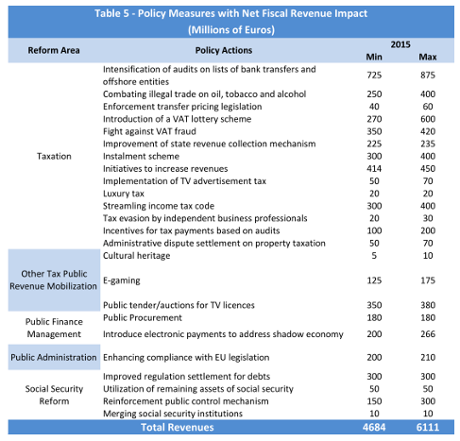
The 26-page reform plan is indeed more detailed than previous documents; many measures have clear, sourced revenue projections to raise up to €6bn. For example:
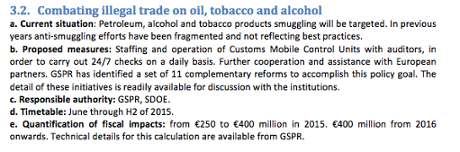
But still not detailed enough....
Updated

Greece’s prime minister has been pressing on with tackling the country’s humanitarian crisis.
Alexis Tsipras told an audience at the health ministry that his government would restructuring the country’s ailing healthcare system.
He pledged to hire 4,500 more healthcare workers, and to reverse the “commercialization of healthcare” under the previous government.
Greek PM Tsipras heralds 4,500 hirings in health sector, abolition of a 5-euro fee patients pay for outpatient treatment at state hospitals.
— NikiKitsantonis (@NikiKitsantonis) April 2, 2015
In case you missed it, here’s Helena Smith’s take on last night’s (leaked) reform list:
Troika gives Greece an ultimatum: sign up to our failed system or else we starve your country http://t.co/xQdQ4n1F7T #grexit
— Carl Packman (@CarlPackman) April 2, 2015

Greek finance minister blasts leaks
Over in the Athens parliament, Greek finance minister Yanis Varoufakis has hit out at yesterday’s leaking of his 26-page reform plan.
Varoufakis told MPs that the disclosure was not acceptable, and blamed Greece’s creditors for passing the information to the Financial Times.
“This is not our choice, we must ensure confidentiality”, he told MPs.
#Varoufakis slams press leaks on EU-Greece negotiations @FT #bailout #eurogroup #Greece- http://t.co/KEUwjNWjok pic.twitter.com/XOm8NxcPB3
— enikos_en (@enikos_en) April 2, 2015
Varoufakis agreed that the reforms should have been announced to parliament.
According to the Kathimerini newspaper, he said it was “unacceptable” for the Greek people to obtain information from websites [so don’t click here, readers].
Varoufakis blames the 'Institutions' for leaks of reform proposals. "Citizens' trust is undermined by such actions" http://t.co/SNcfSvP01v
— Yannis Koutsomitis (@YanniKouts) April 2, 2015
Varoufakis is particularly irked that Brussels has been pushing for confidentiality in the first place.
#Greece FinMin Varoufakis claims the 'Institutions' insisted on confidentiality (although he disagreed) yet leaked the reform list.
— Yannis Koutsomitis (@YanniKouts) April 2, 2015
Updated
Heard the one about the bishop, the baroness and the union chief? They’ve all agreed to join a new body to keep Britain’s banking sector on the straight-and-narrow.
This chart, via the FT, shows how Greek two-year bond yields have fluctuated wildly in recent months -->
HT @lindayueh short-dated Greek debt washing machine http://t.co/3Dtq80mbwH pic.twitter.com/VOK6mpCRun
— Shire Blogger (@Shireblogger) April 2, 2015
The general upward trend, though, shows that investors have been pricing in a higher risk of default or restucturing.
Shares in Marks & Spencer have soared by 5% to a seven year high, as traders welcome the long-awaited turnaround in clothes sales.
M&S shares have been rising since Nov, up 4% today and higher than when Bolland became boss 5 years ago. pic.twitter.com/1jF7aURWyF
— Joel Hills (@ITVJoel) April 2, 2015
There’s grudging praise from some quarters, though:
Bryan Roberts of Kantar on M&S: "The occasional screamer into top corner doesn't negate smashing ball over the bar for the last four years"
— Graham Ruddick (@GrahamtRuddick) April 2, 2015
Extra Easter eggs for Marks & Spencer’s staff, after it *finally* reported a rise in clothes sales in four years.
The high street retailer grew clothing and household sales by 0.7% in the last quarter, suggesting it has got its online operations under control.
My colleague Sarah Butler explains:
The rise in sales comes despite a tricky spring for fashion retailers with the weather much chillier than this time last year.
The company credited improvements in style and quality, and positive press coverage, particularly of a suede skirt which has yet to arrive in stores, for the sales turnaround. But performance was also lifted by a return to growth at M&S.com, where sales rose 13.8%, a considerable bounce from the 6% slump over Christmas, when business was affected by problems at the group’s hi-tech distribution centre in Castle Donington.
UK construction growth slows (but don't panic)

Just in: Growth in Britain’s construction sector slowed last month as builders wait for next month’s general election to play out.
That’s according to data firm Markit. Its UK construction PMI fell to 57.8 last month, down from 60.15 in February -- so still comfortably above the 50-point mark showing no change. Civil engineering saw the biggest slowdown.
Markit says:
Some construction firms noted that uncertainty related to the forthcoming general election had encouraged clients to delay spending decisions.
The latest survey pointed to an element of caution among construction companies in terms of additional job hiring, with overall employment numbers rising at the least marked pace since December 2013.
Encouragingly, confidence about the next 12 months hit a nine-year high (so they can’t be THAT worried about the election...).
The good news is that the UK Construction #PMI continues to show strong growth. The bad news is the dip from 60.1 to 57.8 #GBP #ukhousing
— Shaun Richards (@notayesmansecon) April 2, 2015
Have City traders already bunked off for Easter?
Europe’s stock markets are moribund this morning, with the main indices either up a bit or down a bit ahead of the bank holidays.

Most investors are taking a wait-and-see approach to Greece. They’re more concerned about tomorrow’s US unemployment data, which could be disappointing (yesterday’s measure of private sector job creation missed forecasts.)
Tony Cross, market analyst at Trustnet Direct, explains:
There’s a lot of uncertainty still hanging over the market and with events including the US non farm payrolls and a meeting between Tsipras and Putin - which has the potential to see more political grandstanding from Greece – set to occur [on April 8th], there’s going to be a degree of risk mitigation in play.
Barroso: Greece must drop 'unacceptable' demands
Former European Commission chief Jose Manuel Barroso has laid into the new Greek government this morning.
Ex-Maoist Barroso didn’t show much sympathy for Greece’s leftist administration, accusing it of inexperience.
Interviewed by the BBC, Barroso said Athens’ demands were “completely unacceptable to other countries”.
“It is not helpful if Greece attacks countries that are trying to help it.”
“We should remember that there are poorer countries that are lending money to Greece, so to propose a cut to their debt would be certain to receive a no from their partners.”
Barroso also denied that the EU had created the structural problems and low productivity in Greece.
But we should remember that Barroso was at the helm in 2010, when Greece’s first, flawed bailout was put together.
Greek sovereign debt is weakening this morning as traders fret about the state of its finances.
This has driven the yield on two-year bonds up to 23.27%, up from 22.99% last night. [yields rise when prices fall].
And here’s the quote from French finance minister Sapin:
“There is progress with the last [Greek reform] list ... Is there a need for more progress? Yes - in the quantification of the measures.”
Updated
Newsflash from France: French finance minister Michel Sapin has warned that Greece’s economic reform plan still needs more detail:
- FRENCH FINMIN SAYS PROGRESS HAS BEEN MADE WITH LATEST GREEK REFORM LIST, MORE PROGRESS MUST BE MADE, MORE DETAILS NEEDED
Former Greek PM Samaras suggests anti-Grexit alliance
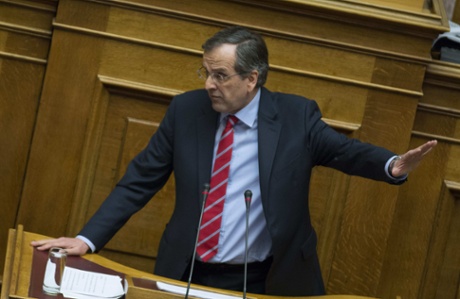
With political tensions rising in Greece, the previous prime minister has suggested he could form an alliance to avoid the country leaving the euro.
Antonis Samaras, who was defeated in January’s general election, told Bloomberg that he’d be prepared to work with Alexis Tsipras if the governing Syriza party splits up.
“If the plan is to keep Greece in the euro area, we will provide support....Exit would signal a total catastrophe.”
There’s no sign that Syriza is about to splinter, but its left-wing elements may find it impossible to support measures which they campaigned against. Privatisations might be a red line, for example, as could labour market reform (an area where the eurozone wants more action).
Samaras also pushed Tsipras to cut the rhetoric, and accept the agreement made in February. Otherwise, he warned, Greece could default.
“I see a lot of words, a lot of theory, a lot of lies, and no action...All of these add up to a big question mark.”
“If they ideologically decide they won’t abide by this agreement, then you may have a default.”.
It’s hard to see Tsipras and Samaras in the same administration, given their clear antipathy. But desperate times and all that....
#Samaras says he'd join the coalition to keep Greece in #euro http://t.co/odjPrIvh36 pic.twitter.com/9JL1Xmlx0A
— Mark Barton (@markbartontv) April 2, 2015
Updated
The Agenda: Greek reform plan 'still lacks detail'
Good morning, and welcome to our rolling coverage of the world economy, the financial markets, the eurozone and business.
We’re heading into the Easter break without any signs of a deal to unlock some bailout cash for Greece, despite some encouraging signs on Wednesday.
Yesterday the Greek finance ministry submitted its most detailed economic reform plan yet; 26-pages of tax measures, administrative reforms and privatisations.
Greece also warned its eurozone partners that the very viability of the EU was at stake, saying:
The Hellenic Republic considers itself to be a proud and indefeasible member of the European Union and an irrevocable member of the Eurozone. Yet the viability of that Union, and especially of the common currency, is now in question, in the minds of many Greek citizens as it is in the minds of many among our European partners.
The question before us all, as Europeans, is whether the European Union can rise to the challenge before it.....
(last night’s liveblog has the details..... and the FT has the full list)
But a stream of eurozone insider have warned that Greece has still not convinced its creditors.
The Wall Street Journal reports:
The list is a “very long way from being a basis [for a deal],” a eurozone official said. “They should negotiate in competence and good faith with the institutions first, and then we will see.”
Another official warned:
“It still lacks detail and substance in many places.”
And with the Western Easter break starting tomorrow, and Orthodox Easter a week later, the negotiations look bogged down. Eurozone finance chiefs may not decide whether Greece has done enough until their next scheduled meeting in three week’s time.
As Michael Hewson of CMC Markets puts it:
A great deal of scepticism remains about the prospect of any type of deal before the next EU finance ministers meeting on April 24th, which given that Greece needs to make various payments of nearly €2.5bn, between now and then, doesn’t bode well for any sort of resolution this week, or next week, for that matter.
Overshadowing everything, of course, is the €430m due to the IMF next Thursday. Athens insists that it will meet it. But yesterday’s warning from interior minister Nikos Voutsis that the payment could be delayed has raised the pressure.
Greece threatens to default on IMF says the front page of @TeleFinance. pic.twitter.com/kKc5WMdobm
— TimesBusiness (@TimesBusiness) April 2, 2015
So, it could be a quieter day... or perhaps not. Either way, we’ll be covering the main events through the day...