That’s all for tonight, unless anything amazing happens in the next couple of hours.
Here’s our latest news story, by Jon Henley:
Seven months after he was elected on a promise to overturn austerity, the Greek prime minister, Alexis Tsipras, has announced he is stepping down to pave the way for snap elections next month.
As the debt-crippled country received the first tranche of a punishing new €86bn (£61bn) bailout, Tsipras said on Thursday he felt “a moral obligation to place this deal in front of the people, to allow them to judge ... both what I have achieved, and my mistakes”.

The 41-year-old Greek leader is still popular with voters for having at least tried to stand up to the country’s creditors and his leftwing Syriza party is likely to be returned to power in the imminent general election, which government officials told Greek media was most likely to take place on 20 September.
The prime minister insisted in an address on public television that he was proud of his time in office and had got “a good deal for the country”, despite bringing it “close to the edge”. He added he was “shortly going to submit my resignation, and the resignation of my government, to the president”.
The prime minister will be replaced for the duration of the short campaign by the president of Greece’s supreme court, Vassiliki Thanou-Christophilou – a vocal bailout opponent – as head of a caretaker government....
More here:
And here’s our Athens correspondent, Helena Smith, explains how Tsipras is taking a calculated gamble:
After the country’s latest rescue – and the onerous terms the young prime minister has agreed to – his popularity ratings will surely have been dented. In a matter of weeks he has lost more than a quarter of his own MPs, radicals who not only feel he has betrayed the cause but will campaign as the only leftists now left to carry the anti-bailout flame.
Few politicians have so reneged on their pre-electoral promises as the Syriza leader, who came to power vowing to “cancel” austerity and all the evils it had visited on Greece. And, yet, paradoxically Tsipras remains more popular than any of his political rivals. His handling of negotiations with international creditors has not elicited the widespread condemnation one might have expected. Most Greeks still regard the tortuous talks as a robust defence of their rights. The fact that the terms attached to the €86bn (£61bn) rescue were harder than any to date has ultimately been seen as better than euro exit. And unlike any prime minister to date Tsipras has been credited with internationalising the problem of Greece’s unsustainable debt burden. The International Monetary Fund, one of three creditors to Greece and once the country’s harshest economic critic, has become the biggest proponent of debt relief as the basis for recovery.....

More drama, this time in New York. The US stock market suffered a late selloff, wiping 2% off the Dow Jones industrial average and the wider S&P 500 index.
That follows big losses in China this morning, and Europe today.
S&P 500 falls 2.1% for worst day since February 2014 http://t.co/0Y96fOt7su pic.twitter.com/7EhIsZz01M
— Bloomberg TV (@BloombergTV) August 20, 2015
Analysts believe shares in London will keep falling tomorrow, after entering correction territory today.
The IG currently forecasting a -65 start for the FTSE100 on Friday at 6303. Low for 2015 is 6298.
— David Jones (@JonesTheMarkets) August 20, 2015
A late rumour from Greece - Syriza’s left-wingers could be planning to split into their own parliamentary grouping.
There are around 40 MPs in the Left Platform, so they would leapfrog Golden Dawn to become the third largest party behind Syriza and New Democracy.
That would mean they could get the mandate to form a government (!) before general elections are called (see earlier explanation).
#Greece | Left Platform indicate they may form a parl group. If so, they will be 3rd strongest group, will get 3rd mandate & not Golden Dawn
— Yannis Koutsomitis (@YanniKouts) August 20, 2015
Updated
Eurogroup chief hopes elections will bolster bailout support
Less than a week ago, the eurogroup was celebrating signing off Greece’s third bailout.
Tonight, its president Jeroen Dijsselbloem is urging Greece not to abandon its “commitment” to the currency bloc.
In a statement sent to Reuters, Dijsselbloem said:
“I recall the broad support in the Greek parliament for the new program and reform package and I hope the elections will lead to even more support in the new Greek parliament.”
It really has been quite a year (and there’s still four months to go!)
Greece's Tsipras resigns, calls snap polls to beat party revolt http://t.co/8RKyBfKc57 pic.twitter.com/GLEuZQW9Tq
— Agence France-Presse (@AFP) August 20, 2015
City economists are already warning that Tsipras’s resignation shows it will be very hard to implement Greece’s bailout programme.
Jennifer McKeown, senior European economist at Capital Economics, said:
“Given its anti-austerity roots, the remaining Syriza party will still struggle to implement the demanding bailout conditions, especially in the likely event that Greece sinks further into recession.
And major reforms seem unlikely to be passed in the period running up to the election.”
Greek opposition may try to form minority government.
Under the Greek constitution, if the PM resigns the mandate to form a government is passed to the largest opposition party, for three days.
So Evangelos Meimarakis of New Democracy could spend the weekend trying to form a minority government to replace Tsipras’s administration, as he just pledged.
Meimarakis says he'll meet Potami & PASOK leaders, as well as other opposition chiefs in bid to form minority gov't #Greece
— Nick Malkoutzis (@NickMalkoutzis) August 20, 2015
If he fails, the mandate would then transfer to the second-largest opposition party -- currently the extreme right-wing Golden Dawn.
Creating a minority government would be rather challenging, as Syriza holds 149 of the 300 seats in the Greek parliament.
Pledge by New Democracy's Meimarakis to try to form minority gov't seems more attempt to rain on Tsipras parade than genuine effort #Greece
— Nick Malkoutzis (@NickMalkoutzis) August 20, 2015
Updated
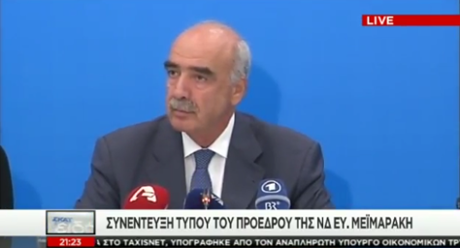
The head of the largest opposition party, Evangelos Meimarakis of New Democracy, has pledged to “explore all avenues” to avoid snap elections.
That suggests Meimarakis might try to form a government -- meaning elections might not be called tonight after all.
ND leader Meimarakis says he will take the mandate @atsipras has handed over and he will try to form a gvt #GreeceElections
— Efi Koutsokosta (@Efkouts) August 20, 2015
Meimarakis also took a few pot-shots at Tsipras’s track record, as the election campaign got underway.
Iliana Magra, a politics student in Greece, has tweeted the details:
#Meimarakis : no one can understand why Mr #Tsipras resigned today.
— Iliana Magra (@Magraki) August 20, 2015
#Meimarakis : #Tsipras is popular but he is a bit of liar
— Iliana Magra (@Magraki) August 20, 2015
#Meimarakis : Never before has a PM caused -by himself- 3 electoral processes. #GreeceElections
— Iliana Magra (@Magraki) August 20, 2015
(that’s January’s general election, July’s referendum, and the upcoming snap poll)
Updated
Moody’s has warned that Tsipras has put Greece’s third bailout programme at risk.
The rating agency fears that Greece could miss out on some of the €86bn loan deal, if it fails to implement the measures agreed with creditors.
Or in Moody’s words:
“The Greek Prime Minister Tsipras’s move to step down and call snap early elections on 20 September could elevate programme implementation concerns and, potentially, puts future official sector disbursements at risk.”
And here’s Tsipras, asking for elections to be held as soon as possible:
Greek PM @atsipras is now submitting his resignation to the President of the Republic Pavlopoulos #GreeceElections pic.twitter.com/sbCxETfc0N
— Efi Koutsokosta (@Efkouts) August 20, 2015
Tsipras is meeting with president Pavlopoulis right now - on a rather large sofa:

Greek PM resigns: instant reaction
Eurocrisis analysts and journalists are struck by Alexis Tsipras’s split from the left-wing side of his own Syriza party:
Express elections forthcoming in #Greece. PM Tsipras throws the gauntlet at the #Leftist Platform, challenging them as #drachme advocates
— Jens Bastian (@Jens_Bastian) August 20, 2015
after years of struggle and opposition to the Troika, that the Greek left will have to start from scratch is really depressing.
— David Ferreira (@Igualitarista) August 20, 2015
Tsipras presenting SYRIZA as best option compared to Left Platform (pro-Grexit) and traditional parties (too soft with creditors). #Greece
— Vincenzo Scarpetta (@LondonerVince) August 20, 2015
If anyone thinks the €zone isn't an engine of convergence, just look at Alexis Tsipras. Six months in and he's turned into Francois Hollande
— Mike Bird (@Birdyword) August 20, 2015
Snap summary: Tsipras the moderate bids for new mandate
And that’s it.
Alexis Tsipras has fired the starting pistol on a new bout of political drama in Greece, by announcing his resignation after seven dramatic months in office.
After one general election, and one referendum, already this year Greeks will head to the ballot boxes again this autumn.
If Tsipras has his way, he’ll be re-elected with a new mandate to implement the third bailout agreement. He’s sticking to his position that he did the best he could for Greece, despite failing to deliver his vow to end austerity.
The Greek PM also appears to be reinventing himself as a moderate. To do that, he must lose the leftist elements in his party, whose refusal to back the deal forced him to call snap elections.
Crucially, Tsipras did not say when new elections will be held. Perhaps that responsibility will fall to president Prokopis Pavlopoulos, who should be receiving Tsipras right now.
Greece, the rest of the eurozone, and the world’s financial market faces an anxious few weeks while the election takes place.
Updated
I am proud of our time in office, says Tsipras, adding that Europe is not the same since Syriza took power in late January.
Tsipras is pitching himself in the centre ground between the left-wing elements in his own party who wanted Grexit, and mainstream opposition parties who signed up to previous bailout deals.
#Greek PM #Tsipras : you will judge us, the ones that promoted the drachma pathway and the ones that served the old system
— Iliana Magra (@Magraki) August 20, 2015
This TV address is swiftly turning into a party election broadcast, even though the election hasn’t even been called yet.
Tsipras says that voters must decide if his government showed “courage” in its talks with creditors, and whether the bailout deal will allow Greece to recover.
I am resigning because I have now exhausted the mandate which the public gave me in January’s general election, says Tsipras.
Now you must “decide with your vote whether we made the right choice”
Alexis Tsipras announces his resignation
Tsipras confirms that he will step down as prime minister, after almost eight months in office, to trigger elections.
"Shortly I am going to submit my resignation and the resignation of my government to the president" #Tsipras
— Omaira Gill (@OmairaGill) August 20, 2015
I have a moral obligation to place this deal in front of the people, to allow them to judge it, says Tsipras.
Tsipsas is running through the good points of his bailout deal (this may not take too long!).
He says Greece resisted pressure to cut pensions and to privatise the country’s electricity supplier.
#Greek PM #Tsipras #live : Firing of public servants is now in the past.
— Iliana Magra (@Magraki) August 20, 2015
Tsipras is arguing that Greece has taken a decisive step forwards in the crisis, though the three-year €86bn deal he signed up to last month.
This is like listening to a bad break up. #Tspiras taking his time to get to the point
— Omaira Gill (@OmairaGill) August 20, 2015
#Greek PM #Tsipras #live : we are obliged to comply with this deal but without accepting bad treatment of lower social classes
— Iliana Magra (@Magraki) August 20, 2015
Tsipras: We got the best deal we could
Alexis Tsipras (jacket, no tie as usual) begins by saying that Greece has been through difficult negotiations, but this phase is finally over.
He concedes that he did not secure the bailout agreement he wanted, but it was the best available.
We will fight to avoid “adverse consequences” of the bailout programme, he pledges.
Nothing on new elections yet.....
Please do not adjust your sets.....
Tsipras' address to the nation ... first 30" transmitted without sound #Greece
— Keep Talking Greece (@keeptalkingGR) August 20, 2015
Tsipras addresses the nation
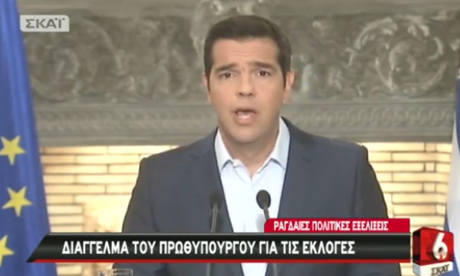
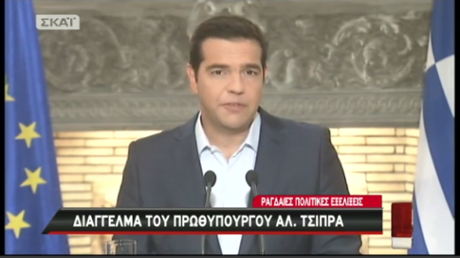
Alexis Tsipras is starting to give his statement now (live feed here, in Greek).
EIU: Opposition to bailout deal won't go away
Snap elections will allow Syriza to remove troublesome left-wingers who won’t accept the bailout conditions, but they won’t make the deal much more popular.
As Joan Hoey of the Economist Intelligence Unit explains:
Tsipras is likely to form the next government having removed dissenting Syriza MPs, but he will not be able to eradicate opposition to bailout policies, which is likely to increase as times goes by.
The mind-boggling scope of the reforms in the new agreement, which extend into virtually every area of the economy and polity, exceed anything visited upon even the post-communist states of eastern Europe.
The referendum result of 5 July, in which 61% of voters rejected austerity measures demanded by Greece’s creditors, revealed that there is a large body of opinion that is prepared to countenance a break with the euro. In coming months and years, support for remaining within the euro zone “at all costs” will diminish significantly.”
Updated
@antheecarassava In most countries September is back to school in #Greece its back to ballot box.
— Tania Oram (@TaniaOram) August 20, 2015
No sign of Tsipras yet.
ERT’s web feed has crashed, unfortunately. But happily you can also watch Skai News live, here.
I believe Alexis Tsipras’s statement will be carried live on the ERT state broadcaster. If so, you can watch it live here.
Snap elections could allow Alexis Tsipras to shore up support for the third Greek bailout, tweets EC president Juncker’s chief of staff, Martin Selmayr:
Swift elections in Greece can be a way to broaden support for ESM stability support programme just signed by PM Tsipras on behalf of Greece.
— Martin Selmayr (@MartinSelmayr) August 20, 2015
The opposite is also true, of course....
Updated
Journalists are now gathering to watch Alexis Tsipras take the short trip to see president Prokopis Pavlopoulos and submit his resignation, nearly seven months after taking office.
Waiting for @atsipras to head to Presidential palace w @aantzoletos #Greece pic.twitter.com/S3voAEoPMg
— Nektaria Stamouli (@nstamouli) August 20, 2015
Reminder: Tsipras should address the nation in a TV address at 8pm local time (6pm UK).
#Greek PM Alexis #Tsipras to officially announce his resignation and elections in one hour. #Greece
— Iliana Magra (@Magraki) August 20, 2015
The European Central Bank has just confirmed that Greece has repaid the €3.4bn of bonds which matured today (using the new bailout loans handed over this morning).
The ECB confirms that all Greek government bonds maturing today and owed to the ECB and Eurosystem NCBs have been repaid by Greece
— ECB (@ecb) August 20, 2015
There was never much risk that Greece would miss the repayment, once its bailout was agreed.
(It means the ECB is now clear to keep providing support to the Greek banking sector, although I can’t see capital controls being lifted before these snap elections.)
Updated
My colleague Jon Henley sums up the situation:
The Greek prime minister, Alexis Tsipras, has decided to step down and call snap elections for 20 September, government officials said.
As the debt-crippled country received the first tranche of its new €86bn (£61bn) bailout, Tsipras was set to make the formal announcement later on Thursday, government sources told Reuters.
Once he submits his resignation the prime minister would be replaced by the president of Greece’s supreme court, Vassiliki Thanou-Christophilou – a vocal bailout opponent – who would oversee the elections as the head of a transitional government.
Tsipras won parliamentary backing for the tough bailout programme last week by a comfortable margin despite a large-scale rebellion among members of his ruling leftwing Syriza party, nearly one-third of whose 149 MPs either voted against the deal or abstained. Syriza governs in a coalition with the rightwing, anti-austerity party Independent Greeks (Anel).
The revolt by hardliners angry at what they view as a betrayal of the party’s pledge to fight austerity left Tsipras short of the 120 votes he would need – two-fifths of the 300-seat assembly – to survive a censure motion and he was widely expected to call a confidence vote this week or next.
He has now decided to skip that step, deciding instead to go straight to the country in an attempt to silence rebels and shore up public support for the draconian three-year bailout programme, which entails a radical overhaul of the Greek economy including further tax hikes, spending cuts and major reforms of health, welfare, pensions and taxation....
Here’s Jon’s full story:
Greek government bonds are suffering from Tsipras’s decision to trigger the country’s fourth election since early 2012.
The yield, or interest rate, on two-year bonds has jumped to 12.1%, from 11.3% last night.
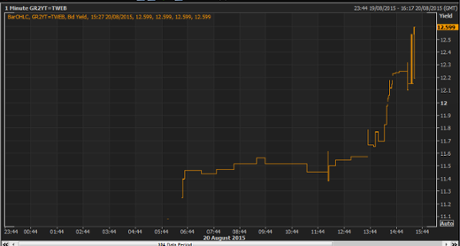
A higher yield shows that the debt is seen as riskier.
once elections called, the #greek state grinds to a halt. that includes revenue collection just days shy of income, property tax filings
— Diane Shugart (@dianalizia) August 20, 2015
Snap elections will not make it easier for Greece to implement the terms of its new bailout agreement.
According to the bailout provisions, Athens has to present by October a supplementary budget for 2015, a draft budget for 2016 and a 2016-19 medium term fiscal strategy, (via Teneo Intelligence;s latest note on Greece).
That will include tackling some tough structural reforms, including to pensions and income tax. It’s hard to see how that can happen during an election campaign.
And Greece needs to meet these conditions so that creditors can then consider the issue of debt relief.
Greek PM Tsipras informing party leaders of his decision to head for snap elections. Ballot date likely to be Sept 20, sources say #Greece
— Kathimerini English (@ekathimerini) August 20, 2015
A government official says Alexis Tsipras is planning to hand in his resignation to Greece’s president later today, Reuters reports.
There’s also a rumour that the rebellious left-wing of Tsipras’s party are preparing to break away and form their own group.
Left Platform (SYRIZA's radicals) are waiting for #Tsipras' announcemenents to announce new party - state TV
— Daphne Papadopoulou (@daphnenews) August 20, 2015
A government official has just confirmed to Reuters that Tsipras will propose holding elections on September 20th.
Greek elections 'to be held on September 20'
Fasten your seatbelts. Mega TV are reporting that Alexis Tsipas has decided to call fresh elections in Greece in four weeks time, on Sunday 20 September.
Updated
Alexis Tsipras’s meeting with his top advisors has broken up....
Meeting of top ministers & Syriza officials with Tsipras has just ended. Que sera sera. We should know soon. #Greece
— Yannis Koutsomitis (@YanniKouts) August 20, 2015
Snap elections, sooner or later, are inevitable due to the deep split within the government, tweets Nick Malkoutzis of the Kathimerini newspaper:
Truth is current set-up (SYRIZA divided & reluctant opposition support) not sustainable. Alternatives to snap elex questionable 1/2 #Greece
— Nick Malkoutzis (@NickMalkoutzis) August 20, 2015
That's why it always seemed only issue Tsipras had to resolve was if elections would come before/after 1st bailout review 2/2 #Greece
— Nick Malkoutzis (@NickMalkoutzis) August 20, 2015
Updated
Greek media are still confident that Tsipras will address the nation at 8pm local time (6pm BST), so just over two hours to wait.....
#Tsipras expected to make statement at 20.00, say Gr media - in time for TV news bulletins
— Daphne Papadopoulou (@daphnenews) August 20, 2015
@Hugodixon this lady here.. pic.twitter.com/4Vu4jZSZIE
— Ilias Chatzopoulos (@IChatzopoulos) August 20, 2015
Having checked with Greek media friends, it appears that Alexis Tsipras would have to formally resign as prime minister if he chooses to trigger snap elections.
A caretaker government would then be installed until the polls had been held.
And the front-runner to lead that administration, according to Greek Reporter, is the president of the Supreme Court, Vassiliki Thanou-Christophilou.
More here: The Judge Who Could be Greece’s First Female Prime Minister.
Vassiliki Thanou, 65 yrs old, President of the Supreme Court of Greece, tomorrows Prime Minister of GR till elections pic.twitter.com/xdXHxVGizU
— George Mitakides (@GMitakides) August 20, 2015
Updated
Who might win a snap election?
Well, Syriza has held a solid lead in the opinion polls all year, even though it hasn’t delivered on the promises made before January’s election.
So on paper, Alexis Tsipras has a good chance of being returned as prime minister, perhaps in a new coalition.
Some recent #Greece opinion polls. Still giving Syriza a large lead albeit slipping slightly https://t.co/c721I0fQhJ pic.twitter.com/Otm3FIuT88
— Raoul Ruparel (@RaoulRuparel) August 20, 2015
However, these polls were taken before Greece finally secured its third bailout (the first loan tranche was paid this very morning).
The Greek public are still digesting the events of a dramatic year, and coming to terms with the tax rises, spending reforms and economic reforms which Tsipras’s government agreed to.
The recent split in Syriza between the rebels of the Left Platform and the rest of the party also complicates the picture.
Previous #Greece opinion polls totally worthless for reaching conclusions on what may happn in poss Sept elections. Evrything's differnt now
— Yannis Koutsomitis (@YanniKouts) August 20, 2015
Updated
Greece’s sovereign debt is falling in value, as investors face up to the prospect of elections next month.
This has pushed the yield on two-year Greek bonds up to 11.6%, from 11.3% last night (a higher yield, or interest rate, means the debt is seen as riskier)
Updated
Syriza rebellion likely to force snap elections
So, why is Greece’s prime minister apparently planning to call snap elections, just days after securing the country’s third bailout?
It all boils down to political mathematics, and the rebellion that has built up in Alexis Tsipras’s Syriza party over the economic reforms demanded by creditors.
Last week, more than 40 hardline Syriza MPs rebelled and refused to back the bailout plan. That deprived Tsipras of his majority (his coalition hold 162 seats out of 300).
Having won power in January on an anti-austerity platform, members of Syriza’s Left Platform argue that the bailout measures are unacceptable.
Analysts had been expecting Alexis Tsipras to call a confidence vote over the Greek bailout deal But this idea appears to have been shelved, in favour of a straight trip to the polls.
Reuters explains:
Tsipras - who remains popular in Greece and would be widely expected to return to power if elections were held now - was huddling with senior advisers on Thursday afternoon to decide his next move, a government official said.
“Everything is possible,” the official told reporters whenasked whether Tsipras could announce elections later in the day.
ERT state television said the timing of snap elections would be announced later on Thursday.
And that announcement could come at 8pm Greek time, or 6pm in the UK.
Alexis Tsipras gave the snappers a cheerful grin when he left his residence, Maximis Mansion, this afternoon, but didn’t reveal whether he’s planning to send Greece back to the polling stations soon:


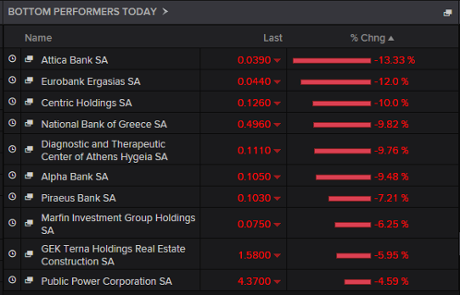
Speculation about snap elections is continuing to weigh on the Greek stock market.
The main Athens exchange has shed 3.2% today, led by financial stocks.
Alpha Bank tumbled 14%, followed by Attica Bank (-11%), and Piraeus (-10%), as investors react to this latest instability.
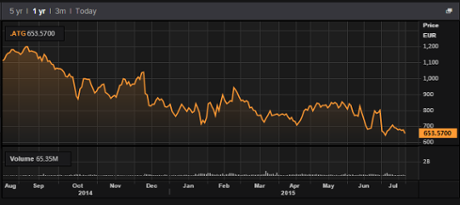
State broadcaster ERT is now reporting that Alexis Tsipras will announce a snap election tonight, after consulting his senior advisers.
That meeting has just started, according to the Wall Street Journal’s Nektaria Stamouli.
#Greece on #election mode again, meeting between @atsipras and top aides started at parliament
— Nektaria Stamouli (@nstamouli) August 20, 2015
September 20th appears to be the most likely date for Greece to hold fresh elections:
Tonight #Tsipras is expected to resign, transitional gov't to take over, with probable date of elections Sept. 20. #Greece
— Dim Rapidis (@rapidis) August 20, 2015
Tsipras 'to decide on early elections' today
Here’s Reuters’ latest take on the situation in Greece:
Greek Prime Minister Alexis Tsipras is due to meet senior advisers shortly to discuss whether to call early elections to quell a rebellion in his leftist Syriza party, a government official said on Thursday.
Speculation of snap polls in September has grown in recent days as senior aides including Energy Minister Panos Skourletis openly call for a return to the ballot box.
Here we go again?
State TV ERT reports Tsipras spoke to Greek President Pavlopoulos last night. Content not known but speculation is about snap polls #Greece
— Nick Malkoutzis (@NickMalkoutzis) August 20, 2015
The rumour mill is gathering pace, with reports that Greece’s prime minister will go on television tonight and trigger snap elections.
Greek media reporting PM Alexis #Tsipras will give a TV address tonight, possibly announcing his resignation & elections in Septemb. #Greece
— Janine Louloudi (@janinel83) August 20, 2015
Updated
Reuters is now reporting that Alexis Tsipras will meet with senior advisors today to discuss whether to plump for early elections:
Greek snap election talk is unsurprising as Greece has now received aid, opposition that Syriza relied on will return to playing role of opp
— RANsquawk (@RANsquawk) August 20, 2015
Wall Street is bracing for losses when trading begins in two hours time:
It's all looking a bit ugly - Dow $DJIA currently forecast to start 180 points lower than Weds close, at 17169. Low for 2015 is 17,038.
— David Jones (@JonesTheMarkets) August 20, 2015
The French and German stock markets have also pushed lower through the morning, and are both down over 1% as traders head for lunch.
The latest slide on the Chinese stock market (down 3% today), and fresh tensions in emerging markets (hello Kazakhstan!) overshadowed any relief over Greece.
Jasper Lawler of CMC Markets explains:
Markets priced in a short term resolution to Greece’s debt problems in the first few days after the deal was announced.
It wasn’t a given that Greece would make its payment to the ECB today but doing so wasn’t enough to offset emerging market concerns.
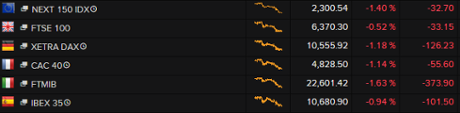
The speculation that Greece could call snap general elections soon is pushing shares lower in Athens:
Market not pleased with talk of early elections. Stocks off more than 3% #Greece
— Stelios Bouras (@SteliosBouras1) August 20, 2015
I’m afraid Kazakhstan rarely gets much attention in this liveblog. But no longer!
The Kazakhstan currency, the tenge (10 points if you knew that already), has plunged by a jaw-dropping 23% today after the country abandoned efforts to keep its value pegged.
1-year chart of the Kazakhstani tenge to the dollar. Definitely the chart of the week. http://t.co/RfxaM1QqOP pic.twitter.com/iC7CILF8n7
— Joseph Weisenthal (@TheStalwart) August 20, 2015
The move appears to be triggered by last week’s devaluation of the Chinese yuan by Beijing.
China is a major trading partner for Kazakhstan, as is Russia, where the rouble has been hit by falling oil prices and the strengthening dollar. A weaker tenge should make Kazakhstan more competitive, and also more vulnerable to inflation....
Euclid Tsakalotos also told MPs that a fresh Greek general election (if it happens) would not cause panic, due to the stability provided by the new bailout agreement.
FinMin Tsakalotos: Elections coming but situation better than 2012 #Greece pic.twitter.com/XWmmUwPvOI
— Derek Gatopoulos (@dgatopoulos) August 20, 2015
As covered at 8.30am, prime minister Tsipras appears to be close to calling a snap election. Nothing official yet, though.
Back to Greece, where finance minister Euclid Tsakalotos has told MPs that the banking sector is on the road to recovery:
Tsakalotos urged Greeks to trust the banking system and return their money to the banks.
He referred to the government’s mistakes but explained that mistakes are always made during hard negotiations.
However, Tsakalotos said, there is a legacy and “I think it helped European social democracy to realize that some things need to change in order for the eurozone to be saved.”
Tsakalotos urges Greeks to bring back their money to the banks - http://t.co/EaArg7LM6C
— enikos_en (@enikos_en) August 20, 2015
Fed minutes give markets the jitters

Confusion over the prospects of a US interest rate rise are also hitting stock markets today.
The minutes of the Federal Reserve’s most recent meeting, published last night, have muddied the waters, helping to send shares down in Asia and Europe.
According to IG, the ‘implied probability’ of a rate hike in September dropped to 38% overnight, from 48% on Wednesday, after Fed policymakers expressed concerns over weak inflation and the threat of a China slowdown.
Some analysts think a rate hike next month is now extremely unlikely:
My guess is that the odds of a Sept rate hike are fast approaching 0%.
— Cullen Roche (@cullenroche) August 19, 2015
But others fear the Fed will soon raise borrowing costs for the first time since the financial crisis began, despite signs of weakness in the global economy:
Shane Oliver, head of investment and chief economist at AMP Capital, told clients:
“The Fed appears to be heading toward a rate hike and this against the backdrop of deflationary forces globally is creating intense uncertainty.
“Investors have now grown used to near zero interest rates for more than 6 years in the U.S. and there is naturally fear that raising them will threaten the still fragile U.S. and global economies.”
There’s no relief at the Athens stock exchange this morning.
The main index has fallen by 2.5% in early trading, with Greek banks leading the rout, despite the news that Greece will receive €13bn of bailout funds today.
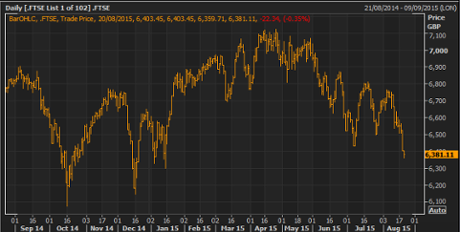
City analysts fear that the Footsie could take more of a kicking this autumn, given the speed of its recent declines:
FTSE 100 continues its push below the 6 year trend - next big level 2015 lows at 6300. Chart: pic.twitter.com/Ol2hFJKgnV
— David Jones (@JonesTheMarkets) August 20, 2015
FTSE 100 sinks into correction territory
Britain’s blue-chip index of leading shares has fallen into correction territory as fears over the global economy hit European stock markets again.
The FTSE 100 index hit a new seven-month low of 6359 points this morning, from 6403 last night.
That’s more than 10% from its record closing high of 7,104 points set in April, meaning the Footsie is now experiencing a correction (a 20% fall would equal a bear market).
Tony Cross, market analyst at Trustnet Direct, tells me:
Having dabbled with the level yesterday, there can be no doubting that the FTSE-100 is now squarely in corrective territory, having dropped by more than 10% since the April highs.
Stock markets have been dropping for several weeks now, as investors become increasingly edgy that the world economy was entering a stickier patch.
The state of the Chinese economy is now centre-stage. And the news that the Shanghai stock market had tumbled more than 3% today has hit European markets.
Conner Campbell of SpreadEX explains:
For such a long time Greece was the market moving force, be that positive or negative; now, despite a deal being signed, sealed and delivered, something that has happened against pretty formidable odds, investors have been infected with a fear over China that is outweighing any other (non-interest rate related) news.
Another tumble by the Shanghai Composite merely reinforced the idea that the Chinese government is struggling to provide a tourniquet for its headline index, and caused the markets to open to more widespread losses after the bell.
It’s not a major selloff, but all the European stock markets are in the red right now:
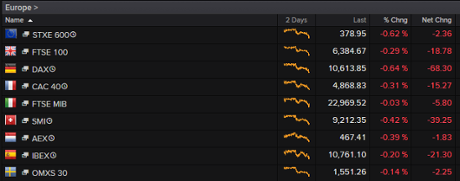
Updated
#Greece gives order to repay Eu3.2b in bonds to ECB after the bailout gets signed off by creditors yesterday
— Caroline Hyde (@CarolineHydeTV) August 20, 2015

With Greece’s bailout now secured, attention has shifted to whether the government will call elections soon or try to hang on.
The Kathimerini newspaper reckons that snap polls are now “certain”, given the rebellion among prime minister Alexis Tsipras’s party over the deal.
Kathimerini understands that one set of advisers is urging the prime minister to move swiftly and call a ballot for September 20 or 27 at the latest so the government can overcome the internal rift that has opened up within SYRIZA.
The other group has advised Tsipras not to consider elections before October 11 so the government has a chance to implement its new bailout agreement with lenders, build trust with them and perhaps clear the adjustment program’s first review.
“It is clear there are issues we have to deal with. We do not deny that,” said government spokeswoman Olga Gerovasil.
ESM agrees to 'immediately' send €13bn to Greece
Things are moving fast this morning.
Europe’s main bailout vehicle, the ESM, has now approved the first tranche of financial assistance for Greece, totalling €26bn.
It also announced that it will “immediately disburse” €13bn to Greece.
That leaves €10bn to help the banking sector, and €3bn to be doled out this autumn.
The money is arriving just in time, as ESM Managing Director Klaus Regling explains:
“Today’s ESM disbursement will allow Greece to meet its urgent financial obligations to the International Monetary Fund and the European Central Bank, and other budgetary needs. The second sub-tranche of €10 billion will contribute to stabilising the banking sector, whose situation deteriorated sharply after the imposition of capital controls in June.
ESM Board of Directors approves first tranche (€26bn) of third Greek bailout. €13bn disbursed immediately. http://t.co/VbsBmS0ce4 #Greece
— Open Europe (@OpenEurope) August 20, 2015
Greece "repays European Central Bank"
Greece has just triggered the procedure to repay the €3.4bn bond held by the European Central Bank, which matures today.
That’s according to the AFP newswire, and Reuters.
#Greece repays €3.4bn to the #ECB, AFP reports citing informed source
— Holger Zschaepitz (@Schuldensuehner) August 20, 2015
Updated
Introduction: Greece gets bailout cash, to repay ECB
Good morning, and welcome to our rolling coverage of the world economy, the financial markets, the eurozone and business.
It’s been a long, bumpy and nerve-racking journey. And the destination isn’t to everyone’s liking. But today, Greece will finally receive an injection of bailout funds for the first time in around a year.
Athens should take delivery of €13bn in fresh loans this morning, as the country’s third, three-year bailout programme gets underway. Another €10bn will be set aside in Luxembourg to help fund the repair of Greece’s banking sector.
As we covered in Wednesday’s liveblog, eurozone authorities signed this off last night, after the Dutch and German parliaments approved the deal.
The arrival of the bailout funds will remove the danger that Greece might default to its creditors. Later today, it must repay €3.2bn to the European Central Bank, to cover a maturing loan.
And after months of negotiations, ESM signs off first 26bn euros of Greece's new bailout (disbursing 13bn immediately so it can pay the ECB)
— John Geddie (@geddiejdk) August 20, 2015
Most of the rest of the bailout cash will also be rapidly spent servicing debts including the €7bn bridge loan agreed last month, to cover Greece’s other loan repayments to its creditors.
Yes, it’s all terribly circular, and doesn’t leave Greece with very much new funding to address its economic plight. But repaying the ECB is another step towards the day when capital controls are lifted.
What else is coming up today?
China remains a major worry for the financial markets, after recent turbulence.
The Shanghai stock market is down another 2% in late trading, despite the government’s efforts to prop up prices.
Hang on, it’s now 3%.....
*SHANGHAI COMPOSITE INDEX FALLS 3.04%
— lemasabachthani (@lemasabachthani) August 20, 2015
And investors are also reassessing the chances of the Federal Reserve raising interest rates in September.
Last night the Fed released the minutes of its latest meeting, which were more dovish than expected. Policymakers pointed to the dangers posed by the stronger dollar, and a China slowdown, as reasons for caution.
With emerging market currencies already at their lowest levels for years, the Fed’s next step will have global ramifications.
We’ll be tracking all the main events through the day....