European markets recover after Greek-inspired falls
There was an immediate knee-jerk reaction to the news that Greek prime minister Antonis Samaras had failed to muster enough support to win the third and final presidential vote, with markets falling back and Greek bond yields soaring. The outcome of a snap election is causing much uncertainty about the outlook for the country’s political status and the prospects for its bailout agreement. Syriza, the party in the lead in the polls, wants to renegotiate the bailout terms, while the likes of Germany are warning Greece to stick to its agreements.
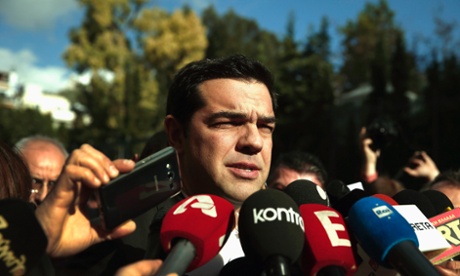
But a growing feeling that Greece’s situation, while serious, may not have an immediate knock on effect on the rest of the eurozone, helped markets recover lost ground. The most affected were the Athens market - despite recovering from its worst levels - and Spain and Italy, on fears they were the likeliest to be hit by any contagion. The final scores showed:
- The FTSE 100 finished 23.58 points or 0.36% higher at 6633.51
- Germany’s Dax edged up 0.05% to 9927.13
- France’s Cac closed 0.51% better at 4317.93
- Italy’s FTSE MIB fell 1.15% to 19,130.02
- Spain’s Ibex ended down 0.84% to 10,394.2
- The Athens market dropped 3.91% to 819.81
On Wall Street the Dow Jones Industrial Average is currently almost unchanged, down just 4.5 points or 0.02%.
On that note it’s time to close up for the evening. Thanks for all your comments, and we’ll be back tomorrow.
Updated
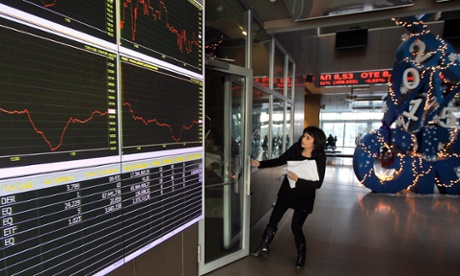
The Athens stock market has closed down 3.91%, a recovery from its earlier fall of 11% or so immediately after the news that a snap election would be called.
But yields on Greek 10 year bonds are currently at 9.7%, as investors baulked at the uncertainty now surrounding the country’s political and economic future.
And let’s not forget Russia. Fitch has just revised its outlook on 20 mid-sized and small Russian banks to negative from stable.
The agency believes “ the sharp deterioration in the Russian operating environment will negatively impact the banks’ credit profiles in 2015.”
The banks include Credit Bank of Moscow, Bank Saint Petersburg OJSC, Bank Zenit, Absolut Bank and, Uraltransbank. Fitch said:
The revision of the banks’ outlooks to negative reflects Fitch’s expectation that economic recession, significantly increased funding costs, sharp rouble depreciation, closed wholesale funding markets, a challenging liquidity situation and rising inflation will weigh on the banks’ credit profiles. At the same time, the affirmation of the banks’ ratings reflects (i) their moderate resilience to the weaker operating environment, as financial metrics are for the most part currently reasonable; and (ii) sovereign support for the sector, in the form of regulatory forbearance, liquidity provision and potential capital injections, which should reduce near-term pressures.
The full comments are here.
Over in the US, and a disappointing figure for Texas manufacturing activity.
The Federal Reserve Bank of Dallas’ monthly business activity index plunged to 4.1 in December, compared to 10.5 the previous month and expectations of a dip to around 9.
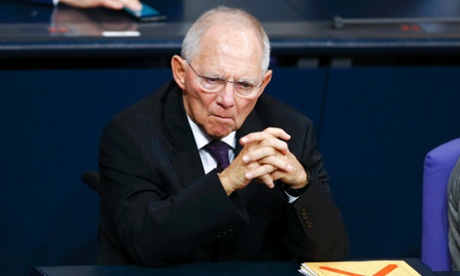
German finance minister Wolfgang Schaeuble has warned Greece to stick to its economic reforms, and said any new government would be held to the agreements made by Antonis Samaras’s current administration. Reuters reports:
“The tough reforms are bearing fruit and there is no alternative to them,” Schaeuble said after Greek lawmakers triggered an early election by failing to a elect a new president in a decisive third round of voting in parliament.
“We will continue to help Greece help itself on its path of reform. If Greece takes another path, it will be difficult,” Schaeuble added. “New elections will not change the agreements we have struck with the Greek government. Any new government will have to stick to the agreements made by its predecessor.”
Samaras said after the vote in parliament on Monday that he would propose January 25 as the date for a general election. Polls suggest that left-wing Syriza, which rejects the terms of Greece’s euro zone bailouts, will emerge as the strongest party in the election.
Back with Greece. and the International Monetary Fund, one of the counry’s troika of lenders, has said talks on the next review would take place one the new government was formed, and that Greece had no immediate financing worries. IMF spokesman Gerry Rice said:
Discussions with the Greek authorities on the completion of the 6th review of the program that is being supported by an Extended Arrangement will resume once a new government is in place, in consultation with the European Commission and the European Central Bank. Greece faces no immediate financing needs.
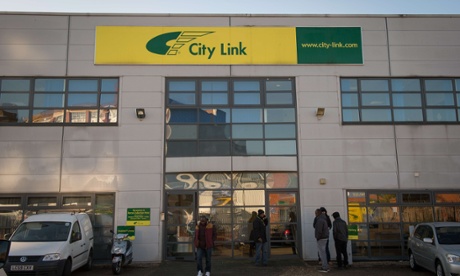
Turning back to City Link, there was no sign of anger about the handling of the insolvency at one of the company’s London depots this morning.
The Guardian’s Josh Halliday has sent this report.
RMT organisers reported “scenes of absolute chaos” at CityLink depots across the country, but there was barely a trace of turmoil at the firm’s delivery centre in Bermondsey, southeast London.
People arrived in more of a trickle than a flood when CityLink opened its gates for the first time since the company announced its collapse on Christmas Eve. An orderly queue of up to four people formed at the front desk, with customers reporting waiting times of between 15 minutes and an hour an a half. Any sign of staff tumult appeared to have long since subsided. “There were people here two weeks ago screaming that they wanted to get paid,” said one volunteer at a homeless charity based across the road from the depot. “But since then the gates have been locked. I haven’t heard of anything unpleasant going on.”
Many of those who turned up to collect parcels heard about the company’s misfortune on the television news, but some remained oblivious. “Has it really? Oh, I didn’t know that!” said Minguyan Li, 24, when told CityLink had gone bust. “Their service is not so good for me. They announced their opening times but they don’t follow them. This is the third time I’ve been here to collect my parcel.”
Updated
US markets have opened mostly flat on what is expected to be a day of quiet trading.
The FTSE100 is also flat, although European markets are slightly down because of the Greek vote. Greek’s main stock market, the ATG, has pared its earlier losses.
- FTSEEurofirst -0.35% at 1370 points
- ATG -4.1% at 818 points
Time for a lunchtime summary:
- Greece is heading for snap elections, after Stavros Dimas failed to win enough votes to become president.
- Prime minister Antonis Samaras had a mandate until mid 2016 for his coalition government, but had promised to bring forward the poll if Dimas, the only candidate, did not win the largely ceremonial post.
- Dimas won 168 votes in a third and final round of voting - 12 votes short of the super majority he needed.
- The election is likely to be held on 25 January and could plunge Greece into political chaos, as leading opposition party Syriza has vowed to re-negotiate the country’s eurozone bailout.
Read more here
Greece plunged into crisis as failure to elect president sets up snap election
And
- Russia’s economy shrank in November for the first time since the financial crisis in 2o09.
Ian Bremmer, president of the Eurasia group, gives his verdict on Greece.
Greece economy with a far better trajectory today than during Eurozone crisis. Greek politics, much worse.
— ian bremmer (@ianbremmer) December 29, 2014
Speaking of the ECB, it is worth catching up with this interview with Jens Weidmann, the president of the Bundesbank and member of the ECB’s governing council.
In an interview with Frankfurter Allgemeine Sonntagszeitung he said
the situation in Europe “isn’t as bad as some people believe”.
As things are at the moment and if oil prices remain this low, inflation will be lower than expected, but growth will be better.
Weidmann is known for his opposition to turning on the money taps of quantitative easing.
(With low oil prices) an economic stimulus program has been handed to us, why should we add to that with monetary policy?”
“I am irritated by one question dominating the recent public debate: when will you finally buy?”
ECB awaits views of Greek authorities on bailout review
The European Central Bank has issued its statement on the Greek vote.
No big surprises, but for the record:
It is now for the Greek electorate to decide about the future composition of the parliament and the government. We will not interfere in or comment on this democratic process.
We will wait for the views and suggestions of the Greek authorities on how to best proceed with the review, and we will discuss this with the European Commission and the IMF.
Bookies cut odds of eurozone 'Grexit'
Once again, those publicity-conscious folks at Ladbrokes have not missed a trick.
The bookmaker has cut the odds of a Greek exit from the euro in 2015 to evens from 2/1.
It said:
The betting firmly suggests 2015 will be a pivotal year for the stability of the Eurozone.
Renzi insists Italy will not be damaged by fallout from Greek vote
Contagion? What contagion?
Italy’s prime minister Matteo Renzi has insisted that Italy will not be affected by further economic turmoil as a result of Greece’s political instability.
Speaking at a year end news conference, he said:
I feel that I can totally exclude a contagion effect between Greece and Italy, which are profoundly different countries.
Syriza might conjure up red-flag economics, but its programme for Greece is basic Keynesianism, according to Paul Mason of Channel 4 News.
Here is an extract from his blog on how the party has changed in two years.
Two years ago I sat in the HQ of Syriza waiting for a very close election result. “Thank god, we’ve lost. That’s great for us,” said one of the party’s journalists as they greeted me. You could see why: they were not prepared for power - the entire party records were in six or seven box files on the shelf next to me.
But in the past two years Syriza has professionalised, mounted a fairly consistently slick performance as the official parliamentary opposition, and moderated its demands. Instead of cancelling the debts to the EU and IMF, it wants to negotiate half of them away. It is pledged to something George Osborne will only achieve in 2018 - a balanced budget.
So even as the symbolism of moderate Marxism is plastered all over Syriza, in reality its programme for Greece is mainstream Keynesian economics.
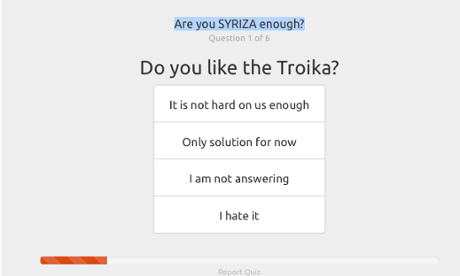
Courtesy of his blog, I have also stumbled across this quiz: are you Syriza enough?
Greeks are already starting to get advice in the wake of the election call, including from the European Commission’s Pierre Moscovici who said (according to Reuters snaps) that it was essential for Greek leaders and voters to support growth friendly reforms for Greece to thrive again.
Updated
Think tank Open Europe has been looking at the implications of the forthcoming Greek election, and the uncertainty it has caused.
For a start, there will be questions about whether Greece can meet the conditions of its recent bailout extension. Open Europe says:
The deal allowed the country an extra two months to complete some further reforms and for the EU/IMF/ECB Troika to complete its current bailout review. However, the first two weeks of this period have been spent on the presidential vote – little time has been spent taking action. Now the parliament is to be dissolved, meaning that nothing can happen for at least a month or six weeks – and certainly no new legislation can be passed. Some work will continue behind the scenes, but with the political establishment in full election mode, minds will be elsewhere. Furthermore, the landscape could fundamentally change after the elections, providing an excuse to delay any radical reforms.
After the election, the new parliament will still have to elect a president, which could again prove tricky depending on how stable the government is.
It will then have to negotiate an exit from the bailout and fill Greece’s funding gap of several billions over the next few years:
The window to work in here is small meaning the pressure will be on, reducing the room for manoeuvre. With the bailout finishing at the end of February the new government will have little time to secure a deal or face cash shortages in the following months. The negotiations over the future role of the IMF will be particularly fraught, with many in Greece keen to see them leave but with eurozone partners wanting the funds involvement to continue. Fundamentally, Greece and the Eurozone will have to face up to the question of debt restructuring for the first time in two years – an issue many incorrectly thought had been put to bed.
Open Europe also assesses the risks to the eurozone:
It has once again been clear from this episode that financial market jitters in Greece are now largely contained, there has been little to no spill over into other Eurozone countries.
That said, what happens in Greece could have important implications. If SYRIZA come to power, many could see it as a dry run for what might happen in the Spanish elections due at the end of 2015, in which [anti-austerily party] Podemos are expected to make huge gains and possibly be the largest party. Similarly, SYRIZA are seen by many as the template which a number of populist/anti-austerity parties are trying to follow. This is driven home by the fact that Pablo Iglesias, the leader of... Podemos, tweeted the following earlier today, “2015 will be the year of change in Spain and Europe. We will start from Greece. Come on, Alexis! Come on, SYRIZA!”.
The negotiations over Greece’s debt will also be seen a precedent. Any deal or restructuring offered to Greece may have to be offered to other countries, particularly those who took bailouts and have very high debt levels (both Ireland and Portugal qualify). The conditionality will also be scrutinised, particularly at a time when France and Italy are pushing back against the strict reform and fiscal consolidation criteria. Any additional room given to Greece will be noted and demanded by other eurozone states. As has often been the case, Greece may once again become a testing ground for the next round of Eurozone crisis policies.
The full report is here:
New crisis looms in Greece as snap elections are to be called
Market analysts are gazing into their crystal balls, as they ponder what the Greek vote will mean for the rest of the eurozone.
The European Central Bank is due to hold its next monetary policy meeting on 22 January - just three days before the Greek vote.
So, could this be the moment for the ECB to finally wow the markets with financial stimulus?
Alastair McCaig, market analyst at IG, thinks the Greek vote will intensify the European debate over austerity.
Although this [vote] is a specific issue for Greece it will raise fresh fears over the fate of the eurozone and the timelines for the possible implementation of a European version of QE. 2015 could see an escalation in the debate over austerity, with the same old north-south divide on what is proportional still raging.
Greece’s main stock market, the Athex General Composite Share Price Index, is *only* down 7.2% at the moment.
The ATG has clawed back some of its losses, having fallen almost 8% before the vote took place. It seems investors had already decided the government would fail to win the vote: the Greek stock market has lost one third of its value in 2014.
The view from the Greek government
Deputy PM Venizelos: Opposition brought early elections with help from Golden Dawn. #Greece #PtD pic.twitter.com/c85Xx0Jt17
— Derek Gatopoulos (@dgatopoulos) December 29, 2014
... and opposition leader Alexis Tsipras.
Opposition leader Tsipras: "The future starts now. Be optimistic and confident" #Greece #PtD pic.twitter.com/Ga6mWcTYJQ
— Derek Gatopoulos (@dgatopoulos) December 29, 2014
Greek election set for 25 January
Greek prime minister Antonis Samaras has called elections for 25 January, reports the Associated Press.
Finland’s prime minister Alexander Stubb is one of the first European leaders to react to the Greek vote.
The political new year will begin with elections in Greece. Necessary for the new gvt to continue reforms. GR is not out of the woods yet.
— Alexander Stubb (@alexstubb) December 29, 2014
It is worth pointing out that Finland has been a prominent supporter of the EU’s austerity policies.
The most likely date for Greece’s early election is either 25 January or 1 February.
Prime minister Antonis Samaras has called a cabinet meeting for 2pm local time (12.00 GMT), and we are expecting a further statement later.
Updated
For those who enjoy electoral inquests, we now have the breakdown of today’s crucial Greek vote.
In a third and final round of voting, Stavros Dimas won 168 votes. He was supported by 127 New Democracy (centre-right) and 28 Pasok (socialist) deputies.
A total of 132 MPs declined to back him, including 71 Syriza deputies, 16 from far-right party Golden Dawn, 12 from the Communist party and 9 from the Democratic Left party.
A handful of independent deputies voted for Dimas, but not enough to get him to the 180 votes required.
More snaps from Reuters
Greek PM says we will not allow anyone to put Greece’s place in Europe in question
German government spokeswoman says watching closely what is happening in Greece, declines to comment in detail on Greek vote result.
The triggering of snap elections comes as no great surprise to political commentators in Greece.
Nick Malkoutzis, deputy editor of the English edition of Kathimerini, argues that prime minister Antonis Samaras never had any intention of building consensus. He accuses Samaras of lacklustre campaigning for presidential candidate Stavros Dimas.
There has been a distinct sense over recent weeks that the government has lost the appetite to see through the adjustment programme it has repeatedly argued is the only option for Greece to exit the crisis. The final troika review was meant to be wrapped up within a few weeks of the meetings in Paris in early September. However, as the review dragged on so it became apparent that the government did not have the political will (and perhaps the necessary votes in Parliament) to push things over the line. Each troika demand squeezed a little more life out of the coalition until it became clear that a new plan had to be devised.
At this point, Samaras made what was a deeply political calculation: He realised that passing the latest clutch of troika demands through Parliament would guarantee that his government had no chance of electing a president in February and would force it to go to national polls having only just approved a new round of unpopular measures. In these circumstances, bringing forward the presidential vote gave the coalition a slightly better chance of success or, if snap elections were not avoided, meant that a SYRIZA or SYRIZA-led government would be left with the task of closing out the troika negotiations.
You can read his article on the excellent Macropolis site here
The leader of the left-wing opposition party Syriza, Alexis Tsipras, has made his first comments on the presidential election result.
Headlines on Reuters:
“In a few days austerity bailouts will be a thing of the past.”
“Lawmakers proved democracy cannot be blackmailed.”
I’ll bring you more as I get it.
A prediction for 2015 from the Guardian’s data editor Alberto Nardelli.
Greece, Spain, Sweden, UK, Poland, Denmark. 2015 will be a year of unlikely coalitions and political fragmentation in Europe.
— Alberto Nardelli (@AlbertoNardelli) December 29, 2014
Greek bonds continued to track upwards following the vote, while German bonds fell to record lows.
Yields on Greece’s 10-year bonds have risen 9% on the day, reflecting investors’ expectation that a debt default is more likely.
German bonds, a safe haven in any financial storm, fell to a record low: yields on 10-yr German bonds have dropped to 0.564%.
The Daily Telegraph’s man in Brussels, Bruno Waterfield, sets out the EU calendar following the Greek vote.
The eurozone crisis is back...
Greece heading for elections - eurozone crisis is back, now it's political
— Bruno Waterfield (@BrunoBrussels) December 29, 2014
#Greece enters period of political turmoil. Inevitable after such a deep econ crisis, was only postponed bc of fear of € exit in 2012.
— Matina Stevis (@MatinaStevis) December 29, 2014
3ra elección presidencial resultado final: 168 Dimas, 132 presentes. El presidente no electo, #Grecia va a elecciones pic.twitter.com/hnyIGY9btx
— spyros gkelis (@northaura) December 29, 2014
Not a single Greek lawmaker changed their vote in round 3 of presidential election. Govt again got 168/300 for its presidential cabdidate
— Elliott Gotkine (@ElliottGotkine) December 29, 2014
Updated
Greece heading for early elections
And it is confirmed:
Greece is heading for elections that could derail the country’s international bailout programme.
Stavros Dimas, the only candidate in the race, failed to win the 180 majority he needed to become president. He won 168 votes, the same number he won in the second round of the vote.
Updated
Greece heading for snap elections - Macropolis
CONFIRMED: #Greece heading to snap elections (Jan 25 or Feb 1) after Parliament fails to elect a new president #PtD
— MacroPolis (@MacroPolis_gr) December 29, 2014
The vote is underway.
Current vote tally. Dimas needs to get to 180 votes. pic.twitter.com/laMCONVMSi
— Joseph Weisenthal (@TheStalwart) December 29, 2014
No sign so far that there will be any surprises in final presidential vote. #Greece on way to snap elections, it seems #PtD
— Nick Malkoutzis (@NickMalkoutzis) December 29, 2014
Three MPs who could protentially vote Yes to Dimas have voted against. Game over. #PtD
— Yannis Koutsomitis (@YanniKouts) December 29, 2014
Updated
Greek ferry update: rescue teams are working to save 149 people from the burning ferry, according to the latest from Reuters.
A tug boat was expected to reach the ship to make another rescue attempt by 10 am local time, Greece’s shipping minister Miltiadis Varvitsiotis told Skai TV.
Labour MP Chris Bryant gives his verdict on Mervyn King’s interview of Ben Bernanke.
Summary
Greek vote - timeline
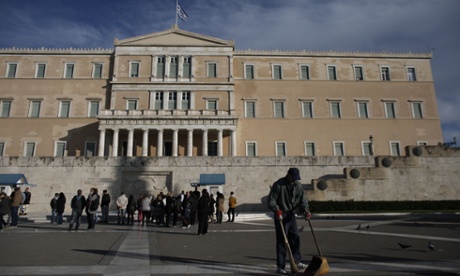
Voting on the Greek presidential election is due to be getting underway around now.
The results are expected around 1pm local time (11am GMT).
Prime Minister Antonis Samaras has called a cabinet meeting for 2 p.m.
According to Ekathimerini, if Stavros Dimas, the only candidate, is not elected Parliament has to be dissolved within 10 days and snap elections called within the following 30 days. The most likely date for the early general elections would be January 25 or February 1.
Updated
Greek bond yields are rising this morning, reflecting investor concern that the government is more likely to default on its debts.
Greek 10-year bond yields are up 29 basis points to 8.82%
Greek 3-year bond yields are up 97 basis points to 83.7%.
The voting starts in around five minutes...
The latest polls show that Stavros Dimas will fall just short of the 180 votes he needs to be elected Greek president.
@TheStalwart Predictions for the Greek prez vote from @MacroPolis_gr pic.twitter.com/Ykw0zR8oiY
— Carl Densing (@carl_densing) December 29, 2014
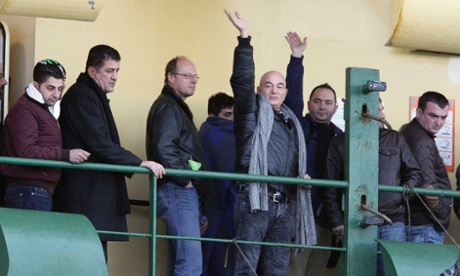
Today’s Greek vote comes as the country waits anxiously for the rescue of more than 200 people trapped on a burning ferry.
Rescue teams working through the night have pulled 265 people off the car ferry, but more than 200 are stranded on board, the Italian navy said on Monday.
Full story: Rescuers battle through night to save passengers on burning Italian ferry
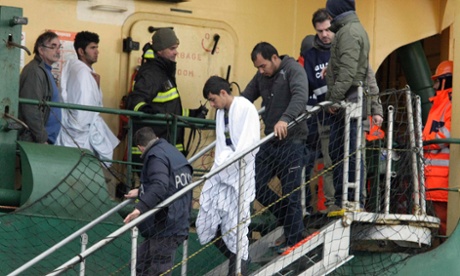

Third photo provided by Italian navy
Updated
With just over half an hour to go until Greek deputies vote, investors are still selling.
Greece’s ATG index has extended its losses, and is now down 7.76% on market opening.
Russian economy shrinks in November
Russia’s economy contracted in November for the first time since the global financial crisis hit the country in 2009.
Data from the economy ministry showed that November GDP was down 0.5% on 2013.
Financial crisis was "exciting" - ex Bank governor
The global financial crisis that tipped the western world into the longest downturn since the 1930s. We remember that. Mervyn King, former governor of the Bank of England, also remembers the crisis as something of a career high.
He has been recalling the UK’s response to the financial crisis on BBC Radio 4’s Today programme.
It was exciting and it was fascinating and it was the sort of problem that we had trained to deal with over many years.
So I think both Ben [Bernanke, then chair of the US Federal Reserve] and I felt that having spent a good deal of time thinking through the intellectual foundations of what to do with a banking crisis and the opportunity to deal with one was one that we were well prepared for.
Lord King was guest editing the Today programme and interviewed Bernanke, who said central bankers tried not to think of the global consequences of their actions to help focus on their response to the crisis.
Ben Bernanke:
It certainly was a lot of stress; the crisis was so complicated, there were so many different aspects to it and the response of the Federal Reserve and the Bank of England was so complex and so many moving parts that I felt like a pilot in a cockpit, always trying to keep my eye on every light that was going red.
So by focusing so much on the individual task, we tried not to be thinking all the time about the consequences for the world of these decisions and that seemed to help somewhat.
While we have Greece on our minds, here is another highlight from the interview.
Lord King:
Greece did not prevent something terrible happening, Greece has been through a repetition of the Great Depression as far as it’s concerned.
Via Press Association
Updated
City Link "unacceptable face of casualised Britain" - TUC
The TUC has called on the government to reverse laws that make it easier to sack workers, following the City Link collapse.
Frances O’Grady, general secretary of the TUC said:
The fast track sackings at City Link are a prime example of the unacceptable face of casualised Britain, with workers denied even basic rights to proper consultation.
But there is nothing inevitable about this company going bust. Too many employers are using insolvency to take the money and run, leaving the taxpayer to foot the redundancy bill.
The government must get a grip and reverse the changes in the law they introduced to make sacking workers in Britain so cheap and easy. Vince Cable should urgently meet with the union and administrators to explore alternatives before it’s too late.
Greek markets fall 5% ahead of vote
Investors are in a jittery mood ahead of this morning’s presidential vote in Athens.
Greece’s main stock market, the ATG index, is down 5% this morning.
City Link owner defends timing of Christmas redundancies
Private equity firm Better Capital has mounted a defence over the timing of the City Link collapse, after unions demanded an investigation into the announcement.
In a statement issued to investors issued today, the firm said the decision to appoint administrators was leaked to the media, leading to employees finding out the bad news on Christmas day.
Unfortunately the appointment of an administrator was leaked to the media ahead of the intended announcement. The directors very much regret the impact on the employees of City Link receiving such bad news on Christmas Day.
Administrators at Ernst & Young were appointed on 24 December.
Updated
No apologies for handling of City Link collapse - private equity boss
The private equity owner who oversaw the collapse of City Link has delivered a combative message, as it emerges that the taxpayer will pick up the bill for redundancy payments to nearly 3,000 workers at the parcel delivery firm.
Jon Moulton, the founder of Better Capital, the private equity firm that bought City Link for £1 in 2013, said he had nothing to apologise for.
“I don’t feel any need to apologise for the process that we’ve followed. That doesn’t make it a pleasant process — or a nice outcome.”
I’ve taken this quote from the FT, but Moulton has also been on the Today programme with a similar message.
We chased every possible way to save this company.
As BBC Business blog summarises:
He says the company had simply failed, and that delaying the closure over Christmas had not been an option, as trading while insolvent was a criminal offence.
Could the affair have been better handled?
Not particularly, no.
That is certainly not the view of trade unions.
Here is RMT general secretary Mick Cash:
It says everything about the state of industry in Britain today that a donor to the party of government can wreck the lives of thousands of people, walk away and leave the taxpayer to pick up the redundancy costs.
Moulton was a Tory party donor until 2012.
Updated
Rouble slips against dollar
The Russian rouble has fallen 3.6% against the dollar this morning.
The rouble was trading at around 57 to the dollar and 68 to the euro in early trading.
On Friday, the Russian currency hit its strongest levels in more than three weeks against the dollar, but remained well off the 35-40 bracket it was trading in around a year ago.
According to Reuters economics team in Moscow, the currency is down this morning, because exporters are reducing sales of foreign currency after having accumulated enough roubles to meet their end-of-month tax payments.
Summary
Good morning, and welcome to our rolling coverage of the world economy, the financial markets, the eurozone and the business world.
Greece is on the verge of a crucial vote that will determine the future of the country’s international bailout, with consequences that will reverberate around Europe.
Greek lawmakers will vote today for a president to take over from 85-year Karolos Papoulias. The only candidate is Stavros Dimas, a former European commissioner for Greece on the centre right, who needs 180 votes to be elected.
But failure to win will trigger a general election that could bring the leftwing Syriza party to power. Syriza, who are already preparing for an election, want to renegotiate Greece’s multi-billion euro bailout agreement with the European Union and International Monetary Fund and roll back the austerity policies.
Greece’s prime minister Antonis Samaras has been urging deputies to back his man, calling on them to “understand that the reforms we’ve shed blood to build in the past three years could be reversed in a single day”.
Here is the Guardian’s Helena Smith in Athens on what it all means.
What happens in parliament on Monday will not only define the course of Greece but of Europe. If Samaras wins, it will be a huge vote of confidence for a man who, despite being a critic of austerity, has implemented policies at the behest of other EU lenders to keep his country solvent. But if the presidential election fails to deliver his man, and snap polls are called as the Greek constitution stipulates, radical insurgents bent on overturning that order are on course to triumph.
More background reading here
The vote is at midday local time (10.00 GMT) and we should get the results within an hour.
Apart from that, I’ll be getting the latest on the collapse of City Link, the parcel delivery firm that went bust on Christmas Day.