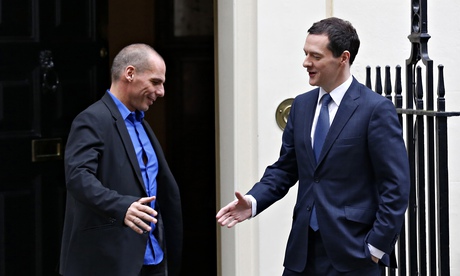
This is where we came in. Almost five years ago, when George Osborne arrived at the Treasury, there were concerns about Greece. They have never really gone away, but now they are back with a vengeance. After his meeting on Monday with Greece’s new finance minister, Yanis Varoufakis, the chancellor was blunt: Greece is a threat to the global economy, and a big one at that.
Osborne’s concerns are understandable, if a tad exaggerated for now. Greece certainly has the potential to damage the global economy, but only if it leaves the eurozone in a disorderly manner, with knock-on consequences first for the single currency area and then the wider world. But the position is not so critical yet, and currently Greece is no more likely than a sharp downturn in China or a worsening of the conflict in Ukraine to blow up the global economy.
Indeed, the eurozone looks better able to cope with a protracted battle between Greece’s prime minister, Alexis Tsipras, and Germany’s chancellor, Angela Merkel, than it was a couple of years back. The Syriza victory in the Greek election has been followed by an increase in the interest rates Athens pays to service government debt, but there has been no similar rise for other countries seen as vulnerable to contagion effects, such as Italy and Spain.
It would, of course, be a different story if Greece left the euro, either because it had decided to leave or because it was shown the door by the other members of the club. There would, though, need to be a trigger for this to happen, perhaps a decision by the Greeks to repudiate their debts, or cutting off financial support to Greek banks by the European Central Bank. Is a doomsday scenario feasible? Certainly. Is it probable any time soon? No. It is little more than a week since the Greek election and both sides are still sabre-rattling.
That said, the eurozone could do with the row being sorted out quickly, because uncertainty will stifle recovery in an economy where growth is sluggish, unemployment is high and prices are falling. The boost to sentiment provided by the ECB’s decision to start its own bond-buying programme has proved short-lived.
Osborne is right to point out the vulnerability of the UK if it all kicks off again in the eurozone, the destination for almost half of Britain’s exports. Growth in Britain slowed from 0.7% to 0.5% in the final three months of 2014 and the next set of GDP data will be released in late April, when the election campaign will be in full swing. The chancellor would prefer not to have to explain away a further cooling in activity.
But on balance, Osborne probably won’t be that unhappy about events in Greece. Why? Firstly, they provide a convenient scapegoat if growth does weaken in the UK in coming months. Secondly, they allow him to have a dig at Labour by saying the choice everywhere is between stability and chaos. Finally, he knows any seriously malign effects from Greece, should they occur, won’t be detectable until after polling day.