European markets close higher
A strengthening euro as the dollar weakened help support stock markets, as did another dip in the oil price on oversupply fears. Ahead of the US Federal Reserve’s latest meeting, the US currency slipped back as weak economic data suggested an interest rate rise may not be imminent. Investors were also buoyed by comments from the Chinese government that it would act to support the country’s economy, while in the UK retailers benefited from hopes of a reduction in business rates. Germany’s Dax moved through 12,000 for the first time to close at a new record high, the beneficiary of the first week of the European Central Bank’s quantitative easing programme. The final scores showed:
- The FTSe 100 finished 63.50 points or 0.94% higher at 6804.08
- Germany’s Dax closed at a record 12,167.72, up 2.24%
- France’s Cac climbed 1.01% to 5061.16
- Italy’s FTSE MIB rose 0.96% to 22,930.92
- Spain’s Ibex ended 0.73% higher at 11,114.7
- But the Athens market lost 0.92% to 763.09 as worries about Greece’s future in the eurozone continued.
On Wall Street the Dow Jones Industrial Average is currently 179 points or 1.01% higher.
And on that note it’s time to close up for the evening. Thanks for all your comments, and we’ll be back tomorrow.
The Greek government has just issued a statement confirming that the German chancellor Angela Merkel has indeed invited her Greek counterpart to Berlin, reports Helena Smith.
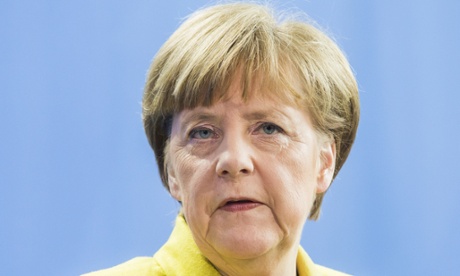
“Mrs Angela Merkel requested a telephone rendezvous with the Greek prime minister which took place at 16:30,” the statement said. “During their telephone conversation the German chancellor issued an invitation to Mr Alexis Tsipras to visit Berlin and the German chancellor on Monday 23 March. The prime minister responded positively to the invitation.”
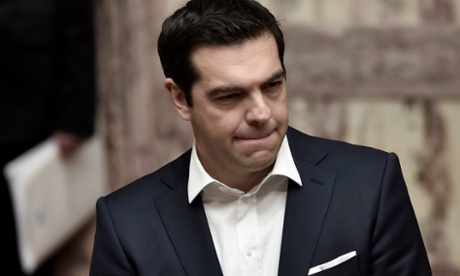
This is not the first time that the German chancellor has attempted to calm spirits by contacting her Greek counterpart personally. Regular readers will recall that she telephoned Tsipras during last month’s dramatic negotiations in Brussels to extend the debt-stricken country’s EU-IMF-sponsored bailout until June.
Updated
On the ECB quantitative easing Jasper Lawler, market analyst at CMC Markets said:
The European Central Bank reported that in its first week it has bought €9.8bn in public sector assets. Were government bonds to be all the ECB was buying, that’s only be 16% of the monthly €60bn total where 25% would be needed to be on target. However the €60bn is inclusive of other asset purchases including covered bonds and asset-backed securities which will make up the difference. €9.8bn is not quite as aggressive as some might have hoped in the first week but the ECB is still testing the waters and this total should creep up in the coming months.
Now this looks interesting. German chancellor Angela Merkel has invited Greek prime minister Alexis Tsipras to visit Berlin on March 23, next Monday, Reuters is reporting, citing a Greek government official.
Given the conflicting views expressed by politicians from the two countries, it will be intriguing to see how this pans out.
Updated
Oil prices continue to slide on fears of oversupply, with US crude falling to $43.18 a barrel, its lowest level since March 2009.
Brent crude is currently down 3.3% at $52.82, on rising global inventories and the prospect of more exports from Iran if an agreement is reached during nuclear talks this week.
More details on the ECB purchases. As part of its plan to buy sovereign bonds to lift inflation and put pressure on the euro, it intends to buy €60bn a month until September 2016. The €9.751bn figure represents the first week’s purchases, and the ECB also gave updates on its other programmes so far. It said its covered bond purchase programme totalled £56.947bn as of March 13, while its asset backed securities programme had reached €3.754bn.
CBSPP3, ABSPP and PSPP cum. settled purchases as at 13/03/2015: 56,947 mln, 3,754 mln & 9,751 mln respectively. Website update to follow.
— ECB (@ecb) March 16, 2015
€2.8 bn to € 3bn per day will be required by the ECB to get to that €60 bn per month figure
— Ashraf Laidi (@alaidi) March 16, 2015
Updated
The European Central Bank has announced it spend €9.751bn on bonds in the first week of its quantitative easing programme which started last Monday.
The continuing worries about Greece and its possible exit from the eurozone, given the apparent differences in Athens and Berlin, has seen the country’s short term bond yields rise again.
Greece’s three year bond yields have climbed above 20% for the first time since the middle of February, up 1% to 20.26%.
The 10 year yield however is up just 6 basis points at 10/87%.
US markets are on the rise and the dollar is weakening against the euro after some weak US data.
Industrial production slipped 0.2% in February, the third monthly fall in a row, with car production down 3%. Economists had expected a 0.1% increase in industrial production, following a revised 0.3% decline in January (compared to the previous estimate of 0.2%).
Meanwhile housebuilder confidence was also down for the third straight month, with the National Association of Home Builders/Wells Fargo index falling from 55 to 53 in March. This compares to expectations of a rise to 56. NAHB chief economist David Crowe said:
The drop in builder confidence is largely attributable to supply chain issues, such as lot and labour shortages as well as tight underwriting standards. These obstacles notwithstanding, we are expecting solid gains in the housing market this year, buoyed by sustained job growth, low mortgage interest rates and pent-up demand.
The weak figures come ahead of the latest US Federal Reserve meeting where the bank will set out its latest views on interest rates. A move higher is widely expected this year, but the disappointing data casts more doubt on when exactly that might happen, hence the dollar weakness and market strength.
Feb to drop 'patient' but Jun hike doubtful: Like retail sales, US manufacturing output fell for 3rd successive months (not seen since 2009)
— Chris Williamson (@WilliamsonChris) March 16, 2015
Updated
Heads-up: the European Central Bank will publish some details of its new QE programme shortly:
As a reminder the #ECB will announce how much they spent on QE last week in 35 mins at 1445GMT, although no breakdown by country
— RANsquawk (@RANsquawk) March 16, 2015
Klaus Regling, who runs Europe’s bailout fund, has just warned that everyone involved in the Greek debt crisis must strive to avoid Greece crashing out of the eurozone by accident.
Efi Koutsokosta of Euronews is tweeting the details:
#Regling:It's a common responsibility of the greek gov, the institutions and the eurozone finance ministers to avoid a #Grexident @ESM_Press
— EfiKoutsokosta (@Efkouts) March 16, 2015
#Regling: €group stated if additional fin assistance is needed for #Greece & conditions in place €group would favourably look @ request #ESM
— EfiKoutsokosta (@Efkouts) March 16, 2015
Lunchtime summary: Greece makes IMF payment amid tensions
Time for a brief recap.
Greece meets deadline, pays third part of its loan to the IMF, a senior finance ministry official tells Dow Jones.
— CNBC Now (@CNBCnow) March 16, 2015
Greece now has a few days grace until Friday, when it must hand over more than €300m to the IMF.
These payments are putting further pressure on Greece’s cash reserves. The country’s largest union has urged the government not to tap into social security funds to meet its debt demands.
Today’s payment was made amid growing anxiety over relations between Berlin and Athens.
Greek finance minister Yanis Varoufakis faces a backlash from German media after claiming last night that footage of him performing a middle-digit salute to Germany is faked. The ARD broadcaster insist it’s genuine:
ARD's #Jauch show editors say Varoufakis 2013 Zagreb video is 'genuine' http://t.co/I7V94lToST /via @tagesschau
— Yannis Koutsomitis (@YanniKouts) March 16, 2015
German’s Bild is leading the charge against Varoufakis this morning, saying he could have misled millions of viewers.
The Germany government has reiterated that it wants Greece to remain in the eurozone.
A spokesman said:
We continue to pursue the political goal - and there are no differences there between the finance ministry and the chancellor on this - to keep Greece in the euro zone and the German government has worked towards that since the start of the crisis and this work is continuing.”
A poll of German citizens, though, shows support for Greece is declining.
“It’s a two-pronged war: We’re being worn down economically and psychologically. It’s deliberate.”
Greek business leaders are also worried.
In the markets, the German DAX has hit a fresh record high over 12,000 points. The European Central Bank’s new QE programme is driving money into German shares, because its exporters will benefit from a weak euro.
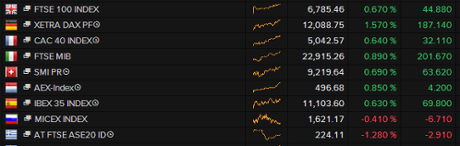
Other European markets are also up, with the exception of the Athens bourse which is in the red:
Technical officials from the Brussels Group (don’t call them the Troika!) have been spotted in Athens in recent days, Helena adds.
But rather than being regularly snapped on the streets, officials representing Greece’s creditors have generally been sighted in “subterranean garages”.
That’s a small victory for the government, which was desperate to avoid photos of Troika officials roaming the streets.
Rumour has it that most meetings are taking place in hotels, as the two sides try to make progress over Greece’s bailout. But Proto Thema reported on Sunday that Greek officials are letting inspectors “step foot” in the General Accountancy office to go over the government’s books.....
New York has followed Europe’s lead, with shares rising in the first few minutes of trading on Wall Street:
U.S. stocks open higher; Dow jumps 115 points http://t.co/E2pePfgZGd
— MarketWatch (@MarketWatch) March 16, 2015
Greek union warns government over social security funds
Greece’s biggest union, ADEDY, has fired a warning shot across the cash-strapped government’s bows saying it must “respect” the country’s social security funds.
The warning comes amid escalating fears that the funds could soon be raided to prevent delays in payment of pensions and civil servants’ salaries later this month.
Helena Smith reports from Athens.
Calling on the Syriza-led government to abandon any “thought or scenario” of using the funds to meet its own payment obligations, the public sector union described the deposits as “sacred.”
ADEDY said in a statement that:
“The government must respect its pre-election promises.
The damage that the funds have suffered in the past is precisely because of the criminal choices of previous governments, [choices] that are incalculable and have lead the funds to their dramatic situation today.”
The funds’ reserves are estimated at around €2bn - enough to cover Friday’s forthcoming loan payment to the IMF and salaries and pensions, if needed.
ADEDY issued the warning after the central bank revealed today that the government’s cash balance had sustained a deficit of €684m euro between January and February this year compared to a surplus of €139m in the same period in 2014.
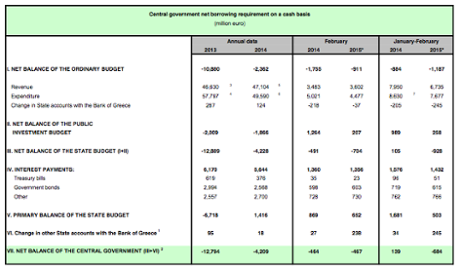
The bank’s announcement was further evidence of the sharp fall in tax revenues in January, itself the result of the political uncertainty that has gripped Greece.
Delays are such that tax departments have yet to produce declarations for the past year.
Updated
Greek insiders: Germany is engaged in “psychological warfare"

Greek officials are accusing Germany of “psychological warfare” as relations between the two countries become ever more strained, reports our correspondent in Athens Helena Smith.
Greece’s governing coalition is finding it ever harder to hide its infuriation with Berlin. The latest “verbal assault” lobbed at Athens triggered thinly veiled outrage from officials this morning.
One said:
“It’s a two-pronged war: We’re being worn down economically and psychologically. It’s deliberate.”
The complaint echoed similar statements over the weekend by Panos Kammenos, who heads the Independent Greeks party, the junior partner in prime minister Alexis Tsipras’ leftist-led administration.
Speaking to Bild, Kammenos accused Berlin of pursuing a concerted policy to eject Greece from the euro zone – despite the insistence of German officials that Athens’ place is in the currency bloc (as flagged earlier).
“I don’t understand why he turns against Greece every day in new statements,” Kammenos - who is also defence minister - said of the German finance minister Wolfgang Schauble.
Kammenos added:
“It’s like a psychological war and Schauble is poisoning the relationship between the two countries through that. The German government is out to get us and some really want to push us out of the Eurozone.”
The business community is becoming increasingly worried. Fears are growing that Greek enthusiasm for the euro will gradually erode in the coming months.
“It is almost as if the government is preparing Greeks for the drachma, that that is its aim,” said one well-placed source at a large Greek industrial firm.
“My fear is that as the situation gradually worsens, support for the euro will drop. Now it is around 70% but in a couple of months’ time, when things are much tougher, we could be seeing a situation of 50—50 support for the currency.”
In recent weeks – as talk of the government holding a possible referendum has mounted – seasoned political observers have voiced similar fears. HS
Updated
Spreadex financial analyst Connor Campbell reckons Germany’s stock market will climb further into record territory, thanks to Mario Draghi:
“As the steroid injection of ECB QE continues to swell the DAX, as well as the other euro zone indices, investors remain enthralled with the region and seem committed to continuing its upswing.”

Germany’s stock market has now surged by 138 points today, or 1.2%, to a new lifetime high of 12,040 points.
The DAX has gained around 25% since the start of January, fuelled by optimism that the ECB’s stimulus package will help German exporters (by weakening the euro).
Alastair McCaig, market analyst at IG, explains:
The benefits of the ECB’s QE policy continue to drive European equities higher with the DAX leading the way.
Germany continues to spearhead the move higher for the rest of the eurozone having broken through the 12,000 level less than a month after moving above 11,000. As cheerful as the average German might be about the DAX this propensity for optimism does not stretch towards the Greeks.
The last month has seen the percentage of Germans wanting Greece to exit the eurozone increase from 41% up to 52%. The grumblings of discontent between German and Greek ministers has once more escalated as the focus on historical wrongdoings has led to even more bitter sentiment, and the phrase ‘don’t bite the hand that feeds you’ appears not to translate well into Greek.
The news that Greece had made its IMF repayment today has helped to keep the main European markets up today. The FTSEurofirst 100, which tracks the region’s largest companies, is up 0.8%.
Germany: We still want Greece in the eurozone
Thanks to Reuters, here’s what German government spokesman Steffen Seibert told a press conference in Berlin today:
“We continue to pursue the political goal - and there are no differences there between the finance ministry and the chancellor on this - to keep Greece in the euro zone and the German government has worked towards that since the start of the crisis and this work is continuing.”
That follows finance minister Wolfgang Schauble’s claim on Friday that Greece could leave the eurozone by accident.
That sparked several reports that Germany had lost patience with Greece over its debt crisis; something Seibert was also forced to deny on Friday.
German government spokesman Steffen Seibert has just told reporters that Angela Merkel and the finance ministry have a “shared goal” of keeping Greece in the eurozone.
GERMAN POLITICAL GOAL REMAINS GREECE IN EURO, SEIBERT SAYS
— Dealingroom (@Dealingroom_EN) March 16, 2015
More on this shortly....
Greece makes IMF payment
The Greek government has handed over the €580m due to the International Monetary Fund today, according to Bloomberg.
#Greece made repayment owed to #IMF: Finance Ministry Official
— Peter Hoskins (@PeterHoskinsTV) March 16, 2015
That means Greece has cleared most of the money owed to the IMF this month, but still faces another €350m bill on Friday.
These IMF repayments are depleting its cash reserves, raising the pressure on Greece to satisfy its creditors and unlock fresh bailout funds [the eurozone has been withholding a €7.2bn payment for several months now].
Technical talks between Greek officials and those of its creditors restarted today, having made little progress last week.
The Kathmerini newspaper explains:
Athens will be hoping that discussions can advance next week because the government is running short of money.
It is hoping for either an early disbursement of some of the 7.2 billion euros in remaining bailout loans or an increase in the 15-billion-euro limit on T-bills that the state can issue.
Several other German media outlets are also up in arms about Fingergate - with Die Speigel, Die Welt and Zeit all running articles about the video clip, and Varoufakis’s denial.
Uproar in #Germany over #Varoufakis ‘middle finger’ gesture - VIDEO #Greece- http://t.co/GzqnG2BKP6 pic.twitter.com/1i546Q2JN4
— enikos_en (@enikos_en) March 16, 2015
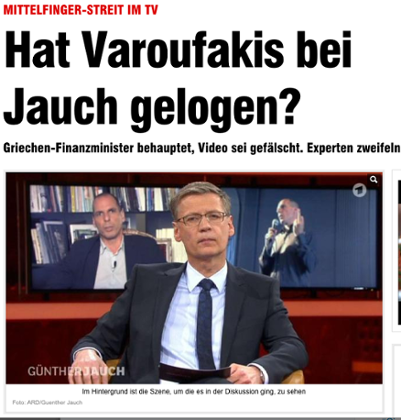
German newspaper Bild is gripped by Yanis Varoufakis’s middle finger (so to speak).
The tabloid is querying Varoufakis’s claim last night that the footage showing him giving Germany the finger in 2013 was faked (see 8.12am post).
It has found a social media specialist, and a video expert, who both insists the footage of the Greek finance minister is actually genuine.
Bild (no fan of the Greek government, of course) even suggests Varoufakis could be “unmasked” as having lied to a TV audience of millions.
More here: Hat Varoufakis bei Jauch gelogen?
A government source has stated that Greece will pay EUR 580mln tranche of its IMF loan due today (@RANsquawk)
— Open Europe (@OpenEurope) March 16, 2015
Greece: We'll make today's repayment
Greece has insisted that it will make today’s loan repayment to the International Monetary Fund today.
A government source told Reuters this morning that:
“It’s in the pipeline. The payment of 580 million euros will go out later today.”
That will leave Greece looking to repay another €350m to the IMF on Friday.
The Greek stock market has fallen 1% this morning, defying the upward trend in other European markets.
In other news, Greece's stock market is down again this am, -19% since FEB 24th when mainstream called it fixed
— Keith McCullough (@KeithMcCullough) March 16, 2015

The head of the International Monetary Fund has urged Greece to press on with structural reforms.
Speaking in New Delhi today, Christine Lagarde also warned that the world economy is vulnerable:
“Looking ahead, something better may yet come on the back of low oil prices and interest rates. Still, there are significant risks to this fragile global recovery.”
Update.... Germany’s DAX just ploughed through the 12,000 mark for the first time ever.
Germany's benchmark index Dax just hits fresh record high above 12k for first time on #ECB's QE. pic.twitter.com/2JXl8oLYKS
— Holger Zschaepitz (@Schuldensuehner) March 16, 2015
Relations between Greece and Germany have not been improved by last week’s demand for war reparations.
A ‘vox pop’ of German citizens by Bloomberg, published today, found many who are losing patience with Greece.
Here’s a flavour....
“The way the Greeks have been behaving has been impossible. Now they’re making their own demands with these reparations,” said Dorli Schneider, an interpreter waiting for a train at Munich’s central station.
“Greece should pay back what they owe. We can’t forever give them more money.”
And over in Berlin...
Cabdriver Jens Mueller says he’s had it with the Greek government and he doesn’t want Germany to send any more of his tax money to be squandered in Athens.
“They’ve got a lot of hubris and arrogance, being in the situation they’re in and making all these demands,” said Mueller, 49, waiting for fares near the Brandenburg Gate. “Maybe it’s better for Greece to just leave the euro.”
More here: Germans tired of demands from Athens want Greece to leave euro
German DAX hits record high
Germany’s main stock index has hit a new record high, as European stock markets make a cautiously optimistic start to the week.
The DAX jumped by 0.6% to 11977 points, while the FTSE 100 and French CAC are both up around 0.3%.
German share prices have rallied strongly in recent weeks, as traders calculate that the eurozone’s new quantitative easing programme will weaken the euro and boost German exporters.
That’s ironic, given Germany’s opposition to the programme.
As Alastair Winter, chief economist at Daniel Stewart, puts it:
How the Bundesbank must be seething with rage as the DAX soars by over 20% so far in 2015 as the punters believe that exports and earnings from overseas operations represent a new Klondike!
Updated
Varoufakis: Germany must help us grow
Relations between Athens and Berlin over its debt crisis remain rather tense, as was illustrated by a news programme on Germany’s ARD last night.
Greek finance minister Yanis Varoufakis appeared on the show (by videolink), and urged the audience that Germany should to more to assist Greece.
Varoufakis told them:
My message to the viewers this evening is very simple: help us to grow, so that we can pay the money back.
Varoufakis also tried to downplay concerns over Greece’s cash position, ahead of today’s IMF repayment, arguing that:
“Small, insignificant problems of liquidity should not divide Europe,”
I watched most of the show, and felt that the audience gave Varoufakis a rather cool reception [unlike other guests, he didn’t win much applause].
He was also called to task over a video from 2013, which appeared to show him suggesting Greece could “stick the finger to Germany” and default.
Varoufakis claimed last night that the footage was ‘doctored’, and he’s never given the finger, ever.
The #Varoufakis denial of the finger video is much stronger than I realised https://t.co/pzG3n6xnoN He made a boo-boo here H/T @spyridakis_k
— Lorcan Roche Kelly (@LorcanRK) March 15, 2015
This screengrab from the German tv show tonight pretty much sums up German/Greek situation pic.twitter.com/PEPcaAkVjF
— Lorcan Roche Kelly (@LorcanRK) March 16, 2015
Varoufakis claims 2013 Zagreb video is faked. German journos will go after this video now. I think Yanis just got in trouble. #Jauch
— Yannis Koutsomitis (@YanniKouts) March 15, 2015
Updated
The Agenda: Greece set for IMF repayment

Good morning, and welcome to our rolling coverage of the world economy, the financial markets, the eurozone and business.
We’re firmly on Greece Watch this morning. The Greek government is due to repay almost €600m to the International Monetary Fund today, which will take another slice out of its cash reserves.
The payment is the third tranche of the loan repayment which Greece must make to the IMF this month (the last slice is due on Friday).
Prime minister Alexis Tsipras tried to calm nerves over Greece’s situation last night, telling reporters that “There is absolutely no problem with liquidity...There is no problem in securing funds for salaries and pensions”.
The Greek finance ministry is also adamant the payment will be met, but it will further deplete Greece’s assets.
Greece is set to make its next repayment to the International Monetary Fund Monday, further depleting cash reserves that risk running out this month unless a deal is reached with European partners.
Greece will deposit about 588 million euros ($617 million) with the IMF, as scheduled, according to a Finance Ministry spokesman, who declined to be named in line with policy. As other repayments come due this week, the government said on March 14 it had a plan to “enhance its liquidity” and won’t have problems paying wages or pensions.
Greece’s funding plight continues to grip the eurozone. On Saturday, a group of protesters held an anti-austerity demonstration outside the finance ministry in Berlin.
They carried posters reading “The banks are going hungry”, “No to austerity. People ahead of profit”, and “Fight the European Criminal Bankers”, as these photos show:


Otherwise, it looks like a slightly quiet day, with not much in the calendar.
Financial markets are expected to be calm, with investors waiting for the US Federal Reserve’s meeting on Wednesday.
Stan Shamu of IG explains:
This meeting will see the Fed update its economic and financial forecasts (summary of economic projections); and will also bring the dot plot analysis.
These will be released along with the statement and the key here is whether the updated forecasts will give the Fed room to adjust its language regarding rates lift-off. Hawkish members such as Mr Bullard have suggested the Fed should remove the ‘patient’ reference at the March meeting.
Some analysts expect the language to be adjusted so as to allow flexibility to raise interest rates sometime around the middle of the year.
Those expectations of a US rate rise continue to dominate the foreign exchange markets, with the euro trading close to the 12-year lows hit last week.
We’ll be tracking all the main events through the day.