Closing summary
Greece has agreed a deal in principle with its lenders about a third bailout, worth around €85bn and allowing some €10bn to be disbursed to the country’s struggling banks almost immediately. There is a long list of reforms the country has to carry out in return for the cash.
But the agreement needs to be approved by state parliaments, with Greece set to discuss it on Thursday. The Eurogroup of finance ministers is expected to meet on Friday to examine the deal, after conference calls between deputies taking place today.
Meanwhile Germany - which seemed to be pressing for a bridging loan for Greece to allow more time to discuss the details of any agreement - has said it would “closely examine” the bailout deal.
But in terms of global stock markets, the optimism over Greece has been put in the shade by the unexpected news that China has devalued its currency, casting doubt on the outlook for the world’s second biggest economy.
News that the ZEW German confidence index had declined again in August also unsettled European markets.
On that note, it’s time to close up for the evening. Thanks for all your comments, and we’ll be back tomorrow to follow all the latest developments.
New IMF Greece mission chief told senior euro officials that fund ready 2 participate by Oct, provided action on debt http://t.co/Z1HmUkWhBP
— Gabriele Steinhauser (@gksteinhauser) August 11, 2015
Greek prime minister Alexis Tsipras has said he wants a draft law on the bailout to be discussed in parliamentary committee on Wednesday, with a vote on Thursday.
In a letter to the parliament speaker, reports Reuters, Tsipras said:
The crucial nature of the situation requires the immediate convening of parliament to proceed with the deal’s approval and allow the disbursement of the first installment.
If all is agreed, and eurozone finance ministers give approval on Friday, the agreement will allow Greece to deal with an immediate financial problem, a payment due to the European Central Bank on 20 August.

Here’s AP’s story on Greek prime minister Alexis Tsipras calling an emergency session of parliament on Thursday to vote on the deal:
Greek leader Alexis Tsipras calls emergency session of parliament to vote on new bailout deal Thursday - @AP http://t.co/5M16ki9b7d
— Breaking News (@BreakingNews) August 11, 2015
Markets slump as China move outweighs Greek deal
There may be signs that a deal between Greece and its creditors for a third bailout is on the verge of being agreed, but you would not know it from the day’s performance on global stock markets. Instead investors have taken fright about the surprise devaluation of China’s yuan, and the implications for the outlook for the world’s second largest economy (poor). The Chinese move sent commodity companies lower as well as the oil price, with Brent crude currently down 3% at $48.9 a barrel.
So the commodity heavy FTSE 100 in the UK has been hit hard, while Germany’s stock market also suffered from a disappointing Zew confidence index. The final scores showed:
- The FTSE 100 finished down 71.68 points or 1.06% at 6664.54
- Germany’s Dax dropped 2.68% to 11,293.65
- France’s Cac closed 1.86% lower at 5099.03
- Italy’s FTSE MIB fell 1.12% to 23,698.49
- Spain’s Ibex ended 1.41% down at 11,152.3
- But, as reported earlier, the Athens market closed 2.14% better as a bailout deal edged closer

On Wall Street the Dow Jones Industrial Average is currently off 1.35% or 238 points.
Updated
Greek prime minister Alexis Tsipras is wasting no time in pushing through the bailout deal, asking the parliament speaker to complete proceedings for approval by Thursday.
#Greece pushing for parliament bill passage on aid by this Thurs which is as expected to push through the rest of EU ahead of the 20th Aug
— RANsquawk (@RANsquawk) August 11, 2015
Updated
But no word on Greece yet from the Eurogroup chair:
Total silence by @J_Dijsselbloem over #Greece. Fishy.
— Yannis Koutsomitis (@YanniKouts) August 11, 2015
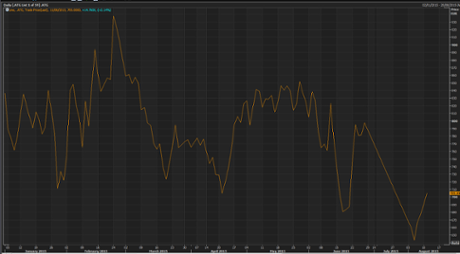
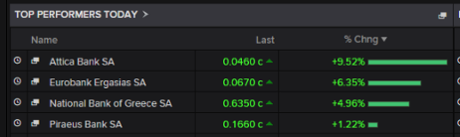
News of the Greek bailout deal - which Athens said was worth up to €85bn over three years and would mean an immediate €10bn for the country’s struggling banks - has lifted its stock market.
The Athens exchange has closed up 2.14% and the banking index is 2.95% better - albeit they are still sharply lower on the year. The yield on Greek two year bonds has fallen 4.7%, signalling cheaper borrowing costs.
As for Greece, the EU Commission’s chief spokesman sounds optimistic:
Reforms pave the way for Solidarity. #Greece firmly anchored in the #euro. #teamjunckerEU
— Margaritis Schinas (@MargSchinas) August 11, 2015
And from Manulife’s chief economist:
Whether the RMB deval is bc of weak exports or bc China wants to be in SDR basket, one thing is clear: it won't be the last one.
— Megan Greene (@economistmeg) August 11, 2015
Back with China, and London Capital Group’s Brenda Kelly points out:
Every1 has a view on why the PBOC devalued + everyone thinks they're right. Beijing doesn't exactly have form when it comes to transparency
— Brenda Kelly (@Brenda_Kelly) August 11, 2015
Dean Turner, economist at UBS Wealth Management, reminds us that Greece is not out of the woods just yet:
Whilst an agreement may have been reached and Greece looks increasingly likely to meet the 20 August payment deadline, we are not out of the woods yet. In spite of Greece reaching a technical agreement in principle, the risk of Grexit has not disappeared altogether. There are a number of challenges ahead, including securing passage through the Greek parliament, and some other European parliaments including Germany. Furthermore, other headwinds may emerge in the event of a snap general election and the future debt restructuring talks.
Greece will also have to make sufficient progress with reforms, privatisations and achieving a flat primary position for 2015. This is no mean feat with the current state of the banking system and debt burden still weighing on the Greek economy.
This bailout agreement is a reassuring sign, but should serve as a reminder of other risks on the road ahead.
Another detail about some of the possible changes to come in Greece:
1 The #Syriza-led govt is seeking to increase VAT tax in tuition fees of private schools to 23%. #Greece http://t.co/LQK1bQ3N5o
— The Greek Analyst (@GreekAnalyst) August 11, 2015
Wall Street falls after Chinese devaluation
As expected, Wall Street has opened lower after China’s surprise devaluation of the yuan cast more doubt on the state of the world’s second largest economy.
Greece, which has dominated sentiment for so long, was a secondary issue despite the signs that a third bailout was close to being done. The China syndrome has sent the Dow Jones Industrial Average down 151 points or 0.845 in early trading, while the S&P 500 is off around 0.5%.
Germany to closely examine bailout deal
Germany will closely examine Greece’s third bailout deal over the next few days to ensure that it lasts several years, deputy finance minister Jens Spahn has told Reuters.
It is decisive that this is a basis for the next few years; it cannot just last a few months. Growth and attractive and reliable conditions for more investments must be the goal.
He stressed that it is important for Germany that the IMF stays on board and agrees with the assessment of the European Central Bank and European Commission on Greek debt sustainability and the agreed reforms.

The euro has extended gains versus the dollar, hitting a fresh 1 1/2 week high of $1.10750 [see 9:42].
Wall Street is expected to open lower after China’s currency devaluation, the biggest in two decades.
Bhaskar Laxminarayan, chief investment officer of Pictet Wealth Management Asia, has looked at the outlook for the reminbi, or yuan, and other Asian currencies.
The move looks to have been designed mainly to support the renminbi’s internationalisation, and specifically the Chinese authorities’ aim to have the currency included in the IMF’s SDR basket. In this sense it is a positive step. However, it caught markets off-guard—expectations were for a gradual depreciation to around the renminbi’s current level by the end of the year—and the PBoC’s communication was rather muddled.
The Chinese authorities’ intentions are not yet entirely clear. The renminbi is likely to find a new level in the next few days, and to depreciate gradually over the rest of the year. The authorities will not want the currency to depreciate sharply, as this would damage the goal of renminbi internationalisation and stoke capital flight.
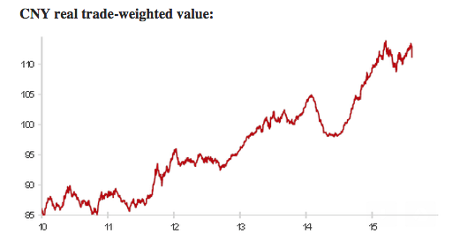
The Chinese authorities may also have aimed to reduce pressure on exports—on a trade-weighted basis the renminbi had risen by around 13% in the past year. However, the impact on GDP growth from the stimulus to exports is likely to be marginal.”
Capital flight is a concern, but cuts in reserve requirements and interest rates are likely. The liquidity situation appears manageable, and there is not a systemic risk to financial stability.
In a context of other measures to support the economy, we expect a small boost to economic activity over the remainder of the year, sufficient to support real GDP growth at just below 7%. The Chinese authorities are muddling through as they attempt to maintain growth at the 7% target, but this is complicating long-term efforts to rebalance the economy.
Asian currencies face downwards pressure
The Korean won, Taiwanese dollar and Singapore dollar appear especially susceptible to further weakening. Outflows from Asia as a region stand to rise, since the renminbi no longer appears the stronghold that many investors had thought. Regionally, the Hong Kong dollar and the Hang Seng may be the only alternative ‘safe haven’ at present, but are already expensive.
Oil rebounds keep getting 'squashed'...today was China's turn to do the honors http://t.co/PNkIG0rNsv pic.twitter.com/qHBp4ww7Cn
— William Watts (@wlwatts) August 11, 2015
Updated
Athens/Tsipras claims bailout envisions less austerity than previous government equivalent to 11% of GDP, so SYRIZA has not u-turned totally
— Robert Peston (@Peston) August 11, 2015
Tsipras ponders delaying snap elections until debt relief talks start https://t.co/Q2yCH73C8i #Greece #politics
— MacroPolis (@MacroPolis_gr) August 11, 2015
@fwred @RaoulRuparel @ekathimerini Am I wrong or does it not matter if Stubb doesn't like it? Thought EFSF qualified majority was 85%.
— Mike Bird (@Birdyword) August 11, 2015
#Greece 3rd bailout fiscal/macro figures Prim balance 2015: -0.25% 2016: 0.5% 2017: 1.75% 2018: 3.5% GDP growth 2015: - 2.1-2.3% 2016: -0.5%
— Manos Giakoumis (@ManosGiakoumis) August 11, 2015
#Greece banknotes in circulation down by €0.35 bln MoM to €50.13 bln in Jul, first drop since Nov 2014 #ecb #banking pic.twitter.com/MMfWkt5QM4
— Manos Giakoumis (@ManosGiakoumis) August 11, 2015
Meanwhile, the Spanish prime minister Mariano Rajoy said the Spanish parliament will probably vote on the bailout package next week. His centre-right People’s Party, which has a majority in parliament, will be asking the other parties to back the deal.
He told journalists at an even in northern Spain:
The European Union is once again making a big bet. Let’s hope that once and for all this bet will help things get back to normal.”

Stubb told reporters, according to Reuters:
We must take one step at a time; agreement is a big word. There remains work to be done with details.”
The Finnish finance minister said his government will decide its stance later this week, adding that the International Monetary Fund needs to participate in the aid package. He also said Greece’s loan maturities could be extended, but ruled out debt cuts.
Updated
The Finns have just poured cold water on the deal, with the finance minister Alexander Stubb saying more work needs to be done.
He is busy preparing Finland’s budget – but never too busy to comment on the Greek bailout.
Big week ahead. We will be publishing the budget on Wednesday. Final preparations today and tomorrow.
— Alexander Stubb (@alexstubb) August 10, 2015
CE: Greek bailout built on fantasy forecasts: Optimistic projections suggest that plan might not last for long. pic.twitter.com/BGUHtPbtZy
— Holger Zschaepitz (@Schuldensuehner) August 11, 2015
Updated
Here’s a rough timeline of what’s going to happen next:
Tuesday afternoon:
Commission president Jean-Claude Juncker to speak with German chancellor Angela Merkel and French president François Hollande
Conference call of EU deputy finance ministers
Thursday: Greek parliament expected to vote on deal
Friday: Eurogroup to meet to approve bailout deal
The deal also has to be approved by the other national parliaments.
20 August: Greece has to make €3.2bn bond repayment to ECB
Updated
Spain’s prime minister Mariano Rajoy says the Eurogroup of eurozone finance ministers will meet on Friday to approve the Greek bailout deal.
Lunchtime summary
Reuters has reported that the new bailout deal is worth about €85bn over three years, and that the Greek government did not accept a proposal from creditors to have distressed funds buy bad bank loans, citing a Greek finance ministry official.
A spokeswoman for the European Commission has confirmed that a deal has been agreed “in principle”. The Athens stock market is up 2%, while banking shares jumped 7.8%.
News of the bailout has failed to lift other European stock markets, which have been dragged lower by carmakers, mining shares and luxury goods stocks such as Burberry – hit by worries over China.
China’s central bank took global markets by surprise when it devalued the yuan by nearly 2%, raising the cost of imports. The move sent Asian stocks and currencies lower. Commodities and oil are also sliding again, with aluminium hitting a six-year low. Brent crude was down 1.3% at $49.75 a barrel while New York light crude slid 1.6% to $44.23.
UK’s FTSE 100 index down 0.9% at 6673.44
Germany’s Dax down 1.7% at 11,410.68
France’s CAC down 1.2% at 5132.70
Updated
The commission spokeswoman indicated that negotiations should be concluded later on Tuesday.
European Commission confirms bailout deal 'in principle'
Greece has reached a bailout deal with its creditors “in principle” and a political assessment will be made now, Reuters reported, citing a European Commission spokeswoman.
Commission president Jean-Claude Juncker will hold talks later on Tuesday with German chancellor Angela Merkel and French president François Hollande. He spoke to Greek prime minister Alexis Tsipras and German finance minister Wolfgang Schäuble on Monday.
There will also be a conference call of EU deputy finance ministers later in the day.
Commission spokeswoman Annika Breidthardt told reporters:
The institutions and the Greek authorities achieved an agreement in principle on a technical basis. Now as a next step, a political assessment will be made. There are some small details that need to be finalised.”
Updated
List of Greek reforms/targets
Reuters has compiled a handy list of the reforms Greece needs to carry out in return for securing up to €86bn in fresh loans:
TARGETS
- Greece to produce primary budget surplus starting 2016.
- Primary budget deficit of 0.25% of GDP in 2015, followed by surpluses of 0.5% in 2016, 1.75% in 2017, and 3.5% in 2018.
- Greek economy to shrink between 2.1% and 2.3% in 2015, contract by 0.5% in 2016, and return to 2.3% growth in 2017.
“PRIOR ACTIONS”
Some of the “prior actions”, or measures required before bailout aid is disbursed, are expected to include:
- New laws on non-performing loans held by banks.
- Deregulation of the natural gas market.
- Setting up an independent sovereign wealth fund in Greece intended to raise €50bn, three-quarters of which would be used to recapitalise banks and decrease debt.
- Scrapping tax breaks for farmers who now receive subsidised fuel.
- Tighter regulation of a repayment system for individuals owing back taxes to the state.
- A gradual increase in a system under which taxpayers ranging from the self-employed to small businesses pay tax in advance on their forecast income.
- Increase to 6% from 4% of a “solidarity tax” paid by those earning €50,000-100,000 a year.
PASSED
Greece passed a number of reforms in July including:
- Simplifying VAT rates and applying the tax more widely.
- Cutting back on pensions and making the national statistics agency independent.
- Measures to overhaul the civil justice system
- Adopting EU bank resolution and bail-in rules, applicable from 1 January, 1 2016.
TO COME
Greece’s bailout agreement is also expected to set a clear timetable for the following measures:
- Ambitious pension reform.
- Reforms covering Sunday trading, pharmacy ownership, milk sales and bakeries.
- Privatisation of electricity transmission network.
- Review of rules on collective bargaining, industrial action and collective dismissals.
Aline Schuiling, senior economist at ABN Amro, says the decline in German sentiment is probably related to ongoing worries about a Grexit, and a combination of fears of a sharp slowdown of the Chinese economy and falling commodity prices. However, she is not concerned about the outlook for the German economy.
Germany’s ZEW economic sentiment unexpectedly staged its fifth monthly decline in a row in August. The ZEW index is largely influenced by sentiment on financial markets, and we do not think that the decline in August is reflecting weaker growth in the German economy.
Indeed, we expect GDP growth in Germany to have picked up in Q2, following the slowdown in Q1 and to continue to grow robustly in the second half of this year. Q2 GDP data will be published on Friday and we have penciled in growth of 0.6% qoq.
Germany’s economy is benefitting from the weak euro, low energy prices and improved financial conditions due to the ECB’s QE programme. Moreover, employment is growing, real wage growth has jumped higher and corporate profitability has improved as well. Therefore, we expect a broad-based improvement in GDP growth in the coming quarters.”
Germany economic sentiment worsens unexpectedly
The closely watched ZEW survey of economic sentiment in Germany declined again in August. The index, which gauges the mood among German analysts and investors, fell to 25.0 points from 29.7 in July.
This was far worse than expected – analysts had forecast an improvement in confidence – but the Mannheim-based think tank noted that the reading is still just above the long-term average of 24.9 points.
ZEW president Professor Clemens Fuest said:
The German economic engine is still running smoothly. However, under the current geopolitical and global economic circumstances a substantial improvement of the economic situation in Germany over the medium term is improbable. That is why economic sentiment has declined.”
You can read the full press release from ZEW here. The assessment of the current situation in Germany improved slightly, with that index rising by 1.8 points to 65.7 points.
Whether Berlin accedes to Tsipras’ game plan is another question. Earlier, Germany’s deputy finance minister Jens Spahn contradicted the Greeks’ announcement, saying on German television: “There are negotiations still going on in Athens”. Our Brussels correspondent Ian Traynor says:
The Merkel government has consistently stressed that the fine print of a three-year programme is too important to be rushed and it would prefer to drag the negotiations out while granting Athens €5bn in bridging loans to help it meet the 20 August £3.2bn bond repayment to the ECB.
Chancellor Angela Merkel was said to have reemphasised these points in a telephone conversation with Tsipras on Monday. The leading hawk on Greece, finance minister Wolfgang Schäuble, is likely to query the deal when the Eurogroup committee of eurozone finance ministers meet to review it, possibly on Friday.”
Updated
It is not clear when Athens can tap the first funds from a bailout expected to total around €86bn over three years, our man in Brussels, Ian Traynor, reports. Nor has the size of the first disbursement been revealed. The Greeks are hoping for €25bn.
As reported earlier, Greece’s Kathimerini newspaper has published a list of 35 “prior actions” the Greeks committed to legislating on before any funds could be disbursed. They included raising the retirement age, phasing out preferential tax treatment for many Greek islands, scrapping fuel subsidies for farmers, and raising taxes for shippers. Traynor writes:
Given the dire state of the Greek economy and new figures predicting a slump of up to 2.3% this year, the creditors from the ECB, the European Commission, the International Monetary Fund and the Luxembourg-based bailout fund, the European Stability Mechanism, appeared to have backed down on setting a key metric for the deal - the level of the primary budget surplus which is the balance of revenue over spending when debt servicing costs are left out of the equation.
The Greeks said the primary surplus target was set at 0.25% of GDP for this year, rising to 3.5% by the end of the three-year bailout. In earlier failed negotiations the creditors insisted on 1% for this year.
Tsipras has been keen to wrap up the talks on Greece’s third bailout in five years as quickly as possible and the Greek team is said to have been unusually helpful and cooperative given the rancour and recrimination that have characterised relations all year.
It is believed that Tsipras is pushing for a quick deal not least for political reasons as his popularity is likely to wane the longer the situation remains unresolved and capital controls remain in place. A quick deal may also enable him to risk early elections to secure his base and rid himself of far left rebels in his Syriza movement who reject the rescue terms and would prefer Greece to quit the euro.
Updated
Euro gains following yuan depreciation
The yuan depreciation, which caught many off-guard, has helped the beleaguered euro, lifting it to an 11-day high against the dollar, as investors unwound euro-funded positions on the Chinese currency.
The euro hit a low of $1.0960 earlier but has now recovered to trade at $1.041, up 0.2% on the day.
Against the yuan, the euro hit a 1 1/2 month high of 6.9816 yuan. Sterling hit a ten-month peak against the Chinese currency, of 9.8690 yuan.
Updated
Greek shares rise, bond yields fall
Shares in Athens rose 1.36% on Tuesday morning, a cautious reaction to news that a bailout deal is all but sewn up. The Greek banking index jumped 6%, with National Bank of Greece, the country’s biggest lender, gaining 6.6%.
Greece’s sovereign borrowing costs also fell: two-year bond yields dropped more than 4 percentage points to 15.27%, while 10-year yields fell 70 basis points to 10.5%.
Connor Campbell, financial analyst at Spreadex, has looked at the European markets.
Whilst this [the Greek bailout deal] would in theory bring with it the end of this ugly, and painfully revealing, period for Greece and the eurozone alike, for Alexis Tsipras it provides another stick to be beaten with ahead of his reportedly planned autumn elections.
Frustratingly for the DAX and CAC, this news failed to buoy investors, with actions in China taking the focus away from the positive end to the Greek saga; the region’s ZEW economic sentiments later this morning [at 10am London time] could provide some respite, but if the successful resolution of the Greek nightmare couldn’t inspire any growth, it will take some pretty spectacular figures to change investors’ minds.
The FTSE once again failed to escape the weight of its oil and mining stocks this Tuesday morning, with the decision by China to devalue the yuan taking its toll on the commodities as a whole... It continues China’s ‘see what sticks’ approach to fixing its economic woes, and failed to help the already choppy situation in the commodity sector. It’s a move that will also incense the US, which has already accused China of manipulating its currency lower in the past.”
China "Loses Battle Over Yuan", And Now The Global Currency War Begins http://t.co/xBctwPFG6I
— zerohedge (@zerohedge) August 11, 2015
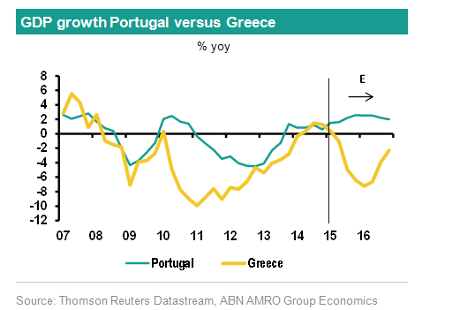
The bailout deal, which has apparently been agreed bar a couple of “minor” issues, still needs to be approved by the Greek and other national parliaments. Nick Kounis, head of macro and financial markets research at ABN Amro, talked of a “remarkable turnaround” but warned that Greece is far from being out of the woods, and highlighted five pitfalls.
These are the deep recession, ongoing tough austerity, the lack of resolution for the Greek debt mountain, the big financing gap in the programme and the complete lack of ownership of the measures.
1. Deep recession: The economy looks set for another sharp dive, contracting 3% this year and 5% next year in our view. That will be a very tough environment to implement difficult measures.
2. Austerity: Although we do not yet have the details, it seems likely that Greece will be asked to carry out further sharp budget cuts. With the economy slumping, these may prove counter-productive, leading the country to miss targets as tax revenues plummet.
3. The debt mountain: With government debt heading for 200% GDP or above, Greece needs major debt relief. A number of eurozone member states sound like they only want to provide a modest debt reduction by extending maturity of debt, but that may not be enough.
4. Insufficient finance: The ESM will provide EUR 50bn of the EUR 86bn needed. The IMF may provide EUR 15bn, but even then there is a financing gap.
5. Lack of ownership: Greece, Germany and the IMF have expressed doubts about the programme. What happens when the going gets tough?”
You can read Kounis’ full note here.
Angus Campbell, senior analyst at FxPro, says China’s currency devaluation could be seen as a retaliation to the International Monetary Fund’s recent announcement that they believe it’s too early to give the yuan reserve currency status.
The People’s Bank of China aims to move the renminbi to a freer floating and accessible currency, prerequisites for it to be given the IMF’s reserve stamp of approval and will see it move in a wider band. The move should also act as a stimulus to Chinese exporters and assist in injecting a little inflation domestically in the face of the continuing decline in commodity prices.”
The move has certainly helped the dollar, which retreated on Monday after comments about low inflation from US Federal Reserve vice chairman Stanley Fischer, who snuffled out the flames lit by Dennis Lockhart last week. Lockhart, another Fed member, reinforced expectations that the first Fed rate hike could come at the meeting in mid-September.
This shows how next month’s FOMC meeting and interest rate decision is finely balanced. With the words “data dependent” being more widely used special scrutiny will be given to US data releases with Thursday’s retail sales being this week’s highlight as today sees yet another quiet economic calendar apart from the German and eurozone ZEW surveys.”

Updated
European shares fall, led by carmakers and luxury goods stocks
European stock markets have opened lower, dragged down by carmakers and luxury goods stocks after China devalued its currency. Germany’s BMW and Swiss luxury group Swatch were among the worst performers as investors worried that the Chinese move smacks of desperation, sparking fresh fears over the state of the world’s second-biggest economy.
UK’s FTSE 100 index down 0.6% at 6697.78
Germany’s Dax down 0.7% at 11,526.06
France’s CAC down 0.7% at 5160.80
Spain’s Ibex down 0.1% at 11295.9
Italy’s FTSE Mib down 0.4% at 23,872.64
The price of oil, commodities such as copper and gold was also hit as the US dollar strengthened following China’s currency move, ending a brief rally in commodities.
The yuan depreciation boosted the dollar and make dollar-denominated currencies more expensive for buyers using other currencies.
Copper lost up to 1.9% to $5,209 a tonne; spot gold slid nearly 1% to $1,093.25 an ounce and Brent crude, the global oil benchmark, slipped below $50 a barrel again before recovering somewhat.
Updated
From the EU, the deal on #Greece is confirmed too. But the Eurozone has not called yet an Eurogroup. 'Not confirmed yet', they tell me /1
— María Tejero Martín (@Maria_Tejero) August 11, 2015
Germany voices caution on Greek 'business model'
Germany has once again sounded a note of caution about Greece’s third bailout, saying the new cash-for-reforms deal must address the debt-stricken country’s “business model” over the next three years.
German deputy finance minister Jens Spahn told Germany’s ARD television shortly before news emerged that Greece and its creditors had effectively hammered out a new bailout package (apart from a couple of minor issues):
We’re talking about a programme for three years, it needs to be negotiated thoroughly. It must be convincing that it’s not just about 20 August.”
Germany has repeatedly urged “quality before speed” in the negotiations.
It’s not just about making savings, that it works for the budget, but above all about how Greece... earns money in the next few years, what is the ‘business model’ so to speak.”
Last month, the German parliament gave the green light for the eurozone to negotiate a third bailout for Greece, but nearly a fifth of chancellor Angela Merkel’s conservatives voted “nein”.
More instant reaction as “white smoke” rises in Athens.
Greece, the ultimate irony. 6 months of shameful Grexit threats, followed by a swift deal focused on reforms rather than austerity.
— Frederik Ducrozet (@fwred) August 11, 2015
Latest Greek deal seems to require less demanding prior actions against fake farmers than actions agreed but mysteriously dropped in July.
— Simon Nixon (@Simon_Nixon) August 11, 2015
In Greek bailout deal, creditors have eased austerity path - 0.25% DEFICIT this year, then .5% surplus 2016, 1.75% 2017 and 3.5% 2018
— Robert Peston (@Peston) August 11, 2015
Good to hear Vicky Pryce talking sense about latest Greek deal on @BBCr4today Trouble is so many of the fundamental problems still persist
— Gerard Lyons (@DrGerardLyons) August 11, 2015
Phone call between Tsipras & Merkel y'day. Merkel sceptical of deal, favoured new bridge loan, Greek gov't sources tell @lidabola #Greece
— Nick Malkoutzis (@NickMalkoutzis) August 11, 2015
"We have a deal," Greek economy minister George Stathakis tells @FT - on @fastFT http://t.co/HrbXnsO6rp
— Tony Tassell (@TonyTassell) August 11, 2015
Back to Greece, where officials have indicated that they expect the new bailout deal – Greece’s third – to be ratified by parliament on Wednesday or Thursday and to be vetted by eurozone finance ministers on Friday.
During the marathon talks which started on Monday afternoon and carried on through the night, the debt-laden country and its international creditors agreed on final fiscal targets, aiming for a primary budget surplus (which excludes interest payments) form 2016, Reuters reported, citing a government official.
#Greece, lenders agree on 2016, 2017 baseline on primary surplus http://t.co/mYeqZ9mD1T ~@Reuters | Creditors make austerity debate obsolete
— Yannis Koutsomitis (@YanniKouts) August 10, 2015
Updated
Marc Ostwald, strategist at ADM Investor Services International Limited, has sent us his thoughts on China’s currency devaluation:
a) While the perception that this is a “devaluation” is natural, it is misplaced. In very simple terms, if China is to move towards being part of the SDR [the IMF’s reserve currency fund] and a more liberal FX regime, it is totally inconsistent to have two FX exchange rates, i.e. “floating” market rate and the daily People’s Bank of China midpoint fix, and obviously it has to be the market rate that has to take precedence.
b) Let us also not forget that China’s Real Effective Exchange Rate (REER), as calculated by the Bank for International Settlements, has risen by some 14% in the past year, today’s 2.0% drop pales into insignificance.
c) Of course, markets that are already fretting about Fed rate lift-off will not appreciate this surprise, but in truth this has been coming for quite some time, China equity market reaction has for choice been quite muted (Shanghai Comp currently +0.3% on the day)
d) Has China bitten off rather more than it can chew by enacting all these reforms simultaneously? More than likely. But there are not many choices on that front...
With biggest depreciation in 20 years China imparts disinflation, reducing need for interest rate rises in the West. pic.twitter.com/8ImAl1hSW3
— RBS Economics (@RBS_Economics) August 11, 2015
Updated
The yuan dropped the most in two decades after the devaluation, sending ripples across Asia where stocks slipped and government bonds rallied.
Asian currencies lost ground against the US dollar, led by the Australian dollar, as traders and investors reckoned they would need to fall to stay competitive with China. Singapore’s dollar hit a five-year low while the Malaysian ringgit and Indonesian rupiah fell to levels last seen during the Asian financial crisis 17 years ago.
Oil prices slumped, with Brent crude losing 0.87% to $49.97 a barrel while New York light crude shed 1.16% to $44.44.
China effect: South Korean won tumbles 1.7%, biggest fall in 10 months and a whisker from being biggest in 4 years: pic.twitter.com/lCNwTWhyrZ
— Jamie McGeever (@ReutersJamie) August 11, 2015
not sure if a weak FX is the right medicine for EM markets pic.twitter.com/VNsEcjZGrS
— Call Me Baloo (@Hubon) August 11, 2015
Updated
China devalues yuan
Meanwhile, China has devalued the yuan in an attempt to help exporters after a spate of disappointing economic data, allowing its currency to fall to three-year lows. The move was billed as free-market reform.
China’s central bank described it as a “one-off depreciation” of nearly 2%, based on a new way of managing the exchange rate that better reflected market forces.
The move risks deepening the global currency war. Here is our full story.
New figures out over the weekend showed that China’s exports tumbled 8.3% in July, hit by falling demand from three major trading partners: Europe, the US and Japan.
Guo Lei, economist at Founder Securities in Shanghai, told Reuters:
We think the move is aimed to ease pressure on China’s weak exports performance in recent months and relieve imported deflation pressure.”
British economist Gerard Lyons says:
Today's currency move by China should not be major surprise as the authorities have given hints and recent data has shown a slowing economy.
— Gerard Lyons (@DrGerardLyons) August 11, 2015
'Finally, we have white smoke' – Greek official
Good morning, and welcome to our rolling coverage of the world economy, the financial markets, the eurozone and business.
After all-night negotiations, Greek finance minister Euclid Tsakalotos emerged on Tuesday morning to declare that a bailout deal is imminent, according to Reuters.
“Two or three small issues” remain, he told reporters after a marathon 23-hour session with Greece’s European creditors and the International Monetary Fund in Athens:
Greece needs up to €86bn to stay afloat, with a €3.2bn bond repayment to the European Central Bank due on 20 August.
Earlier, a senior Greek finance ministry official said the two sides had agreed on a wealth fund to handle privatisations, and how to handle non-performing loans in Greece’s banking sector. Both had been sticking points in negotiations.
The official said:
Finally, we have white smoke. An agreement has been reached. Some minor details are being discussed right now.”
For those who speak Greek:
Kathimerini publishes draft of new bailout agreement #Greece https://t.co/MRWdonK8dB
— Derek Gatopoulos (@dgatopoulos) August 11, 2015
Updated