Closing summary: Deadlock in Brussels

And finally, over to Ian Traynor, our Europe Editor, for a summary of the situation:
The new Greek government’s confrontation with its Eurozone creditors over its campaign to relieve its staggering debt burden while also relaxing the terms of five years of austerity resulted in stalemate late on Wednesday.
The first proper negotiations between Greece and eurozone finance ministers failed to make any progress or result in a joint statement. While no immediate agreement had been expected, the emergency meeting had been tipped to produce a framework for talks to be finessed over the next few days before a further meeting next Monday.
Jeroen Dijsselbloem, the Dutch finance minister who chaired the Brussels meeting, announced that this aim was not met. It appeared that the new leftwing government in Athens was isolated in seeking to extract better terms from Europe.
It appeared that Alexis Tsipras, the new Greek prime minister, ordered his finance minister, Yanis Varoufakis, to stand firm against the pressure to make any concessions. Tsipras is due in Brussels on Thursday for his debut on the European stage at an EU summit
Following 10 days of touring Europe in a failed attempt to woo Berlin, Frankfurt and other key capitals to shift the terms of trade between Athens and the eurozone, Varoufakis, went into negotiations with the other finance ministers at a specially convened session in Brussels. Entering and leaving the meeting, he was uncharacteristically taciturn.
The stalemate could see Greece running out of cash next month, unilaterally defaulting on the bailout programme with the European Central Bank, the European Commission, and the International Monetary Fund, and being forced to leave the single currency....
Ian’s full story will be live on the Guardian website soon. So that’s all from us. Goodnight, and thanks for reading and commenting (as always!) GW
Open Europe analyst Vince Scarpetta homes in on the key point:
Obviously, as Dijsselbloem said, technical work on the details can't begin as long as there's no political agreement on what to do. #Greece
— Vincenzo Scarpetta (@LondonerVince) February 11, 2015
A reminder of how disappointing tonight’s press conference was:
A 1 min statement, 7 mins of qs with same answer: no political agreement on way forward, no plans under discussion. http://t.co/ThFeeAdYA4
— Ken Monahan (@Foudroyant) February 12, 2015
Peter Spiegel nails it:
Expectations for this evening's emergency #eurogroup on #Greece were exceedingly low, and they still managed to fall short of them.
— Peter Spiegel (@SpiegelPeter) February 12, 2015
The rumour that tonight’s meeting unraveled after Germany’s finance minister left the room is gathering pace:
#Eurogroup: Germany FinMin allegedly left meeting at 23h thinking that there was a final statement, vetoed later by #Tsipras-sources
— José Miguel Sardo (@jmsardo) February 11, 2015
Oops... We bump into @yanisvaroufakis on our way out Eurogroup pdt's presser #greece pic.twitter.com/9R81bTaXsT
— AnneSylvaineChassany (@ChassNews) February 11, 2015
Don’t make any plans for Monday night, dear readers
On the plus side, for fans of the beloved late-night #Eurogroup there is the promise of at least one more episode next week #Greece
— Nick Malkoutzis (@NickMalkoutzis) February 11, 2015
Updated
Tom Nuttall of the Economist has heard that the eurogroup had agreed a deal, but then the German finance minister departed, and then it all went wrong.....
Source: Schaeuble left meeting believing statement agreed. Then Varoufakis took floor to speak again and deal fell apart.
— Tom Nuttall (@tom_nuttall) February 11, 2015
Is it really plausible to expect a breakthrough at next Monday’s eurogroup meeting?
Wolf Piccoli, analyst at Teneo Intelligence, thinks not:
Set for another extraordinary #Eurogroup meeting as deal on Monday looks rather unlikely given vast gap. Clear the diary for 27 Feb #Greece
— wolf piccoli (@wolfpiccoli) February 11, 2015
For all our gloom, Greek finance minister Yanis Varoufakis remained upbeat when he spoke to Greek reporters afterwards:
What @yanisvaroufakis said in Greek to the Greeks sounded far more interesting than his words in English pic.twitter.com/09UqAPnDnn
— Bruno Waterfield (@BrunoBrussels) February 11, 2015
Eurogroup presser already over. Impression is there's no agreement whatsoever, not even on how to proceed with negotiations. #Greece
— Open Europe (@OpenEurope) February 11, 2015
Eurocrisis experts agree that tonight’s meeting was a big disappointment:
#grexit #eurogroup this is beginning to sound like quite a failure
— Ian Traynor (@traynorbrussels) February 11, 2015
So Eurozone finance ministers weren't even able to agree on a joint statement. Clearly not a good sign. #Greece #Eurogroup
— Vincenzo Scarpetta (@LondonerVince) February 11, 2015
So eurogroup ends without even a statement on a process for moving forward with Greece? Must have been bad.
— Simon Nixon (@Simon_Nixon) February 11, 2015
I ask @yanisvaroufakis if failure to produce traditional bullshit statement is progress. He replied, 'Well in a sense you are quite right'
— Bruno Waterfield (@BrunoBrussels) February 11, 2015
Greece’s finance minister apparently told reporters that tonight’s talks were “constructive”:
#Greece: FinMin @yanisvaroufakis says #eurogroup talks were "constructive" and "see you monday". Photo via @Suanzes pic.twitter.com/I2hT4uYduU
— José Miguel Sardo (@jmsardo) February 11, 2015
Eurogroup: Snap summary
That’s the shortest, and most disappointing, press conference I can remember covering since this financial crisis began.
The failure to agree a statement, even a holding one, suggests that the two sides have made desperately little progress tonight.
In fact, we’ve moved backwards -- as officials who should now been working on a resolution ready for Monday will be sitting on their hands.
Dijsselbloem: People will not start working before Monday as there was no political agreement on the way forward
— Lorcan Roche Kelly (@LorcanRK) February 11, 2015
The disputes clearly go straight to the heart of this crisis -- with Dijsselbloem saying that political agreement is needed. That bats the problem over to tomorrow’s EU Summit.
Reaction to follow...
Updated
And that’s it! Dijsselbloem ends the press conference, on the grounds that he’s repeating itself.
Dijsselbloem: Didn't agree common ground
We didn’t agree the common ground that will allow officials to start work now, ready for Monday, Jeroen Dijsselbloem reiterates. We need a political agreement first.
This sounds bad. Dijsselbloem says that the eurogroup has not made as much progress as he hoped.
He wanted a plan on the table that officials could then work on ready for Monday, but “unfortunately” that didn’t happen.
What’s the sticking point?
Dijsselbloem: We discussed the possibility of an extension for Greece. For some people, that was the preferred option, but we haven’t come to that conclusion yet.
We need a political decision before the financial institutions can get to work.
We might make the final progress we need at next Monday’s eurogroup meeting.
Updated
Commissioner Pierre Moscovici now -- he says that some progress was made, towards understanding each other’s position.
There is lots of goodwill on both sides, he adds.
A question for Christine Lagarde - what is the situation with the Ukraine bailout?
She invites journalists to a press conference tomorrow morning at 9am - a lot of progress has been made, she adds.
What happened to all those draft statements?
If you don’t reach a joint conclusion you can’t release a statement, Dijsselbloem.
We do have a better understanding about where we all are, he says, so there was some progress.
Onto questions-- this should be fun....
THAT’S IT?!
Dijsselbloem: Not enough progress for conclusion
Dijsselbloem says some progress has been made, but we have not made enough progress to reach a joint conclusion.
So talks will continue on Monday.
There are no conclusions that I can share with you.
Updated
Press conference begins
OK, we’re off. Reminder - you can watch the action here. And also here (needs Microsoft Silverlight)
Back in Brussels, an official just told the press room that “They have just come out of the room”.....
Greece: No agreement at the eurogroup
The Greek government has had enough of the delays, and has released its own statement, reports Helena Smith in Athens.
And crucially, it reads,
“At this euro group there has been no agreement.”
“An extension of the memorandum cannot be accepted. Negotiations will continue with the goal [of achieving[ a mutually beneficial agreement.”
The statement added that the Greek side had put forward well-founded arguments as to why the bailout accord had failed, enlightening listeners on Greece’s problems of public debt and the humanitarian crisis it has also suffered.
Updated
Sources are saying that #Eurogroup statement is ready but #Greek minister is on the phone trying to get a yay or nay from #Athens.
— max hofmann (@maxhofmann) February 11, 2015
Rumours in press room that another dispute over #Eurogroup statement wording holding up presser. #Greece
— Peter Spiegel (@SpiegelPeter) February 11, 2015
Redrafting the redraft of the redraft of the draft?
Journalists are assembled ready to question Greece’s finance minister when he emerges from the eurogroup meeting (Varoufakis won’t be at the [alleged] press conference):
Greek journos are waiting. Mr @yanisvaroufakis do come down please #greece pic.twitter.com/Go1WCWDbLt
— Marco Zatterin (@straneuropa) February 11, 2015
I remember when they said the Eurogroup press conference would start at 9:45 pm... Two hours later, still waiting.
— Gabriele Steinhauser (@gksteinhauser) February 11, 2015
Choppy chop, guys, we are getting restless.
#Eurogroup presser starts any day now. #Greece
— zerozero (@gary_zero) February 11, 2015
I'm going to start the rumour that the reason #Eurogroup presser is delayed is because @J_Dijsselbloem got in a fistfight
— Peter Spiegel (@SpiegelPeter) February 11, 2015
The solution presents itself:
@MehreenKhn @graemewearden You mean "Pier"`?
— Artur Ortega (@DesignedByBlind) February 11, 2015
Finland’s finance minister says no deal, and not much progress either, according to this tweet:
FIN FM Rinne: We still don't have any kind of Greek proposal on paper
— Jarno Hartikainen (@JarnoHa) February 11, 2015
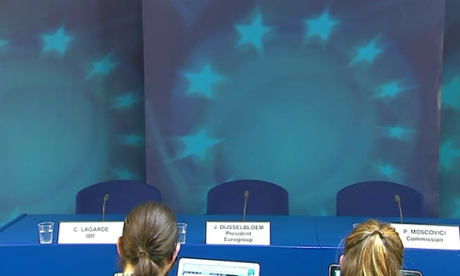
Just waiting for Jeroen Dijsselbloem, President of the eurogroup, Pierre Moscovici, member of the commission in charge of economic and financial affairs, taxation and customs, and Klaus Regling, managing director of the European Stability Mechanism.
And Christine Lagarde of the IMF.
Updated
Another Reuters newsflash:
Luxembourg FinMin: Eurogroup agreed way forward on #Greece, Discussions to continue in coming days. There was no clash today. (rtrs)
— Holger Zschaepitz (@Schuldensuehner) February 11, 2015
Klaxon! Take your seats, open your live streams, pour another slug of coffee/glass of wine/hot chocolate....
The press conference has been called for. Eurogroup is now over. @la_stampa #greece
— Marco Zatterin (@straneuropa) February 11, 2015
Sounds like the eurogroup are redrafting the redraft of the draft (to quote Yes Minister for the second time tonight)
#Eurogroup 3rd draft underway. Deadlock in the previous 2 - #Germany really anxious on terminology. Jargon is alive. #Greece #mazi #Juntos
— Dim Rapidis (@rapidis) February 11, 2015
Greek officials are apparently briefing that an agreement has not been reached -- as their team could not accept extending the current bailout.
That’s via Capital GR’s Efi Efthimiou:
#Greece govt in Athens says “there was no deal, we cannot accept bailout extension” TR @capitalgr: Μαξίμου: Όχι http://t.co/LpS7bv6X2x
— Efthimia Efthimiou (@EfiEfthimiou) February 11, 2015
That “Greece and Europe have agreed on a deal” rumor lasted for what, three maybe four minutes?
— Matt O'Brien (@ObsoleteDogma) February 11, 2015
Sources: No deal
As suspected, talk of a deal was overdone:
Eurogroup Source: “No Deal” As Of Yet, Potential For Bailout Extension --RTRS
— Yannis Koutsomitis (@YanniKouts) February 11, 2015
Updated
Mystery solved:
Greece and Eurogroup apparently discussing language on bailout extension. Varoufakis going through it crossing out every mention of Troika?
— Lorcan Roche Kelly (@LorcanRK) February 11, 2015
Press conference starting soon
The official EU Council press service just tweeted that the press conference with eurogroup chief Jeroen Dijsselbloem starts soon. It’s being streamed here....
Starting soon: #Eurogroup press conference with @J_Dijsselbloem. Watch live through http://t.co/jrJuYg6cte. #Greece
— EU Council Press (@EUCouncilPress) February 11, 2015
Hmmm. CNBC has just reported that Greece and the eurogroup have reached an ‘agreement in principle”, but it’s not clear over what, exactly.....
-
EU, Greece come to agreement in principle, meetings to continue: Source
BREAKING: EU & Greece come to agreement in principle as meetings continue, source says. http://t.co/PPYRy7oW45 (via @MCaruso_Cabrera)
— CNBC Now (@CNBCnow) February 11, 2015
However, the FT’s Peter Spiegel is rather more cautious:
Much like @BrunoBrussels, I'm hearing #eurogroup statement a big fudge. Talks to continue on deputies level...but no word to what end
— Peter Spiegel (@SpiegelPeter) February 11, 2015
Final Details Of Greek Deal To Be Made Clear When Talks Cease On Monday ~@CNBC #Greece
— Yannis Koutsomitis (@YanniKouts) February 11, 2015
Updated
And still we wait....
Eurogroup is still drafting. @la_stampa #Greece
— Marco Zatterin (@straneuropa) February 11, 2015
Possible changes & extension to programme, said one Eurogroup draft statement, fudging & obfuscation continues
— Bruno Waterfield (@BrunoBrussels) February 11, 2015
Analysts at RBC Capital Markets aren’t expecting much from tonight’s press conference (assuming it ever happens!)
They write:
Greek finance minister Varoufakis is expected to again make the case for short-term ‘bridge financing’ until June, so as to make room for negotiations on a longer-term debt solution. Various euro area officials have nevertheless already stated that even a bridging loan must be accompanied by suitable conditionality, suggesting that the Greek authorities will be hard-pressed to build consensus on even a stopgap measure at today’s meeting.
Discussions are likely to be handed over to European Leaders at the informal Council in Thursday’s European session, with further finance minister-level meetings also scheduled for this coming Monday.
Back in Athens, the BBC’s Mark Lowen tweets that eurozone officials should heed the protests tonight (we ran some photos earlier)
Big support for govt in #Athens rally. Loud call for #Eurozone to heed mandate given to #Greek govt - and warning of backlash if it doesn't
— Mark Lowen (@marklowen) February 11, 2015
Reuters tweets that market can expect a joint statement - from #Greeece & Eurogroup that states intent to reach a deal on Monday. (via Citi)
— Holger Zschaepitz (@Schuldensuehner) February 11, 2015
Eurogroup and #Greece preparing common statement on how to handle Athens finances ~Reuters
— Yannis Koutsomitis (@YanniKouts) February 11, 2015
Still no press conference. Instead, Bloomberg is reporting that Greek Finance Minister Yanis Varoufakis presented his European counterparts with four principles for a new financing deal.
Greece wants a deal that provides for financial stability, financial sustainability and debt restructuring, while addressing Greece’s humanitarian crisis, Varoufakis said during talks Wednesday in Brussels without offering details, according to the officials, who asked not to be named because the talks are private.
Greece has offered Europe 4 principles for talks, sources say http://t.co/Y4Mv2vtbL6 pic.twitter.com/vbXRuccQI6
— Bloomberg Business (@business) February 11, 2015
Reuters has snapped that the eurogroup and Greece are preparing a common statement on how to handle Athens finances....
Updated
Perhaps the eurogroup aren’t finished, after all....
After standing at the base of the stairs in #eurogroup press rm for about 15 minutes, reporters now disbursing. False alarm?
— Peter Spiegel (@SpiegelPeter) February 11, 2015
Ελληνοφρένεια ΤΩΡΑ! Waiting for the #Eurogroup press briefing to start pic.twitter.com/22AT83umCT
— Maria Aroni (@aronimar) February 11, 2015
Proof that a pair of sharp elbows can be an invaluable journalistic tool:
Thing seem to come to an end as journos wait to be let into press room for @J_Dijsselbloem presser #Eurogroup pic.twitter.com/O3qcL2Eom7
— Stefan Riecher (@Stefan_Riecher) February 11, 2015
This will be a mad scramble for seats in the tiny #Eurogroup press room today. pic.twitter.com/oolSHLyOna
— Gabriele Steinhauser (@gksteinhauser) February 11, 2015
The FT’s Peter Spiegel reports a flurry of activity outside the eurogroup meeting room
Large gaggle of reporters gathering near stairs in #Eurogroup press rm. I have no idea why, but I suspect things may be wrapping up. #Greece
— Peter Spiegel (@SpiegelPeter) February 11, 2015
#Greece PM #AlexisTsipras will be meeting 4 leaders in Burssels ahead ofThursday's EU summit - you've guessed it: Merkel is not among them
— Helena Smith (@HelenaSmithGDN) February 11, 2015
The Greek prime minister’s office has JUST released Alexis Tsipras’ schedule for the leaders summit in Brussels tomorrow, Helena reports.
It makes for quite a read. This is the far left leader’s first appearance on the international stage as premier of Greece:
- 10am: meeting with the Belgium PM Charles Misel
- 11:15am: meeting with the president of the Ukraine Petro Poroshenko
- 12-1pm: meeting with the prime minister of the United Kingdom David Cameron, and the prime minister of Latvia Laimntota Straoutzouma
- 1pm: Exchange of view with participants attending the summit meeting with president Martin Schulz
- 13:45pm: Working lunch at EU summit
The head of Spain’s anti-austerity Podemos party has warned that the European project could unravel if Greece is not given fresh help by its partners.
Writing for our Comment Is Free site, Pablo Iglesias argues:
Austerity has shattered the political space historically occupied by social democracy, so it would be in the interests of these parties to rectify this and support the Greek government.
It seems that Italy’s Matteo Renzi, despite his lukewarm support, is alone in fully grasping what is at stake in Greece. Or do people perhaps think that if Europe’s leadership refuses to budge in its attitude, then the “normality” of austerity can be restored? It is unwise to put a democratic government between a rock and a hard place. The wind of change that is blowing in Europe could become a storm that speeds up geopolitical changes, with unpredictable consequences.
The viability of the European project is at stake. Pro-Europeans, especially those in the socialist family, should accept the hand offered by Tsipras and help curb the demands of the pro-austerity lobby. It’s not just their own political survival that is at stake but that of Europe itself.
Here’s the full piece:
Pablo Iglesias: If the Greek olive branch is rejected, Europe may fall
Sounds like an ultimatum heading South...
— Yannis Koutsomitis (@YanniKouts) February 11, 2015
Till Monday Greece will have to decide if they want extension of current program. No other option on the table. #Eurogroup
— Eleni Varvitsiotis (@Elbarbie) February 11, 2015
Ahem, just corrected that earlier post in case I’m reading too much into the “bridge” reference, so do please refresh to avoid us causing confusion....
Updated
The Brussels press pack are working hard tonight...
debatte der eurofinanzminister zu griechenland offenbar intensiv und konkret, für uns journis heißts warten pic.twitter.com/4hyo2FXizz
— Thomas Mayer (@TomMayerEuropa) February 11, 2015
Marco Zatterin of La Stampa has heard that a statement is being drawn up, and the meeting might be over within half an hour.... (updated).
"Eurogroup is drafting some kind of bridge-declaration, it will be over in 30 mins circa", says a Eu source. @la_stampa @FGoria #greece
— Marco Zatterin (@straneuropa) February 11, 2015
Updated
Bruno adds:
I suspect we're about to learn that @yanisvaroufakis (& his cheerleaders) can do trad euro bullshit blabla along with the rest of the gang
— Bruno Waterfield (@BrunoBrussels) February 11, 2015
We’re starting to see more leaks from the eurogroup meeting.
Bruno Waterfield of the Telegraph says officials will take the plan presented by Greece tonight, and compare it against the existing programme.
By Monday night’s Eurogroup meeting, they’ll know how much they differ by; and, I guess, how much more funding would be needed.
Source: euro working group experts & Greece to make analysis on divergences between @yanisvaroufakis plan and existing programme for Mon
— Bruno Waterfield (@BrunoBrussels) February 11, 2015
Eleni Varvitsiotis, Kathimerini’s correspondent in Brussels, hears that Greece is coming under pressure to stick with the status quo.
Pressure on #Greeks to accept extension of the current program. #Eurogroup
— Eleni Varvitsiotis (@Elbarbie) February 11, 2015
Sounds like it might nearly be time to stop admiring Varoufakis’s scarf and get to work...
#eurogroup press conference will be livestreamed on EBS Live. Supposed to start soon. http://t.co/ZSrhIyUHe3 #mazi #weareallgreeks
— Erik Wesselius (@erikwesselius) February 11, 2015
Germany’s finance minister sounded a little sarcastic, going into tonight’s meeting:
#Schaeuble: The Greek programme will continue to be run by the #Troika, which apparently we can't call 'Troika anymore.' #Eurogroup
— Open Europe (@OpenEurope) February 11, 2015
The seating plan
Here’s the seating plan for tonight’s eurogroup meeting. The Greek delegation is slap-bang in the middle of the table.
The #Eurogroup seating order. #Varoufakis between #Ireland and #Spain via @Stefan_Riecher pic.twitter.com/ll8d0kT83X
— Dorothy (@dorothyier) February 11, 2015
If you click, you’ll see that Giannis Dragasakis, greece’s deputy premier, is sitting with Yanis Varoufakis. Dragasakis is head of the government’s economics team, so actually the frontman at tonight’s talks.
Great turnout in Parliament Square tonight for solidarity protest with people of #Greece pic.twitter.com/uIa3Pynpz8
— JubileeDebtCampaign (@dropthedebt) February 11, 2015
Tonight’s demonstrations aren’t restricted to Greece -- anti-austerity campaigners across Europe are rallying tonight.
Follow @OlivierDrot who's keeping track of solidarity marches around Greece and Europe (#Greece #mazi) pic.twitter.com/lKCO97T83W
— Derek Gatopoulos (@dgatopoulos) February 11, 2015
Including at Parliament Square in London.


We have a winner.
They're either discussing GDP-linked bonds or talking about getting the band back together pic.twitter.com/DMGaWCgynY
— Jason Karaian (@jkaraian) February 11, 2015
Ian Traynor: Greece warned to stick to its agreement
From Brussels, Ian Traynor writes:
Greece’s new leftwing government started its first serious negotiations with its eurozone creditors on Wednesday evening as fellow currency bloc members insisted that the country stick to its bailout agreement.
Yanis Varoufakis, the new Greek finance minister, went into negotiations with the other finance ministers at a specially convened session in Brussels of the Eurogroup, following 10 days of touring Europe in a failed attempt to woo Berlin and other key capitals to shift the terms of trade between Athens and the eurozone. Entering the meeting, he was uncharacteristically taciturn.
The Greeks can expect no favours, ministers stressed ahead of the crunch talks, which are certain to run into next week. A showdown that results in stalemate could see Greece running out of cash next month, unilaterally defaulting on the bailout programme with the European Central Bank, the European commission, and the International Monetary Fund, and being forced to leave the single currency.
That prospect is viewed as a disaster fraught with high risk in Brussels, Paris, and Rome. But Berlin, whose voice will matter more than most in the negotiations, is reliably said to be “extremely relaxed” about the Greek crisis and opposed to tearing up the agreements that Greece is formally bound to under the bailout terms.....
Here’s Ian’s full story on tonight’s meeting.
Greece warned to expect no favours as bailout negotiations begin http://t.co/O4qvcgfUpo
— Guardian World (@guardianworld) February 11, 2015
Updated
Still no clarity on how long tonight’s meeting will take. Greek reporters from SKAI TV reckon that it will not be a marathon session.
As Yes Minister taught us, “The word ‘no’ is one of the shortest in the language”. Mind you, so is “Ja”.....
Updated
Thousands demonstrate in Athens, and beyond

The Greek government is drawing strength from the thousands who have poured into city squares around the country to back its demands for a new bailout deal.
From Syntagma Square in Athens, Helena Smith reports:
“The freezing cold and the the snow have not been an obstacle to the birth of a new movement of squares,” the government spokesman Gabriel Sakellaridis announced.
Sakellaridis added:
“At the Euro group and EU summit it is not only the Greek government that is negotiating but together with 10 million Greeks. Hope has overcome fear.”
Tonight’s gathering (for that is what it felt like) in front of the Athens parliament was by far one of the biggest but also one of the most joyful I have ever seen.
I am struck by how middle class the crowd was. Most, like Mario Athanasiou, stood there with friends swapping notes about the economic situation.
“The important thing is that people here right now are happy. It’s a wait and see situation,” he said.
Others, like Christos and Magda Papadopoulos, were there to say:
“we just want our country to go forward. What we need is solidarity - and jobs. The Europeans, Germans, Austrians, French, should all come back and open investments here.”
There are also big demonstrations tonight in the city of Thessaloniki.

Varoufakis isn’t the only one with a leather coat in his wardrobe - perhaps Christine Lagarde was inspired by the Greek finance minister’s Downing Street catwalk...
Is Lagarde showing fashion solidarity with Varoufakis? #bikerjacket #eurogroup #greece pic.twitter.com/x5Ka77PGgh
— Valentina Pop (@valentinapop) February 11, 2015
No deal expected tonight
We can dial down any lingering expectations of a breakthrough deal tonight.
Tom Nuttall of the Economist has heard that our best hope is an agreement to prepare more work for next Monday’s eurogroup meeting.
Senior source: best possible scenario is a mutual understanding by end of night that there will be a process to prepare for next Eurogroup
— Tom Nuttall (@tom_nuttall) February 11, 2015
Updated
There’s more public interest in tonight’s eurogroup meeting than usual, reports Ian Traynor, our man in Brussels.
#greece first time ever crowds out for a #eurorgroup meeting. @J_Dijsselbloem a bit of a rock star
— Ian Traynor (@traynorbrussels) February 11, 2015
Dr Elizabeth Stephens on @SkyIanKingLive - #Greece debt negotiations "when we say eurozone, it really is the Germans leading the way here"
— Ian King Live Team (@SkyIanKingLive) February 11, 2015
Vanis Varoufakis’s choice of a Burberry scarf has caused a stir on social media.
New Greek Finance Minister Varoufakis is wearing a Burberry scarf? What a great way to ask for more bailout money pic.twitter.com/N9b2CGoddd
— Jon Hartley (@Jon_Hartley_) February 11, 2015
Nice to see lefty Greek finance minister Varoufakis looking like a capitalist wearing a Burberry scarf when meeting IMF's Lagarde. #tcot
— Frank Salinger (@KStreetLawyer) February 11, 2015
A great endorsement for the British fashion house.
Updated
The body language from eurogroup chief Jeroen Dijsselbloem didn’t look great when he met Yanis Varoufakis this evening.....

....but he soon warmed up.

Anyone know a decent takeaway service in Brussels?..
#EU institutions have differences on how long #eurogroup will go. Some say done by 10pm, some say I have no time 4 dinner. Should I go eat?
— Peter Spiegel (@SpiegelPeter) February 11, 2015
Eurogroup meeting under way
The eurogroup meeting is continuing behind closed doors, but we’ll be back later with any developments, including highlights from the post-meeting press conference.

Updated
Massive anti-austerity rally outside the Greek Parliament: https://t.co/5rZfH9RKAe #Greece #Syntagma #mazi #Eurogroup pic.twitter.com/HsmDb6g25P
— Alexandros Maragos (@AlexMaragos) February 11, 2015
Greek official says meeting today with Lagarde, Dijsselbloem and Weiser was to discuss what would constitute a bridge loan
— Live Squawk (@livesquawk) February 11, 2015
All friends together. Greek finance minister Yanis Varoufakis glad hands his German counterpart Wolfgang Schaeuble and the IMF’s Christine Lagarde at the emergency eurogroup meeting in Brussels.


European markets close lower
With investors cautious as the European finance ministers meet to discuss Greece, markets have edged lower, not altogether surprisingly. The final scores showed:
- The FTSE 100 finished 10.95 points or 0.16% lower at 6818.17
- Germany’s Dax dipped 0.02% to 10,752.11
- France’s Cac closed down 0.35% at 4679.38
- Italy’s FTSE MIB fell 0.77% to 20,565.76
- Spain’s Ibex ended 1.29% lower at 10,364.8
- The Athens market closed down 4.02% at 793.09
On Wall Street the Dow Jones Industrial Average is currently 28 points or 0.16% lower.
Meanwhile another rally is being held in Greece:
Another rally is being held in front of the #ert HQ, will move to #Syntagma later #mazi via @alepouda
— Theodora Oikonomides (@IrateGreek) February 11, 2015
At least twice the crowd as last time #mazi #Greece pic.twitter.com/GlSCDKNPWz
— Yiannis Βaboulias (@YiannisBab) February 11, 2015
Here’s Christine Lagarde of the IMF arriving in Brussels earlier:
Meanwhile some encouraging words for Greece from Christine Lagarde, managing director of the IMF (one of the troika of creditors, let us not forget).
After meeting Yanis Varoufakis, Lagarde said (courtesy Reuters):
They are competent, intelligent, they’ve thought about their issues.
'There will be plenty of work to do,' #Lagarde of #IMF says about talks w/ #Greece
— Kathimerini English (@ekathimerini) February 11, 2015
Updated
... although Reuters does appear to have this from the Greek finance minister:
1-Feb-2015 16:33 - GREECE’S VAROUFAKIS, ASKED IN BRUSSELS IF GREECE MIGHT LEAVE EURO ZONE, SAYS “ABSOLUTELY NOT”
Anyone hoping for comments from Yanis Varoufakis on his arrival in Brussels may be disappointed, according to Open Europe:
Seems as if Greek Fin Min Yanis Varoufakis ghosted into the #Eurogroup w/out giving comments to the media, different to recent approach...
— Open Europe (@OpenEurope) February 11, 2015
A Grexit is unlikely and any contagion from the country’s problems is likely to be limited, according to James Butterfill, global equity strategist at Coutts. He said:
We believe fears of this worst-case scenario – Greece reverting to the drachma, defaulting on its debt, causing a liquidity crisis in the Greek banking system and failure of Greek businesses – are unlikely to come to fruition. What is most likely in our view is some kind of compromise with Greece on repaying its debt, following an initial period of uncertainty.
While Greece represents only 1.8% of eurozone gross domestic product, and the impact on eurozone economic growth of Greece leaving would be minimal, the concern is that a Greek exit could undermine confidence in the whole euro project. Still, bond markets and credit default swaps (a kind of insurance against default) are currently pricing in a low probability of contagion spreading to other peripheral markets.
Key differences between the current situation and the height of the eurozone debt crisis in 2012 include the presence of economic growth, improving lending conditions and unequivocally supportive monetary policy from the European Central Bank (ECB).
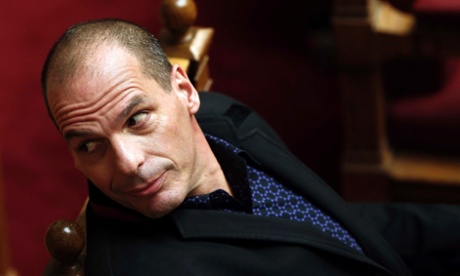
We see a debt-renegotiation compromise as the most likely outcome of the current impasse. Greek finance minister Varoufakis – a student of game theory – may have presented seemingly unreasonable demands as a tactic for gaining greater concessions for Greece. And it is encouraging that the two sides have agreed to meet today.
The populism of Greece’s new prime minister Alexis Tsipras could give other anti-austerity parties in Europe a boost, prompting German concessions (despite the politically toxic ‘bail-out’ label). We think it’s likely that Greece’s more unrealistic demands will be curtailed by Greek-bank liquidity concerns. This time the creditors are primarily the ECB, IMF and Germany, so other peripheral countries are not on the hook and contagion shouldn’t spread to them.
We continue to have a positive view on European equity markets, with corporate earnings set to post their fifth consecutive quarter of growth. Survey data, such as purchasing managers indices of business activity and business confidence indicators, are also indicating Europe’s economy is entering a new phase of expansion. Aggressive stimulus from the ECB, a weak euro and low energy prices should all help too.
Updated
And here’s some video of Pierre Moscovici arriving:
More talk before the big talks, this time from EU economics commissioner Pierre Moscovici:
EU Economics Commissioner Moscovici: Today is first opportunity for #Greece to present its ideas and hear what others think about that.
— Open Europe (@OpenEurope) February 11, 2015
#Moscovici: We want a good discussion today. We know it will take some time to find a solution. #Eurogroup
— Open Europe (@OpenEurope) February 11, 2015
#Moscovici: The stipulations of the programme is the basis for our discussions today. #Eurogroup
— Open Europe (@OpenEurope) February 11, 2015
Moscovici: Some time will be needed to get to a good compromise. #Greece
— Open Europe (@OpenEurope) February 11, 2015
#Moscovici: There is a need for a lot of good will for this first conversation at collective level. We must listen closely to each other.
— Open Europe (@OpenEurope) February 11, 2015
Moscovici: We can't not listen to Greek voters, but Greek gov't needs to understand there are commitments made by its predecessor. #Greece
— Open Europe (@OpenEurope) February 11, 2015
#Moscovici: The Greek finance minister will hear what the collective Eurozone has to say on this matter today. #Eurogroup
— Open Europe (@OpenEurope) February 11, 2015
#Moscovici: The Greek government has to understand that committments have to be honoured. #Eurogroup
— Open Europe (@OpenEurope) February 11, 2015
#Moscovici: The Commission enters in to these meetings with the aim to keep #Greece in the Eurozone. #Eurogroup
— Open Europe (@OpenEurope) February 11, 2015
Moscovici doesn't answer Q on T-bills increase: We're not here to talk about technicalities. We're here to talk about politics. #Greece
— Open Europe (@OpenEurope) February 11, 2015
#Moscovici: The programme is the basis for discussion. Some compromise only within this legal framework. #Eurogroup
— Open Europe (@OpenEurope) February 11, 2015
#Moscovici sounding quite German in parts - "commitments must be respected", "current programme basis" for discussion #Eurogroup
— Open Europe (@OpenEurope) February 11, 2015

Eurogroup president Jeroen Dijsselbloem has arrived for the meeting in Brussels.
Helena Smith, our correspondent in Greece, brings us this report from Athens:
I have been speaking to a top government official whose reaction to Dijsselbloem’s ultimatum – that Athens accepts the agreement already signed by the previous government – was that “he’s playing us.”
“Disselbloem is known for being disagreeable. He is doing himself no favours with the way he is behaving,” said the official who wished to remain anonymous.
Greek analysts are getting worried.
“Greece has very little leverage. It is becoming ever more clear that our partners consider the new government’s decision to unilaterally change roadmaps with its proposal of a bridging agreement as a big red line,” Eleni Panayiotarea, a senior research fellow at Greek think tank Eliamep, told me this afternoon.
“What is uppermost in Germany’s mind right now is political contagion given elections elsewhere in Europe later this year and so for them to change position now is going to be very, very hard.”
Open Europe puts the likelihood of a Greek exit from the euro at 40%.
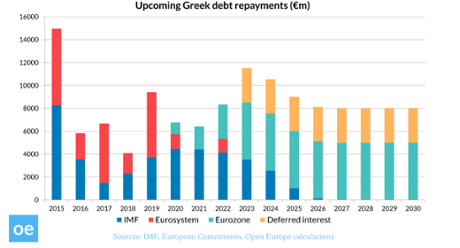
The think-tank has also published some data showing that the large majority of Greek debt payments will go to ECB and IMF in next decade and not the eurozone . “These parties are even harder to negotiate with,” says Raoul Ruparel, head of economic research.
Open Europe runs through the proposals likely to be put forward by Greece today:
- Scrap 30% of the bailout programme in exchange for 10 new reforms agreed with the OECD (meaning 70% would be kept).
- Reduce Greece’s primary surplus target from 3% of GDP to 1.5% this year, and keep it around this level for the medium term (as opposed to increasing it to 4.5% as currently planned).
- A swap plan for the loans to Greece. This is likely to focus around the previous proposals of turning eurozone loans to Greece into GDP linked loans or bonds and asking the ECB to swap its current holdings of Greek bonds for ‘perpetual bonds’.
- Allow (if not support) Greece to tackle its humanitarian crisis.
- Funding will come from €1.9bn in profits on Greek bonds held by the eurosystem being transferred to Greece and an increase in the limit of T-bills (short term debt) issued by the Greek government of €8bn.
- Other potential funding lines include tapping into the €7.2bn tranche of EU/IMF/ECB Troika funding waiting to be released or using the €11bn leftover in the bank recapitalisation fund.
- The plan would run until September and allow time for negotiations over a “new deal” on Greece’s debt.
Could a deal be struck on these terms? Unlikely, says Ruparel.
The initial signs aren’t good and there looks to be a large divide between the two sides to bridge.
Little progress is expected in today’s meeting of finance ministers and the big risk is that all the time is spent negotiating the bridge agreement with too little thought given to where said bridge will go.
For these reasons we believe Grexit is now more likely than in the fraught period of 2012. Back then we put the chances of Grexit at 25%. We now put them around 40%.
A compromise is possible but it will require one side or the other to shift significantly. This still looks more likely to be Greece and Syriza but with strong backing from the Greek parliament and polls showing strong public support for their tough stance both sides positions are becoming increasingly entrenched.
Back in Greece, the ATG is down 4% at 792.
Other European indices are also down, but less sharply.
- FTSE 100: -0.5% at at 6,797.92
- France’s CAC 40: -0.3% at 4,683.37
- Germany’s DAX 30: +0.01% at 10,754.54
- Spain’s IBEX: -0.9% at 10,406.2
- Italy’s FTSE MIB: -0.7% at 20,587.1
US markets open down slightly
Investors on the other side of the Atlantic are also weighing up the possible outcomes from today’s emergency eurogroup meeting.
- DJ Industrial Average: -0.3% at 17,811.41
- S&P 500: -0.1% at 2,066.94
- Nasdaq: +0.2% at 4,290.71
New career for Varoufakis if Greek debt talks fail?
Yanis Varoufakis stars in Taken 2 (h/t @Sarah_Buckley @Berlaymonster) pic.twitter.com/DzuE2C7PDh
— General Boles (@GeneralBoles) February 11, 2015
There is a one-in-four chance Greece will leave the euro this year, according to economists polled by Reuters.
They also predicted the eurozone will be in deflation for most of 2015, despite the European Central Bank’s €1.1tn programme of quantitative easing, announced last month.
Consumer inflation is likely to remain negative until the fourth quarter, the poll suggested. Inflation in the 19-member region is currently -0.6% and if economists are correct, it would signal the longest run of falling prices since the euro was first introduced as a currency in 1999.
Greece alone would be responsible for winding down any problem bank this year, according to the head of Germany’s financial watchdog.
It cannot count on help from other European bank resolution funds, said Elke Koenig, head of Bafin. She takes up a new role as head of the EU Single Resolution Board on 1 March and hopes to have it up and running on 1 January.
For everything up to 31 December, the Greek national resolution authority is responsible.
If talks should fail and it came to uncontrolled movements in Greece, national supervisory authorities would be in charge.
Feelings were running high in Athens before the showdown in Brussels later on.

Our vision for our program and policies is clear: our goal is to put the needs of our people above all else #Greece
— Alexis Tsipras (@tsipras_eu) February 10, 2015
Eurogroup chairman (and Dutch finance minister) Jeroen Dijsselbloem has been giving his view on a potential deal with Greece before the finance ministers kick off talks later today.
Addressing the Dutch parliament (where a majority has called for no new financial support for Greece), he said that while the bailout programme might be tweaked, the broad terms of the original agreement must be upheld. A kind of one-in, one-out, approach to reform.
An agreement is an agreement. That means that only within the programme, measures could be exchanged for other measures.
Then you can change the programme, you can fill the programme in differently. But support without a program, support without further progress on reforms is unthinkable.
We have the joint ambition to come to a solution, and I do think that it’s possible. The alternative measures will always have to be vetted, tested by the Troika.
He was speaking before heading to Brussels for the eurogroup meeting.
Eurogroup's Dijsselbloem: Any changes to #Greece deal must conform with troika pact http://t.co/RHdlf5VbkJ
— Efthimia Efthimiou (@EfiEfthimiou) February 11, 2015
Doorstep #Eurogroup at around 16.00.
— Jeroen Dijsselbloem (@J_Dijsselbloem) February 11, 2015
Portugal’s President has warned it will be a disaster if Greece leaves the euro.
Speaking in Lisbon, Anibal Cavaco Silva, said:
I think it would be good for the European Union and Greece to remain a member of the euro.
I am convinced that it would be a total disaster for Greece if it were to leave the euro.
I hop that it continues to correct [its position] so that it can reach agreement in the eurogroup meeting, in its dialogue with the European Commission and in the meeting with the European Council.
While no one knows how far (if anywhere) eurogroup finance ministers will get on reaching an agreement on Greece at today’s emergency meeting, they have got a little breathing space.
Ministers have given themselves a deadline of Monday, 16 February - the next scheduled eurogroup meeting - to come up with a solution one way or another.
Eurogroup on Greece tonight will be "procedural not substantive" say officials. D-day will be 16 Feb
— Bruno Waterfield (@BrunoBrussels) February 11, 2015
Fears of a massive flight of capital from Greece in the wake of a Syriza victory were overdone, as it turns out.
So says London-based CrossBorder Capital. The investment advisory firm has been crunching the first available numbers since the election and concludes that net outflows were modest.
It claims $177m (£131m) flowed out of Greece in January, compared with $166m in December and $149m in November. Almost $2.4bn left the country back in August, the highest monthly figure of 2014.
Michael Howell, managing director of CrossBorder Capital, gives his verdict:
The January data show that Greece has been more stable than many feared. It’s not the disaster many worried about. It may well be the case that money is being taken out of domestic banks and put in foreign-owned banks within Greece, but there is little sign that the economy as a whole is haemorrhaging funds.
S&P: Risk of contagion from Greece is low
Ratings agency Standard and Poor’s is not overly concerned about Greece’s troubles spreading to the rest of the eurozone.
Moritz Kraemer, S&P’s chief sovereign ratings officer, has been speaking to German newspaper Boersen-Zeitung:
Greece’s risk premium has drastically increased again recently but the panic hasn’t leapfrogged over to other former crisis countries. The risk of contagion doesn’t seem to actually be that big.
He said if Greek debt had to be written off, Greece’s creditors could withstand it.
Contrary to public perception, the extent of liability is not that high at all in proportion to the creditors’ economic strength.
The story would be different for Greece however. Kraemer said a Greek exit from the euro would be “devastating” for the country.
The population might have to go through all of the deprivation it thought it had already put behind it.

Helena Smith, the Guardian’s correspondent in Athens, says the mood between Tsipras and Gurria appeared relaxed and friendly. She brings us this report of the meeting.
Following his “working dinner” with the Greek finance minister Yanis Varoufakis (who is now on his way to Brussels), the OECD’s secretary-general is holding what are being described as “crucial ” talks with the Greek premier.
Arriving at Tsipras’ prime ministerial office, the former finance minister of Mexico felt fit to describe the leader “as one of the most important men in Europe because you speak about growth.”
Gurria, who will be focusing in the discussions on the reforms the left-dominated government has proposed to make, is believed to have said Athens should channel the extra money it makes through diligent pursuit of tax evaders to projects that will enhance growth.
The government has said it is seeking the OECDs technical expertise to help draft reforms that it wants to put forward to partners in lieu of those currently outlines in the country’s €240bn bailout accords. Guria’s advice in dealing with renegotiating public debt will also be sought. As finance minister of Mexico in the late 1990s, he oversaw negotiations that lead to the substantial reduction of his country’s debt load.
Updated
OECD chief meets Greek PM in Athens

Angel Gurria, the secretary-general of the Organisation for Economic Co-operation and Development, is in Athens and has been holding talks with Alexis Tsipras.
Speaking at a press conference following the meeting, Tsipras insisted Greece would determine its own future, with reforms decided on by Athens rather than imposed from outside.
Gurria said the crisis in Greece had resulted in low growth, high unemployment, rising inequality and an erosion of trust.
The two men agreed to work together on reforms, with Tsipras saying he will visit Paris, where the OECD is based.
Greek PM @atsipras, FinMin @yanisvaroufakis meet w/OECD’s #Gurría to discuss #reform cooperation program MT @pitres pic.twitter.com/RWAnUzBckc
— OECD (@OECD) February 11, 2015
More: Tsipras says Greece will have close coop with OECD to overhaul reform program #Greece pic.twitter.com/t8WzdekzYK
— Derek Gatopoulos (@dgatopoulos) February 11, 2015
Updated
Greece is no longer discussing plans to privatise the country’s two biggest ports in Piraeus and Thessaloniki, a government spokesman has confirmed on Greek television.
The plans, put forward by the previous government, have been cancelled. There had been some confusion over the matter in recent days.
#Greece new pm #alexistsipras made clear last night privatisations of ports are off table read my piece http://t.co/G76OR58Ldq
— Helena Smith (@HelenaSmithGDN) February 11, 2015
Michael Hewson, chief market analyst at CMC Markets, is pessimistic about the outcome of this afternoon’s meeting of eurogroup finance ministers, and the fate of Greece in general.
It is hard to be anything other than pessimistic about the outcome of what is unfolding in Europe, with respect to Greece and its negotiations with its creditors, as the negotiations continue to resemble a form of Mexican stand-off, or a game of Russian roulette.
The hope is that we may get some form of deal by next week, and hopefully before the end of the month, but after the events of the last few days it is hard to see any hope of a lasting solution given all the threats and the name calling, which suggests that any solution over the coming days could well be just a sticking plaster, or a case of Grexit deferred, and then markets will have to go through the whole tedious process of name calling again.
Updated
The pound has hit a seven-year high against the euro, helped by relatively upbeat UK economic data and as support for the euro wobbles amid Greek uncertainty.
One euro was worth 73.995p, the strongest for the pound since January 2008.

Yanis Varoufakis, Greek finance minister and man of the moment, has been engaging in a spot of diplomacy ahead of the crunch meeting in Brussels today.
In an interview with German magazine Stern, Varoufakis heaps praise on the German Chancellor Angela Merkel and her finance minister Wolfgang Schaeuble - arguably his two biggest opponents.
On Schaeuble (where he appears to criticise all other European politicians):
Wolfgang Schaeuble is probably the only European politician with intellectual substance. He is a committed European and rooted federalist.
On Merkel:
Angela Merkel is by far the most astute politician in Europe ... there is no doubt.
On Germany:
They are better Europeans than the French or we Greeks .
And on his lifestyle now he’s gone all famous:
I want to ride a motorcycle and go home on foot.
Greek FinMin Varoufakis in interview w/ Stern: "Angela Merkel is the most astute politician in Europe by a long way." (BBG)
— Holger Zschaepitz (@Schuldensuehner) February 11, 2015
Varoufakis: “Schäuble is probably only European politician w/ intellectual substance. He’s a convinced European & deeply rooted federalist.”
— Holger Zschaepitz (@Schuldensuehner) February 11, 2015
Greek FinMin Varoufakis in interview w/ Stern: The Germans are better Europeans than the French or we Greeks. (BBG)
— Holger Zschaepitz (@Schuldensuehner) February 11, 2015
Updated
Greek shares fall
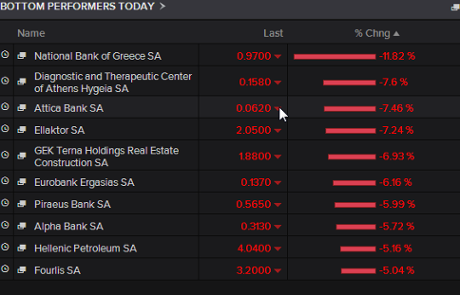
Greek shares have lost some of the ground they gained yesterday, with investors jittery about the potential fall-out from the eurogroup meeting later today.
Greek bank shares jumped 20% yesterday, but are down this morning. The banks are dragging the wider ATG in Athens down 3.8% to 795.17.
Updated
Major European stock markets dip
Other major European indices are mainly down (slightly) this morning, as uncertainty reigns over the outcome for Greece of this afternoon’s meeting of eurozone finance ministers.
- France’s CAC 40: -0.4% at 4,678.07
- Germany’s DAX 30: +0.1% at 10,763.87
- Spain’s IBEX: -0.4% at 10456.4
- Italy’s FTSE MIB: -0.3% 20,660.59
FTSE 100 opens down, led by Sky
Away from Greece for a moment, the FTSE 100 has opened slightly lower this morning, down 0.2% at 6,817.32.
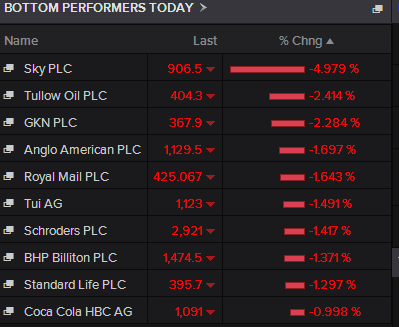
The index has been dragged down by Sky, which has fallen 5% in early trading to 906.5p. Investors are clearly unnerved by its record bid to win the rights to show Premier League football matches.
Sky will pay on average more than £10m per match, an increase of 70% on the current £6.5m. It retained the rights to 26 first-pick matches compared with 12 for BT and will also show Friday night football for the first time.
While Sky shares are down, BT shares are up 3% at 459p.
Updated

Greek prime minister Alexis Tsipras gave an empassioned speech at last night’s confidence vote.
He repeatedly talked about solidarity for Greece, as supporters of the country prepare to demonstrate tonight in cities around Europe, including in Germany, Italy and Portugal.
Next weekend there will be demonstrations in Edinburgh, London, Amsterdam and Brussels (among others).
In 1953, Europe chose to pursue understanding & solidarity not only for the sake of Germany, but also for the sake of the European "dream"
— Alexis Tsipras (@tsipras_eu) February 10, 2015
The solidarity shown to #Greece by the peoples of Europe is the European "dream" in practice. It is the future of #Europe
— Alexis Tsipras (@tsipras_eu) February 10, 2015
Updated
Crucial moment for Greek debt deal
Good morning, and welcome to our rolling coverage of the Greek debt crisis, and other events across the world economy, the financial markets and business.
It’s a huge day for Greece and the eurozone. The region’s finance ministers meet later today to attempt to find a way beyond the current impasse on a Greek debt deal. The extraordinary meeting of eurogroup ministers, held in Brussels, is likely to be a tense affair.
Yanis Varoufakis is expected to ask for a six-month bridging loan, to give Greece time to discuss a longer deal. He’ll push for lower budget surplus targets, and only implementing 70% of the austerity programme, plus new measures to reform the economy, address the humanitarian crisis and tackle tax avoidance.
Last night, prime minister Alexis Tsipras struck a defiant tone in a speech before winning a confidence vote in parliament. He insisted that the current bailout had been a failure, and vowed to get a new deal (as we covered in last night’s blog).
I want to assure the Greek ppl that our policies will be implemented in full & I'm optimistic that we'll find a compromise w/EU partners
— Alexis Tsipras (@tsipras_eu) February 10, 2015
We do not wish to burden European taxpayers in perpetuity w/new loans to #Greece. We're seeking logical solutions
— Alexis Tsipras (@tsipras_eu) February 10, 2015
An agreement that is in the mutual interest of #Greece and its lenders, that will end punitive conditions & destruction of the Greek economy
— Alexis Tsipras (@tsipras_eu) February 10, 2015
But Greece may not get a warm reception. Yesterday, German officials were adamant that Greece must present serious plans to meet its existing commitments.
The meeting in Brussels starts at 4.30pm GMT, or 6,30pm for readers in Greece.
Realistically, we’re not going to get a deal today - the best Athens can hope for is some progress before ministers meet again next Monday.
As Stan Shamu of IG explains:
At the moment, it seems European leaders and Greece are willing to meet each other in the middle and this has comforted investors’ concerns after the aggressive tone by Greek Prime Minister Tsipras over the weekend.
However, some key officials have attempted to pour water on suggestions a plan for Greece was close. This includes German Finance Minister Schaeuble who suggested there is little room for negotiation.
We will be bringing you all the build-up to the big event and live updates when the meeting gets underway.