Here’s our latest news story on today’s developments:
And that’s a good time to stop. We’ll be back tomorrow with another live blog, which will include developments from Greece and Portugal - where left-wing parties are expected to overturn the new centre-right government.
Thanks, and goodnight. GW
..and here's the statement.
The eurozone’s finance ministers have now issued a statement following today’s meeting.
It confirms that the Eurogroup called on the Greek authorities to finalise the financial sector measures, as well as the legislation agreed under the first set of milestones, in the course of the week.
Once that is done, Greece can unlock €2bn of aid funds, plus up to€10bn for the recapitalisation of the Greek banking sector.
#Eurogroup main results on #Greece: #economy #banking pic.twitter.com/a12U9uR0eC
— Manos Giakoumis (@ManosGiakoumis) November 9, 2015
One late development... Greece’s cabinet will meet on Tuesday at 10.30am (local time) at parliament, the prime minister’s office has announced.
That’s via the ANA newswire.
#Greece has until next Monday to agree on measures to unlock the disbursement of 2bn€ bailout funds and 10bn€ bank recap funds. #Eurogroup
— Jarno Hartikainen (@JarnoHa) November 9, 2015
Evening Summary: Greece gets a little more time
So, to recap...
At a eurogroup meeting in Brussels today, eurozone ministers decided that Athens has not done enough to qualify for its next aid tranche.
That money, including up to €10bn to recapitalise its banking sector, won’t be released until various outstanding measures have been taken.
In particular, the eurogroup insists that Greece must bring in new rules for banks to handle non-performing loans, such as bad mortgage debts.
Alexis Tsipras’s government wants to protect poorer citizens from losing their homes - but without new foreclosure rules, Greece’s creditors won’t hand over the funds to rebuild its banks.
Eurogroup president Jeroen Dijsselbloem told tonight’s press conference that Greece has made “a lot of progress” towards meeting the conditions of its third bailout, agreed this summer.
But:
The next thing to do is have all the financial sector measures in place before the completion of the recapitalisation process.
Our Greek colleague, Euclid Tsakalotos, gave his commitment that this will be done.
The eurogroup has thus given Greece until the end of the week to tackle these measures around household insolvency and non-performing loans, so that aid funds can be handed over early next week.
A Greek official has told Reuters that Athens is confident that these issues will be resolved in time, so that the bank recapitalisation funds, and €2bn of loans for Greece, can be disbursed.
But the delay has raised fears that Greece’s 3rd bailout, hammered out this summer, could hit problems if Athens continues to struggle to meet the terms of the deal.
With a 24-hour strike scheduled for Thursday, to protest against austerity, Greece’s government is coming under more pressure...
Updated
And that’s the end of the press conference - all over quite quickly.
1st time we have an Eurogroup on #Greece where the journalists have no needed to exhaust the time for questions t press conference #nodrama
— María Tejero Martín (@Maria_Tejero) November 9, 2015
I’ll pull together a summary now
Onto questions: Why is the eurozone refusing to compromise and protect more less wealthy Greeks from the new laws on foreclosures?
Pierre Moscovici explains that the Greek banking sector must take action on bad loans if it is to become healthy and credible.
He also suggests that some people are “strategic defaulters”, who have chosen to stop servicing their mortgages.
(reminder: Athens wants to protect more primary residences from being repossessed if mortgage holders can’t meet their repayments).
And Jeroen Dijsselbloem adds that the issues of non-performing loans, governance issues and bank recapitalisations are all linked.
In other words, Greek banks can’t have more money until they take a tougher line on bad debt, and are better managed.
Jeroen Dijsselbloem’s media team have tweeted that Greece has until the end of the week to meet the remaining milestones:
At presser#eurogroup: mandated EWG to reconvene not later than beginning next week to take stock regarding implementation #greece
— Jeroen Dijsselbloem (@J_Dijsselbloem) November 9, 2015
The #Eurogroup welcomes the commitment of the Greek authorities to fulfill the required measures in the course of the week. #Greece
— Jeroen Dijsselbloem (@J_Dijsselbloem) November 9, 2015
Klaus Regling, head of the ESM, speaks briefly - and confirms that Greece’s banking sector needs less fresh capital than previously feared.
That means the final bailout bill will probably be less than 86bn euros.
That’s good for Greece, and good for the ESM, he says.
Updated
Reuters: No bank recapitalisation cash until Greek reforms are done
Reuters has seen a statement from the eurogroup, which confirms that money will not be handed over to recapitalise Greece’s banks until Athens has hit all the milestones agreed with its creditors.
The statement also notes that Athens has pledged to meet the conditions this week.
In the document, the eurozone finance ministers say:
“We await the finalisation of all the measures in the first set of milestones and the financial sector measures which are essential for a successful recapitalisation process.”
Last month’s stress tests showed that Greek banks need less than 15 billion euros, less than feared.
The eurozone has 10bn euros lined up to recapitalise Greek banks.
EU commissioner Pierre Moscovici is also attending the press conference -- he says four-fifths of Greece’s milestones have been achieved.
.@pierremoscovici - We are 80% of the way there on #Greece milestones. @EEAthina
— Simon O'Connor (@socbxl) November 9, 2015
Unresolved issues include: governance of banks and household insolvency, #Eurogroup President says on #Greece. #economy
— Manos Giakoumis (@ManosGiakoumis) November 9, 2015
Reminder: you can watch the press conference here.
On other issues, Dijsselbloem declares that the recovery in the eurozone is continuing.
Dijsselbloem: Must get agreement with Greece by next week
Dijsselbloem begins by telling reporters in Brussels that “a lot of progress has been” achieved by Greece, in a very cooperative process.
He singles out the work towards recapitalising Greece’s banks, which is a key milestone in the bailout deal.
But more work is still needed before bailout funds are handed over.
And Dijsselbloem confirms that the eurozone working group will be asked to reconvene by next week at the latest, to assess if Greece has done enough to qualify for its first aid tranche.
Then the eurogroup finance ministers can assess the situation.
And then the ESM board of governance will decide how much money to unlock to recapitalise Greece’s banks.
(that’s the European Stability Mechanism; the region’s main bailout vehicle).
So for Greece, the clock is ticking (again). It must do more to satisfy its lenders before bailout funds are handed over.
Beyond the nice words, #Eurogroup gives #Greece 5 days to reach agreement with the Quadriga or else banks' recapitalization is in question.
— Yannis Koutsomitis (@YanniKouts) November 9, 2015
Updated
Eurogroup press conference begins
The press conference is getting underway now.
We’re about to hear whether Greece has been handed its next aid tranche (unlikely), along with what progress was made on those other areas such as Spain, monetary union, and the euro economy.
At start of presser, both @J_Dijsselbloem and @pierremoscovici grinning goofily. Not sure why. #eurogroup
— Peter Spiegel (@SpiegelPeter) November 9, 2015
Brussels is overwhelmed with press conferences tonight -- ministers are also discussing the refugee crisis in one room, and the problems of the steel industry in another one.
#EU press conference train crash! @EUCouncilPress announces #eurogroup presser imminent, but @eu2015lu still briefing on #refugeecrisis
— Peter Spiegel (@SpiegelPeter) November 9, 2015
So many problems to solve....
Updated
Sounds like the press conference is starting soon!
Eurogroup: Press conference in a few minutes (main press room), live on https://t.co/nnpAT4C9am
— Eleni Varvitsiotis (@Elbarbie) November 9, 2015
While we wait for tonight’s Eurogroup press conference, here are some photos from this afternoon’s meeting:


Kathimerini’s reporter in Brussels, Eleni Varvitsiotis, has details from the eurogroup meeting.
She’s heard that euro finance ministers will ask their deputies to resume talks with Greece over the remaining milestones needed before its bailout tranche can be paid.
#Eurogroup stands ready support disbursement to #Greece provided conditionality is met & has given mandate to EWG to reconvene by Fri 13/11
— Eleni Varvitsiotis (@Elbarbie) November 9, 2015
EWG is the Eurozone Working Group - one level below the eurogroup.
More from Greece:
HCMC to extent short selling ban on #Greece bank stocks by one month (via @euro2day_gr) #economy #banking #markets
— Manos Giakoumis (@ManosGiakoumis) November 9, 2015
European shares fall back
A downbeat start to the week for European markets was made worse once Wall Street opened and US shares began a rapid slide. Poor Chinese trade data set the tone early on, along with reports that Greece would not get its latest tranche of bailout funds at today’s Eurogroup meeting. To add to the gloomy mood, the OECD cut its global growth forecasts.
The prospect of a US rate rise in December, despite the continuing worries about a slowdown in global growth, sent American markets sharply lower and caused the falls in Europe to accelerate. The final scores showed:
- The FTSE 100 finished 58.67 points or 0.92% lower at 6295.16
- Germany’s Dax ended 1.57% down at 10,815.45
- France’s Cac closed 1.46% lower at 4911.17
- Italy’s FTSE MIB fell 1.88% to 22,107.30
- Spain’s Ibex ended 1.22% lower at 10,325.2
- In Greece, the Athens market added 0.89% to 683.49
On Wall Street, the Dow Jones Industrial Average is currently down 240 points or 1.33%.
Despite the differences between Greece and its creditors over foreclosures, MNI is reporting that the country could present updated proposals at the europgroup meeting. MNI reports:
The disagreements pushed [Greek prime minister Alexis] Tsipras to have a round of calls over the weekend with Germany’s Chancellor Angela Merkel, France’s President Francois Hollande and European Commission President Jean-Claude Juncker and asked them for a political solution on the issue.
A Greek government official told MNI that Tsipras found “sympathetic ears” and that an updated proposal from the Greek side would be presented during the Eurogroup meeting and could bring a deal.
The source added that Tsipras stressed that maintaining social cohesion in Greece right now is a top priority and that the poor must be protected at a time where the immigration problem is mounting and could strengthen further the fascist Golden Dawn party.
Elsewhere Fitch has cut its rating on Volkswagen from A to BBB+ with a negative outlook, in the wake of the emissions scandal. The ratings agency said:
The downgrade reflects the corporate governance, management and internal control issues highlighted by the ongoing emission test crisis related to up to 11 million diesel-powered vehicles.
Fitch already incorporated the group’s relatively weak corporate governance in its ratings but we believe that the emergence of a fraud of this magnitude, going either unnoticed or uncorrected by top management for so long is not consistent with a rating in the ‘A’ category. Volkswagen’s recent admission that it understated carbon dioxide emissions on 800,000 vehicles reinforces this view and highlights the fundamental issue of internal control failure within the group.
The full report is here:
Fitch Downgrades Volkswagen to ‘BBB+’; Outlook Negative
Here’s what finance ministers are due to discuss at today’s Eurogroup meeting, and it’s not just Greece on the agenda:
There will be an update from the single resolution board, which will be in charge of preparing and carrying out the resolution of any euro area bank in trouble from next January.
Then it’s Greece, and an update on the state of play (spoilers: they are behind schedule).
Ministers will also get an update on the economic situation in the eurozone from the European Commission and a briefing from the European Central Bank.
They will also discuss the results of the latest review mission to Spain which took place in early October.
On top of that, there will be talks about further steps toward economic and monetary union.
Wall Street opens lower
A fairly downbeat day for European markets has been echoed in early trading across the Atlantic.
On Wall Street the Dow Jones Industrial Average is currently down 126 points or 0.7%, following the poor trade data from China earlier and news that the OECD had cut its global growth forecasts. The prospect of higher US interest rates in December, following Friday’s stronger than expected non-farm payroll numbers, is also a factor.
In Europe, Germany’s Dax is down 0.28% while France’s Cac is 0.39% lower. On top of the global growth worries, investors are nervous as the Eurogroup meets, with Greece unlikely to have done enough yet to see the latest €2bn tranche of bailout funds released.
In the UK, the FTSE 100 is virtually flat, down just 0.12%.
Updated
A late lunchtime summary

Time for a quick recap.
Eurozone finance ministers have arrived in Brussels to discuss the state of the eurozone economy, and Greece’s bailout programme.
A string of ministers have warned that Greece’s next aid tranche, worth €2bn, will not be approved today. Despite measures taken in recent weeks, Athens has still not done enough to satisfy its lenders.
The main dispute centres on new laws to help banks repossess homes from people who can’t pay their mortgage. The Greek government is still pushing for more first homes to be exempt, but creditors have been sticking to the deal agreed in July.
European commissioner Pierre Moscovici is hopeful that a compromise can be reached later this week, to unlock the funds.
Greece’s economy minister, George Stathakis, has warned that a ‘political decision’ will be needed; that suggests Athens is hoping that its lenders soften their demands.
But despite these problems, Athens is reportedly planning to return to the financial markets next summer.
Analysts are concerned that the Greek situation is heating up again, although we’re a long way from a full-blown Grexit crisis.
#Tsipras & creditors clash over foreclosures as #Eurogroup meets. Lingering sense of deja-vu but we're far away from #Greece crisis climax.
— Maxime Sbaihi (@MxSba) November 9, 2015
The Eurozone is also facing new upheaval in Portugal. Shares and government bond prices have been hit, as socialist parties prepare to take power.
And the OECD has cut its forecasts for global growth. It warned that global trade has weakened sharply in recent months.
Slovakia’s finance minister, Peter Kažimír, was one of Greece’s more vocal critics last summer.
He sounds slightly more upbeat today, pointing out that last month’s stress tests showed Greek banks weren’t in as bad shape as feared.....
Recently we had some positive news coming from #Greece – I mean the banks’ stress tests results #eurozone #Eurogroup
— Peter Kažimír (@KazimirPeter) November 9, 2015
....before pointing out that Greece is already lagging behind.
However, we are, yet again, a bit behind the schedule #eurozone #Greece
— Peter Kažimír (@KazimirPeter) November 9, 2015
Which means no bailout cash today:
There are still issues holding up release of the 2 billion euro tranche and the review itself #Greece #eurozone #EU
— Peter Kažimír (@KazimirPeter) November 9, 2015
Schaeuble says conditions aren't "such that we can reach an agreement" today on #Greece. Ah, I miss these #Eurogroup meetings. Noooooooot.
— Maxime Sbaihi (@MxSba) November 9, 2015
Valdis Dombrovskis, the EC vice-president in charge of the euro, is speaking to reporters outside the meeting.
He says he visited Athens two weeks ago, and saw that the Greek government is committed to implementing its bailout programme.
But having said that there are still several issues outstanding, he adds.
Wolfgang Schauble also flagged up that Greece has not yet implemented its new privatisation fund.
This was a key part of July’s bailout deal, under which €50bn of Greek assets will be sold off to cover the cost of recapitalising its banking sector.
FinMin #Schäuble bei #Eurogroup über #Griechenland: "Großteil der Reformen noch nicht erfüllt".Plan für Privatisierungsfonds liegt nicht vor
— Dirk Hoeren (@DirkHoeren) November 9, 2015
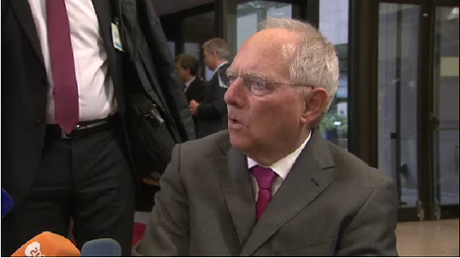
Germany’s Wolfgang Schäuble has arrived at the meeting.
He sounds fairly relaxed as he speaks to reporters.
Schäuble says that Greece has not yet taken all the required steps to qualify for its next aid tranche (according to his knowledge anyway).
Laconic Schäuble over #Greece: "I don't think we can have an agreement today but we'll hear what the Institutions have to say".
— Yannis Koutsomitis (@YanniKouts) November 9, 2015
Here’s the key quote from Eurogroup chief Dijsselbloem, confirming that Greece won’t get its €2bn today:
“The 2 billion will only be paid out once the institutions give the green light and say that all agreed actions have been carried out and have been implemented. That still has not happened.”
Some reaction to Jeroen Dijsselbloem’s comments as he arrived at the eurogroup meeting:
Dijsselbloem used the word 'optimistic'!!
— Danny Kemp (@dannyctkemp) November 9, 2015
Dijsselbloem did not sound negative on #Greece and did not mention foreclosures specifically. (smart)
— Yannis Koutsomitis (@YanniKouts) November 9, 2015
Dijsselbloem: Greece must complete first milestones very soon
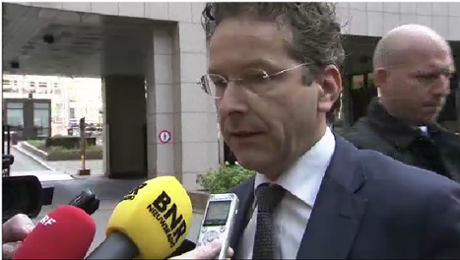
An official limo has just deposited Eurogroup president Jeroen Dijsselbloem at today’s meeting.
He gave a brief ‘doorstep’ to reporters -- it sounds like he’s not expecting to sign off Greece’s next aid tranche today.
Eurogroup's Dijsselbloem: Does not see Greek disbursement today
— Live Squawk (@livesquawk) November 9, 2015
Dijsselbloem says progress has been made in recent weeks regarding Greece’s banks and reform programmes.
But there are still open issues, and a lot more work needs to be done in the next two weeks.
The first set of milestones must be completed soon, he adds (which would pave the way to disbursing that €2bn in new loans).
'time is limited, we need to finish the 1st set of milestones as soon as possible' says #Eurogroup @J_Dijsselbloem for #Greece
— Efi Koutsokosta (@Efkouts) November 9, 2015
And Dijsselbloem says he can’t speculate about the political crisis in Portugal where left-wing parties could soon win power.
My understanding is there will be debate today and tomorrow, says Dijsselbloem. There is always a legitimate government in each country, and that’s the government we work with....
Updated
Moscovici: Still a little way to go on Greece
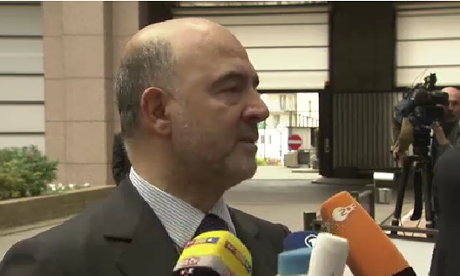
Ministers are starting to arrive at today’s Eurogroup meeting in Brussels.
Commissioner Pierre Moscovici has told reporters gathered outside that he hopes Greece will receive its €2bn aid tranche this week, if not today.
Moscovici says he had “very positive, very fruitful meetings” in Athens last week with prime minister Alexis Tsipras and finance minister Euclid Tsakalotos.
The moves are positive. Most of the milestones are already adopted or decided. There is still a way to go.
We are not yet completely there, but I am hopeful and confident that with the spirit of compromise, with good co-operation with the authorities we can make it... if not today then in the days to come.
We are not far from that, but obviously there is a little way to go.
Moscovici then vanished inside, where he (or his team) tweeted this optimistic message too:
I'll update #Eurogroup on the state of play on #Greece. Dynamic remains positive. Agreement can be reached in the coming days @EU_Commission
— Pierre Moscovici (@pierremoscovici) November 9, 2015
Shares are falling sharply on the Lisbon stock market, as investors react to the latest political upheaval in Portugal.
The main stock index, the PSI 20, has shed more than 2%, as the country’s socialist parties prepare to oust the centre-right administration sworn in two weeks ago.
Portuguese sovereign bonds are also continuing to fall, showing greater anxiety over the prospect of an anti-austerity government taking over.
The 10-year Portuguese bond is now yielding nearly 2.9%, a jump of 23 basis points. That’s a four-month high.
Over the weekend, four left-wing parties put aside their differences to support a legislative programme. They collectively hold a majority of seats in the parliament, following October’s election.
Analysts at the Royal Bank of Scotland Group have already warned that the Socialist-led program “is clearly less market-friendly than the one of the incumbent government,” Bloomberg flags up.
More here:
Tired of following #Greece? Here you go: #Portugal's Socialists forge alliance to oust govt & reverse spending cuts. https://t.co/TJPuVYgW5E
— Alessandro Leipold (@ALeipold) November 9, 2015
Updated
Greece "plans return to capital markets" in 2016
Now here’s a thing. Greece is apparently hoping to return to the financial markets next year.
Government insiders have told the Financial Times that plans are afoot to sell debt in the capital markets in 2016.
Despite the wild drama this year (capital controls, failing to repay the IMF, nearly leaving the eurozone), Athens hopes that investors will put their faith in them.
The FT says:
It won’t be in the first quarter but summer has been talked about,” said a person familiar with the situation.
“It depends on a positive chain reaction of events but discussions have been held.”
Full story: Greece plans a return to capital markets
Experienced City investors may raise their eyebrows....
Jesus wept. Will people never learn? RT @FGoria: Greece plans a return to capital markets https://t.co/JwrHe9tSFO
— Burnett Tabrum (@BTabrum) November 9, 2015
On the other hand, Greece hasn’t actually defaulted on the three-year debt it issued last summer:
If you held 2017 bond since issue in July 2014, seems you've had a 6%ish return. Plus several heart attacks https://t.co/eJRU8CDgKy
— Joseph Cotterill (@jsphctrl) November 9, 2015
Updated
European Commissioner president Jean-Claude Juncker has just welcomed eurogroup president Jeroen Dijsselbloem to his office, for talks ahead of this afternoon’s meeting of finance chiefs.
Dijsselbloem got the tradition greeting:
They're baaack #Junckerkiss #Dijsselbloem #Greece pic.twitter.com/Z8vKmdpjU0
— Danny Kemp (@dannyctkemp) November 9, 2015
Analyst: Greek crisis is repeating
Peter Rosenstreich, head of market strategy at Swissquote Bank, says investors need to pay attention to Greece again:
Rosenstreich is worried that Athens and its eurozone neighbours couldn’t reach agreement on how to handle the repossession of houses from people who are in default on their mortgages.
It suggests the whole third bailout deal, agreed after so much angst in July, may be in early trouble.
Rosenstreich says:
Left-wing Syriza is concerned that the high threshold will expose too many Greece citizens to the loss of their primary properties. In addition, Athens is balking at a 23% take rate on private schools.
This feels like a repeat of 8-months ago. The whole world understood that the third bailout agreement made was unsustainable. It was only a matter of time before it unraveled.
Getting back to Greece...
AFP’s man in Brussels, Danny Kemp, has heard that the outstanding issues between Greece ands its creditors *might* be resolved in a few days.
No Greek bailout payment today but approval likely* at Euro Working Group level this week, sources saying. *conditions apply
— Danny Kemp (@dannyctkemp) November 9, 2015
The OECD has also cut its forecast for global growth this year to 2.9%, down from 3%, due to the sharp slide in trade.
It also predicts growth of 3.3% in 2016, down from 3.6% previously.
OECD cuts global growth forecast (again) to 2.9% on unusually weak global trade. https://t.co/ZkB1PJU71x pic.twitter.com/9WPA4DitFF
— Holger Zschaepitz (@Schuldensuehner) November 9, 2015
OECD cuts global growth f'cast to 2.9 for 2015, 3.3% for 2016, from 3.0 and 3.6 in Sept. Sept (left) and Nov tables pic.twitter.com/6aHTtIfch0
— Katie Allen (@KatieAllenGdn) November 9, 2015
The two demonstrators who disrupted David Cameron’s speech have revealed they created a fictitious company to get into the CBI’s flagship event:
Student protesters who heckled David Cameron boast it was 'easy' to get into #CBI by setting up fake company pic.twitter.com/QBo3MNhb2h
— Michael Wilkinson (@ThatMichaelW) November 9, 2015
Exclusive Interview with the students who interrupted Cameron coming soon on Sky. They got CBI accreditation by setting up a fake company.
— Jason Farrell (@JasonFarrellSky) November 9, 2015
Perhaps the CBI should get some advice from the European Central Bank, which upgraded its own security systems after a protester jumped on Mario Draghi’s desk this year...
The OECD’s latest economic outlook is online here.
All the new OECD material here: https://t.co/1PqBGuK9g6 with a link to previous forecasts too: https://t.co/pt2SlaJpoW
— Katie Allen (@KatieAllenGdn) November 9, 2015
OECD sounds alarm over global trade
The OECD has just released its latest economic projections.
And the Paris-based thinktank has warned that global growth is threatened by the impact of China’s slowdown on world trade, but raised its forecast for US growth.
It also urged richer countries to step up investment while keeping monetary policy loose, as my colleague Katie Allen explains.
The thinktank’s twice-yearly outlook highlights risks from emerging markets and weak trade.
Presenting the Outlook in Paris, OECD Secretary-General Angel Gurría said:
“The slowdown in global trade and the continuing weakness in investment are deeply concerning. Robust trade and investment and stronger global growth should go hand in hand.”
OECD worried abt trade: "Growth rates of global trade observed so far in 2015 have, in the past, been associated with global recession."
— Katie Allen (@KatieAllenGdn) November 9, 2015
The thinktank edged up its forecast for economic growth in the group of 34 OECD countries this year to 2.0% from 1.9% in June’s outlook, when it had noted a sharp dip in US growth at the opening of 2015. For 2016, it has cut the forecast for OECD countries’ growth to 2.2% from 2.5%.
The OECD left its forecasts for the UK little changed with growth of 2.4% this year and next, compared with a forecast for 2016 growth of 2.3% made in June. The US economy, the world’s biggest, is now seen growing 2.4% this year and 2.5% in 2016, compared with June’s forecasts of 2.0% and 2.8%.
On the UK, the OECD said economic growth was projected to “continue at a robust pace over the coming two years, driven by domestic demand.”
New OECD fcasts vs June f'casts: UK little changed, US stronger this yr, weaker next, OECD countries weakr in 2016 pic.twitter.com/5uhYH67HJ7
— Katie Allen (@KatieAllenGdn) November 9, 2015
Updated
Greece’s economy minister, George Stathakis, has suggested that eurozone governments might have to take a ‘political decision’ on whether Greece should get its €2bn aid tranche.
Stathakis told Real FM radio that talks with officials over how to enforce foreclosure laws have run their course:
The thorny issue is the distance that separates us on the issue of protecting primary residences.
“I think the negotiations we conducted with the institutions has closed its cycle .. so it’s a political decision which must be taken.
Updated
WSJ: Eurozone won't release Greek loan today
Two eurozone officials have told the Wall Street Journal that there’s no chance that Greece will get its €2bn bailout loan at today’s eurogroup meeting.
That won’t please Michel Sapin, given his optimistic comments earlier. But it appears that Greece simply hasn’t done enough to satisfy lenders....
...in particular, over how to treat householders who can’t repay their mortgages. Athens and its creditors are still divided over which householders should be protected from foreclosure.
The WSJ’s Gabriele Steinhauser and Viktoria Dendrinou explains:
Senior officials from the currency union’s finance ministries were updated on Greece’s implementation of around 50 promised overhauls, known as milestones, during a conference call Sunday afternoon. While progress has been made on some issues—including measures to substitute a tax on private education, the governance of the country’s bailed-out banks and the treatment of overdue loans—Athens and its creditors will need more time to sign off on all overhauls, the officials said.
Greece needs the fresh loans to pay salaries and bills and settle domestic arrears. However, the government faces no immediate major payments to its international creditors, reducing the sense of urgency.
There will be “no agreement on [the] €2 billion,” one official said.
It'll b 1 exciting #Eurogroup 2day:Eurozone finance ministers won’t release EUR2 billion loan to Greece https://t.co/eVNiGgPmxh @v_dendrinou
— Gabriele Steinhauser (@gksteinhauser) November 9, 2015
Updated
Drama at the CBI conference!
David Cameron’s speech has been briefly disrupted by protesters, chanting that the CBI is the “voice of Brussels”.
They’re clearly unhappy that Britain’s top business group is firmly in favour of EU membership:
'CBI - voice of Brussels' say protestors who stand up in middle of audience interrupting PM speech pic.twitter.com/2z14QuqIxz
— Chris Ship (@chrisshipitv) November 9, 2015
hecklers from anti-EU group hold up and interrupt PM's CbI speech saying "CBI voice of Brussels"... PM says "c'mon ask a question"
— Faisal Islam (@faisalislam) November 9, 2015
Cameron handles it pretty well - suggesting they ask him a question rather than looking foolish.
Updated
Another important meeting is taking place in Brussels today.
UK business secretary Sajid Javid will discuss the crisis in Britain’s steel works with EU economy and industry ministers this afternoon.
Steel unions have urged Javid to demand a clampdown on cheap steel imports from China, which they blame for triggering thousands of job cuts across the UK steel industry:
Cameron at the CBI
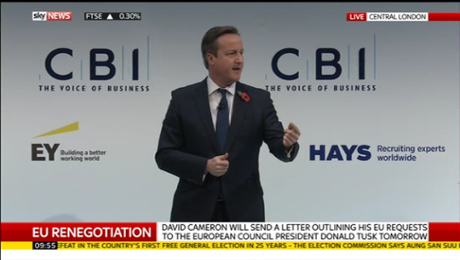
David Cameron is telling the CBI that he’s met business concerns, by cutting red tape and corporate taxes.
On infrastructure, he says the government has made progress - citing the planned HS2 railway - but admits there’s more to do.
We want to the most business friendly, enterprise friendly, government in the world, he adds. But the PM also acknowledges that Britain must do better on exports.
And he’s now outlining a new plan to give everyone guaranteed access to broadband, by 2020.
My colleague Andrew Sparrow is covering all the key points in his politics liveblog:
Heads-up: prime minister David Cameron is addressing the CBI’s annual conference in London. There’s a live feed here.
He’s expected to warn that he could consider campaigning to leave the EU, if his attempts to reform Britain’s relationship with Brussels is met with a ‘deaf ear’.
WATCH LIVE: David Cameron to address CBI's annual conference in London https://t.co/86ZSKJl3sP pic.twitter.com/N5JyP75apH
— Bloomberg TV (@BloombergTV) November 9, 2015
Updated
The prospect of yet another tussle over Greece’s bailout programme is casting a pall over Europe’s stock markets this morning.
The main indices are mainly in the red, as investors prepare to hear the dreaded phrase ‘eurogroup deadlock’ again.
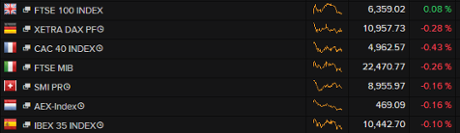
Conner Campbell of SpreadEx says that Greece’s “sluggish progress” over implementing foreclosure rules is an unwelcome reminder of the eurozone’s lingering issues.
The country’s next €2 billion tranche, which should be signed off at today’s Eurogroup meeting, is currently being withheld by Greece’s creditors, who are dissatisfied with the way the region’s hot potato has (or hasn’t) implemented the required reforms.
It’ Déjà vu all over again, as China’s stock market is pushed up by stimulus hopes, and Greece’s bailout hits a snag.
Shanghai Comp continues its recent positive trend and the Eurogroup are meeting to discuss Greece - welcome to 8 months ago
— RANsquawk (@RANsquawk) November 9, 2015
Open Europe analyst Raoul Ruparel points out that today’s dispute is small potatoes, compared to the big challenge of cutting Greece’s debt pile.
Sigh. And all this before we even get into discussions on debt relief which are infinitely harder https://t.co/GdJk3cJMg6
— Raoul Ruparel (@RaoulRuparel) November 9, 2015
Greece is also clashing with its creditors over plans to hike the tax rate for private education, as the Telegraph’s Mehreen Khan explains:
Greeks already stumbling at first hurdle. No bail-out cash today - here's why https://t.co/d3kSbwPSNm pic.twitter.com/Dlyr9GdD9S
— Mehreen (@MehreenKhn) November 9, 2015
That’s a slightly unusual issue for a hard-left party to go to the barricades over, when it needs agreement with its lenders to unlock the big prize of debt relief.
Updated
France: We want a Greek deal today

France is playing its traditional role as Greece’s ally, ahead of today’s meeting of eurozone finance chiefs.
French finance minister Michel Sapin has told reporters in Paris that he hopes an agreement can be reached today over the main outstanding hurdle -- how to handle bad loans at Greek banks (as explained earlier).
Sapin offered Athens his support, saying:
Greece is making considerable efforts. They are scrupulously respecting the July agreement.
One thorny issue remains: the seizure of homes for households who can’t pay their debts. I want an agreement to be reached today. France wants an agreement today.
(thanks to Reuters for the quotes)
France Finmin Sapin: Greece has made "considerable efforts." Wants deal at Eurogroup meeting today.
— MNI Eurozone (@MNIEurozone) November 9, 2015
Updated
Greek journalist Nick Malkoutzis of Kathimerini tweets that the gloss is coming off Alexis Tsipras’s new administration:
No tranche for #Greece at today's Eurogroup. This govt's limitations are already starting to show at home & abroad https://t.co/ZSczaXn9ii
— Nick Malkoutzis (@NickMalkoutzis) November 9, 2015
Portuguese bond yields jump as leftists prepare for power
The prospect of a new anti-austerity government taking power in Portugal is hitting its government debt this morning.
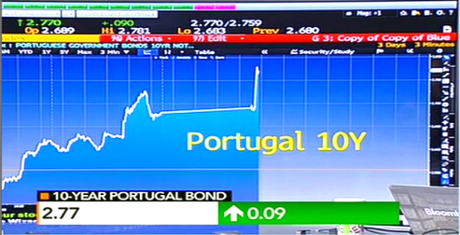
The yield (or interest rate) on 10-year Portuguese bonds has risen from 2.67% to 2.77%, a ten-week high.
That’s not a major move, but a sign that investors are anxious about events in Lisbon.
Updated
This new dispute over Greece’s bailout comes three days before unions hold a general strike that could bring Athens to a standstill.
The main public and private sector unions have both called 24-hour walkouts for Thursday, to protest against the pension cuts and tax rises contained in its third bailout deal.
ADEDY, the civil servants union, accused the government of taking over “the role of redistributing poverty”.
Just six week after winning re-election, Alexis Tsipras is facing quite a wave of discontent....
Dow Jones: Ministers won't release Greek aid today
The Dow Jones newswire is reporting that eurozone finance ministers definitely won’t agree to release Greece’s next aid tranche at today’s meeting, due to the lack of progress over its bailout measures:
Updated
#Eurozone Finance Ministers Won't Release €2bn Loans Slice for #Greece at Monday #Eurogroup Meeting ~Officials via DJ
— Yannis Koutsomitis (@YanniKouts) November 9, 2015
Updated
Greek officials have already warned that the argument over legislation covering bad loans won’t be resolved easily.
One told Reuters that:
There is a distance with lenders on that [foreclosure] issue, and I don’t think that we will have an agreement soon.
Prime minister Alexis Tsipras discussed the issue with Commission chief Jean-Claude Juncker yesterday.
The official added that those talks were a step towards resolving the issue at “a political level”; Greek-speak for a compromise hammered out between leaders, rather than lowly negotiators.
Updated
Greek debt talks hit by foreclosure row

After a couple of quiet months, Greece’s debt crisis has loomed back into the spotlight today.
A new dispute between Athens and her creditors is holding up the disbursement of Greece’s next aid tranche, worth €2bn.
Athens spent last weekend in a fevered attempt to persuade its creditors that it has met the terms agreed last summer, to qualify for the much-needed cash.
But it appears that lenders aren’t convinced, meaning that the payment won’t be signed off when eurogroup ministers meet in Brussels at 2pm today for a Eurogroup meeting.
The two sides are still arguing over new laws to repossess houses from people who are deep in arrears on their mortgage payments.
Athens is trying to dilute the terms agreed in July’s bailout deal, but eurozone creditors are sticking to their guns. They insist that Greek residences valued above €120,000 should be covered by the foreclosure laws, down from the current level of €200,000.
The Kathimerini newspaper explains:
The key stumbling block is primary residence foreclosures.
Greece has put forward stricter criteria that protects 60 percent of homeowners, while suggesting that this is then gradually reduced over the next years.
With a deal unlikely today, officials are now racing to get an agreement within 48 hours or so:
Greece told to break bailout deadlock by Wednesday
And Greece certainly needs the money, to settle overdue payments owed to hundreds of government suppliers who have been squeezed badly this year.
Updated
The Agenda: Markets see Fed hike looming
Good morning, and welcome to our rolling coverage of the world economy, the financial markets, the eurozone and business.
Across the globe, investors are finally facing the prospect that the long run of record low interest rates is ending, at least in America.
There’s now a 70% chance that the US Federal Reserve hikes borrowing costs in next month’s meeting, according to this morning’s data.
Market now thinks there is a 70% chance of a Fed hike in December pic.twitter.com/8IXekYTzAa
— Guy Johnson (@GuyJohnsonTV) November 9, 2015
This follows Friday’s strong US jobs report, which show 271,000 new positions created last month. With earnings rising too, Fed doves will probably be tempted to finally press the rate hike button at December’s meeting.
That is pushing up the dollar this morning, and weakening the euro. That will please the European Central Bank, as it ponders whether to launch its own new stimulus measures.
European stock markets are expected to inch higher at the open:
Our European opening calls: $FTSE 6368 up 14 $DAX 11037 up 49 $CAC 5009 up 25 $IBEX 10480 up 27 $MIB 22613 up 83
— IGSquawk (@IGSquawk) November 9, 2015
Also coming up....
- The OECD will issue new economic forecasts at 10.30am GMT.
- Britain’s business leaders are gathering in London for the CBI’s latest conference. The event is dominated by the UK’s “Brexit” referendum, and claims that the CBI is too pro-EU.
- Eurozone finance ministers are holding a eurogroup meeting in Brussels this afternoon.
And there is fresh drama in the eurozone.
In Portugal, three left-wing parties have agreed to work together in a new “anti-austerity government”.
That will bring down minority administration created by Pedro Passos Coelho two weeks ago, after October’s inconclusive election.
Portuguese Socialist party to vote to oust minority government https://t.co/fq5G0nYDLP
— The Guardian (@guardian) November 9, 2015
And with Greece struggling to implement its own austerity measures, Europe’s problems are pushing up the agenda again.
We’ll be covering all the main events through the day....
Updated