Closing summary
Time to recap the main points, now the debate has finally wound up.
A defiant Alexis Tsipras has vowed to win an honourable compromise from Greece’s lenders, after negotiations over economic reforms dragged on without a deal.
Greece’s PM told parliament tonight that:
“It is true that we are seeking an honest compromise with our lenders but don’t expect an unconditional agreement from us,”
Tsipras vowed to stop ‘the bleeding’ in Greece, and repeatedly argued that the country needs a new debt restructuring deal. Greece has a simple choice, he argued, between surrendering, or changing the policies that have caused such economic misery.
He pledged to end the ‘pillaging’ of the middle classes, and revealed that a new clampdown on unpaid taxes had already delivered 100 million euros.
Tsipras also ruled out raising sales taxes on food and medicine, or shaking up the labour market, as these “red line” measures could plunge Greece back into recession.
#Greece PM Tsipras say he can't agree to recessionary measures, liberalization of labor law, raise of VAT in food & medicine.
— Yannis Koutsomitis (@YanniKouts) March 30, 2015
Greek PM Tsipras: Red Lines Are Pension, Wage Cuts & Austerity
— Live Squawk (@livesquawk) March 30, 2015
Here's word cloud of Tsipras' speech Live debate continues at http://t.co/roQpDQijKi #Greece pic.twitter.com/q9WYro9yKN
— Derek Gatopoulos (@dgatopoulos) March 30, 2015
Tsipras called on the centre-right opposition party, New Democracy, to back him in negotiations with the ECB, IMF and EC. He also offered the prospect of a new deal, centered around growth, this summer.
- GREEK PM TSIPRAS SAYS THIRD BAILOUT WILL NOT BE UNDER DISCUSSION IN JUNE
- GREEK PM TSIPRAS SAYS LENDERS HAVE COMMITTED TO START DEBT RELIEF TALKS IN JUNE
But he did not give many firm details on the reform plans which creditors demand from Greece before unlocking any bailout payments.
Few specifics in parliament but PM tweet's time to stop "plundering the middle class and wage earners" #Greece pic.twitter.com/P9ou8GUBg5
— Derek Gatopoulos (@dgatopoulos) March 30, 2015
Tsipras was criticised by opposition leaders, including ND’s Antonis Samaras, for provoking fights in Europe, and for creating deadlock by failing to deliver a credible reform plan.
Samaras also claimed that Tsipras’s party, Syriza, is badly split over his reform plans.
Tonight’s debate came after Greece and its creditors held more meetings over the list of economic reforms which Athens must provide, before bailout funds are unlocked.
Back tomorrow (or later today, if you’re still awake in Greece) for another crack at it all. Goodnight, and thanks for reading and commenting. GW
Updated
Tsipras ends debate with call for support
Greece’s embattled prime minister Alexis Tsipras has ended tonight’s raucous parliamentary debate with a vow to act on his far left party’s pre-election pledges.
And that will start with the reinstatement of collective work agreements, reports Helena Smith.
Red lines, says Tsipras, have to be respected.
“I asked representatives of opposition parties to support us because what we want are red lines not of every party but the country,” he tells the 300-seat House.
And what a long debate it has been:
#Greece Parliament debate was supposed to last 70 minutes and lasted 250 minutes.
— Yannis Koutsomitis (@YanniKouts) March 30, 2015
Updated
More thoughts from Helena:
#Greece most striking of all about 2night's parliamentary debate are the empty seats in the 300-seat House
— Helena Smith (@HelenaSmithGDN) March 30, 2015
Is #ZoeKonstantopoulou, president of the Greek parliament, stickler for detail par excellence, the real winner of 2night's debate?
— Helena Smith (@HelenaSmithGDN) March 30, 2015
#Greece PM #AlexisTsipras tells parliament 2night "we are really conducting critical negotiations with our partners"
— Helena Smith (@HelenaSmithGDN) March 30, 2015
Tonight’s debate has been quite tetchy, with two opposition leaders clashing with speaker Zoe Konstantopoulou.
Pasok’s Evangelos Venizelos chastised Konstantopoulou for being “rude” and said “I don’t mind if you ring the bell all the time”.
It’s her bell, Benny!
A row then broke out with New Democracy’s leader, Antonis Samaras.....
#now #nasty fight between #Samaras and #speaker konstantopoulou. Mikes shut down! Now back on. Everyone shouting. Some squeal. #parliament
— Ilias Siakantaris (@iliassiak) March 30, 2015
Guardian: Greek crisis needs realism and compromise
Hot off the press, tomorrow’s edition of the Guardian argues that Greece and its creditors need to meet halfway to avoid the crisis
Here’s a flavour:
If Greece dropped out of the eurozone, in an accidental “Grexit”, the consequences would be far-reaching. Not only would it damage the EU’s monetary union, the EU itself would be weakened geopolitically. Mr Tsipras must show he has the credentials to be a realistic partner.
But, equally, Greece’s lenders must walk a fine line to prevent a breakup of the European project. Just as importantly for the EU’s democratic credibility, there must be room for negotiation. In Greece as in any country, it is never a good thing when voters’ choices end up being ignored.
Our Athens correspondent Helena Smith reports:
Golden Dawn leader Nikolaos Michaloliakos has addressed parliament, fresh from prison and speaking with the moral upper hand (barely a month before the far-right group’s leadership goes on trial for using the group as a political front to run a criminal organisation).
Michaloliakos is making much of the fact that some MPs have been gagged because they have been behind bars and unable to protest against the “enslaving memorandum.” He is now railing against the proposed reforms as leaked by Bloomberg today.
The far-right leader says:
“Golden Dawn is opposed to every privatisation of sectors of our economy which are linked to our national independence.”
Photos: Tonight's debate


Ex vice pm #EvangelosVenizelos in his element tonight as parliament debates what essentially is fate of #Greece
— Helena Smith (@HelenaSmithGDN) March 30, 2015
Alexis Tsipras has the floor again. He’s telling parliament that Greece will seek a new contract for growth when its existing bailout expires this summer, not another memorandum laden with austerity.
He also repeats his earlier point, that Greece needs a debt restructuring deal:
#Greece PM Tsipras: Νο country with debt 180%/GDP can raise finance from the markets. | ← Wrong. Japan has bigger debt & super low rates.
— Yannis Koutsomitis (@YanniKouts) March 30, 2015
Back in Athens, Greece’s former deputy PM has been lecturing the current government about its predicament:
Evangelos Venizelos argued that there was no way out of repaying Greece’s commitments:
PASOK's Venizelos says debate helps SYRIZA realise how much of a dead-end it's in, stresses loss of €11bln in bank recap funds #Greece
— MacroPolis (@MacroPolis_gr) March 30, 2015
#Greece Venizelos (Pasok): There is no way out, everything is going to be paid and those who must pay, will pay
— Efthimia Efthimiou (@EfiEfthimiou) March 30, 2015
Greece’s debt deadlock didn’t prevent the US stock market rebounding, with Wall Street closing 1% higher tonight.
Stocks surge to close higher by 1%; Dow up over 260 points. http://t.co/YzZN1gdgVo pic.twitter.com/VKsxkOYbG9
— CNBC (@CNBC) March 30, 2015
Tsipras doesn’t get any cheer from the communist KKE party,; their leader blasts him for agreeing to extend the current bailout programme until the end of June.
#Greece Koutsoumpas (KKE leader): Syriza didn’t cancel MoUs as had promised, they even extended current MoU
— Efthimia Efthimiou (@EfiEfthimiou) March 30, 2015
Potami party leader Stavros Theodorakis has offered Tsipras some support, saying his party will back him over restructuring Greece’s debt mountain.
But Potami continue to support Greece’s bailout programme; Theodorakis argues that agreed measures should generally be implemented.
#Greece Theodorakis (Potami): We will support you on your fights about the debt. We always suggested a debt restructuring
— Efthimia Efthimiou (@EfiEfthimiou) March 30, 2015
#theodorakis says his party believes agreements must be honoured for the sake of continuity unless there is an issue of corruption
— Diane Shugart (@dianalizia) March 30, 2015
Next up ........ the leader of Greece’s extremist, neo-Nazi party, Golden Dawn.
It’s Nikos Mihaloliakos’s first contribution in parliament since he was released from custody a week ago, after 18 months detention (the maximum allowed under Greek law). He is due to stand trial next month on charges of participating in and directing a criminal organization.
Golden Dawn leader Michaloliakos speaks in parliament in first main appearance since prison release #Greece pic.twitter.com/0FZS97VV42
— Derek Gatopoulos (@dgatopoulos) March 30, 2015
No need to summarise Samaras’s speech - Diane has done it for us <tips hat>
samaras had only 2 points--one, we'll support you if you follow our policies and, two, tsipras's problems are his opposition w/in syriza
— Diane Shugart (@dianalizia) March 30, 2015
Antonis Samaras also tried to prise open the fractures within the Syriza party, saying is is divided over the route forward.
#Greece ND Samaras: "LOOK at your party, Mr. Tsipras, they do NOT even want us to help where we can."
— The Greek Analyst (@GreekAnalyst) March 30, 2015
Samaras has urged the Greek government to meet the 450m euro repayment owed to the IMF on April 9th. Failure to do so would be extremely serious, he warns.....
#Greece | ND's Samaras: Don't even think abt not paying back the IMF. It wld constitute a credit event & would be the 1st step toward Grexit
— Yannis Koutsomitis (@YanniKouts) March 30, 2015
Samaras is piling into Tsipras with some tasty one-liners.
Samaras says Tsipras imagined he'd get money without terms but ended up getting terms without money #Greece
— MacroPolis (@MacroPolis_gr) March 30, 2015
samaras: when i was abroad i liked making friends for greece. you like making enemies, sometimes artificially.
— Diane Shugart (@dianalizia) March 30, 2015
All good knock-about stuff, but we’re not getting much actual progress on Greece’s problems.....
Samaras says his party are prepared to offer Tsipras support, but only on measures that they would choose to implement themselves.
And he criticises the PM for demanding support, without revealing exactly what his reform plans will be.
ND's Samaras tells Greek govt: 'We will support you, but not on anything. If you push the country back to recession and deficits, we won’t'
— Kathimerini English (@ekathimerini) March 30, 2015
Antonis Samaras responds
Former prime minister Antonis Samaras is now responding to Alexis Tsipras.
Samaras defends his own track record, saying Greece was on course to exit its bailout under his leadership.
Samaras responds to Tsipras by stressing his gov't also adopted policies not in MoU, such as handing out part of primary surplus #Greece
— MacroPolis (@MacroPolis_gr) March 30, 2015
#Samaras to #Tsipras : As you keep going with the virtual negotiation, the bill will keep increasing.
— EfiKoutsokosta (@Efkouts) March 30, 2015
He also criticises Tsipras for still failing to allow MPs to debate the bailout extension agreed in February, or even to tell parliament exactly what was agreed then.
samaras: if you wanted people to know what is happening, you would've brought the bailout extension to parliamnet.
— Diane Shugart (@dianalizia) March 30, 2015
Here’s some instant reaction to Tsipras’s address to parliament:
Those hoping @atsipras would seek to broaden support to @pasok & @ToPotami likely to be disappointed in speech mainly attacking opposition
— Peter Spiegel (@SpiegelPeter) March 30, 2015
#Greece PM Tsipras ends speech. No attacks on creditors. That's a first.
— Yannis Koutsomitis (@YanniKouts) March 30, 2015
#Greece PM Tsipras ended his speech, didn’t say much abt the negotiations with the partners though, which was the reason for this session
— Efthimia Efthimiou (@EfiEfthimiou) March 30, 2015
Tsipras speech: snap summary
Not the most rousing speech in Alexis Tsipras’s career. And not the most informative either. I don’t think we actually learned anything about the state of the negotiations over Greece’s reform programme.
The speech did avoid any direct attacks on Greece’s lenders, but the PM made up for that with a swathe of attacks on opposition parties, particularly Antonis Samaras’s New Democracy party. No olive branch for them!
Tsipras ended his speech by urging citizens to continue to stand by his government, and calling on other parties to speak the truth too.
More applause, as Tsipras vows not to deceive the Greek people.
#Greece PM Tsipras: We only know how to speak the language of truth. We have chosen sides a long time now.
— The Greek Analyst (@GreekAnalyst) March 30, 2015
#tsipras: the pillaging of the middle class and salaried workers must end. that is our plan.
— Diane Shugart (@dianalizia) March 30, 2015
Tsipras then takes a pop at his predecessor, Antonis Samaras, for failing to tackle tax evasion even after the government received a list of Greeks with Swiss bank accounts.
#tsipras openly challenges samaras over inaction on broadcast licences and lagarde list
— Diane Shugart (@dianalizia) March 30, 2015
Tsipras says he wants to reach a fair compromise with Greece’s lenders, but not a full-scale surrender to their demands.
He’s received a couple of rounds of applause, and one ripple of dissent, but MPs are being generally quiet (so far).
Tsipras in brief: You’re either with us, or you’re with the Institutions (the former Troika)
Tsipras reveals 1 of his goals from tonight's speech: To try to put opposition parties in tight spot over whether to back gov't #Greece
— Nick Malkoutzis (@NickMalkoutzis) March 30, 2015
Tsipras then asks the opposition parties if they will support his efforts, or simply be a mouthpiece for Greece’s creditors.
Greece faces a straight choice, says Alexis Tsipras, between unconditional surrender, and reversing the disastrous policies that have caused such damage to the Greek economy.
*TSIPRAS: GREEK DEBT NEEDS RESTRUCTURING, IN ORDER TO BE REPAID
— Julie VerHage (@julieverhage) March 30, 2015
Tsipras: Greece needs debt restructuring
The four-month bailout extension agreed last month is an opportunity to reshape Greece’s future, Tsipras says.
And he then declares that Greece needs debt restructuring if it is ever to repay its debts.
#tsipras describes feb20 agreement as a landmark deal
— Diane Shugart (@dianalizia) March 30, 2015
#Greece PM Tsipras says that w the #Eurogroup agreement of 20th Feb, the issue of debt restructuring opens up.
— The Greek Analyst (@GreekAnalyst) March 30, 2015
Our strategy is bearing fruit, Tsipras insists, and denies that Syriza is dragging Greece deeper into trouble:
Greek PM Tsipras tells Parl't: We inherited a country not the edge of the abyss, but deep in the abyss already
— Kathimerini English (@ekathimerini) March 30, 2015
PM Tsipras: The country has stopped being a debt colony #Greece pic.twitter.com/1vsfjjH3PG
— Derek Gatopoulos (@dgatopoulos) March 30, 2015
It is time to face the truth, Tsipras says. And he accuses the previous government of misleading the people about the health of the public finances.
The brilliant Diane Shugart is tweeting the details:
#tsipras: the last govt spoke of a primary surplus of abt 3.3 bn euros but reality was it was 2.7bn less than what it said in campaign
— Diane Shugart (@dianalizia) March 30, 2015
#tsipras says public coffers had nothing and cash deficit of about 2.5bn euros
— Diane Shugart (@dianalizia) March 30, 2015
Alexis Tsipras begins his speech by telling MPs that his government has been delivering on its pledge to ‘turn the page’, and end Greece’s existing as a country governed by memorandums imposed by its creditors.
We are delivering on our election pledges every day, and support for our plans have grown since January’s election, he says.
#tsipras says this choice is a choice to return to democracy. people support us and consistently ask us not to take a step backwards
— Diane Shugart (@dianalizia) March 30, 2015
Alexis Tsipras addresses parliament on debt talks
Alexis Tsipras is speaking to MPs now -- there is a live feed here (no translation from Greek, though).
Is Greece’s unpopular property tax (an annual levy of real estate) going to be abolished or not?
Efi Efthimiou of financial news website Capital GR hears that it is definitely being ditched, as Syriza promised in the past. There have been persistent rumours, though, that it would be included in the reforms being drawn up in Brussels......
#Greece Remember these FinMin sources saying ENFIA (property tax) will remain? Forget them. Govt sources say it will be replaced
— Efthimia Efthimiou (@EfiEfthimiou) March 30, 2015
The debate on Greece’s reform plan, and the laborious route towards a deal, is now expected to start in 20 minutes.
parliament on short break; tsipras to open party leaders' debate at 8:30 pm.
— Diane Shugart (@dianalizia) March 30, 2015
Tension is building in Athens ahead of Alexis Tsipras’s speech in parliament, which should start shortly....
Lots of speculation on what Tsipras may say (or announce) in his parl speech. I'll just hear what he has to say & take it w a pinch of salt.
— Yannis Koutsomitis (@YanniKouts) March 30, 2015
European markets move higher
Despite the continuing worries about Greece’s financial predicament, leading shares were on the rise, helped by positive comments from China suggesting it will implement measures to boost its economy if necessary, and a number of takeover deals in the US. The final scores showed:
- The FTSE 100 finished up 36.41 points or 0.53% at 6891.43
- Germany’s Dax added 1.83% to 12,086
- France’s Cac closed 0.98% higher at 5083.52
- Italy’s FTSE MIB rose 1.2% to 23,260.57
- Spain’s Ibex ended 0.89% better at 11,529.1
- The Athens stock market edged up 0.53% to 772.71
On Wall Street, the Dow Jones Industrial Average is currently 276 points or 1.56% higher.
The FT’s Brussels bureau chief, Peter Spiegel, has a good take on the talks around Greece’s reform plans, as negotiations drag on tonight.
People on both sides of the talks say that despite three days of talks, the list is not comprehensive as yet. “There was no such thing as an original list,” insists an official from one of the bailout monitoring institutions. “There were contributions, tables, pieces of paper.”
Indeed, on the Greek side, some involved in the discussions say a fuller, longer, and more detailed document is in the works. They argue the issue is not, as many among the bailout monitors claim, a lack of detail. The issue is getting all the details – some 72 reforms, according to one person in the Athens camp – into a well-organised document, in English, without mistakes in substance or politics.
Peter has also heard that eurozone finance ministers are very unlikely to meet this week, pushing a decision on Greece’s reform list (when it’s finished) until next week at the earliest
EU officials said they don’t expect to be back and in full force from the Easter holiday until next Tuesday, leaving very little time for any decision to release bailout funding before Greece must make a €450m payment to the International Monetary Fund next Thursday, April 9. All eyes are on whether Athens has enough cash on hand to make that payment. It could be a nerve-fraying week.
Is yet another #Greece reform list in the works? It would appear so. An @FTBrussels blog post on latest developments: http://t.co/R9EKqaLtI2
— Peter Spiegel (@SpiegelPeter) March 30, 2015
Riot police have been deployed outside Athens University after a group of protesters occupied the main building today.
They are supporting a hunger strike being conducted by prisoners; calling for maximum security prisons to be closed, and anarchist campaigners to be released from custody.


Updated
Here’s a summary of the leaked Greek reform proposals:
Details of #Greece govt's reform & fiscal proposals [via @toxrima]: - 2015 privatizations to bring in €1.5bn (€7… http://t.co/LKwEbdxjo7
— Yannis Koutsomitis (@YanniKouts) March 30, 2015
Government officials are refusing to confirm the details of the Bloomberg story, says Helena Smith in Athens:
If true, the report would suggest that prime minister Alexis Tsipras’ leftist-led administration has put the emphasis on shifting reform onus to wealthier Greeks, starting with a crackdown on deposits held abroad.
That would fit perfectly with the government’s mission.
Taxes have also been raised for the rich - in addition to new levies that will be slapped on luxury goods (including a “fat tax” for foods with high sugar content).
Bloomberg is reporting more details of the proposed Greek reforms:
Greece’s bid to bolster its finances relies on taxing capital transfers and fighting tax evasion, according to a list of reforms submitted to European negotiators.
Prime Minister Alexis Tsipras’s coalition targets revenue of as much as €875m from the “intensification of audits on lists of bank transfers and offshore entities,” according to a 15-page draft document detailing reform proposals in exchange for more emergency loans from the euro area and the International Monetary Fund.
Seeking a strategy that passes muster with European officials now withholding bailout funds, Greece’s government foresees a net increase of €3.7bn in receipts this year. Measures include as much as €400m from streamlining income-tax rules and at least another €350m from auctions of television-broadcast licenses, according to the list, which was seen by Bloomberg News.
Updated
Back with the US, and more signs of an improving housing market.
Pending home sales rose 3.1% in February, according to the National Association of Realtors, compared to expectations of a 0.4% increase. This was the highest level in around 18 months.
But January’s figure was revised down from 1.7% to 1.2%.
An update on the European Central Bank’s quantitive easing programme:
ECB Announce EUR41.016 Bln Settled In QE Purchases As Of March 27 (Prev EUR26.3 Bln)
— Live Squawk (@livesquawk) March 30, 2015
Wall Street opens sharply higher
US stock markets have opened strongly after a series of deals gave investors a lift.
The Dow Jones Industrial Average is up more than 250 points in early trading, while the S&P 500 has jumped by 1%, following news that insurer UnitedHealth was paying $12.8bn for pharmacy benefit firm Catamaran, Israeli pharmaceuticals group Teva would buy drug developer Auspex Pharmaceuticals for $3.5bn and Ireland’s Horizon agreed to buy US drugmaker Hyperion Therapeutics for $1.1bn.
Global markets were already on the front foot on hopes that China would introduce more stimulus measures to boost its economy.
Updated
Late on Friday, Fitch downgraded Greece’s default ratings and unsecured currency bonds from B to CCC, ahead of its next scheduled review on 15 May. It said:
Fitch believes that developments in Greece warrant such a deviation from the calendar and our rationale for this is laid out below.
It listed a number of reasons for the downgrade:
Lack of market access, uncertain prospects of timely disbursement from official institutions, and tight liquidity conditions in the domestic banking sector have put extreme pressure on Greek government funding. We expect that the government will survive the current liquidity squeeze without running arrears on debt obligations, but the heightened risks have led us to downgrade the ratings.
The damage to investor, consumer, and depositor confidence has almost certainly derailed Greece’s incipient economic recovery. The damage will take time to repair even if prospects for a successful programme completion improve over the coming days or weeks. We have revised down our growth forecast significantly to 0.5% this year from 1.5% in January 2015 and 2.5% in December 2014, with risks to growth on the downside. Liquidity conditions faced by firms will have worsened substantially, in our view, due to increased government arrears to suppliers and bank funding strains.
The agreement reached in February to extend the EFSF programme to end-June after several weeks of brinkmanship supports our base case scenario that Greece and its creditors will ultimately reach a compromise deal. However, progress since then has been slow. It is unclear when the earliest disbursement could take place and what will be required for this to happen.
In the coming days, Greece has been asked to submit a more detailed list of reforms to the Eurogroup. If this is accepted, it would bring the government closer to a partial disbursement before fully completing the programme review. However, in our view, it is likely that the Eurogroup will want the Greek government to demonstrate they have implemented some part of this list before funds are disbursed. This pushes back the probable disbursement date well into April at the earliest.
The full report is here.
Merkel: Greece's plan must "add up"

Over in Helsinki, Angela Merkel has warned that Greece’s reform programme must “add up”, while insisting that Germany wants to avoid Grexit.
And her counterpart, Alex Stubb, has told reporters that Greece cannot expect its aid conditions to be changed, and time is running out.
The German chancellor told a press conference that:.
“The question is can and will Greece fulfil the expectations that we all have...
“There can be variation as far as which measures a government opts for but in the end the overall framework must add up.”
Merkel added that she is waiting to see how the talks with officials from Greece’s creditors (taking place now) pan out:
“We saw this in Ireland when a new government changed parts of the programme. But in the end the financial stability of the country must be restored. Greece is talking with the institutions now. We are waiting on these talks. And we will wait for the evaluation of the institution.”
(quote via Reuters). And here are more details:
- HELSINKI - MERKEL SAYS MAJORITY OF GREEKS WANT TO STAY IN EURO ZONE, GERMAN POLICY HAS ALWAYS BEEN GEARED TOWARDS THIS
- MERKEL SAYS NOT SURPRISED THAT DEBATE OVER GREEK REFORMS IS TAKING A LONG TIME, THIS HAS ALWAYS BEEN THE CASE
- FINLAND’S STUBB SAYS TIME IS RUNNING OUT FOR GREECE, CONDITIONS FOR AID WILL NOT BE CHANGED

Updated
Lunchtime summary: Clock ticking for Greece
A quick recap.
Greek officials are sitting down with their creditors in Brussels for another round of talks over the country’s reform plans, as time continues to run short.
Greece had been expected to present a final programme by today. But after a weekend of talks on the proposals submitted on Friday, Athens appears as far away as ever from receiving any of the €7bn of bailout funds that are outstanding.
Germany has insisted that Greece has not yet presented adequate plans, and cautioned that money won’t be released until reforms have been approved by the Athens parliament.
The Commission says that talks are continuing in an attempt to reach a credible and comprehensive conclusion.
Without a breakthrough, Greece is still expected to run out of funds in April.
Ilya Spivak, Currency Strategist, at DailyFX, explains:
“Investors fear that if external funding is not secured, a cash crunch and subsequent default may lead to the country’s exit from the Eurozone.
Such an outcome would be unprecedented, carrying with as-yet unknown implications for the financial markets at large.

Prime minister Alexis Tsipras is due to speak to the Greek parliament this evening, from 8pm local time or 6pm GMT.
Members of his own Syriza party sound increasingly concerned about the situation, and unhappy that measures including privatisating Greece’s Piraeus Port are going ahead.
Greece is proposing around €3bn of new tax revenue – partly from fighting tax evasion, and partly from raising VAT rates on Greece’s island and through a property tax he’d vowed to abolish. Its lenders, though, are concerned that the government is still not delivering reforms on pensions and the labour market.
The uncertainty has weighed on Greek bonds today, pushing yields higher.
On the economic front, though, the picture is brighter - with eurozone economic sentiment hitting a 44-month high.
And the eurozone’s flirtation with negative inflation may be ending - Germany’s CPI has turned positive, while Spanish prices are falling at a slower rate.
German’s inflation rate has inched back into positive territory, in the latest sign that the eurozone is not sinking into a deflationary slump.
The German consumer prices index rose by 0.1% annually on a harmonised basis, with prices up by 0.5% month-on-month.
Tomorrow we get the overall inflation figure for the eurozone, which is expected to rise from -0.3% to -0.1%.
Updated
Alexis Tsipras has reminded us that sixty-three years ago today, Greek communist and resistance hero Nikos Beloyannis was executed.
We honor the memory of the Greek resistance fighter, Nikos Beloyannis, who was executed on March 30, 1952 #Greece pic.twitter.com/ATNoFFJzQi
— Alexis Tsipras (@tsipras_eu) March 30, 2015
The arrest and subsequent death of Beloyannis, on espionage charges, provoked an international outcry, and was commemorated in this painting.
Heads-up. Angela Merkel is visiting Finland today, for talks with prime minister Alex Stubb.
He’s just given her a warm welcome to a rather chilly Helsinki.
Kanzlerin #Merkel besucht finn. MP @alexstubb in Helsinki. Pressekonf ca 14 Uhr dt. Zeit live: http://t.co/KI8y6ZD9iW pic.twitter.com/iG39WszyOS
— Steffen Seibert (@RegSprecher) March 30, 2015
Press conference due soon, where they should discuss the state of the eurozone.
Prime Minister @alexstubb and Chancellor #Merkel will discuss situation in Ukraine and matters relating to Russia and the euro area economy.
— Finnish Government (@FinGovernment) March 30, 2015

Greece’s new president, Prokopis Pavlopoulos, is visiting Cyprus for his first official visit since taking office -- as is traditional for all new Greek presidents.
Pavlopoulos held talks with Cyprus’s president, Nicos Anastasiades (a veteran of Cyprus’s own bailout crisis). The two men have addressed the media, and pledged that the two countries’ ties will remain very strong regardless of the economic crisis.
Anastasiades told reporters that Cyprus backs the Greek government, saying:
“We expressed our determination for the unwavering support of the Greek government in its effort to deal with the economic and humanitarian crisis.”

Tensions growing in Greece over reform plans

Over in Athens, heated debate over the government’s proposed reforms has prompted frantic negotiations within the ruling Syriza party.
Our correspondent Helena Smith reports:
Demands for Greece to forge ahead with reforms have, more than ever, begun to weigh heavily on the governing Syriza party.
Cadres are now speaking of “open warfare” among the various factions of the far-left group with militants holding back-to-back meetings in fury over perceived red lines being transgressed.
Officials coalesced around Energy Minister Panagiotis Lafazanis’s Left Platform, who are attached to unions and federations, are insistent that Syriza keeps to the anti-austerity programme on which it was elected. Many are saying openly that “rupture” with the euro zone would be preferable to “betraying voters” by rolling back on pre-election promises.
The prospect of the government caving in to creditor demands for privatizations – following deputy premier Yannis Dragasakis’ announcement in China on Saturday that the Greek state will sell its majority stake in the port of Pireaus - has prompted the biggest backlash. Lafazanis came out all guns over the weekend rejecting denationalizations outright.
Theodoros Dritsas, alternate minister for shipping and the Aegean, who had announced that all privatisations would be cancelled before the government had even held its first cabinet meeting, also ratcheted up the pressure.
“The position announced in the programme statements [of Syriza] regarding the issue of privatising the Pireaus port authority was clear,” he thundered reiterating that the leftist-led administration would never endorse the sale.
Dragasakis, who is in charge of economic policy, said he expected the sale of a 67% in the Pireaus Port Authority (OLP) to begin within weeks [sending its shares rallying this morning].

China’s conglomerate, Cosco, which already runs two of the port’s piers, was likely to be the favoured bidder, he said. In a front page editorial this morning Ta Nea opined that just like its predecessors, the Syriza-dominated government would be forced to cave in to selling off the port.
It wrote:
“The Chinese have been here for some time – and it is accepted that their activities have worked positively for the wider region.”
Prime minister Alexis Tsipras spent much of the weekend (and is likely to spend much of the debate in parliament tonight) trying to placate militants over the government’s moves.
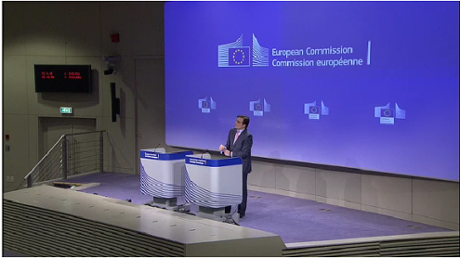
The European Commission’s top spokesman, Margaritis Schinas, is briefing Brussels journalists on the situation in Greece now.
Schinas has confirmed that the negotiations between the two sides are ongoing (reminder, they are due to restart in under an hour).
The goal of the talks is to deliver an economic reform programme that is “credible and comprehensive”, Schinas says.
And he adds that deputy finance officials (known as the eurozone working group) will discuss the issue on Wednesday.
"We're not there yet," says @EU_Commission spox @MargSchinas on #Greece talks. #Understatement
— Peter Spiegel (@SpiegelPeter) March 30, 2015
Euroworking Group will have a teleconference on Wednesday to take stock of negotiations @MargSchinas #Greece
— EfiKoutsokosta (@Efkouts) March 30, 2015
Germany: Greece hasn't submitted proposals yet
Over in Berlin, the German government is warning that Greece has not yet submitted a firm list of proposals to its creditors.
The finance ministry spokesman also cautioned that bailout funds will not be released until some measures have actually been approved by Greek MPs in Athens.
Here’s the news flashes:
- GERMAN FIN MIN SPOKESMAN SAYS THERE IS NO DATE FOR A EUROGROUP MEETING ON GREECE YET
- GERMAN FIN MIN SPOKESMAN SAYS BEFORE GREECE CAN GET FURTHER AID PARLIAMENT IN ATHENS MUST PASS FURTHER REFORM MEASURES
German FinMin spokesperson: #Greece hasn't submitted proposals to Euro area. Talks on reforms continuing. (BBG)
— Holger Zschaepitz (@Schuldensuehner) March 30, 2015
Updated
Bank of England announces new stress tests
Britain’s banks are to be tested on their ability to cope with a dramatic slowdown in China, a eurozone recession, the worse deflation since the 1930s and UK interest rates being cut to zero.
These new stress tests, just announced by the Bank of England, have a more international flavour than last year’s edition.
However, they don’t include the specific risk of Greece leaving the euro.
Our City editor Jill Treanor has just been briefed on the plans, and tweets:
BoE to stress banks for contraction the eurozone, slowdown in China along with deflation and zero interest rates in the UK
— Jill Treanor (@jilltreanor) March 30, 2015
Cooperative Bank is not included in BoE stress tests this year as too small, seven others financial firms to be tested
— Jill Treanor (@jilltreanor) March 30, 2015
Updated
European Commissioner Pierre Moscovici has welcomed the jump in economic confidence:
Encouraging news: @ecfin #eurozone economic sentiment indicator at highest level since June 2011.Confidence returning http://t.co/L0G0gNe3vF
— Pierre Moscovici (@pierremoscovici) March 30, 2015
This morning’s rise in economic sentiment means confidence is now at its highest since July 2011, points out Howard Archer of IHS Global Insight.
He adds:
A third successive, and markedly, increased rise in overall Eurozone economic sentiment to a 44-month high in March indicates that a more favourable growth environment in the Eurozone is increasingly being fostered by the much more competitive euro, low oil prices and major ECB stimulus.
Consumer confidence across the Eurozone rose to a near eight-year high in March while sentiment improved in most business sectors.
Italy has also reported an increase in economic confidence, suggesting that Europe’s economy is, finally, strengthening after several tough years.
#Euroboom2015 has now reached Italy. Only France and Greece left acc to economic sentiment indicator pic.twitter.com/VNwTSaDwEd
— grodaeu (@grodaeu) March 30, 2015
European economic sentiment jumps
European companies are increasingly confident about their economic prospects, the EC’s latest survey has found.
The Commission’s economic sentiment index jumped to 103.9 this month, beating expectations.
This “continues the upward trend observed since the beginning of 2015”, says the EC.
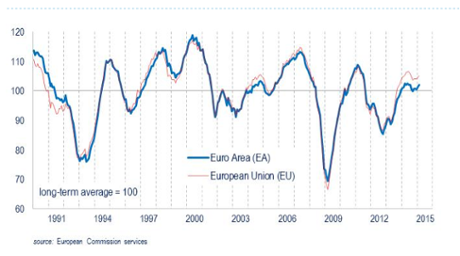
It suggests that the ECB’s new stimulus programme, and the impact of weak oil prices, are cheering business leaders, and that Greece’s ongoing debt problems are not causing too much alarm.
Consumer sentiment has also picked up, hitting an eight-year high (but still below its long-term average)
Eurozone consumer sentiment improves from -6.7 in February to -3.7 in March. Economic sentiment rises from 102.3 to 103.9
— Markit Economics (@MarkitEconomics) March 30, 2015
Updated
Britain’s housing market is picking up pace, according to new data from the Bank of England.
Mortgage approvals hit a six-month high of 61,760 in February, up from 60,707 in January, and beating analyst expectations.

China’s main stock market has hit a seven-year high, driven by stimulus hopes.
Shares in infrastructure companied rallied after the government fleshed out its new “New Silk Road” plan to boost trade and economic relations with the rest of Asia, Africa and Europe.
That plan will include hefty investment in railways, roads, power grids, oil and gas pipelines.
Hints of more central bank stimulus measures (see earlier) also helped to push the Shanghai Composite index up by 2.6% to its highest level since March 2008.
Updated
Greek bond yields rise as bailout uncertainty swirls
The uncertainty over Greece’s financial situation is weighing on its bonds this morning.
The yield (or interest rate) on 10-year Greek debt has inched up to 11.11%, from 11.04% on Friday night
And Greece’s two-year bond yields has risen from 20.4% to 20.8%, implying an even higher risk of default.
This follows the news that Greece still hasn’t presented an acceptable list of solid economic reforms to its lenders, despite the weekend’s negotiations.
One senior euro zone official told Reuters last night that:
“Greece did not submit a reform list on Friday. They just showed some ideas over the weekend. The discussions from Friday to Sunday were meant to help the Greeks prepare a list for tomorrow.....
We still look forward to receiving something on Monday.”
German TV news programme Tagesschau has heard a similar story this morning:
#Greece's delegation at #BrusselsGroup presented reform proposals only in e-form for mobile devices and in Greek ~EU official to @tagesschau
— Yannis Koutsomitis (@YanniKouts) March 30, 2015
Greece’s stock market isn’t sharing in this morning’s rally. The main ATG index has dropped by 1.4% in early trading, with bank shares among the fallers.
But....shares in Piraeus Port Authority have jumped by 8.5%, following reports that the government will press on with plans to privatise it. Such a move will not please members of the Syriza party, though.
Updated
Greece’s deputy finance minister Dimitris Mardas has insisted that the government hasn’t given up its demand for debt relief.
He told financial daily Naftemporiki that:
“The government has not abandoned any claim regarding its aim to make the country’s debt viable..... either there will be a haircut or it will be extended, or ....linked to an increase in output or exports, or there will be a lower interest rate.
Greek talks to resume
Talks between Greece and its creditors over its economic reform plans are due to start at 1pm in Brussels (or noon BST), according to the FT’s bureau chief Peter Spiegel:
"Brussels Group" talks on #Greece bailout to resume here at 1pm.
— Peter Spiegel (@SpiegelPeter) March 30, 2015
Updated

European stock markets are rallying in early trading, following Asia’s lead, on hopes of more stimulus measures in China.
The FTSE 100 has jumped 47 points, or 0.7%, to 6902. Germany’s DAX and France’s CAC indices are both up over 1%.
Traders are citing comments made by People’s Bank of China governor Zhou Xiaochuan over the weekend. He warned that China’s growth rate had fallen “a bit” too much and that policy makers have scope to respond. A hint of more central bank action?
Across the eurozone in Spain, prices are still falling, but at a slower rate.
Spain’s harmonised consumer prices index dropped by 0.7% this month, data released this morning showed, compared with -1.2% in February.
Alexis Tsipras to address parliament tonight

Greece’s MPs will get an update on the situation this evening, when prime minister Alexis Tsipras addresses parliament.
The session starts at 8pm local time, or 6pm BST, according to Enikos.
Updated
Greece had hoped that eurozone finance ministers might meet this week to agree to hand over some aid funds.
But that now looks unlikely, as Europe heads towards the Easter break.
According to Greek newspaper Kathimerini, a Eurogroup meeting is unlikely “next week or even the week after”.
That could be problematic for Greece, as it is due to repay €450m to the IMF a week on Thursday.
Updated
The Agenda: Weekend talks don't deliver a breakthrough

Good morning, and welcome to our rolling coverage of the world economy, the financial markets, the eurozone and business.
Another week of tension over Greece’s bailout lies ahead, as Athens struggles to persuade its creditors to unlock bailout funds before it runs out of money next month.
The two sides spent the weekend locked in talks, over the reform proposals which the Greek government submitted on Friday night.
Athens appears to have made some concessions, including various measures to raise €3bn in extra taxes. But officials from ECB, IMF and and EU are apparently still not convinced that the plans go far enough.
Greek govt is still working on a plan to meet terms for further bailout; it may well miss its 450m euro IMF payment, says #SocGen
— Francine Lacqua (@flacqua) March 30, 2015
Negotiations between Greece and troika not going well. This is not going to be settled soon. http://t.co/5k79LAUuoq
— Wolfgang Munchau (@EuroBriefing) March 30, 2015
The FT has a good take of the weekend’s talks.
Greece struggles to accommodate lenders as cash dwindles
Here’ s flavour:
Greek officials said Alexis Tsipras, the prime minister, had given ground on two key demands made by creditors: increasing value added taxes for Greek islands, a measure previously repudiated by Yanis Varoufakis, the Greek finance minister, and retaining an unpopular property tax that Mr Tsipras had vowed to abolish.
The property tax concession appeared to be the centrepiece of the new plan. It would raise an estimated €2.5bn of a predicted €3bn in new revenues, which Greek authorities estimated would put their primary budget surplus — the amount of revenue taken in, minus spending, not counting interest on debt — at almost €3.5bn for 2015.
But the list failed to include reforms to labour laws and Greece’s pension system — two areas that monitors have insisted are essential to finalising the bailout programme. They remained “red lines”, said Greek officials.
Prime minister Alexis Tsipras is standing firm too, insisting over the weekend that his government would not accept any “recessionary measures”, such as slashing wages or making it easier to fire workers.
And with Fitch downgrading Greece’s credit rating late on Friday night, investors are getting edgier...
Also coming up today:
The Bank of England is publishing details of new stress tests for Britain’s banks. They’re expected to assess if the banks have enough capital to handle global risks such as a foreign currency crisis, a geopolitical crisis and tumbling commodities and stock markets.
The latest Eurozone consumer confidence survey is due at 10am BST.
And German inflation data is released at 1pm BST. It’s likely to show that prices are rising slightly year-on-year, after dipping into negative territory last month. Spanish inflation data is also out this morning.
Updated