Greece will apply for extension to loan agreement - Greek TV
Greece will reportedly apply for an extension to its current loan agreement, distinguishing this from its full bailout programme. Helena Smith reports:
Greek state television Nerit is tonight reporting that Athens will apply for an extension to its current bailout “under certain conditions.”
Finance ministry officials are confirming the reports. Greece will apply for an extension of up to six months for its financial assistance program - most likely on Wednesday.
The Greek finance minister Yanis Varoufakis is believed to have discussed negotiations again, on a one-to-one basis with the EU monetary affairs commissioner Pierre Moscovici.
The Greek side is making much of the point that prime minister Alexis Tsipras made in parliament earlier: that there is a difference between the the programme of conditions as set out in the previous bailout accord and the loan agreement itself.
Pasok, the social democrat party and junior partner in the former coalition government, has slammed the new government saying it is effectively agreeing to a “third memorandum for Greece” while pretending to put up a robust defence with the country’s partners.
Apparently, Greek authorities have pledged to refrain from taking any unilateral action (which would make passage of social reforms on Friday rather difficult).
#Greece to ask Wed for 6-mnth xtension of loan agrmnt. Govt to ask for freeze of bailout measures http://t.co/difZNyDAl1 via @kathimerini_gr
— Yannis Koutsomitis (@YanniKouts) February 17, 2015
So on that note it’s time to close up for the day. Thanks for all your comments, and we’ll be back tomorrow.
Updated
European markets mixed but no panic despite Greek uncertainty
Investors are clearly hopeful a deal can be reached between Greece and its creditors before the money runs out, to judge by the reaction to Monday’s events on European stock markets, which turned in a mixed performance. The UK in particular is edging closer to its record high, helped by inflation data which suggested there would be no early rise in interest rates. The final scores showed:
- The FTSE 100 finished 41.08 points higher at 6898.13
- Germany’s Dax dipped 0.25% to 10,895.62
- France’s Cac closed up 0.04% at 4753.99
- The Athens market ended down 2.45% at 838.61
On Wall Street the Dow Jones Industrial Average is currently up 10 points or 0.06%.
Updated
There may be a certain weariness creeping in:
Greece headlines are going to continue to be deal, no deal...bailout extension, no extension...talks fail, resume...until they're not...
— Dominic Chu (@TheDomino) February 17, 2015
Here’s a link to Tsipras’ full speech to the Greek parliament (in Greek):
Tsipras' office releases speech to parliament Full Here: http://t.co/zTLd0FIjka #Greece
— Derek Gatopoulos (@dgatopoulos) February 17, 2015
A Grexit is almost inevitable, in the view of Alastair Winter, chief economist at Daniel Stewart. He writes:
There is probably too much coverage of Greece already but most people including the Eurofederalists (notably Juncker, Draghi, Lagarde) still seem to think that another can-kicking exercise can work somehow. However, whatever fine words may or may not be agreed, any deal will would quickly unravel for two reasons.
1. It is not just a matter of principle or politics for the German Government that Greece sticks to the current programme and pays its debts in full, it is also a legal obligation under the Maastricht Treaty, for which it would have to account for any breach to the constitutional court in Karlsruhe.
2. Greece needs a lot more money both for its banks which are suffering massive deposit withdrawals and for itself as many taxpayers are withholding their dues before even the new government takes a stand on its mandate from voters.
Grexit seems inevitable and all the parties will suffer. Talking this afternoon to my own contacts in Athens, bemused bewilderment and denial are the prevailing sentiments amongst the lunching classes.
And now something from the European Central Bank on the Greek situation, specifically from governing council member Christian Noyer:
- 17-Feb-2015 16:45 - ECB’S NOYER SAYS SEES SOLUTION FOR GREEK DEBT INVOLVING A RESCHEDULING OR LOWER INTEREST RATES
- 17-Feb-2015 16:49 - ECB’S NOYER SAYS GREEK ECONOMY MUST BECOME MORE COMPETITIVE, CONCERNED REFORMS WILL BE DROPPED
More comments from Tsipras:
#TSIPRAS: TO CALL NEW ELECTIONS IF EUROGROUP DEAL FAILS - #GREECE READY TO AGREE LOAN EXTENSION NOT TIED TO BAILOUT - MNI- #forex
— Ashraf Laidi (@alaidi) February 17, 2015
Syriza would win majority in new Greek election...
— MineForNothing (@minefornothing) February 17, 2015
The Greek parliament is due to vote on its contentious reform measures - which it is pressing ahead with in defiance of its bailout agreement - on Friday,.
Greek parliament to vote on social reform bills Friday http://t.co/rUSU5CvCwS
— Kathimerini English (@ekathimerini) February 17, 2015
Greek prime minister Alexis Tsipras has given an interview to German magazine Stern, in which he reiterates his usual messages.
Anyone suggesting the current programme should be extended by six months is wasting their time, he said, adding:
We don’t need [a Plan B] because we will stay in the euro, but we will not achieve this goal at the expense of the weak.
And here’s why the Greek banks need the ECB’s support:
Greek Banks Need More Emergency Funds as Deposits Drop - Bloomberg http://t.co/qyBMZF0IAS pic.twitter.com/E1ALqFuD30
— Nick Kounis (@nickkounis) February 17, 2015
With withdrawals from Greek banks reportedly picking up, the European Central Bank’s support through its emergency funding programme is key.
The ECB is due to review its assistance on Wednesday, but is unlikely to pull the plug while there is a chance of a deal between Greece and its lenders being negotiated (however far apart they may seem), Reuters reports:
The ECB’s Governing Council meets on Wednesday and will review the provision of so-called Emergency Liquidity Assistance (ELA) to Greek banks, as Greece is at loggerheads with euro zone governments over the future of its international bailout, which expires at the end of this month.
Provision of the ELA funding is essential to the survival of Greece’s banking sector, and hence to the country’s continued membership in the euro zone.
The ECB stopped accepting Greek bonds as collateral for funding on February 5, shifting the burden of financing its lenders via ELA to Greece’s central bank. However, the ECB retains control over that ELA funding, which is subject to tight conditions.
The rules stipulate that national central banks can only grant such funding temporarily and to solvent banks.
“There is no sudden end of ELA expected this week,” the person familiar with the situation said.
The ECB raised the cap on ELA for Greek banks by about €5bn to €65bn last week, Greek central bank and government officials told Reuters.
The ECB added money because deposit outflows had picked up and to ensure Greek banks have liquidity while tense talks take place in Brussels, Greek banking sources said on Friday.
Updated
What are the options for Greece and the EU? Economics editor Larry Elliott has looked at the possibilities, and here’s a flavour:

Brussels and brinkmanship. It’s a familiar mix. The EU has been there many times before. The latest episode involves the standoff between Greece and the other 18 eurozone members over whether the new Syriza-led government should be forced to stick to the terms of its bailout, despite the Greek people voting for an end to austerity in last month’s general election.
The assumption, both in European capitals and the financial markets, is that a deal will be done. That, after all, is what normally happens. An honest broker proposes the outlines of a deal, both sides give a little and a compromise is reached in the early hours of the morning.
But there’s always a first time, an occasion when precedent is broken. Europe has 72 hours to find a solution to the Greek crisis. The possible outcomes are limited.
The full analysis is here:
Greece bailout talks: the options
Updated
Here’s an updated timetable of events to watch out for in the Greek crisis, courtesy of Deutsche Bank:
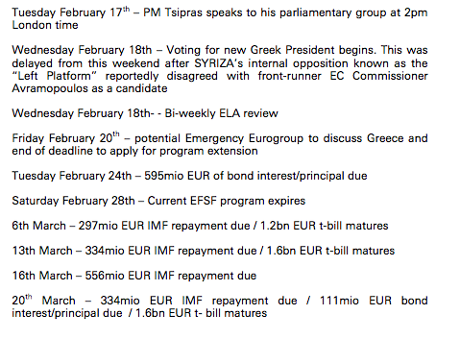
Tspiras has already spoken, and we now know the identity of the presidential candidate, of course.
Updated
Afternoon summary: Deadlock over Greek bailout

Time for a recap.
Greece is refusing to bow to pressure from its creditors and seek an extension of its bailout programme, without new measures to address its humanitarian crisis and help its economy grow.
Prime minister Alexis Tsipras told MPs a few minutes ago that his government will not be rushed into a deal, and will not be forced to compromise. Instead, it will implement the programme it was elected to deliver.
“There has been a custom that newly elected governments act differently from their pre-election promises. I am saying it again, we are thinking of actually implementing our promises for a change.”
Germany is also holding its line, at a meeting of EU finance ministers in Brussels today. Finance minister Wolfgang Schauble told reporters that Greece must make the next move, saying:
We are not much further than we were. And as we know the situation in Greece is not getting any better.”
“Greece must decide does it want this programme or does it not.
UK chancellor George Osborne urged both sides to reach an agreement. Otherwise, he warned, economic and financial stability could be badly hit.
Osborne said:
We are reaching crunch time for Greece and the eurozone, and I’m here to urge all sides to reach an agreement, because the consequence of not having an agreement would be very severe for economic and financial stability.....
What Britain really needs to see is competence not chaos.
Today’s meetings were overshadowed by the drama at last night’s eurogroup meeting. Talks collapsed after Greece was initially shown a draft arrangement it supported, only to be presented with another, unacceptable version.
Financial markets remain calm today, though. And several commentators believe a deal will still be reached.
Wolf Piccoli, analyst at Teneo Intelligence, reckons that Greece has a 60% chance of getting a deal before its bailout extension expires.
However, he adds:
There is also a chance that Athens decides to drag talks beyond the deadline as the mixture of strong public support at home and the government’s own inexperience could lead Athens to play hardball.
In terms of alternative scenarios, there is a 25% chance that Greece decides to let the current program end on 28 February to then apply for a new program (this may require capital controls in the interim to prevent a large deposit flow from Greek banks). Finally, there is a 15% probability that Athens decides to escalate the matter by calling a referendum, not on euro membership but on whether or not to apply for a new program.
<drum roll>...... The Greek government’s candidate for the presidency is....
Prokopis Pavlopoulos!
He’s a former centre-right minister for the interior in one of New Democracy’s governments (the party which Tsipras defeated last month).
Pavlopoulos is #Greece's govt candidate for Prez, an old politician of New Democracy, former Minister in Karamanlis cabinets
— Efthimia Efthimiou (@EfiEfthimiou) February 17, 2015
MPs, who will vote on the presidency tomorrow night, applauded the choice.
Applause for Tsipras after announcing conservative presidential candidate, Prokopis Pavlopoulos #Greece pic.twitter.com/wbgNBAfx26
— Derek Gatopoulos (@dgatopoulos) February 17, 2015
Although not everyone is overwhelmed:
tsipras says thousands of greeks are inspired by the new policies just minutes after nominating pavlopoulos for president. #sarcasm?
— Diane Shugart (@dianalizia) February 17, 2015
Tsipras: "The impasse at Eurogroup cannot be solved by technocrats but political leaders. We are hopeful of solution" #Greece
— Kathimerini English (@ekathimerini) February 17, 2015
Alexis Tsipras is now explaining what went wrong at last night’s eurogroup .
He says that Greece was prepared to sign the proposal drawn up by commissioner Pierre Moscovici, only for it to be replaced at the last minute by Jeroen Dijsselbloem (as finance minister Varoufakis explained last night).
Tsipras has condemned that notorious cartoon of Wolfgang Schauble in Nazi uniform.
Tsipras: We denounce the 'Avgi' cartoon. No one has the right to play around with history's ghosts.
— Yannis Koutsomitis (@YanniKouts) February 17, 2015
Alexis Tsipras tells MPs that his government will begin the task of fixing Greece’s humanitarian crisis.
And he also vows to give workers the right to negotiate their pay collectively, reversing one of the country’s austerity measures.
Tsipras: We will reinstate collective wage bargaining, which was abolished by the Troika. (via @ekathimerini) #Greece
— Open Europe (@OpenEurope) February 17, 2015
Hmmm, so much for Greece not implementing new measures unilaterally.
— Megan Greene (@economistmeg) February 17, 2015
Ouch. Tsipras has just accused Germany’s Wolfgang Schäuble of losing his cool at last night’s eurogroup meeting, and expressing words that undermined Greece.
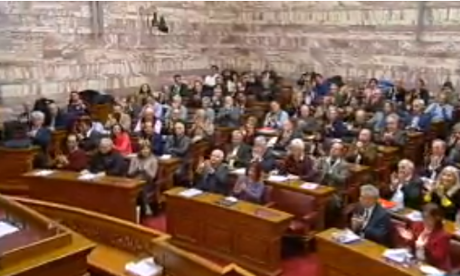
Alexis Tsipras then insists that Greece is in no hurry, and will not be forced to compromise.
"We are not in a hurry and we are not compromising," says Alexis Tsipras, who is in a hurry, and will have to compromise. (h/t @YanniKouts)
— Stanley Pignal (@spignal) February 17, 2015
Tsipras: Can't treat Greece as a debt colony any more
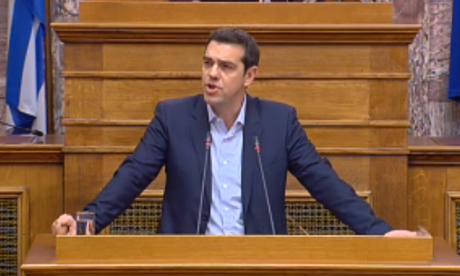
Over in Athens, Greek prime minister Alexis Tsipras is announcing his nominee for the presidency....and attacking the mistakes of the past at the same time.
Speaking in parliament, Tsipras insisted that Greece can no longer be treated like a colony, or a European pariah .
For the first time, our country has its own voice, which is being heard also in the streets of Europe, he declared....adding that Greece will exit the ‘debt trap” created by its austerity programme.
We may not have solved all our problems in the last three weeks, but Greeks no longer feel humiliated....they feel proud and dignified, he says.
And Tsipras also takes a jibe at Wolfgang Schäuble for saying a few days ago that he felt sorry for Greeks.
* Greek PM says Schaeuble should not pity people who raise their head high - RTRS
— Fabrizio Goria (@FGoria) February 17, 2015
Updated
In another press room, Latvia’s finance minister Valdis Dombrovskis has predicted that a deal will be reached in time:
Dombrovskis: #Greece bailout review completion is precondition for release of funds, that is why extension is best option
— Open Europe (@OpenEurope) February 17, 2015
Dombrovskis: no concrete schedules for visit to #Greece but in discussions
— Open Europe (@OpenEurope) February 17, 2015
Dombrovskis, no planning for consequences of no agreement with Greece because such a thing will not happen. He's the new Olli Rehn
— Bruno Waterfield (@BrunoBrussels) February 17, 2015
My conclusion after Schäuble's press conference: Germany isn't going to move one inch and already said goodbye to Greece as €-zone member
— Erik Wesselius (@erikwesselius) February 17, 2015
Schäuble: Situation will be difficult without Greek deal
Wolfgang Schäuble went on to reiterate that his discussions with Yanis Varoufakis have not been acrimonious and he has again refused to speculate on quite what would happen after February 28 if there is no deal.
“I have said it three times, I have nothing to reproach about the personal contact I have had with my Greek colleagues.”
On what happens after the bailout deal expires at the end of the month, he said:
“If this programme is not concluded in an orderly manner a difficult situation will ensue...But there is no sense in speculating over what will happen.”
The German finance minister also said:
“All this speculating and excitement don’t help anything. Of course, we know that whatever scenario the situtation for Greece is extraordinarily difficult and for Europe too. That is not in question at all. But it won’t be made better by us excitedly running around the place...saying oh God, oh God, oh God... And I would point to the so-called financial markets... and they are completely unaffected, they are completely unaffected.”
And there was a light-hearted moment at the end.....
Asked a question in English at the end of the press conference, Schaeuble said this was still a German press conference and appeared to add a little dig at George Osborne, the finance minister of a non-euro member, but vocal on Greece nonetheless.
“I hope George Osborne will deliver some press conference and he is the most engaged mitglied [member] of the eurogroup.”
(hat-tip to Katie Allen for the translations)
Schäuble is basically saying We won't kick Greece out of the Eurozone, she'll hv to decide on her own (In the mean time we'll sterilize her)
— Yannis Koutsomitis (@YanniKouts) February 17, 2015
Wolfgang Schäuble went on to lay the onus on Athens to get a deal by the deadline.
“What do they want? What is their plan. I don’t know, and so I am staying calm.... but bear in mind, today is 17 February, the programme requires that if nothing happens by 28 February, the programme is over and things can’t happen without a deal in advance,”.
He also reiterating the Germany would have to vote on changes to the bailout programme.
Updated
The German finance minister says he had heard from his Greek counterpart Varoufakis that the latter was “ashamed” of the caricature that had appeared of Schäuble as a Nazi in Greece.
Schäuble: Greece must decide if it wants bailout programme
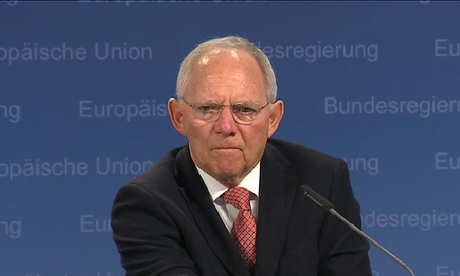
Germany’s Wolfgang Schäuble is telling reporters that there was little progress at yesterday’s eurogroup meeting, (writes my colleague Katie Allen who is watching the press conference).
He also raised questions over what Greece is fighting for and how other ministers will be able to sell it to their respective electorates who face their own problems when it comes to pensions, jobs and other welfare issues.
Schäuble: Many Eurogroup colleagues pointed out their pensions, min wages lower than in Greece, they'd have to justify to their electorates
— Open Europe (@OpenEurope) February 17, 2015
“We sadly didn’t really make any progress” at the eurogroup meeting, the German finance minister said.
“We are not much further than we were. And as we know the situation in Greece is not getting any better.”
“Greece must decide does it want this programme or does it not.”
Schäuble added that “No one is forcing anything on anyone” and if Greece don’t want to stick with the programme they do not have to, he said.
“Doubts have grown over what Greece actually wants”.
Schäuble said people must remember that an extension will require votes in some countries, including Germany.
He also said the eurozone does not just need to hear from Greece that it wants changes to the programme, but wants “clear, reliable, believable commitments to fulfill the programme.... Whether Greece wants that, Greece must decide.”
“Sometimes I have the feeling that in Athens they don’t know what they want and how things will work out.”
He also said help for Greece had “not lacked in the past and would not be wanting in the future” but that it can’t be abused.
This brief video clip confirms that Greece’s Yanis Varoufakis has left the Ecofin meeting:
#ECOFIN Council - Departure of #Greek Minister @yanisvaroufakis http://t.co/Myuyts5qF6 pic.twitter.com/iN5zYjyvPd
— EU Council TV News (@EUCouncilTVNews) February 17, 2015
Ed Conway of Sky News reports that UK chancellor George Osborne has raised the possibility of the Greek bailout negotiations floundering:
Latest: @George_Osborne intervened in the Ecofin meeting, asking @yanisvaroufakis if he’d explored consequences of these talks falling thru
— Ed Conway (@EdConwaySky) February 17, 2015
Germany’s finance minister, Wolfgang Schauble, is giving a press conference in Berlin NOW, at the end of the Ecofin meeting.
Highlights to follow....
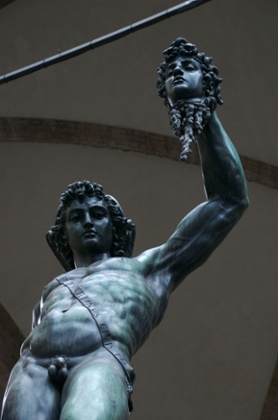
Bookmaker Paddy Power has cut the odds on Greece leaving the eurozone this year again, to 6/4 from 3/1.
Worth mentioning just for this quote:
“There hasn’t been a stare down this frightening since the days of Medusa and if further talks fail the Greeks might be left with no option but to leave the Euro.”
So who is playing the monstrous Gorgon, and who is the heroic Perseus?
Updated
Video: Today's meeting in Brussels
Here’s video footage of Yanis Varoufakis, Jeroen Dijsselbloem and George Osborne arriving at the Ecofin meeting this morning:
Yanis Varoufakis said:
“The next step is the responsible step...
We will continue to deliberate, in order to enhance the chances and actually achieve a very good outcome for the average European. Not for the average Greek, the average Dutch person, or the average German.”
Varoufakis added that he was also excited to be discussing the European investment bank today.
It appears that the Ecofin meeting in Brussels is wrapping up.
Sky News’s Emily Purser reports that Greece’s finance minister will head home tonight:
Hearing that Varoufakis has left the #ecofin meeting and is back at his hotel. Due to leave for Athens tonight #Greece
— Emily Purser (@EmilyPurserSky) February 17, 2015
The Greek negotiating team are said to be leaving tonight/tomorrow too. So that suggestion of deal in 48 hours looking unlikely #Greece
— Emily Purser (@EmilyPurserSky) February 17, 2015
Greek official: Solution is 'absolutely possible'

Helena Smith, our Athens correspondent, says a senior Greek government official has announced that the search for a “mutually beneficial agreement” is still very much on.
A lot of what we are seeing is political posturing – theatre that prime minister Alexis Tsipras is expected to indulge in to placate militants in his far-left Syriza party, says Helena.
She writes:
Almost a third of Syriza, represented by the Left Platform, are against any sort of compromise on the anti-austerity front. The energy minister, Panagiotis Lafazanis, has taken an increasingly strident stance, rejecting any deal that might see the government rolling back on its pre-election pledges.
But an official close to Tsipras said this morning that he thought a mutually beneficial solution was still “absolutely possible.” And he added: “The Greek government is not going to accept ultimatums. It is determined to honour its popular mandate and the democratic history of Europe. The memorandum [bailout accords that debt-stricken Athens has signed with its creditors at the EU, ECB and IMF] has prompted a humanitarian crisis and led the economy to complete impasse.”
Common sense, said the official, as much as the decision of Greek voters to catapult the anti-Syriza party into power, demanded that the accord be ended immediately.
The Greeks, Helena adds, will take this to the brink.
“We are good at haggling, it’s in our DNA,” said a former diplomat now a top level official in the EU.
Lafazanis, it should be pointed out, put the kibosh on Tsipras’ selection of the veteran conservative Dimitris Avramopoulos as candidate for president, this week.
Tsipras is due to announce his chosen candidate for the presidency later today.
Updated
French finance minister: Consensus with Greece on some issues
Now this looks encouraging. France’s finance minister, Michel Sapin, has said there is a “consensus” with Greece about some of the issues around its bailout programme.
Sapin also suggested that Greece could run a smaller budget surplus than currently mandated in its agreement with its creditors; one of Athen’s key demands.
- FRANCE’S SAPIN: GREECE COULD KEEP PRIMARY BUDGET SURPLUS AT 1.5%/GDP FOR DURATION OF PROGRAMME EXTENSION, BUT NOT LOWER
- FRANCE’S SAPIN: SOLUTION TO A DEAL IS MAINLY ABOUT WORDING, THERE IS CONSENSUS WITH GREECE ON ISSUES SUCH AS DEBT, NO HAIRCUT
The Greek government is telling reporters in Athens that it will not be forced into an ultimatum by the eurogroup, but still believe a deal will be reached.
Capital GR’s Efi Efthimiou is tweeting the details
#Greece govt rejects "ultimatum", yet considers feasible that a mutually beneficial solution 4 Greece & partners can be reached
— Efthimia Efthimiou (@EfiEfthimiou) February 17, 2015
#Greece Also, govt sources say MoU has created a humanitarian crisis, led economy to a dead end. Common sense dictates its end
— Efthimia Efthimiou (@EfiEfthimiou) February 17, 2015
This was my favourite moment of last night’s press conference, when Bloomberg’s Hans Nichols asked Varoufakis if he’ll soon be playing Monopoly with fake money:
GREAT SOUND. Varoufakis talks to @HansNichols about Monopoly and why Greece is NOT playing game theory OR poker http://t.co/xWXd1AKhyw
— Anna Edwards (@annaedwardsnews) February 17, 2015
Updated
On a lighter note:
Ricardo Santos on today’s #Eurogroup meeting. #Greece #Varoufakis pic.twitter.com/wi5fgWXTEz
— Oscar Reyes (@_oscar_reyes) February 16, 2015
European commissioner Pierre Moscovici has denied that Europe is divided over Greece.
Speaking to reporters in Brussels, Moscovici insisted that the compromise plan he had presented to Yanis Varoufakis did not show a clash between Brussels institutions.
There is no good cop, bad cop. There needs to be a margin of flexibility, room for politics, but everyone must understand the working process. The Commission contributes to the collective work of the Eurogroup. There is not one paper or another paper. There are contributions to a global agreement.”
Moscovici added that Greece must make the next move:
“The only privileged scenario is Greece in the euro zone and for that we have told the Greek government that they must now send a request for the extension of the programme, call it technical if you want ... We are united, we all think a solution is possible, there is no plan B,” he said.
(via Reuters)
Greece: Reasons for optimism
If you dig beneath last night’s dramatic press conferences, and George Osborne’s warnings, how close are we to a deal?
As I mentioned at the start, many astute observers reckon the two sides will manage to hammer out an agreement to extend Greece’s funding beyond the end of this month.
That’s partly because failure would be so damaging (financial blogger Frances Coppola dubs it TINA, or There Is No Alternative).
@keithfrankish they are not contemplating Grexit. Actually, despite the rhetoric, neither is the Eurogroup. There will be a deal.
— Frances Coppola (@Frances_Coppola) February 17, 2015
But the other reason is that the two sides may not be as far apart as it sounds. The turmoil in Brussels last night actually works well for both sides, argues Duncan Weldon of Newsnight, bolstering their credibility with their domestic audiences.
And he reckons a deal is close, namely:
- It would be based around the leaked Moscovici draft from yesterday.
- Here’s how it would play out — Greece swallows some pride and asks for an extension.
- The deal gives Greece 4–6 months of financing. Syriza hold back on implementing some of their manifesto and continue to run a hunky primary surplus.
- In the next few months a wide ranging deal is negotiated.
- Both sides have compromised.
Greece - I think a deal is close, here's why: https://t.co/WEGrSBV8j6 - plus the risks around that view. A 2 min read.
— Duncan Weldon (@DuncanWeldon) February 17, 2015
Over on Business Insider, Tomas Hirst argues that we misunderstood the “red lines” which Greece’s finance minister isn’t prepared to cross. They relate to ending the Greek humanitarian crisis, not its bailout commitments.
And those commitments – including budget surplus targets and austerity measures – would be negotiated once Greece has a bridging arrangement/extension to cover its immediate funding needs.
He points out that Yanis Varoufakis would have signed that deal yesterday referring to as a “new arrangement”, rather than tying Athens to the 2012 deal.
The current stumbling block is clear — Greece does not want to pre-commit to “honour all financial obligations to its creditors” within the current programme.
This explains why they rejected yesterday’s final Eurogroup draft out of hand as it explicitly called for Greece to honour “the agreed framework”.
Europe may be just two words away from a deal on Greece http://t.co/yyh471dMdQ pic.twitter.com/SdKmG5Uu5T
— Business Insider UK (@BI_Europe) February 17, 2015
Updated
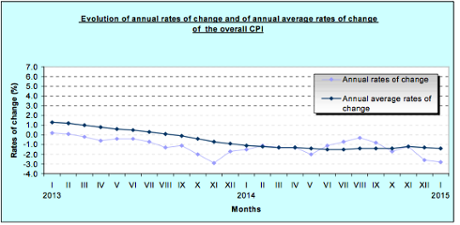
Greece has slumped deeper into deflation, data just released shows.
Consumer prices fell by 2.8% in January, down from -2.6% in December, Elstat reported.That’s the 23th consecutive month of falling prices.
In January,
- Clothing and footwear prices fell by 2.9%
- Housing costs fell by 8.0%
- Transport costs fell by 6.9%
Hello.... Greek bank shares have now turned positive, up by 3% after their early wobble. And the main Athens stock market is now flat, having been down 4.5% in early trading.
Negotiations between Greece and the eurozone look like “a train wreck”, says Aengus Collins, lead eurozone analyst at the Economist Intelligence Unit.
Yesterday was far from a hard deadline but the way the eurogroup meeting collapsed -- in acrimony and over a basic building block of any ultimate accommodation -- was pretty dismal. At the moment, the two sides are running down their reserves of trust more quickly than they are narrowing the gulf that separates them.
The Economist Intelligence Unit remains of the view that a last-minute deal will be agreed, but the risk of Grexit remains high at 40%. Nor are these negotiations the end of the challenges for Greece; implementing any revised bailout programme is going to involve painful reforms that will test the resilience of the country’s politicians and its voters”.
Here’s the scene inside today’s meeting of EU finance ministers:

German finance minister Wolfgang Schaeuble, bottom right, is talking with Finnish Finance Minister Antti Rinne, left.
George Osborne: it's crunch time for Greece and the eurozone
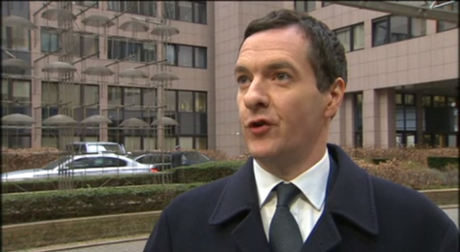
UK chancellor George Osborne has warned that Britain’s economic stability would be hit if a deal can’t be reached on Greece’s bailout.
Speaking on his way into the EU ministers’ meeting this morning, Osborne declared
We are reaching crunch time for Greece and the eurozone, and I’m here to urge all sides to reach an agreement, because the consequence of not having an agreement would be very severe for economic and financial stability.
Adding:
What Britain really needs to see is competence not chaos.
And then Osborne headed into the meeting room to see his fellow finance chiefs.
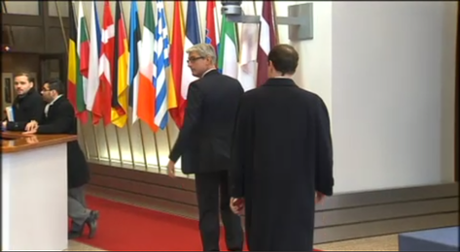
#ECOFIN Council #UK @George_Osborne I am here to urge all sides to reach an agreement #Greece http://t.co/pLCvsrlutT pic.twitter.com/22LmiAlcCD
— EU Council TV News (@EUCouncilTVNews) February 17, 2015
Updated
And the tumble continues: inflation falls to a record low of 0.3% in January. But stripping out volatile oil and food it rises to 1.4%
— Richard Edgar (@ITVRichard) February 17, 2015
UK inflation falls to 0.3%
Just in: Britain’s headline inflation rate has hit its lowest rate since records began in 1989.
The consumer prices index rose by just 0.3% annually in January, down from 0.5% in December, dragged down by weak oil prices.
Greek bond yields spike
Greece’s government debt is being hammered this morning too. Prices are sliding, driving up the yield (or interest rate) on the bonds.
The yield on Greece’s benchmark 10-year bond has jumped from 9.9% to 10.6% this morning.
The three-year bond yield soared from 17.7% to 19.7% -- a level that suggests a high chance that Greece will default on the loan.
Brussels breakdown... Greek banks -7.1%. Greek 3-year yield up almost 200bps. pic.twitter.com/dNpZIJwmZ2
— Jonathan Ferro (@FerroTV) February 17, 2015
Analysts at Commerzbank reckon there’s a 50:50 chance that this deadlock will result in Greece leaving the eurozone. More here.
Risk of Greece exiting the euro was raised to 50 percent by #Commerzbank after talks with euro-area finance ministers broke down on Monday
— Francine Lacqua (@flacqua) February 17, 2015
Today’s 4.5% drop in Greek stock prices sounds severe, but it’s largely in line with recent volatility:
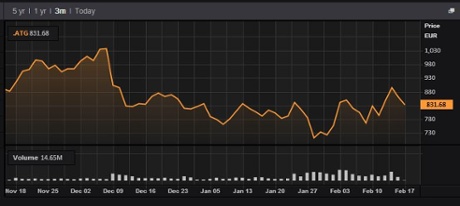
Athens market falling but no panic. Yet.
— Yannis Koutsomitis (@YanniKouts) February 17, 2015
Greek stock market slides 4.5%
The Athens stock market is falling sharply at the start of trading, after the collapse of last night’s talks.
Bank shares are down almost 9%, as traders react to the latest deadlock.
#Greece Athens stock exchange already -4.49%, banks -8.78%
— Efthimia Efthimiou (@EfiEfthimiou) February 17, 2015
Other European markets are also in the red; Germany’s DAX and France’s CAC are down around 1%:
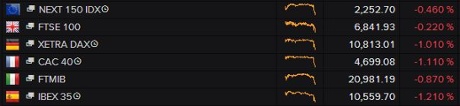
A slightly baffling quote from Cyprus’s finance chief:
Cyprus FinMin: "Not sure which demand of Greece should Cyprus support"... Maybe this is a polite way of saying that Greece has no plan?
— Katerina Paraschou (@KParaschou) February 17, 2015
Photos: Varoufakis and Dijsselbloem speak at ECOFIN
We just received photos from inside today’s meeting of European finance ministers in Brussels.
They show that, despite last night’s clashes, Jeroen Dijsselbloem and Yanis Varoufakis shared a handshake and a conversation before the start of the meeting:


Varoufakis also spoke with Spanish finance minister Luis de Guindos, before taking his seat:


Updated
Ed Conway of Sky News reports that Greek fatigue is growing in Brussels:
One finance minister told me: “Fatigue is setting in. Everyone is tired of having devoted so much of their time to Greece for so many years”
— Ed Conway (@EdConwaySky) February 17, 2015
Dijsselbloem: I hope Greece asks for an extension

Jeroen Dijsselbloem has arrived at today’s EU finance meeting, and pledged that eurozone minister are “ready to work” with Greece.
But he also repeated that Greece must request an extension of its bailout first:
Reuters has the quotes:
“I hope they (Greece) will ask for an extension to the programme, and once they do that we can allow flexibility, they can put in their political priorities.”
“Of course we will see whether their programme remains on track. But that is the way forward. It’s really up to the Greeks. We cannot make them or ask them. It really is up to them. We stand ready to work with them, also the next couple of days.”
Updated
Luxembourg: Both sides must compromise
Luxembourg’s finance minister Pierre Gramegna, argues that both sides have to make concessions to break last night’s stalemate.
Speaking before today’s ECOFIN meeting of finance ministers, Gramegna said:
“We can’t remain in a blockade so everyone has to move a bit, water-down demands so we can find a compromise.”
Gramegna added that there is room to maneuver:
“There are flexibilities in the programme, we have to make use of them. When the Greeks are against the programme and don’t want to work in this framework it will be tough.”
Austria’s finance minster has predicted that Greece will not be forced out of the eurozone.
Hans Jörg Schelling told the Deutschlandfunk radio station that he was “ruling out” the scenario where Greece goes bankrupt and leaves the euro zone.
Schelling added:
“A ‘Grexit’ is in noone’s interests - neither the euro group’s nor Greece’s”.
Greek bailout crisis: the morning after

Good morning.
The recriminations are flying. The inquest is under way. And the clock is still ticking in Greece’s battle to agree a new deal on its debts.
As you probably know, talks collapsed at the eurogroup last night after the Greek government refused to stick to its existing bailout arrangements.
Greece bailout talks break down after Athens rejects ‘unacceptable’ eurozone demands
In dramatic scenes, Athens cried foul; finance minister Yanis Varoufakis publicly blamed eurogroup chief Jeroen Dijsselbloem for wrecking a deal.
Varoufakis was prepared, indeed eager he said, to sign up to a new plan presented by commissioner Pierre Moscovici. That would extend Greece’s loan agreement, with some crucial modifications, to create time for a “new contract for growth”.
The Moscovici plan, the FT reports, was created following talks between Greek PM Alexis Tsipras and Commission chief Jean-Claude Juncker. At least two drafts are circulating; this version looks to be the final one:
Exclusive Pierre #Moscovici draft statement withdrawn from #Europgroup pic.twitter.com/iSC4k3U2ig
— Thanasis Koukakis (@nasoskook) February 16, 2015
In contrast, the version presented by Dijsselbloem shows few concessions to Greece, and still commits Athens to stick to existing targets.
Draft Eurogroup statement rejected by Greece
Now, all is not lost. Some analysts reckon that, despite the deadlock, the two sides are inching towards a deal. Varoufakis, showing remarkable assurance, predicted an ‘honourable deal’ within 48 hours. But he also refused to be bounced into Dijsselbloem’s ultimatum to get a bailout request in quickly so the eurogroup could meet on Friday.

The action continues in Brussels this morning, where all the European finance ministers are gathering for a full ECOFIN meeting. So we’ll be watching eagerly for signs of progress.
The financial markets are holding their nerve; investors clinging to the idea that a compromise will be cobbled out. But the main European indices are still expected to fall around 0.5% this morning.
Stan Shamu of IG says:
In terms of the next step now, another meeting could be held as early as Friday if Greece submits a request to extend the current programme. It seems all other options are now off the table for Greece and this will certainly put traders on high alert of an escalation of the situation.
A consolation is the fact Greece’s Prime Minister has emphasised that a solution could be found in the next couple of days.
Regardless of the differences, optimists will continue to feel a solution will be reached somehow to prevent undoing all the hard work we’ve been seeing from European leaders to resuscitate the economy....
The other main events today are
1) the latest UK inflation report, due at 9.30am. Inflation is expected to have fallen closer to zero, dragged down by the tumbling oil price. UK inflation edging closer to zero, analysts predict
2) Greece’s government is expected to name its candidate to become the country’s new president.
Updated