AFP’s Danny Kemp sums it up:
Tsipras says Merkel, Hollande agreed need to 'viable solution' and to intensify efforts for a deal. So, no deal
— Danny Kemp (@dannyctkemp) June 10, 2015
Ctrl+V 'ended without a breakthrough'
— Danny Kemp (@dannyctkemp) June 10, 2015
So I think we’ll wrap up now. Back (later) in the morning. Sleep well. GW
Updated
Greece’s PM touches on the need for a debt restructuring:
TSIPRAS: DEAL SHOULD INCLUDE DEBT RELIEF IN ORDER RETURN TO GROWTH - MNI #Greece
— Fabrizio Goria (@FGoria) June 10, 2015
Tsipras: We agreed to keep looking for a solution
Tsipras is saying that the discussions with Angela Merkel and Francois Hollande took place in a “very good climate”.
The leaders have agree to continue their efforts to reach a solution, he adds.
Nothing from @atsipras in English. Greek reporters say it was mostly "constructive" and "intensifying", etc.
— Peter Spiegel (@SpiegelPeter) June 10, 2015
Tsipras also sounded optimistic about prospects for a deal:
Tsipras: I think we are going to reach a solution. European leaders realize #Greece needs a viable solution.
— Yannis Koutsomitis (@YanniKouts) June 10, 2015
And that’s it? No word on budget surplus targets, or reforms? Or the rumour that Merkel supports a staggered deal, or that Greece wants a nine-month extension. Apparently not.
Here comes Alexis Tsipras, to face the media in Brussels.
Here we go. He is smiling And he's talking to us! (In Greek so far) pic.twitter.com/U7OETVnRoq
— Pablo Rodríguez (@Suanzes) June 10, 2015
Last motorcade pulls up. @atsipras departure imminent?
— Peter Spiegel (@SpiegelPeter) June 10, 2015
Bonne nuit, Francois.
On his way out, @fhollande also says nothing
— Peter Spiegel (@SpiegelPeter) June 10, 2015
Updated
The Greek government has issued a statement, but it doesn’t say much... just that the talks were constructive, all sides agreed to intensify talks to bridge the differences, to deliver growth and sustainable debt levels.
Dear @tsipras_eu all this people is waiting for you pic.twitter.com/ehKLsIQDur
— Pablo Rodríguez (@Suanzes) June 10, 2015
Merkel, Hollande, Tsipras agree to intensify debt talks
Here’s the latest from Reuters:
The leaders of Germany and France agreed with Greek Prime Minister Alexis Tsipras on Wednesday that negotiations between Greece and its international creditors must be intensified to reach a deal to avert a Greek default.
A German government spokesman said after Chancellor Angela Merkel and President Francois Hollande reviewed the state of the talks with Tsipras on the sidelines of an EU summit in Brussels that the meeting took place in a constructive atmosphere.
The spokesman said in a statement:
“It was agreed unanimously that the talks between the Greek government and the institutions (IMF, European Commission and European Central Bank) should be pursued with great intensity,”
Brussels reporters are still waiting patiently (ish) for Tsipras, so we might hear something yet....
Weather report: It's really hot in the press area of the VIP exit #WaitingForAlexis
— Peter Spiegel (@SpiegelPeter) June 10, 2015
Updated
Ahha! Talks also took place in “a constructive atmosphere”. Another familiar phrase for eurozone crisis watchers....
Reg. Sprecher: Treffen #Merkel #Hollande @Tsipras "in konstruktiver Atmosphäre". Gespräche sollen "mit hoher Intensität fortgesetzt werden"
— Dirk Hoeren (@DirkHoeren) June 10, 2015
Newsflash:
- MERKEL, HOLLANDE, TSIPRAS AGREE GREEK DEBT TALKS WITH CREDITORS MUST BE INTENSIFIED - GERMAN SPOKESMAN
Surely that can’t be all?
German govt statement says three leaders agreed Greek talks must continue 'with more intensity'
— Danny Kemp (@dannyctkemp) June 10, 2015
Meeting over...Merkel leaves first
Angela Merkel is leaving the building for the night. She doesn’t speak, but apparently a diplomatic aide waves an apple at the media throng.
Meeting between #Merkel, #Tsipras, #Holland is over. pic.twitter.com/dzhvwzkIrM
— Maria Aroni (@aronimar) June 10, 2015
#Merkel makes no comment, but Meyer-Landruyt waves an apple at the press corps. No idea what that means.
— Peter Spiegel (@SpiegelPeter) June 10, 2015
Good news -- Alexis Tsipras will speak to the media shortly. Not clear if it will be streamed live...
@PrimeministerGR will shortly make a statement. Awaiting.
— George Evgenidis (@g_evgenidis) June 10, 2015
Waiting for @atsipras pic.twitter.com/4yXhAG2sjS
— Peter Spiegel (@SpiegelPeter) June 10, 2015
Gov sources saying that #Greece has request 9-month extension of its bailout programme: #Europe's debt crisis kicked down the road - again?
— Helena Smith (@HelenaSmithGDN) June 10, 2015
Brussels reporters say the meeting between Germany, France and Greece is breaking up now.....
Greek media: Nine-month extension requested
Greek media tonight are reporting that officials in Athens have made the bombshell admission that they have requested an extension of the country’s current bailout until March next year.
The request is believed to be at the root of the proposal being discussed tonight by the Greek leader Alexis Tsipras and his German and French counterparts.
The nine-month extension would tide Greece over the summer through the harnessing of funds from the European Stability Mechanism (presumably to cover Greece’s obligations to the ECB), according to the reports.
As relayed yesterday (including in this blog) March sees the official expiry of the International Monetary Fund’s participation in the debt-stricken nation’s bailout program. Prolonging the European side of the programme, which formally ended in December before being extended though to June 30, would allow Tsipras to begin implementing reforms (starting with privatisations) and give him the wiggle room to deal with dissent within his own radical left Syriza party.
It would also mean the can that is the Great Greek Debt crisis is kicked down the road once again.
Curious scenes at the exit of the Justus Lipsius building in Brussels, as journalists wait for the Tsipras-Merkel-Hollande meeting to finish:
Well, this car that was waiting at VIP exit just pulled away w/nobody in it. No idea what that means, though #Greece pic.twitter.com/3BIbGBPPtc
— Peter Spiegel (@SpiegelPeter) June 10, 2015
New opinion polling from Greece shows that the public may be losing faith in Alexis Tsipras’s negotiating skills, but not in the eurozone itself.
Most Greeks (for 1st time) dissatisfied with government negotiations 53.4-45.5% #Greece @MARCpolls for @ALPHA_TV pic.twitter.com/CLXxKvTFDl
— Derek Gatopoulos (@dgatopoulos) June 10, 2015
MORE: 77.4% Greeks support staying in euro #Greece @MARCpolls for @ALPHA_TV pic.twitter.com/HXMTIgT1Rv
— Derek Gatopoulos (@dgatopoulos) June 10, 2015
Anyone else detect some slightly forced smiles?
All smiles. @atsipras @fhollande #Merkel (via @Elysee) pic.twitter.com/tctPqAsKFS
— Peter Spiegel (@SpiegelPeter) June 10, 2015
Heads-up: Here’s a photo from inside tonight’s meeting between Hollande, Tsipras and Merkel.
So sitzen sie jetzt zusammen: #Kanzlerin #Merkel, F Präs. #Hollande und #Griechenland MP @atsipras #Greece #Grexit pic.twitter.com/F9lf0dWDt3
— Dirk Hoeren (@DirkHoeren) June 10, 2015
Journalists in Brussels report that they’re not expecting any formal press conferences, but we might hear something at 11.30pm local time (10.30pm BST) -- perhaps only that the meeting has finished.....
S&P say they’ve downgraded Greece because they don’t see much chance of a deal in the next few days, and any arrangement might not last beyond September.
S&P on #Greece: We do not consider it likely that there would be any official debt relief or more substancial financing agreed in next days.
— Holger Zschaepitz (@Schuldensuehner) June 10, 2015
S&P lowers #Greece to CCC on opinion that govt likely to default on commercial debt within next 12 months. pic.twitter.com/vrJU6c6lH5
— Holger Zschaepitz (@Schuldensuehner) June 10, 2015
*S&P DOESN'T SEE POTENTIAL GREECE PACT COVERING DEBT BEYOND SEPT text here: http://t.co/fw87pwiA7b
— lemasabachthani (@lemasabachthani) June 10, 2015
Great timing from Standard & Poor’s... they’ve just cut Greece’s credit rating by one notch, to CCC. That’s just two notches above default.
S&P lowers Greece's credit rating to CCC from CCC+
— Live Squawk (@livesquawk) June 10, 2015
Thanks to Euronews’s Efi Koutsokosta, we know the meeting’s now begun....
The meeting btw @atsipras #Merkel and #Hollande just started
— EfiKoutsokosta (@Efkouts) June 10, 2015
Updated
Dinner is over..... which means Merkel, Tsipras and Hollande will now hold their much-anticipated meeting.
#EUCELAC dinner finished. The summit will restart with the retreat session, leaders only, tomorrow at 10.00. pic.twitter.com/a8us0I4Xuu
— Jüri Laas (@jurilaas) June 10, 2015
Evening summary
Time for a quick recap, while we await further developments in Brussels.
The leaders of Germany, France and Greece are due to hold a meeting tonight to discuss the measures the Greek government must take to receive desperately needed bailout loans.
Alexis Tsipras, Angela Merkel and Francois Hollande will speak on the sidelines of the EU-Latin America summit, (having wolfed down sole fillet and an intriguing strawberry pudding).
The meeting comes amid rumours that Germany might be prepared to give up some ground in the ongoing negotiations, as my colleague Phillip Inman explains:
According to the reports, the chancellor Angela Merkel is prepared to accept a much-reduced reform programme, slimmed down to just one or two areas as part of an initial package, to salvage a deal with Greece and prevent it exiting the eurozone.
Shares on the FTSE 100 moved ahead 76 points or 1.1%, while the German Dax and French CAC jumped 2.4% and 1.75%, respectively.
The European commission, the International Monetary Fund and the European Central Bank, which have lent Greece €240bn (£175bn) between them, had until recently demanded all-encompassing reforms in return for the last tranche of bailout funds worth €7.6bn.
News agency Bloomberg said it spoke to at least two German officials close to the bailout talks who described the compromise deal as a possible way to end the impasse between the radical leftist Greek government and its creditors.
The report, later denied by the German government as official policy, followed statements by Merkel and the French president, François Hollande, that they were ready to meet Greece’s embattled prime minister, Alexis Tsipras, at a summit in Brussels.

Earlier, Merkel had raised hopes of progress by telling reporters “Where there’s a will, there’s a way”.
The European Central Bank has also shown it is still willing to support Greece, by raising the emergency liquidity on offer to its banks by another 2.3 billion euros.
There is talk tonight that Athens could indeed shift its position, and accept its creditors proposal of a 1% primary budget surplus this year. It’s not clear, though, which cuts or tax rises it would implement to pay for this (or if it would be politically tenable)
And here’s that menu:
What the leaders eat tonight. Cosa mangiano i leader ue stasera. Celac summit. @la_stampa pic.twitter.com/yIH2ow6LKJ
— Marco Zatterin (@straneuropa) June 10, 2015
Hopefully they’ll give any leftovers to the ravenous press pack:
I'm still not 100% sure what I'm doing here in the #EU summit building press room at 9:30pm. #WaitingForMerkel?
— Peter Spiegel (@SpiegelPeter) June 10, 2015
Day one of the summit is over, so leaders are tucking into a tasty feast: quail, then sole, then something clever with strawberries.
EU-Celac menu: quail supreme, followed by fillet of soul and samphire, then strawberry variations, via @aureliemayembo
— Danny Kemp (@dannyctkemp) June 10, 2015
fillet of sole, been watching too much Live and Let Die
— Danny Kemp (@dannyctkemp) June 10, 2015
Italy’s finance minister has thrown his weight behind the idea of a Eurozone unemployment insurance scheme.
Under this plan, a euro country would receive help from its neighbours if joblessness rose too high.
Writing in the Guardian, Pier Carlo Padoan argued that such a joint insurance scheme for job-seekers would help Europe prosper.
Here’s the article:
Couldn’t Brussels bail out the jobless? | Pier Carlo Padoan
And here’s a flavour:
Reform of economic governance within the eurozone is also essential to improve the effectiveness of monetary union and foster greater cooperation in times of crisis. Structural reforms undertaken at national level must be better coordinated to maximise their impacts. We need to put a special focus on the social and employment side of structural policies, as an integral part of economic convergence in the euro area. Eurozone labour markets especially must be made more resilient. This could be done by introducing a common European unemployment insurance scheme.
This would complement ongoing reforms and boost the effectiveness of various national initiatives. Moreover, it would smooth demand and cushion the negative fallout of any future crises. Longer term, the eurozone should develop a proper stabilisation function to help it cope with what economists call asymmetric shocks – or events that strike one nation harder than others – leading to, among other things, a temporary spike in unemployment.
But this implies stepping up fiscal integration: in other words endowing the eurozone with a proper budgetary policy and a common budget, which should be part and parcel of any monetary union. It goes without saying that such fiscal integration would need to be designed to minimise moral hazard and avoid the need for permanent financial transfers between countries.
italy's padoan goes further than france's macron, germany's gabriel. calls for eurozone unemployment insurance http://t.co/xsdxsoGW1a
— Ian Traynor (@traynorbrussels) June 10, 2015
You can see why these are called “family photos” - half the group won’t stop chatting to pose for the picture (I’m looking at you, Mariano. Just because you’re in the second row...)

Updated
Our spies in Brussels report that Angela Merkel is chatting with Evo Morales, the socialist leader of Bolivia.
Sight I'd never thought I'd see: #Merkel locked in an intense conversation with @EvoMorales.
— Peter Spiegel (@SpiegelPeter) June 10, 2015
Dutch finance minister Jeroen Dijsselbloem has declared that a deal can indeed by reached for Greece soon.
Dijsselbloem reckons it could be signed off by June 18, when the eurogroup of finance ministers (which he chairs) next meets. But Greece would need to produce more serious proposals.
He told a press conference in Helsinki that:
“We are still open to serious alternatives, but the alternatives of the last couple of days have not been of a high enough standard....
“In the last talks which I had together with President Juncker and Prime Minister Tsipras, we made quite clear that there is room to put in alternative measures, but… the bottom line is that it has to add up, because Greece has to become financially independent again.”
- EUROGROUP’S DIJSSELBLOEM, ASKED ABOUT A 3RD BAILOUT FOR GREECE, SAYS CAN’T DISCUSS FUTURE IF NEGOTIATORS CANNOT AGREE WHAT TO DO TODAY
- DIJSSELBLOEM SAYS ONLY A FEW ISSUES WITH GREECE REMAIN TO BE SOLVED, BUT THERE MUST BE TIME FOR TECHNICAL WORK BY INSTITUTIONS BEFORE EUROGROUP
Reuters has also established that a three-way meeting will take place tonight. The game is afoot!
* Merkel, France's Hollande to meet Greek PM after dinner at EU summit in brussels - spokesman - RTRS
— Fabrizio Goria (@FGoria) June 10, 2015
Greek media: Tsipras might accept 1% primary surplus
Media reports in Athens are suggesting that the Greek prime minister could yield on a major sticking point: creditors’ demand for a primary surplus of 1% of GDP this year.
Helena Smith reports from Athens
Regular readers will recall that the government itself proposed the budget surplus should not exceed 0.6 % in its own 47-page proposal, submitted to creditors last week.
The news portal Newsit.gr is quoting commissioner Pierre Moscovici as saying:
“we are closer than ever before to a deal.”
An agreement may well be sealed when the Greek prime minister Alexis Tsipras sits down for talks again with EU commission president Jean Claude Juncker tomorrow.
According to information from Greek sources, Greek PM Tsipras willing to settle on a primary surplus of 1%, as proposed by the institutions.
— George Evgenidis (@g_evgenidis) June 10, 2015
Alexis Tsipras has helpfully tweeted a picture, showing he did indeed chat to Jean-Claude Juncker on the sidelines of the EU summit:
(OK, it might have been an aide who tweeted it; Tsipras has enough on his plate without handling social media too)
Κατά τη διάρκεια της #EUCELAC , συναντήσεις με τον κ. @JunckerEU & την Πρόεδρο της Χιλής,κ. Michelle Bachelet.#Greece pic.twitter.com/UcOoF3zYDt
— PrimeMinisterGR (@PrimeministerGR) June 10, 2015
A German government spokesman has told Reuters it will only accept a deal approved by the three institutions (the EC, IMF and ECB). All else is “pure invention”, he says.
And back with Greece:
#EU Commission and #Greece to work on a deal with the approval of the #Eurogroup ~MNI citing sources
— Yannis Koutsomitis (@YanniKouts) June 10, 2015
Greek government could be willing to accept a 1% primary surplus target for 2015 (higher than they suggested) under certain conditions
— Live Squawk (@livesquawk) June 10, 2015
Here’s Jill Treanor’s report on Mark Carney’s speech:
Mark Carney is to warn City traders that they should face up to 10 years in jail for rigging and abusing markets as he pledged to end “the age of irresponsibility” that has gripped the financial sector.
The Bank of England governor acknowledged the economic harm caused by what he described as the “ethical drift” that took hold in the fixed income, currency and commodities (FICC) markets ahead of the financial crisis.
Around $150bn (£96bn) worth of fines have been imposed on major banks since 2008 depriving the real economy of $3tn of credit and potentially holding back the global economy, he said.
Carney will use his annual Mansion House speech to top City bankers on Wednesday night to concede that the Bank of England under his predecessor, Lord King, made its own mistakes during the crisis, failing to spot the risk building up in the system and failing to pump enough liquidity into crippled financial markets. The bank’s own arcane governance “weakened the social licence of markets”, he said.
Setting out four elements of a new approach to those financial markets which have not been directly regulated by the Bank of England or the Financial Conduct Authority, Carney will say a global approach to cleaning up market practices is necessary.
He is expected to say: “For the best of the industry this won’t be new. This is just how you run your business. But for others who free-ride on your reputations: the age of irresponsibility is over.”
Full story:
Mark Carney calls for ten prison terms for market abuse and rate rigging, says “the age of irresponsibility” needs to end
— Jill Treanor (@jilltreanor) June 10, 2015
Osborne says individuals who manipulate markets should be treated like criminals. No trade off between conduct and competitiveness
— Jill Treanor (@jilltreanor) June 10, 2015
Mark Carney also acknowledges the short-comings of the Bank of England in the run-up to the 2008 crisis in his Mansion House speech
— Jill Treanor (@jilltreanor) June 10, 2015
Bank of England governor unveils new clampdown on market abuse
Away from Greece for a moment, and Bank of England governor Mark Carney has announced plans for a clampdown on abuse in financial markets after a series of scandals.
Rogue traders in fixed income, currency and commodity markets would face up to 10 years in jail if found guilty, under the proposals.
Updated
More meetings. Greek prime minister Alexis Tsipras is set to meet EC president Jean-Claude Junker again tomorrow on the sidelines of the continuing summit with Latin American leaders. A Greek government official told Reuters:
The two leaders exchanged views in detail [earlier today] and in a constructive climate, while they agreed to meet again tomorrow.
Spanish economy minister Luis de Guindos has said creditor’ institutions have shown flexibility with Greece, adding: “Grexit is off the table, we want to keep Greece in the eurozone.”
Quotes courtesy Reuters.

Updated
The reports of a possible breakthrough have sent markets sharply higher.
Germany’s Dax is now up 1.54%, France’s Cac has climbed 1.1% and the FTSE 100 has added 1%. On Wall Street the Dow Jones Industrial Average is up 1.3%.
Meeting between #Tsipras #Hollande and #Merkel to take place tonight at @EUCouncil, around 9PM, "after dinner" says EU official
— Céline Schoen (@CelineSchoen) June 10, 2015
Here’s the Bloomberg story on Germany’s supposedly attempt to bring a deal to the table:
Chancellor Angela Merkel’s government may be satisfied with Greece committing to at least one economic reform sought by creditors to open the door to bailout funds, according to two people familiar with Germany’s position.
While the Germans still insist on a package of steps that includes higher taxes, state asset sales and less generous retirement benefits, they may settle for a clear commitment by the Greek government to a measure up front to unlock aid, said the people, who asked not to be identified discussing the government’s negotiating stance.
With Greece’s aid program set to expire on June 30 and no deal in sight, the comments reflect more German flexibility than the government’s public statements. Merkel and French President Francois Hollande may hold talks with Greek Prime Minister Alexis Tsipras on the sidelines of a European Union summit on Wednesday to try to break the impasse...
While Tsipras could be given until next year to carry out changes, such as trimming retirement benefits, he would have to initiate at least one major overhaul if he wants to get aid flowing, the people said. Neither person specified which demand Greece should fulfill.
Merkel’s chief spokesman, Steffen Seibert, and his deputy Christiane Wirtz didn’t return text messages seeking comment. A German Finance Ministry spokeswoman declined to comment.
Full story here:
Germany to Consider Offering Tsipras Staggered Deal on Aid
Germany reportedly ready to offer Greece a staggered deal on aid
And if there is indeed a meeting there may be something to talk about, according to Bloomberg:
GERMANY SAID TO CONSIDER OFFERING GREECE STAGGERED DEAL ON AID. GERMANY SAID TO CONSIDER SETTLING FOR ONE GREEK REFORM UP FRONT, BBG reports
— Holger Zschaepitz (@Schuldensuehner) June 10, 2015
Updated
And there may well be a meeting after all:
Hollande suggests there might be a meeting with Greek PM @atsipras In wings of summit pic.twitter.com/1O4AgxvJtS
— Faisal Islam (@faisalislam) June 10, 2015
The €2.3bn increase in the emergency liquidity assistance cap for Greek banks follows a €500m increase last week. It is the highest weekly rise since mid-February.
The incremental moves by the ECB keep the pressure on Athens to come up with a deal with its creditors.
Updated
But at least Greece appears to be getting continued support from the European Central Bank through the Emergency Liquidity Assistance:
ECB said to raise Greek ELA ceiling to €83.0 Bln from €80.7 Bln
— Sigma Squawk (@SigmaSquawk) June 10, 2015
Our correspondent Helena Smith flags up some possible protests tomorrow:
#Greek communist party unionists declare "combative resistance" to the "new memorandum" (bailout) being prepared 4 the country
— Helena Smith (@HelenaSmithGDN) June 10, 2015
#Greece we may see some fun demos trm in #Athens as commie party militants protest leftwing Syriza gov's econ policies
— Helena Smith (@HelenaSmithGDN) June 10, 2015
Updated
After days of decline, most markets are regaining a little of the lost ground at the moment. Wall Street has opened stronger, with the Dow Jones Industrial Average up 142 points or 0.8%.
In Europe Germany’s Dax has added 1.28% and France’s Cac is up 0.75%. In the UK, the FTSE 100 has added 0.6% but in Athens the Greek market has bucked the optimistic mood, down 0.9%.
Traders said the recent sell-off may have gone too far, although with the continuing inability to get a deal between Greece and its creditors, investors are likely to remain nervous.
Meanwhile the Greek economy continues to struggle:
According to Greece's retailers association, about 59 businesses close down and some 613 jobs are being lost each day
— MineForNothing (@minefornothing) June 10, 2015
Greece: No-one told us there was a problem....
Betwixt all the smiles, hugs and backslapping in Brussels this afternoon, the Greek government has issued a strongly-worded statement.
It bemoans the fact that they (apparently) learned about the negative response to its latest reform package proposal via today’s EC press conference and not from the EU monetary affairs commissioner himself.
The leftist-led administration says:
“The Greek side finds itself in the unfortunate position to have to point out that it was never informed about its proposals by Mr Pierre Moscovici.”
EU officials, though, insist Moscovici told the Greeks that their plan isn’t good enough:
EU official:@pierremoscovici talked 2 @nikospappas16 telling him that GR proposals not in line with discussions btw @atsipras & @JunckerEU
— Eleni Varvitsiotis (@Elbarbie) June 10, 2015
Updated
It’s not a formal meeting, but we can report that Angela Merkel and Alexis Tsipras have shaken hands in Brussels, and shared a few words.


And they’re off....
#EUCELAC Summit 2015 Opening remarks @eucopresident @JunckerEU #Correa @Presidencia_ec http://t.co/VxbZrJWWp0 pic.twitter.com/v9C8gMmp2h
— EU Council TV News (@EUCouncilTVNews) June 10, 2015
Angela Merkel will urge Alexis Tsipras to keep Greece’s officials negotiating with creditors in Brussels, when they speak on the sidelines of today’s EU summit.
I’ve taken the quotes from Reuters:
“The message will be: the talks with the three institutions must be continued,” said Merkel on arrival in Brussels, referring to the European Commission, International Monetary Fund (IMF) and European Central Bank.
“The goal is, we want to keep Greece in the euro zone,” she said, adding: “Where there is a will, there is a way.”
Tsipras still gets some Juncker love though... pic.twitter.com/ftGX13rxdu
— Danny Kemp (@dannyctkemp) June 10, 2015
All isn’t lost. Jean-Claude Juncker just gave Alexis Tsipras a hug in Brussels.
Despite the EC president’s unhappiness over the Greek PM’s criticism of the creditors last week, the two men managed to put on a show of solidarity, at least.
Talks at awkward stage, but Juncker gives PM Tsipras a hug #Greece #CELAC pic.twitter.com/HWkU4rYiav
— Derek Gatopoulos (@dgatopoulos) June 10, 2015
A hug is a pretty standard greeting in the world of Juncker. Favoured colleagues run the risk of a sloppy kiss, while Hungary’s dictatorial prime minister earned a gentle (ish) slap last month.
Merkel: Where there's a will, there's a way

Angela Merkel has arrived in Brussels, telling reporters that “of course” she’ll meet with Alexis Tsipras if the Greek PM would like to.
So, the date is on!
The German chancellor also declared that ‘Where there’s a will, there’s a way’, when asked about the prospects for a breakthrough....
MERKEL SAYS POSSIBLE MEETING WITH TSIPRAS IN BRUSSELS TODAY MERKEL SAYS `WHERE THERE'S A WILL THERE'S A WAY #Greece
— Michael N. (@mnicoletos) June 10, 2015
Looks like this Europe-LatAm summit in Brussels is turning into another #Greece meeting behind the scenes. At least Argentina is cheering.
— Maxime Sbaihi (@MxSba) June 10, 2015
Alexis Tsipras has now raced from the Argentinian delegation to meet with European Council chief Donald Tusk.
Meeting with the President of the European Council, Mr. @donaldtusk at #EUCELAC #Greece pic.twitter.com/3w4TQVUoKc
— Alexis Tsipras (@tsipras_eu) June 10, 2015
Back in March, Tusk told the Guardian that Greece is a political and geostrategic problem, not simply a financial one.
“We have to understand, Greece is not only a question of money.... “Can you imagine Europe without Greece?
The former Polish PM is also a firm supporter of Russian sanctions, so may not be impressed by suggestions that Moscow could possibly help Athens.
Greece's @tsipras_eu is in Brussels & meeting with Argentina's Minister of Foreign Affairs, Hector Timerman, Talk of debt restructuring??
— Simon Marks (@MarksSimon) June 10, 2015
Here’s a photo confirming that Greece’s pharmacies are shuttered today
As we flagged up this morning, it’s a protest against plans to liberalise the sector (so Greeks could buy over-the-counter drugs at the supermarket)

Updated
Alexis Tsipras got straight down to business in Brussels, with a sit-down meeting with the Argentinian delegation:
I'm currently in Brussels & meeting w/Argentina's Minister of Foreign Affairs, Mr. Hector Timerman #EUCELAC #Greece pic.twitter.com/FTEBtL9EJU
— Alexis Tsipras (@tsipras_eu) June 10, 2015
Little advice on defaulting? https://t.co/qkHpIMrGxs
— Olly Barratt (@ollybarratt) June 10, 2015
Will she or won’t she?
Germany is leaving the issue of a meeting between Angela Merkel and Alexis Tsipras hanging tantalisingly in the air. A spokesman in Berlin won’t confirm or deny any plans, but says the opportunity is there.
- GERMAN GOVT SPOKEWOMAN SAYS CANNOT CONFIRM THAT MERKEL WILL MEET TSIPRAS IN BRUSSELS, BUT THERE WOULD BE OPPORTUNITY TO DO SO IF HE WANTS TO
- GERMAN GOVT SPOKESWOMAN SAYS MERKEL WORKS VERY CLOSELY WITH FIN MIN SCHAEUBLE ON GREECE AND THERE IS MUTUAL TRUST
- GERMAN FIN MIN SPOKESMAN SAYS WE ARE IN DECISIVE PHASE ON GREEK TALKS
- GERMAN FIN MIN SPOKESMAN SAYS GREEK DEBT WRITEDOWN IS NOT A QUESTION FOR THIS GOVERNMENT
- GERMAN GOVT SPOKESWOMAN SAYS MERKEL HAS NO CONDITIONS BEFORE POSSIBLY MEETING TSIPRAS
Tsipras to meet Tusk soon
The Greek prime minister will meet the president of the European Council, Donald Tusk, at 13.30 Brussels time on Wednesday, Reuters reports.
So, in around eight minutes....
Updated
Alexis Tsipras has now arrived in Brussels for today’s EU summit with Carribbean and Latin American nations. He’s still smiling, despite recent knockbacks.


The FT’s Peter Spiegel explains why Greece’s latest proposal falls short:
The Greek submission calls for a primary budget surplus -- revenues less expenses when interest on sovereign debt are not counted -- of 0.75 per cent of gross domestic product this year, rising to 1.75 per cent next year and 2.5 per cent in 2017. That is higher than originally suggested in a Greek counter-proposal, but still below the 1 per cent, 2 per cent and 3 per cent in an offer by creditors presented by Mr Juncker.
Officials believed that Mr Tsipras had agreed to the creditors’ targets during the Juncker meeting and were preparing a new plan on how to hit those levels. Instead, the new Greek submission changed the targets and provided no new proposals on underlying economic policies.
So, commissioner Pierre Moscovici has now demanded a rewrite, according to spokesman Margaritis Schinas today.....
Back to the drawing board. Again. @SpiegelPeter on the latest Greek reform plans >> http://t.co/spAUrCjhYI
— Katie Martin (@katie_martin_fx) June 10, 2015
Whatever the background if #Greece & #euro area fail over primary surplus difference of 0.25 pts, history will not be kind to those involved
— Nick Malkoutzis (@NickMalkoutzis) June 10, 2015
EC: Juncker has no plans to meet Tsipras
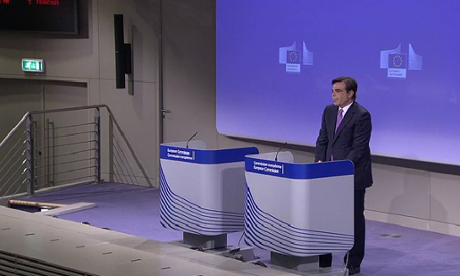
The EC’s top spokesman, Margaritis Schinas, is facing the Brussels press pack now.
They’re eager to ask about Greece, and he’s equally keen not to give too much away.
Asked about the state of play with negotiations, he says that the ball is “clearly” in Greece’s court, and says the latest proposals fall short of what Greece has promised.
Ow - EU's @MargSchinas says new Greek reform plan 'does not reflect' state of Juncker-Tsipras talks last week
— Danny Kemp (@dannyctkemp) June 10, 2015
Schinas declines to say whether the EC is insisting on a 1% budget surplus this year. That’s a matter for the negotiating table, not the press room, he says.
Will president Juncker meet with Alexis Tsipras today?
There is nothing scheduled at the moment, Schinas replies. [reminder, there are reports that Juncker has lost patience with Greece now]
@SpiegelPeter @PoliticoRyan . . . and in #BILD! pic.twitter.com/BnbExbhtXg
— Dirk Hoeren (@DirkHoeren) June 10, 2015
Updated
From Brussels, Spanish journalists Jorge Valero reports that creditors aren’t budging on Greek budget surplus targets.
They want Athens to commit to a primary surplus of 1% of GDP this year, rejecting the 0.75% it is offering, he says.
EU/#IMF insist #Greece must meet 1% primary surplus target this year, although mor flexible on measures (including pensions) if they r sound
— Jorge Valero (@europressos) June 10, 2015
Institutions are waiting for a new proposal from #Greece including primary surplus of 1% for 2015 (a must) and sound measures to achieve it
— Jorge Valero (@europressos) June 10, 2015
Updated
Leaders are arriving in Brussels for the Latin American summit; Brazilian President Dilma Rousseff is currently meeting Belgium’s Prime minister Charles Michel:

Own up, have any Greek readers been ordering owls?
From today's @dailytelegraph announcements the middle one has got be a coded message between spies surely? pic.twitter.com/iphMHdhQZN
— Rob Dex (@RobDexPA) June 10, 2015
Could it be related to ancient Greek currencies? Oliver Clarke of New College (hurrah!) reckons it might:
@RobDexPA @GeneralBoles @dailytelegraph Owls to Athens was the classical phrase equivalent of coal to Newcastle, from Athenian coinage
— Oliver Clarke (@Astroclassicist) June 10, 2015
Despite the deadlock, Greece has just successfully auctioned almost €3bn of short-term debt.
That doesn’t solve its funding crisis, though. This money will be used to repay other short-term debt which matures shortly.
*GREECE SELLS TREASURY BILLS Well done !!!
— Steve Collins (@TradeDesk_Steve) June 10, 2015
More relevant: *INVESTORS BUY GREEK TREASURY BILLS https://t.co/h0hU56HEZW
— Ipek Ozkardeskaya (@IpekOzkardeskay) June 10, 2015
The buyers are probably Greek domestic banks, who are ‘rolling over’ their Greek sovereign debt holdings.
Greece’s latest proposal asks the European Central Bank to lift the cap which stops Greek banks from buying more of these bond - that seems very unlikely unless a deal is in sight.
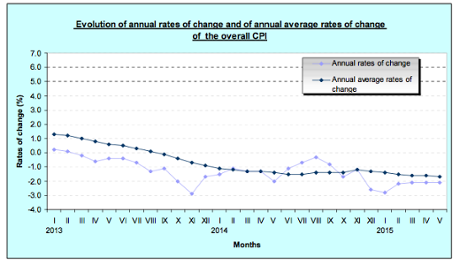
Greece remains deep in deflation, as prices continue to be forced down across the country.
Elstat reports that the Greek consumer prices index fell by 2.1% year-on-year in May, unchanged from April.
If Angela Merkel and Francois Hollande do give Alexis Tsipras the cold shoulder tonight, the Greek crisis could then switch to the capital of Slovakia:
If no meeting tonite between @atsipras & #Merkollande, action moves to #Bratislava (!). Euro working group meeting there at end of week.
— Peter Spiegel (@SpiegelPeter) June 10, 2015
Amid rumors that Tsipras-Merkel-Hollande meet may not happen, Greek gov source reports no feedback to revised proposals.
— NikiKitsantonis (@NikiKitsantonis) June 10, 2015
Updated
Demonstrators are already gathering in Brussels ahead of today’s summit:
#EU #CELAC summit has not startet yet, but first #Mexico protesters with good music on #Brussels streets. pic.twitter.com/Pg1Mmk8Bkr
— Dirk Hoeren (@DirkHoeren) June 10, 2015
Rumours are swirling that tonight’s informal meeting between the leaders of Greece, Germany and France might not happen!
A French insider has told Reuters that nothing’s scheduled in Hollande’s diary....
“No meeting is planned at this stage - we’ll see what happens when we get there.”
German officials are giving a similar line:
*GERMAN GOVT OFFICIAL SAYS MERKEL-TSIPRAS TALKS NOT CONFIRMED
— lemasabachthani (@lemasabachthani) June 10, 2015
So, Alexis Tsipras faces the prospect of being snubbed by the leaders of the eurozone’s two largest members at the EU-Latin American/Caribbean summit.

Over in Greece, pharmacists have gone on strike.
They are protesting against foreign-imposed demands that the pharmaceuticals industry opens up to allow customers to buy medicines in supermarkets.
Helena Smith reports
Up and down the country pharmacies have brought down their shutters in a mass display of defiance over the industry being liberalized.
Pharmacists are enraged, that five years into the crisis, supermarkets will now be allowed to sell medications, a move that creditors say is long overdue and will boost competitiveness but which industry figures insist will undermine business.
The anti-austerity government is clearly taking sides. Addressing the matter yesterday the health minister Panagiotis Kouroumblis said:
“The institutions [EU and IMF] have obsessions which unfortunately cannot be explained … as there is no problem with the issue of competitiveness.
We are fighting to [stop] this obsession becoming reality. We will fight until the last moment.” <end>
Greece’s lenders, though, believe that Greece’s pharmacy sector lacks competition. They have also pushed for rules on opening hours, and how many customers each chemist can serve, to be liberalised too.
Michael Fuchs also denied that the German parliament could split over Greece.
Fuchs, who is deputy chairman of the CDU party, reckons that European leaders simply won’t agreed a deal that isn’t broadly similar to the old plan.
That means Angela Merkel wouldn’t need to put contentious plans before the Bundestag.
And while he hopes Greece says in the eurozone, he doesn’t accept that Grexit would scupper the single currency (as Tsipras argued in an interview yesterday).
German CDU lawmaker Fuchs at BBG TV: We want #Greece to stay in the Euro BUT Euro won't fail without Greece. #Grexit
— Holger Zschaepitz (@Schuldensuehner) June 10, 2015
#Germany CDU MP Fuchs: If #IMF pulls out [of #Greece programme], Germany will too.
— Yannis Koutsomitis (@YanniKouts) June 10, 2015
Updated
Merkel ally: Greece's proposals aren't serious
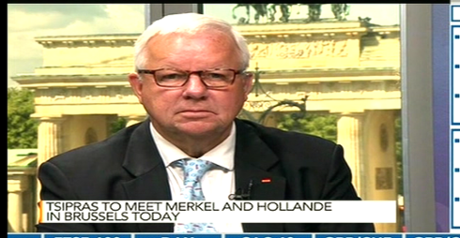
An influential member of Angela Merkel’s CDU party, Michael Fuchs, has just cast serious doubt on the chances of a breakthrough soon, in a Bloomberg TV interview.
Fuchs, who is the deputy parliamentary floor leader of Merkel’s conservative bloc, also criticised the Greek government’s latest proposal, which includes help from the eurozone bailout fund, and the ECB, to cover its funding needs this summer.
Here’s the key points:
Can Angela Merkel make progress with Alexis Tsipras at today’s EU summit?
It’s very difficult, becuase Mr Tsipras’s new proposal is ‘non-negotiable’, Fuchs replies.
It is far away from the bailout extension we agreed in February and what we agreed with Mr Samaras (Greece’s former PM).
If there is any change to the second [bailout] package, it must go to the Bundestag.
What they do at the moment is non-negotiable.
Can a deal be reached in time?
I hope a deal can be reached. But it is fully and only on Greece’ side.
Fuchs insists that he doesn’t want a Grexit:
We want Greece to stay in the euro, very much. It is our wish and will.....
But they need to come up with serious proposals, and what they are coming up with now is not serious at all.
"What Greece is now proposing is not serious" @drmfuchs tells @flacqua from Berlin. pic.twitter.com/1DzuZZubpD
— HansNichols (@HansNichols) June 10, 2015
Fuchs also criticised Greece’s finance minister Yanis Varoufakis, for telling Germany that they won’t get back all the money loaned to Greece and then asking for more help.
It is very hard to understand his position, Fuch concluded.
(I think that’s a reference to Varoufakis’s speech in Berlin on Monday night.)
Updated
Newsflash from Athens: Greece hasn’t had any feedback on its latest proposals, according to a government official.
GREECE HAD NO FEEDBACK FROM CREDITORS ON ITS PROPOSALS: GOVT
— Steve Collins (@TradeDesk_Steve) June 10, 2015
Not encouraging...
Today’s EU-Latin American summit begins at 2pm Brussels time (1pm BST).
Alexis Tsipras’s best hope of cornering Angela Merkel and Francois Hollande for talks (assuming it happens) is probably in the evening.
-
14:00 - official welcome
-
14:30 - opening session
-
15:30 - first working session on “Reinvigorating the bi-regional partnership”
-
17:00 - second working session on “Facing together global challenges”
- 19:00 - social dinner
The summit continues tomorrow.
Updated
Here we go! The 10 year bond (bund) yield of Germany that dropped so recently to 0.07% has now reached 1% #ECB #QE
— Shaun Richards (@notayesmansecon) June 10, 2015
German 10y yield now = 1.01% German 10y yield on day #ECB announced QE = 0.45%
— RANsquawk (@RANsquawk) June 10, 2015
Back in the UK, the boss of Sainsbury has blamed “strong levels of food deflation” and “highly competitive pricing” for its latest drop in takings. Good news for consumers!
CLUNK. The yield on Germany’s 10-year bonds just hit 1%, up from 0.96% last night.
That means Germany’s benchmark government debt is offering its highest rate of return since last September 2014.
A blow to any investor who piled into safe-haven German debt in recent months, helping to drive the yield (or interest rate) to almost zero.
The City mantra used to be “never sell the bund”. But not any more.....
Never ever sell the OH WAIT pic.twitter.com/0Lg5YprNHH
— Katie Martin (@katie_martin_fx) June 10, 2015
Updated
European markets fall again
European stock markets are falling again this morning, having hit their lowest level since mid-February yesterday:

Greece is one factor, of course, but traders are also reacting to the selloff in the government bond market.
Bond prices are falling, pushing yields higher, as the long bull market begins to unwind....
#Germany's Dax continues to drop on Bund rout. pic.twitter.com/jNPX8D6bS2
— Holger Zschaepitz (@Schuldensuehner) June 10, 2015
The general mood is the markets is quite glum, as Christ Weston of IG puts it:
There is little conviction in equity buying at present and clearly a catalyst is missing that would provide the confidence needed.
Deadline not this week, but June 30. Two more weeks of this madness. And don’t expect any heroics from Merkel. http://t.co/5k79LAUuoq
— Wolfgang Munchau (@EuroBriefing) June 10, 2015
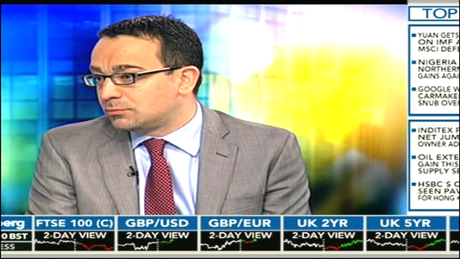
Even though Greece is running short of allies in the eurozone, Wolfango Piccoli of Teneo Intelligence believes Tsipras will eventually be given a ‘take-it or leave it” deal.
He’s on Bloomberg TV, explaining that:
If you look around Europe, in Berlin, Paris, Frankfurt, the position has not change, they want Greece to stay in the eurozone”
But that deal could be hard to sell at home, and could potentially split the Syriza coalition of left-wing groups.
If Tsipras takes it to parliament it will get passed, because the opposition will support it.
But at the end, Tsipras might not have a majority any more.
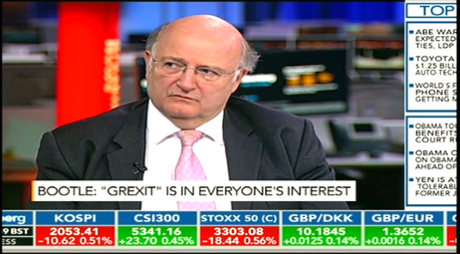
Roger Bootle, the managing director of Capital Economics, believes it’s “only a matter of time” until Greece leaves the euro , and it would be in both sides interest to do so.
This is an economy where output has fallen by 25% - that is catastrophic, similar to the US Great Depression, he told Bloomberg TV.
We’ve seen nothing like it in an advance economy in the second half of the 20th century.
But doesn’t that prove that Greece must reform its economy, as its lenders demand?
Reforms are needed, Bootle agrees, but you simply cannot solve a problem of lack of demand with structural reforms.
In fact, some of those structural reforms will make the demand problem worse.”
Updated
Angela Merkel and Francois Hollande are not the only leaders the Greek prime minister Alexis Tsipras will be meeting on the sidelines of today’s EU/Latin America summit.
Helena Smith has the details:.
The Greek government has announced that Tsipras will be holding talks with a number of leaders from the region - many heroes of the radical leftist. In order of appearance, the Greek government has listed the interlocutors as:
- President of Chile, Michelle Bachelet
- President of Brazil, Dilma Rousseff
- President of Bolivia, Evo Morales
- President of Ecuador, Rafael Correa
- Vice president of Cuba, Miguel Diaz-Canel
- Foreign minister of Argentina, Héctor Timerman
Tellingly, the Greek government made the announcement hours after EU commission president Jean Claude Juncker, still clearly incensed over Tsipras’ denunciation of the proporsed reform package by lenders, let it be known that it would be “a waste of time” to meet the Greek leader.
Juncker said he would be better off meeting Latin Americans. And he’s sticking to that stance today:
EU Commission President Juncker not willing to meet Greek PM Tsipras today in Brussels. There is no basis for further talks, EU sources say.
— Stefan Leifert (@StefanLeifert) June 10, 2015
Greece and creditors still disagree
Bloomberg is reporting that “no progress” has been made between Greece’s negotiators and the creditors in recent days:
#Greece, creditors said to disagree on targets, measures, BBG reports. Talks said to make no progress this week.
— Holger Zschaepitz (@Schuldensuehner) June 10, 2015
So, Greece’s latest offer of budget surplus targets (close, but still below the old bailout targets) is still unacceptable.
That doesn’t bode well for Tsipras’s meeting with Merkel and Hollande this afternoon.
It may also dampen the mood at the European Central Bank, which will decide today whether to continue providing emergency liquidity assistance (ELA) to the Greek banking sector.
So what should a rule-based institution do reviewing ELA today? *GREECE TALKS THIS WEEK SAID TO MAKE NO PROGRESS TO END IMPASSE
— Frederik Ducrozet (@fwred) June 10, 2015
Updated
The Agenda: Greek PM to meet Merkel and Hollande (probably)
Good morning, and welcome to our rolling coverage of the Greek bailout crisis and other events across the world economy, the financial markets, and business.
Greece is running short of time, and allies.
Prime minister Alexis Tsipras is heading back to Brussels today for another meeting with the leaders of Germany and France, in yet another attempt to broach a compromise and unlock bailout funds for his country.
But the meeting with Angela Merkel and Francois Hollande, on the sidelines of the EU summit with Latin American and Caribbean nations, is unlikely to deliver a breakthrough, as Athens and her creditors remain divided over the measures that Greece must take.
There’s even some doubt that the meeting will actually happen, after one official warned:
“If there is no movement, there is no meeting,”
“Germany and France don’t see the point of a meeting for now.”
As we covered on Tuesday’s liveblog, Greece’s latest three-page proposal has been slapped down privately by EU officials, for still not going far enough on budget targets, pension reforms, VAT rates....
And the European Commission is also losing patience with Athens. An exasperated President Jean-Claude Juncker has told fellow commissioners that a new Tsipras meeting would be a “waste of time”.
Juncker told commission meeting Tsipras tmrw 'waste of time', wd be 'better off meeting Latin Americans' - sources https://t.co/h0aLd5GxA9
— Danny Kemp (@dannyctkemp) June 9, 2015
So, something of a mess, given Greece’s bailout expires in under three weeks.
Also coming up today....
European stocks are expected to dip again today, extending the recent selloff. Here’s IG’s opening calls:
-
FTSE 6748 -5,
-
DAX 10990 -11,
-
CAC 4839 -11,
-
IBEX 10911 -27
-
MIB 22555 -28
UK supermarket chain Sainsbury’s is in focus, after reporting its sixth straight quarter of falling sales:
Sainsbury's like-for-like sales in first quarter down 2.1% (excl fuel), down 3.7% inc fuel, blames strong food deflation and competition
— Julia Kollewe (@JuliaKollewe) June 10, 2015
And late tonight in London it’s the Mansion House speech, where the chancellor and the governor of the Bank of England address the great and good of the City.
I’ll be tracking all the main events through the day....