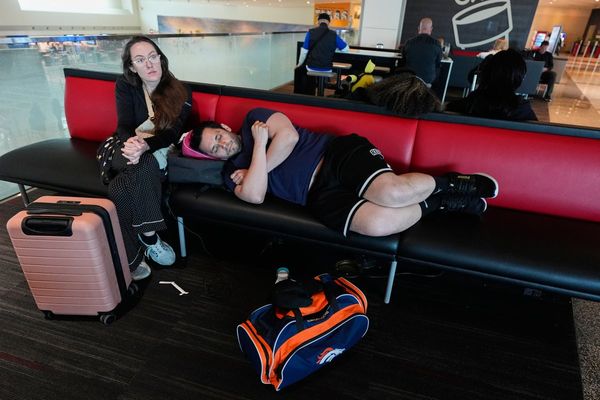
Hospitals are struggling under pressure as general beds fill up with Covid-19 patients - leaving people waiting hours longer than they should for emergency help in A&E.
The number of Covid patients hospitalised in general beds has increased by more than a third in just three weeks.
And as infection rates remain high, patients are 'staying in hospital for longer', according to the region's health bosses.
The high volume of Covid patients in general beds has had a knock-on effect on the amount of time people spend in A&E, say hospital chiefs.
Those patients are often showing up with conditions that have worsened during the pandemic, due to a delay in treatment as people were naturally concerned about going to hospital at the peak of virus transmission.
The severity of cases is also being coupled with a general rise in the demand for urgent and emergency care, according to a host of doctors from across the region who have shared their concerns with the Manchester Evening News .
They say that, as people continue to mix socially as they have refrained from doing over the last 18 months, general coughs, colds and viral illnesses are spiking, leading people to seek help at hospital.
With a lack of beds for people needing admission after turning up at A&E, they are instead forced to wait for hours longer than they should, with one A&E seeing ‘70 per cent’ of patients waiting more than four hours in A&E last weekend.
Making matters worse, infection control measures are still crucial in hospital, according to Greater Manchester leaders, 'impacting on the capacity of already very full hospitals and the speed with which patients can be treated'.
Wythenshawe Hospital’s A&E department was filled with patients waiting for hours over the last weekend, October 30 and 31.
The proportion of patients being seen within four hours - the waiting time target which is in force across all of the region’s emergency units - should be at 95 per cent.
But over the course of last week, October 30 and 31, Wythenshawe saw its fulfilment of that target plummet to just ‘20 to 30 per cent’, the Manchester Evening News understands.

The dramatic decline in service comes as the region’s health bosses admit Greater Manchester hospitals are feeling the pressure.
A spokesperson for Manchester University NHS Foundation Trust, which manages Wythenshawe Hospital, said: “Similar to other healthcare providers, we are experiencing a very high level of demand in our Emergency Department (ED) at Wythenshawe Hospital.
"We have robust processes in place to help us manage increased demand, with staff focusing on safe patient care. All patients attending emergency departments are seen in order of clinical priority, so those attending with minor ailments will be waiting for longer than more seriously ill patients. "

A Greater Manchester Health and Social Care Partnership spokesperson added: “We are seeing very high levels of attendance at A&E departments across Greater Manchester, which is impacting on how long patients are having to wait for treatment.
“Patient safety remains our top priority and we are working hard to reduce the time people need to spend in hospital and to increase the number of people that can be treated in the community in order to ease some of the demand on hospitals.
“If anyone needs help, they should always seek it - the NHS will always be there for them, but the public can support us by considering the most appropriate options, contacting NHS 111 first or visiting NHS online to be advised of the best healthcare provider for their needs.”
But, with the most challenging months for the NHS still to come, the latest figures paint stark portrait of the situation in Greater Manchester's hospitals.
The weekly admissions to hospital for Covid-19 have risen from 131 as of October 19, to 146 as of November 1.
The number of ICU beds being occupied by Covid patient has also seen an upward swing, going from 51 on October 19 to 58 by November 1.
Perhaps the most drastic increase is that of the number of general beds being taken up by Covid admissions, rising from 371 on October 19 to 432 by the start of this month.
Meanwhile, at A&Es across Manchester University NHS Foundation Trust alone, attendances lasting over four hours ran more than 14,000 in the month of September - the latest figures publicly available.
That figure is a rise on the previous month, August, when just shy of 12,000 attendances at the trust's A&E departments ran beyond four hours.
The trust also operates North Manchester General Hospital, Manchester Royal Infirmary, the Royal Manchester Children's Hospital, among other locations.
Within other hospital trusts in Greater Manchester, which cover units like Salford Royal and Fairfield General, waiting times at A&E are similarly skyrocketing.
In Greater Manchester's hospitals and beyond, doctors say they are finding it difficult.
"We're all in a pretty similar position, we're all under a lot of pressure," emergency medicine consultant and North West chair of the Royal College of Emergency Medicine, Andy Ashton, told the M.E.N.
"During Covid, we were under pressure because it was a new illness, we didn't know a lot about it or how to treat it. But levels of attendances at A&E were very low. Every day was Christmas Day levels of attendance.
"Since around May this year, attendances have gone right back up again, but the thing that is putting all of us in the emergency departments under pressure is that hospitals have very high bed occupancy, and very high levels of patients awaiting discharge into social care.
"It's very difficult to get patients discharged, which means the hospital is full and it overflows into the emergency department. That department is then filled with patients waiting to get into the hospital, it spills forward into them being in the corridor.
"What that means is, it makes the situation when we come on shift feel very overwhelming. You've got your normal areas where you work are full, you're having to work in different areas and there's just a lot more patients in the department.
"All of my Manchester colleagues say they are absolutely under the cosh. I have to keep five per cent of my brain saying 'don't be overwhelmed, just focus on what's in front of you, keep going.' I've never really had to do that before.
"It's very uncomfortable for the patients because we're seeing them in places we shouldn't be seeing them. In terms of privacy and dignity, if you're waiting on a corridor, we're not doing everything we'd like for them."
See the latest news in your area by receiving email updates.