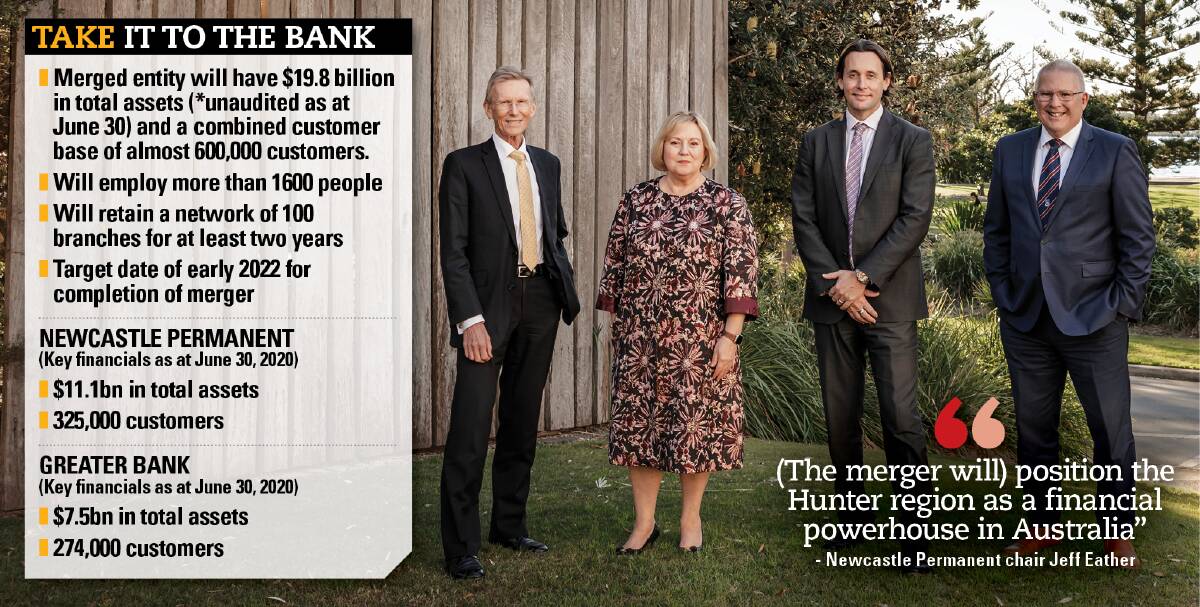
There will be no forced redundancies and all branches would remain open for the first two years of a proposed merger of the Newcastle Permanent and Greater banks.
The assurance was front and centre of yesterday's historic announcement that the two Hunter financial institutions intended to join forces to become Australia's largest customer-owned bank.
In announcing a memorandum of understanding, executives from the banks said the logic supporting the merger was "compelling" given technological advancements and an increasingly competitive marketplace.
The merged entity, which could be a reality in early 2022, would hold $19.8 billion worth of assets and have 600,000 customers.
In addition to guaranteeing that there would be no forced redundancies among the combined 1600-person workforce for at least two years, Newcastle Permanent chief executive Bernadette Inglis said she expected the merged entity would continue to be a major employer in the region.
"We actually want to be a large employer and provide a variety of roles for people," she said.
"Those roles might change over time as our business changes and our customer needs change and as the services that we provide change. We have every intention of being a large and vibrant employer and provide diverse career paths for our people."
The institutions were globally recognised this year as the top two Australian-owned financial institutions in the Forbes annual ranking of World's Best Banks.
Ms Inglis would be the chief executive of the new entity, while the Greater Bank's Scott Morgan would be deputy chief executive.
Mr Morgan said ongoing success was dependent on institutions' ability to rapidly adapt, meet evolving customer expectations and new regulatory demands.
"This merger will allow us to be a genuine competitor with the major banks," he said.
"Our DNA is built in our collective histories but our future is not guaranteed by standing still or looking in the rear view mirror at past success.
"Unfortunately it is a fact of life that small organisations can be at a disadvantage in keeping pace with the required investment with frequent and complex technological advancements.
The merger is the latest example of consolidation that has seen the number of mutuals in Australia fall from 200 to just 70 over the last ten years.
"Mutual banks without scale and financial strength will in the longer term be unsustainable," Mr Morgan said.
He said COVID-19 had accelerated the rate of change relating to customer expectations and technology.
"It makes a lot of sense for us to face that challenge as a combined organisation rather than facing into it alone," he said.