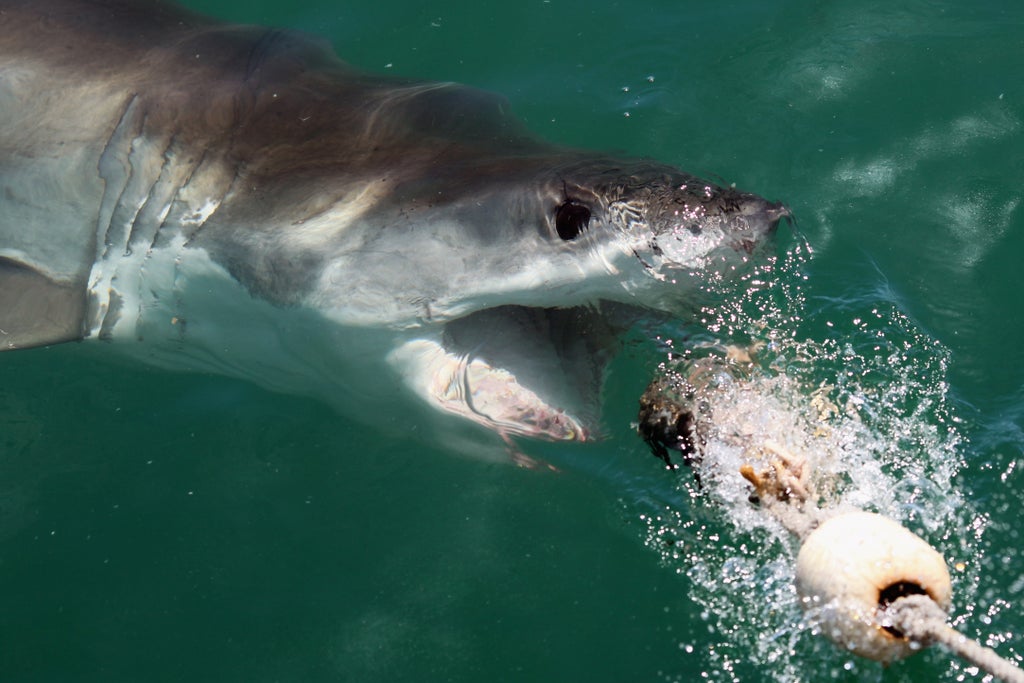
Great white shark attacks on humans are often a case of mistaken identity, new research suggests.
A study by the Macquarie University in Australia found that the predators sometimes attack because they have mistaken surfers and people swimming for seals and sea lions.
In a first, scientists filmed seals and sea lions as well as humans in the water, and simulated the footage into a “shark vision” model to match the vision of juvenile
The study, published in the Journal of the Royal Society Interface, found that juvenile great whites cannot significantly tell the difference between the life forms.
“We found that surfers, swimmers and pinnipeds (seals and sea lions) on the surface of the ocean will look the same to a white shark looking up from below because these sharks can’t see fine details or colours,” said Laura Ryan, a post-doctoral researcher in animal sensory systems at Macquarie University’s Neurobiology Lab.
The findings, the researchers believe, shed more light on why certain sharks, such as the great whites, as well as bull and tiger sharks bite humans, and also help develop non-invasive vision-based devices to potentially protect surfers and swimmers from the marine beasts.
In the study, scientists compared underwater videos of rectangular floats, seals, people swimming different strokes and humans paddling on variously-sized surfboards in a large aquarium at Taronga Zoo, with both stationary and travelling cameras directed at the water surface.
They applied filters to the video footage with shark neuroscience data and used modelling programs to simulate the way that a juvenile white shark would process the movements and shapes of the different objects.
When humans swim and paddle surfboards, they bear a strong resemblance to seals and sea lions to a juvenile white shark, Dr Ryan said.
Smaller surfboards were harder to distinguish from the pinnipeds, the researchers say, adding that these might pose a “more tempting quarry” than longboards or even stand-up paddleboards to white sharks.
Since most sharks are completely colour-blind, the scientists say the main visual cue for white sharks is the silhouette shape. Therefore, colours on the boards and the wetsuits worn are unlikely to change sharks’ impressions of floating humans, they added.
While shark bite incidents have risen in the last two decades, the marine beasts are also endangered, with attack mitigation measures like shark nets and drumlines further threatening them.
“Understanding why shark bites occur can help us find ways to prevent them, while keeping both humans and sharks safer,” Dr Ryan says.