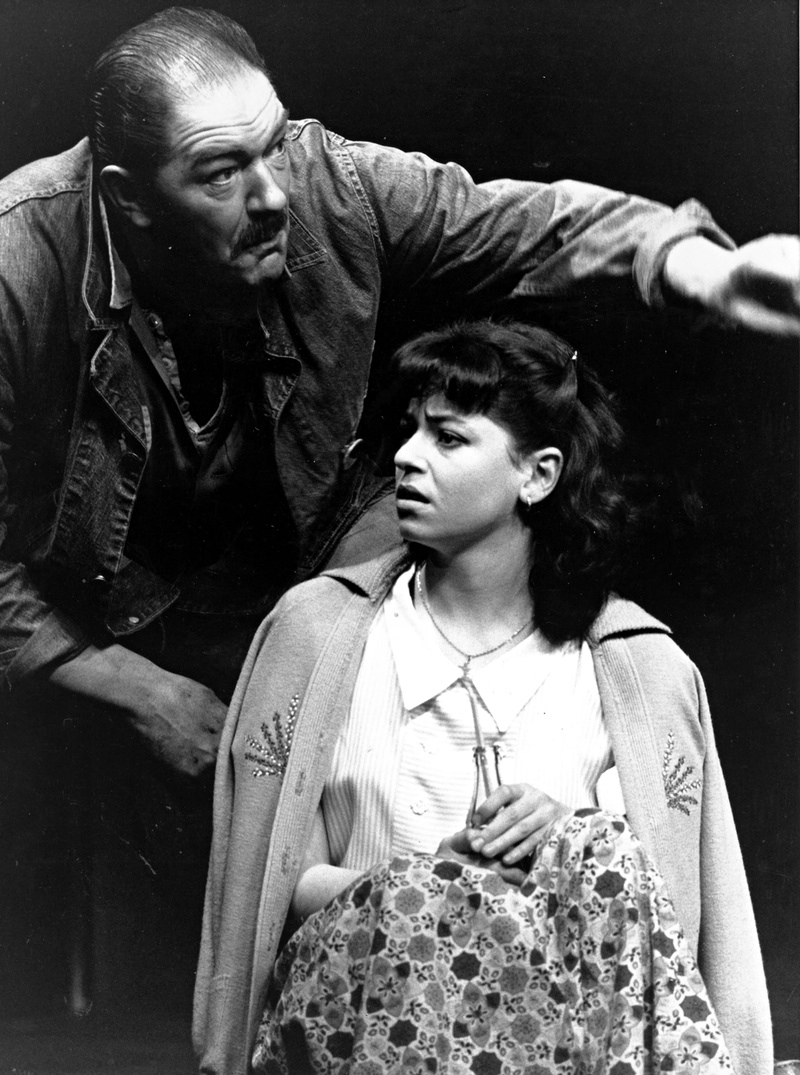
Michael Gambon has talked openly about his enforced retirement from the stage, although not from television, because of difficulty retaining lines. But, when you meet Gambon he still has the aura of a great actor. It’s partly the result of his massive physical presence, his pouched, seamed, highly expressive face and a voice that can seemingly hit all registers from basso profundo to light tenor. If I had to choose one performance that was a testament to Gambon’s greatness, it would be his Eddie Carbone in a 1987 National Theatre revival of A View From the Bridge. People talk excitedly of Ivo van Hove’s recent Young Vic version with Mark Strong. But good as it was, I still prefer Alan Ayckbourn’s more naturalistic production, which reminded us that Arthur Miller’s play is a social, as well as a psychological, tragedy.
Gambon started with the advantage of looking like everyone’s idea of a Brooklyn longshoreman. He is big, barrel-chested and has muscular forearms which told you that this was a character who could work the docks and heave coffee-bales. Gambon also defined Eddie’s unhealthy obsession with his niece, Catherine, through precise physical actions. Learning she had got a job, he stabbed a tablecloth angrily with his fork. When he heard the immigrant Rodolpho call her beautiful, he turned on the boy with a blood-freezing stare (something he may well have picked up from watching Olivier). Seeing Catherine and Rodolpho quietly courting also drove Gambon’s Eddie to paroxysms of furtive jealousy as he sat in a chair glaring restlessly at an evening paper.
All great acting carries with it a sense of danger and unpredictability: something famously unleashed in this production when Gambon picked up a table and hurled it violently at a wall. I learned only recently that this electrifying moment stemmed from Ayckbourn needing to find a way of getting rid of the table in time for the next scene. But there was more to Gambon’s Eddie than inarticulate rage. As I wrote at the time, Gambon showed a Brando-like capacity to suggest the sensitivity lurking inside a muscular frame. When Eddie told his wife that his inexplicable passion was breaking his heart, it was with the beautiful melancholy of the uncomprehending. And, after Eddie’s final phonecall to the immigration authorities, Gambon’s knees sagged and buckled in awareness of his guilt at having betrayed the laws of his tribe.
Tragedy, we’re always told by the textbooks, involves a downfall from a great height. Gambon’s magnificent performance proved that the capacity for limitless suffering transcends class and status.