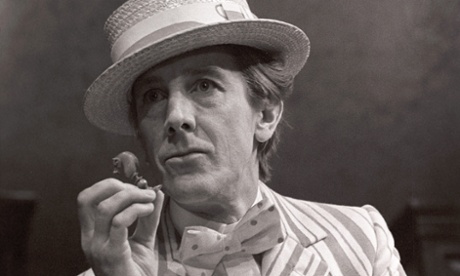
Intelligence in acting takes many forms. In the case of Olivier, it showed itself in an extraordinary interpretative originality. It was a totally different type of intelligence from that of actors such as Simon Russell Beale, Ian McKellen and Michael Pennington, who bring to their work well-schooled, academically trained minds.
But of the all the actors I’ve come across in the past four decades, the most formidable brain box was John Wood, which is what made him not only a close friend of Tom Stoppard but also an ideal interpreter of his work. It was in Stoppard’s Travesties in 1974 that Wood gave one of those performances that leave one gasping in admiration.
Wood played Henry Carr, a minor consular official in Zurich in 1917 who imagined himself to be a pivotal figure in a political, literary and artistic revolution. As the aged, reminiscent Carr, Wood was a querulous figure in a battered Panama and dressing gown. As the sprightly younger Carr, speeding through Zurich in blazer and boater, he resembled a Max Beerbohm cartoon in perpetual motion. But it wasn’t just the lightning contrasts between age and youth that made the performance so dazzling. It was the vocal control that enabled Wood, in Carr’s recall of his encounters with James Joyce, Lenin and Tristan Tzara, to make it sound as if Stoppard’s hurtling phrases were spun from his own brain.
But intellect alone doesn’t make a great actor. Wood also had the ability to strip away the accretions of the past and get to the essence of a character. As Brutus in an RSC Julius Caesar, Wood buried for ever the idea of the character as a noble idealist: instead, he gave us a pigheaded autocrat wrong in every decision he makes.
Wood also brilliantly brought out the contradictions in King Lear by famously rushing up to Goneril, having wished on her the most terrible curses, and rapturously embracing her.
Wood was especially expert at playing characters, such as Sherlock Holmes, whose rational exterior was the mask for a furious neurosis.
I once got a clue to Wood’s gift when he told me that he was a great admirer of Jerry Lewis, in several of whose films he appeared. Wood cited one particular example of a scene where Lewis had to put down all the balls on a pool table at one stroke and did it in a single take. “You can’t call it risk-taking,” said Wood, “because it’s not acknowledging there are any risks to take.” Something of that approach rubbed off on Wood in Travesties in that he achieved perfect balance on the high wire of Stoppard’s prose without once contemplating the abyss beneath.