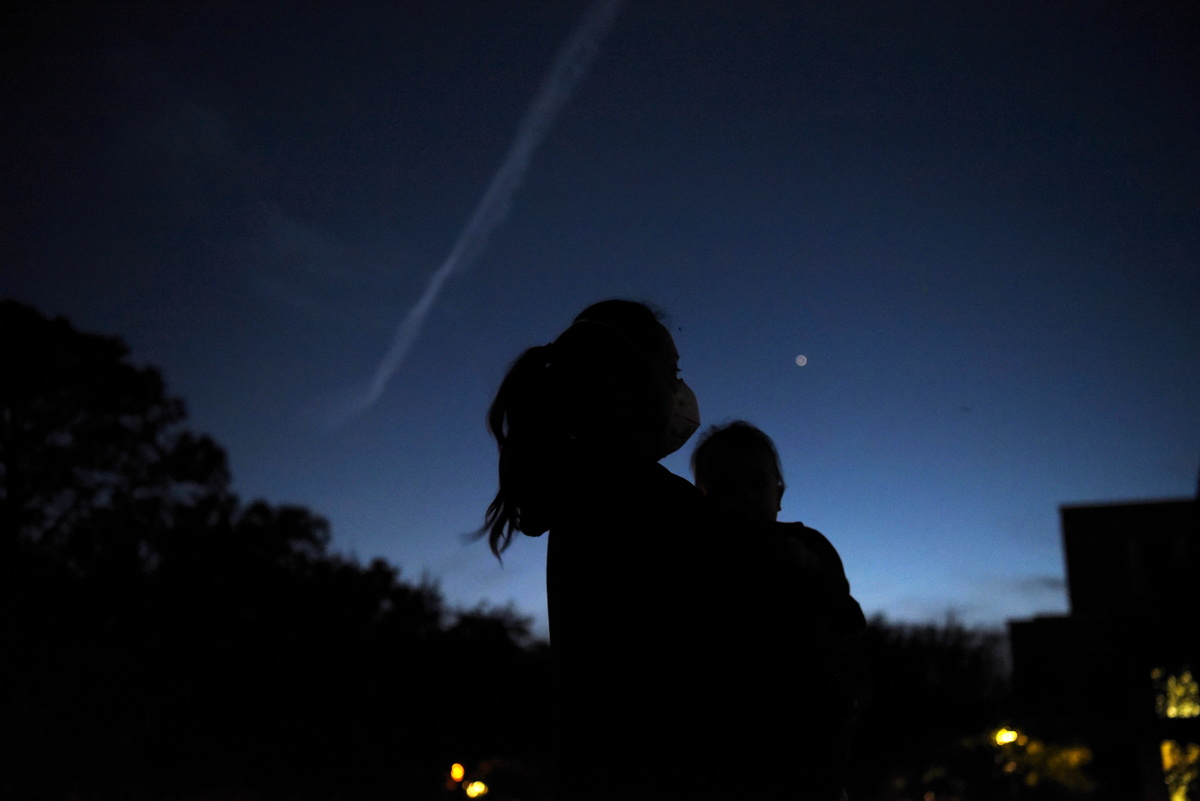
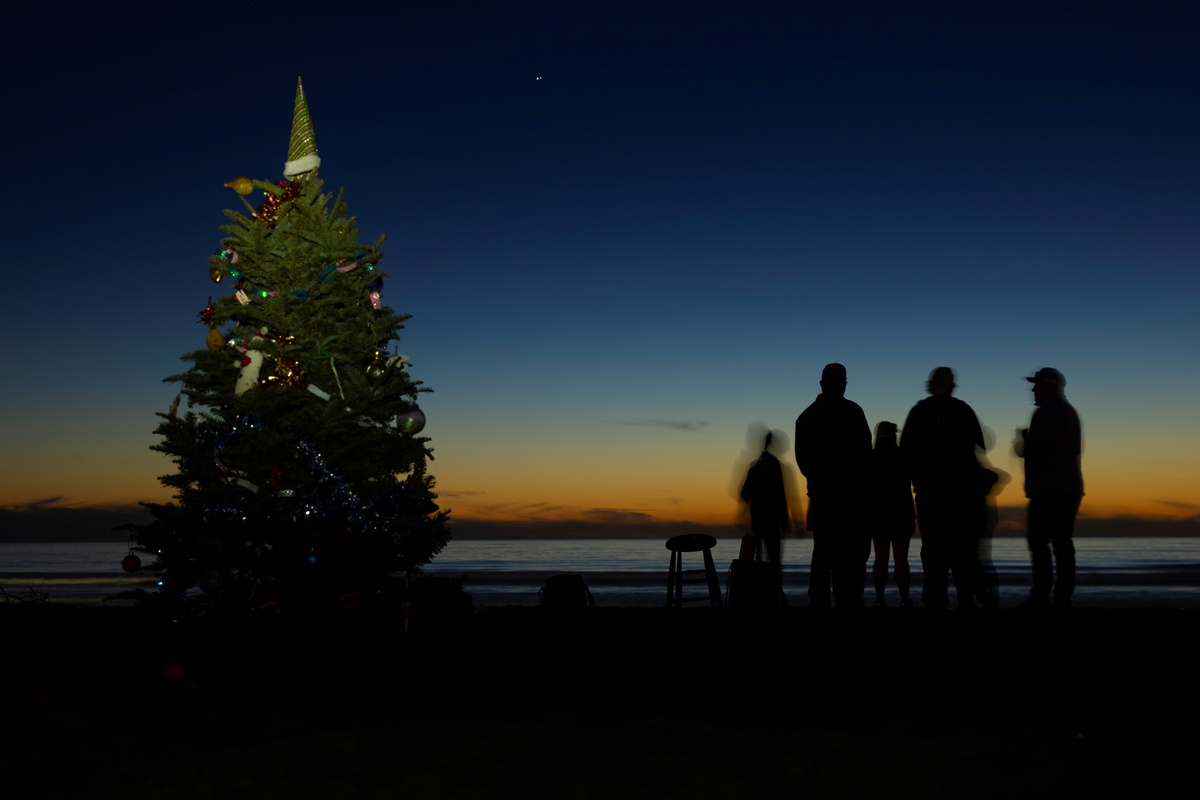
The evening sky over the Northern Hemisphere treated stargazers to a once-in-a-lifetime illusion on Monday as the solar system's two biggest planets appeared to meet in a celestial alignment that astronomers call the "Great Conjunction."
The rare spectacle resulted from a near convergence of the orbits of Jupiter and Saturn that happened to coincide with Monday's winter solstice, the shortest day of the year. For those able to observe the alignment in clear skies, the two frozen-gas spheres appeared closer and more vibrant - almost as a single point of light - than at any time in 800 years.
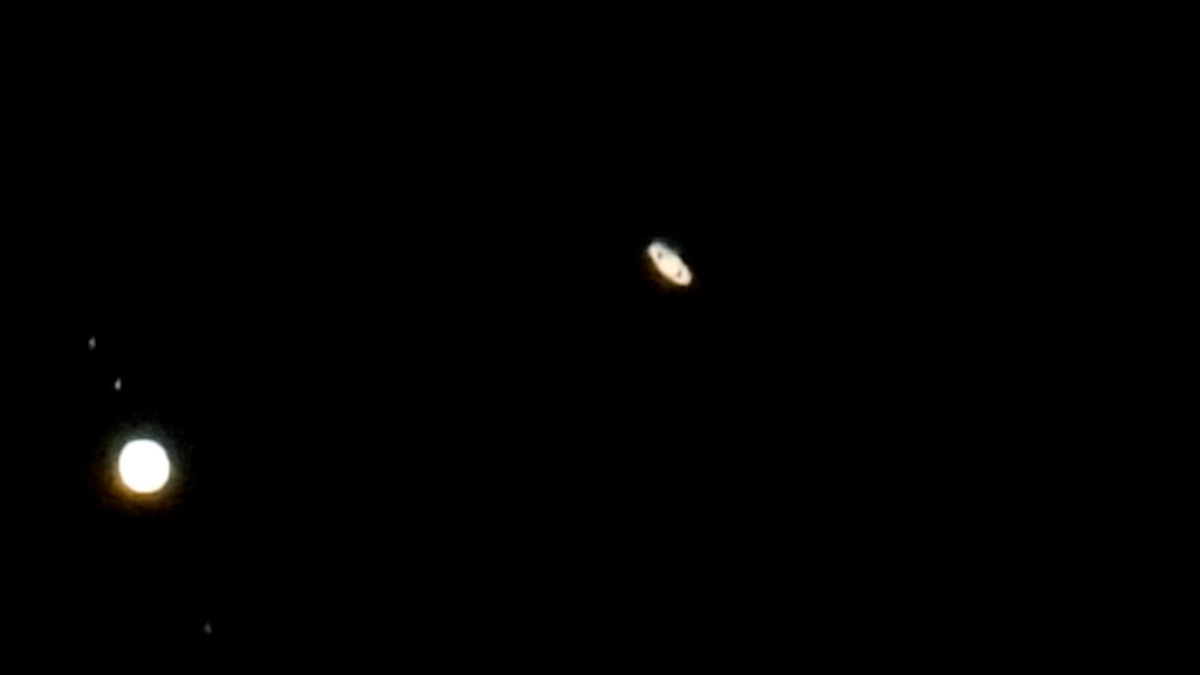
Jupiter - the brighter and larger of the pair - has been gradually nearing Saturn in the sky for weeks as the two planets proceed around the sun, each in its own lane of an enormous celestial racetrack, said Henry Throop, an astronomer at National Aeronautics and Space Administration headquarters in Washington.
"From our vantage point, we’ll be able to be to see Jupiter on the inside lane, approaching Saturn all month and finally overtaking it on Dec. 21,” Throop said in a statement last week.
At the point of convergence, Jupiter and Saturn appeared to be just one-tenth of a degree apart, roughly equivalent to the thickness of a dime held at arm's length. In reality, of course, the planets remained hundreds of millions of miles apart, according to NASA.
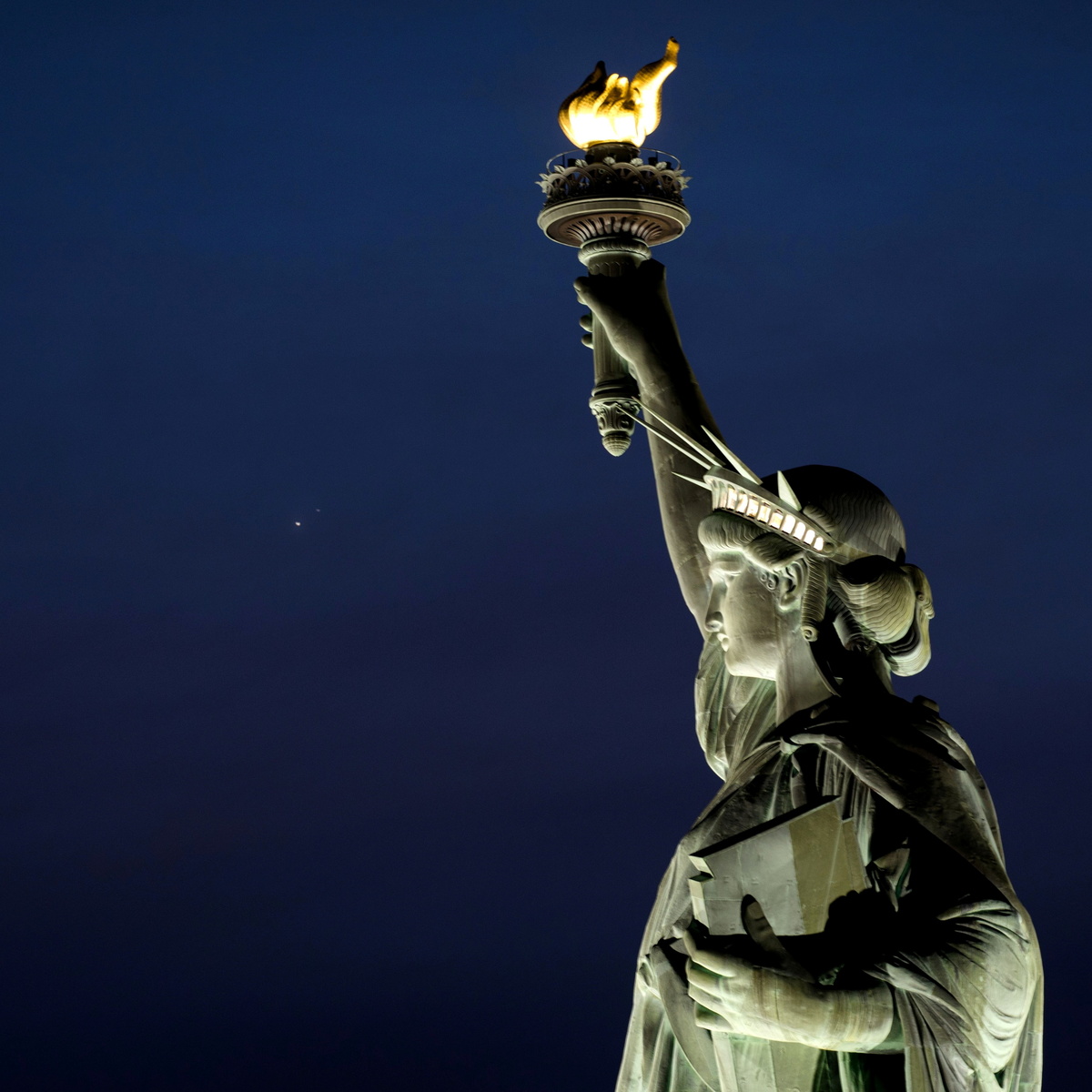
A conjunction of the two planets takes place about once every 20 years. But the last time Jupiter and Saturn came as close together in the sky as on Monday was in 1623, an alignment that occurred during daylight and was thus not visible from most places on Earth.
The last visible great conjunction occurred long before telescopes were invented, in 1226, halfway through construction of the Notre Dame cathedral in Paris.
The heightened brightness of the two planets as they almost merge in the sky has invited the inevitable speculation about whether they formed the "Christmas star" that the New Testament describes as having guided the three wise men to the baby Jesus.
But astronomer Billy Teets, acting director of Vanderbilt University’s Dyer Observatory in Brentwood, Tennessee, said a Great Conjunction is only one of several possible explanations for the biblical phenomenon.
"I think that there is a lot of debate as to what that might have been,” Teets told WKRN-TV in Nashville in a recent interview.
Astronomers suggested that the best way to view Monday's conjunction was by looking toward the southwest in an open area about an hour after sunset.
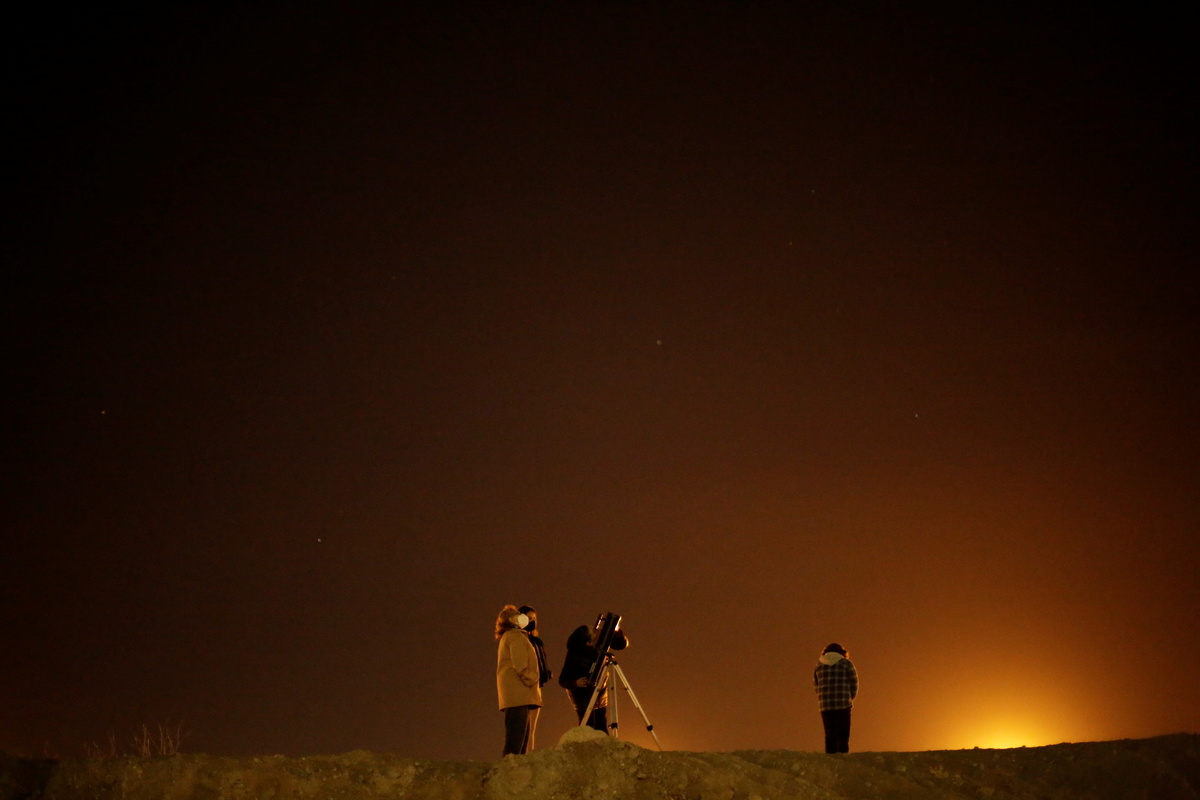
"Big telescopes don't help that much, modest binoculars are perfect, and even the eyeball is okay for seeing that they are right together,” Jonathan McDowell, an astronomer at the Harvard-Smithsonian Center for Astrophysics, wrote in an email to Reuters.
The next Great Conjunction between the two planets — though not nearly as close together — comes in November 2040. A closer alignment similar to Monday’s will be in March 2080, McDowell said, with the following close conjunction 337 years later in August 2417.
(Reporting by Peter Szekely in New York; Additional reporting by Joey Roulette in Washington; Editing by Lisa Shumaker and Sonya Hepinstall)