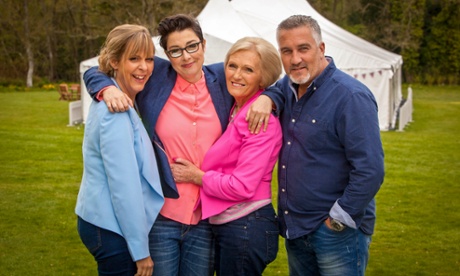
The BBC could face a battle to hold on to its most popular show, The Great British Bake Off, with the corporation’s financial constraints a potential sticking point of any new deal with the show and its presenters, Mel Giedroyc and Sue Perkins.
Last week’s final of the BBC1 show, won by Nadiya Hussain, was the most watched TV show of 2015 to date with a peak audience of 14.5 million viewers.
Despite the success of the show, which has a bigger audience than BBC1’s Saturday night hits such as Strictly Come Dancing, Giedroyc and Perkins are not believed to be among the BBC’s highest earners.
The series is made by Love Productions, which is 70% owned by Sky, with the BBC’s current three-year deal for the show running out after next year’s seventh series.
Negotiations around a new deal, expected to start imminently, come at a time when the BBC’s finances are under pressure as it negotiates its future size and funding with the government, and the amount it pays its top stars is under close scrutiny.
Any move away from the BBC would allow for greater commercial opportunities, such as product placement, but would have to be balanced against the dip in audience in its new home away from BBC1, the most-watched channel in the UK.
Off-screen, the programme’s judges Mary Berry and Paul Hollywood sell a huge number of recipe books and products from T-shirts – “Paul says get your bake on” – to egg cup and spoon sets.
Last week’s record ratings have given Love Productions the whip hand in the negotiations around a new deal.
“The BBC is in a hefty bind here,” said one industry source. “The question is how far they can push it given the current strictures the corporation is under.
“Paul and Mary have had massive revenue streams off merchandise like cookbooks and so forth. Mel and Sue are arguably a more important part of the mix but they have had none of that.”
There would be no shortage of rival broadcasters keen to take the show, which began on BBC2 five years ago with an audience of just 2 million viewers.
The uncertainty around the show echoes the situation around another BBC1 show, Saturday night talent show The Voice.
Like The Great British Bake Off, it is also made by an independent producer owned by a rival broadcaster (ITV-owned Talpa Media, which makes it in association with Wall to Wall) and the BBC’s deal to show it will also run out after next year’s series, its fifth.
It reflects a changing media environment in which independent producers, who the BBC looks to for a large number of its hits, are increasingly owned by commercial broadcasters.
One of the BBC’s biggest hits, the first final of the show was watched by 2.5 million viewers in 2009.
It grew by around 2 million viewers ever year to 8.4 million by 2013, when it was won by Frances Quinn, before leaping another 50% to 12.3 million last year, its first after it switched form BBC2 to BBC1.
This year’s final saw a further increase of more than a million viewers to an average of 13.4 million and a five-minute peak of 14.5 million. The show was highlighted by the BBC in its response to the government’s green paper on the future of the BBC last week.
Both Love Productions and the BBC declined to comment.