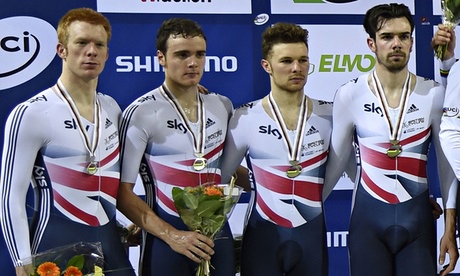
Great Britain’s second team pursuit silver medal of Thursday night followed rapidly on from a bitter defeat for the women’s quartet, but for the men second place came in a completely different context.
After their disastrous eighth place in Colombia last year, the men’s team pursuit quartet would have willingly taken a medal of any colour here, and Ed Clancy, Steven Burke, Andy Tennant and Owain Doull could look back on an enthralling, closely fought final against New Zealand, winners by just under seven tenths of a second.
This was the fastest world pursuit final since the Olympic decider in London, with both finalists well below 3min 55sec, and although the record Burke and Clancy set with Geraint Thomas and Peter Kennaugh in London was never under threat, the overall speed of this series – with all the eight teams going below four minutes in the second round – means that if Sir Bradley Wiggins wants to slot in for Rio, he will need to get his skates on. Clancy, at least, is certain that the 3min 50sec barrier will fall in 2016.
“There are a lot of positives we can take from that, we’ve come a long way from last year,” said Clancy, reflecting on the fact that in mid-January, after Burke and Doull collided while training in Majorca, their chances of coming so close to a world title had looked uncertain. The turnaround since last year, he felt, was in part due to the influence of their new coach Heiko Salzwedel, but also the inevitable momentum among the entire British cycling squad as Rio hoves into view.
“A month ago Burkey had a broken collarbone and Owain was cut to ribbons after a crash so we’ll take that. It was a couple of fast rides. A lot was said last year about how bad we were, we just had a shocker. [Team head] Shane Sutton said to us this morning that we can do Rio now, and he’s right. It’s all coming together now.”
As well as Wiggins, Kennaugh, Ben Swift or perhaps Mark Cavendish may still put themselves forward, so in terms of personnel there are more options and, as Clancy says, it is better for any potential newcomers to have to try to break in to a team which is already travelling close to world record pace.
The Great Britain quartet started steadily in their final, falling half a second behind early on before grappling their way into the lead in the third kilometre, at which point Pieter Bulling, Regan Gough, Dylan Kennett and Alex Frame responded and the Britons could not find the extra speed. At one kilometre to go, the Kiwis had a lead of only a quarter of a second, but the Olympic champions were running on empty.
“All I knew was we were up on our schedule, all you can do is go flat out and race yourself. There is more to come before Rio in terms of training camps and sports science,” added Clancy. “We can’t guarantee we’ll win there but we’ll be in with a chance.”
Earlier the British quartet had continued where they had left off in the qualifiers, winning comfortably against Germany in the second round, but with a spectacularly fast time of 3min 55.087sec. That in turn was a riposte to their perennial rivals Australia, unlucky victims of a mechanical incident in qualifying, who looked to be making a point in their second round ride for fifth place, where they posted 3min 55.292sec.
There had been hopes that Jason Kenny might make up for the Great Britain sprinters’ poor start with a successful ride in the keirin but while the home favourite François Pervis romped to a perfectly calculated gold medal, the 2013 world champion never looked in the hunt and exited in the repechage. The “nightmare”, as Kenny termed it, began in a first round in which he was positioned last wheel in the string from the off and never managed to get to grips with the race.
“I should’ve moved up early, to get at the thick end of it,” he said. “Sitting back in fifth, sixth wheel, you’re six bike lengths off the front and it’s a long way. I need to get up near the business end earlier and get involved.”
While youngster Matt Gibson made his worlds debut for sixth in the men’s scratch race, in the women’s 500m time trial, the former heptathlete Katy Marchant finished 13th in her first world championship event. Great Britain’s sprinters have been well off the pace here, and they will have to gain inspiration from the men’s team pursuiters, who have put themselves completely back on track in the last 12 months.