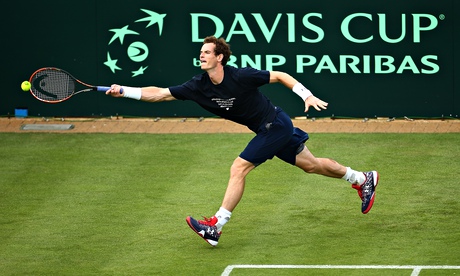
France should start as favourites against Great Britain in the Davis Cup this weekend, but for two factors: Andy Murray and the Queen’s Club grass on which they will play the quarter-final.
While the world No3 admitted he is still getting over his Wimbledon semi-final loss to a zoned-out Roger Federer, he is in the form of his life and back at the venue where he won his fourth title only a month ago.
Still, he looked non-plussed when his brother, Jamie, who lost in the doubles final, said his own post-Wimbledon gloom had long lifted. “I’m pretty focused on this weekend ... Nobody died,” the elder Murray said, drawing what looked like mock disapproval from Andy, whose own take on defeat was more downbeat.
“The guy served at over 80% in the first and third sets,” Murray said earlier of Federer, who went on to lose in the final to Novak Djokovic. “That won’t happen to me the rest of the year, I know that. But, yeah, it was a tough day and I’ve been thinking about it still.”
Whichever two players the French put up in the singles – from Jo-Wilfried Tsonga, Richard Gasquet and Gilles Simon, who slipped in training but claimed later he was “in great shape” – will struggle to contain Murray on his favourite surface.
Jamie Murray and Dominic Inglot played fantastically well against the Bryan brothers when Great Britain beat the United States in the first round in Glasgow in March, but the team captain, Leon Smith, would not be drawn on the significance of the middle match of the tie, which starts with two singles on Friday, and finishes with the reverse singles on Sunday.
“A lot of people have talked about the doubles being important,” Smith said, “but I think we’ve learned from our last few matches that you can’t plan that way. You don’t know what’s going to happen.”
When Murray Jr was asked if he could play three days in a row on grass – thus replacing either his brother or Inglot in the doubles if the tie was going badly for the home team – he said: “Maybe. You don’t know how the matches are going to go and also how I am going to feel after playing [singles].”
The prize for the hosts, ranked 10th in the world, is a semi-final place for the first time since 1981, whereas France, the 2014 losing finalists to Switzerland and third in the rankings, have reached this stage for the past six years, going on to the semi-finals from four of those ties.
So, they have reason to be confident – but for the X-factors. Murray has won all five of his Davis Cup singles matches on grass and the fit and in-form Scot again will underpin Britain’s campaign, here and if successful, the semi-finals in September against either Australia or Kazakhstan, who play in Darwin this weekend.
Historically there is not a lot between France and Great Britain, who have won nine cups each – with France leading 11-9. Whatever other way you crunch the numbers, however, France have a statistical edge. . The have 16 players in the top 200, 10 in top 100, seven in the top 50, four in the top 20. Great Britain have six in the top 200, three in the top 100 (with Alijas Bedene still ineligible) and only you-know-who in the top 10.
On a broader landscape, where the real development takes place, there are 29 British players in the top 1,000 – compared with 89 for France. Those are stark numbers, disguising top-heavy British excellence for those who do care to look away, and underlining the fact that France has invested in the grassroots far more assiduously in recent years.
Without Murray the British cupboard is pretty bare.
As far as Anglo-French tennis rivalry is concerned, the long-term future is looking red, white and blue (or blue, white and red, to be exact), but with The Marseillaise rather than God Save The Queen the soundtrack.