Grayson Perry: Who Are You? (C4) | 4OD
Life Story (BBC1) | iPlayer
Grand Designs (C4) | 4OD
As he showed in the 2012 documentary series All in the Best Possible Taste, the straw-haired artist Grayson Perry is an astute observer of social class. Alive to the customs and curiosities of tribal membership, he is armed with an engaging mixture of empathy and irony.
How we view the world, he argued, is determined by where we come from. Our aesthetic is largely a product of our socioeconomic environment. It wasn’t exactly a revolutionary thesis, but it was carried off with some style and a lot of good humour.
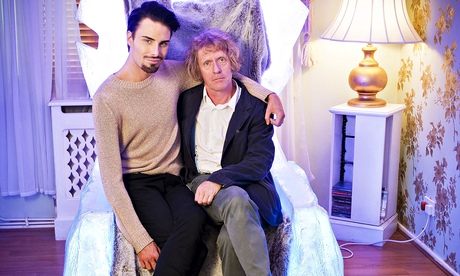
In the first episode of his new three-part series Grayson Perry: Who Are You?, he swapped anthropology for psychology. Instead of asking where an individual fits into society, he wanted to know where we sit in ourselves. What’s our true identity, he asked, the one that lies “beyond the masks we wear”? If that’s the fundamental psychological question, Perry sought to answer it artistically. When it comes to getting to the truth of a personality, he claimed, nothing beats portraiture. “Get it right and it will tell you something a thousand selfies never could.”
But does art ever reveal someone’s true identity, or simply confer the one that, for whatever reasons, the artist prefers to see? There was no time to grapple with such knotty issues because Perry had four portraits – bound for the National Portrait Gallery – to make of people in various states of transition.
There was a successful politician who became an imprisoned convict (Chris Huhne), a single mother of five who converted to Islam (Kayleigh), an Essex lad who became a reality TV celebrity (Rylan Clark), and a young woman who was becoming a man (Jazz).
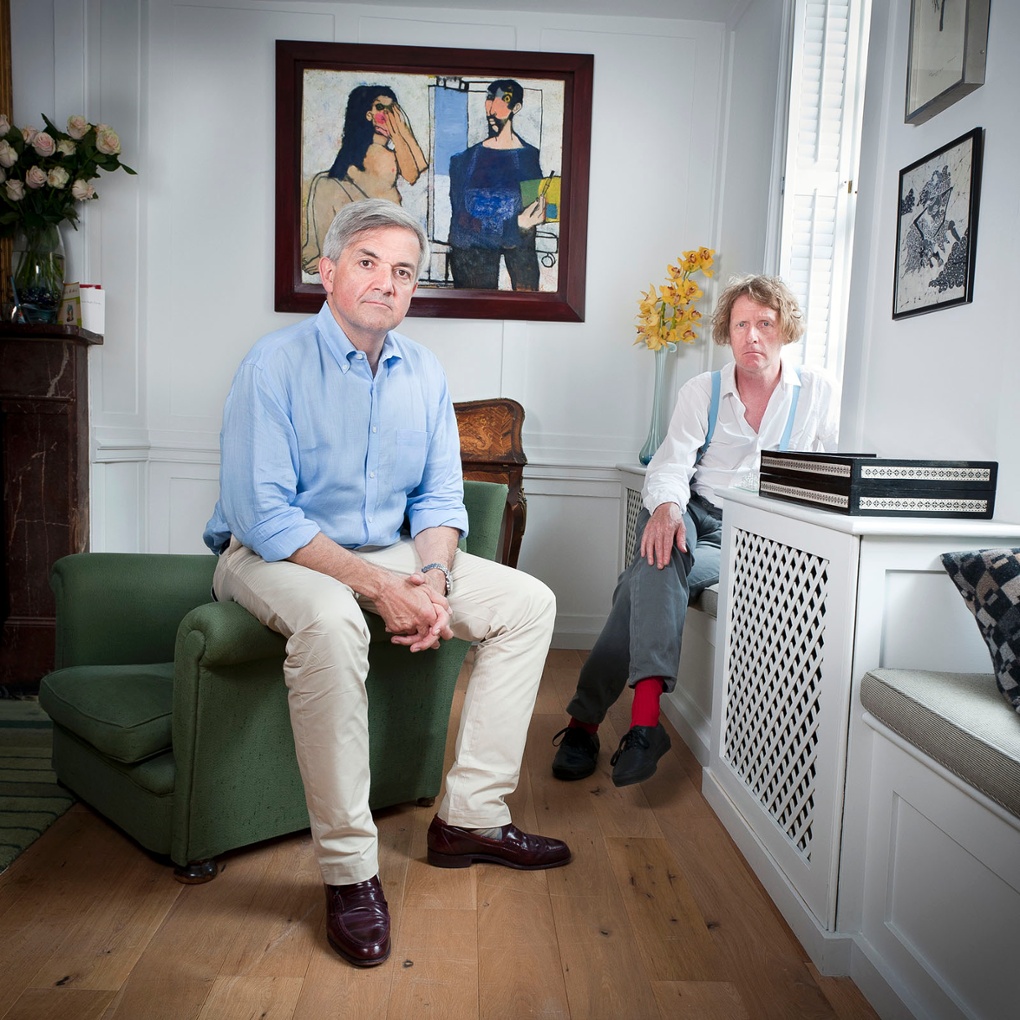
Perry hoped that these life changes would shed light on his subjects’ inner selves. But with the exception of Huhne, whose change of circumstance was involuntary, the subjects were hyper-articulate about what their personal transformations meant to them. Their identities were about as hidden as Buckingham Palace.
As touching as Kayleigh’s and Jazz’s stories were, they didn’t leave much room for artistic interpretation. Nor was Perry looking for it. Instead he seemed quite content to reduce his sitters to the simplest of narratives, the ones they told themselves, presumably because they underscored his own ready-made theme of metamorphosis.
Huhne stuck out as an awkward case as he refused to play the role of contrite fallen man that Perry had prepared for him. The former secretary of state for energy remained problematically positive, even after two months in the nick and with a tag on his leg.
His reward was a handsome vase decorated with sets of male genitals – which Perry attributed to the politician’s downfall – and his stubborn facial image. Perry then smashed the vase with a hammer and had it mended, apparently to represent Huhne’s concealed vulnerability. But more, you suspect, to reflect the artist’s frustration.
None of the artworks revealed anything that didn’t conform to their subject’s self-image or – in Huhne’s case – the one popularised by the media. As with all the best art, the identity that really stood out was that of the artist himself.
At one stage in his study Perry said that he felt “like David Attenborough looking at the gorillas”. That, of course, is one of the most memorable images of modern television, and it was referenced at the outset of Attenborough’s new series Life Story, when the great man sat with a group of young meerkats in South Africa.
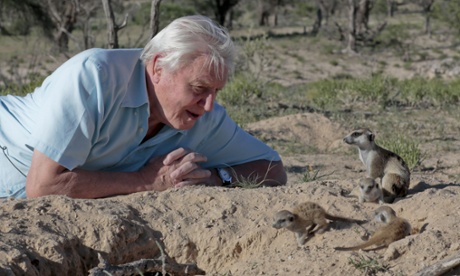
South Africa? Yes, it was a little disorienting, after years of those infernal adverts, to be reminded that meerkats were not in fact natives of Russia.
But if we’re going to compare the meerkats, their tale of youthful struggle wasn’t nearly as dramatic as that of their fellow cast members.
Animals don’t have identities – they’re not interested in the self – but they do have natures, and each is shaped, said Attenborough, by a will not just to survive but to reproduce. He included humans in that universal drive, though plenty would disagree.
“Offspring,” he announced, “the next best thing to immortality.”
I suspect Rylan might make a case for celebrity over children. But then he’s a peacock, not a barnacle goose. To protect their offspring from predators, barnacle geese hatch their eggs on top of mountainous cliffs in Greenland. It’s a great spot, if you don’t suffer from vertigo. The only problem is that to get food, the newborn goslings have to throw themselves off the cliff edge before they can fly.
There was some truly exceptional filming in this opener of yet another awe-generating series from the Attenborough stable. But the sight of those goslings falling hundreds of feet through the air and bouncing off the cliff side was just breathtakingly and tragically beautiful.
It was a harsh start to life. Of the five filmed, only three survived the drop. But at least the two that didn’t make it got a narration from one of the most sympathetic voices the human race has ever produced. If we have to die, then let it be to the sound of an Attenborough commentary.
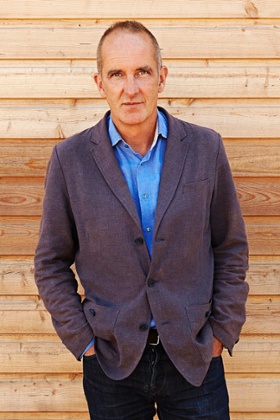
What you absolutely don’t want to hear on your deathbed is the dry echo of Kevin McCloud wondering why you spent your life savings on that hopeless ruin in the middle of nowhere.
That might have been the dreadful fate that lay waiting for Doug and Deni, a quietly understated English couple, in Grand Designs. They bought a wrecked manor house deep in the French interior 11 years ago and, without any building experience or knowledge of the French language, set about restoring it to the glory it enjoyed before the Nazis burned the place down in the second world war.
Pretty much every other series featuring house-buying is either hysterical or venal or both, but McCloud remains admirably sane, and genuinely committed to the process of transformation that house-building can entail. He’s not very interested in where his subjects come from, but he is fascinated about where they want to go.
In spite of McCloud’s dark predictions, Doug and Deni finished their house and it looked lovely, if you like that sort of thing. Eleven years on they’re still there, now fluent in French and beaming with house pride.
Master the art of plumbing and late midlife happiness awaits. Yes, the dreams that Grand Designs projects may be unforgivably bourgeois, but as both Perry and Attenborough would recognise, the impulses it celebrates are irrepressibly human.