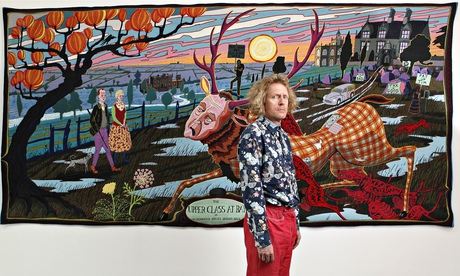
I was in Leeds last week visiting my eldest daughter, Jean. We visited Temple Newsam to view the Grayson Perry exhibition, The Vanity of Small Differences, a collection of tapestries by Perry about taste, most particularly about those decorations and furnishings in our homes. It made me wonder – as it was presumably intended to – about what the interior of our house says about our family?
Our class orientation would be pretty clear. Books line the walls, and there is a piano and a violin in the spare room. We have made liberal use of Farrow & Ball paint. We have more paintings than posters on the wall, albeit ones of little financial worth.
The difference between our house and the middle-class houses portrayed by Perry is that our place is shabby – a characteristic he more readily identifies with the impoverished aristocracy but I think applies to the stressed middle.
In my house, sofas and carpets are clawed by cats. Upholstery is marked by children’s droppings of yoghurt (Rachel’s Organic), hot chocolate (Green & Black’s) and home-made smoothies. The paintwork is chipped and stained, clutter punctuates the space. I don’t necessarily disapprove – I always consider the mark of a real family house to be some form of disorder and am suspicious of overly tidy homes or an overweening concern with what is “correct” in a design sense.
Quite aside from the condition of an interior, how much does taste matter to our children? The standard line, I imagine, would be that children accept whatever they find themselves growing up with as “normal taste”. I’m not so sure. I always had a vague sense when I was a child that I was surrounded by ugliness and inauthenticity – the parade of coal-effect electric fires, gilt carriage clocks and cheap prints of dull landscapes.
Perry made the claim, at the end of his television programme that accompanied the tapestries, that there was no such thing as good taste or bad taste; but although I can accept the theory intellectually, I find it very hard to believe it. I think there are beautiful objects – and we didn’t have any, and it used to depress me.
I do not think I have particularly good taste, but when I was growing up I worked in my father’s greengrocers shop and I used make deliveries to arty houses in Notting Hill that were nothing like the one I lived in. This exposure to “taste” had an effect on me. It imbued me with a desire to have surroundings like that, even from a very early age. Although it didn’t give me good taste, it made me want it.
Am I saying that the choice of objects with which you surround yourself is not entirely neutral from a family perspective – that your taste choices may have an effect on your children?
As much as we’d like to suppose these choices have no permanent impact on our children, especially when it comes to matters such as soft furnishings, I think they might have more of an effect than we believe. That sounds like an outrageous claim to make, but just think about the effort we make to ensure we dress our children in clothes that flatter and fit them.
Is that so very different from saying that we should make an effort to have a “nice house”? And yes, I understand that the very concept of “niceness” is a deeply middle-class one – not only because we flatter ourselves to think we’re discerning, but because it provides an environment that is pleasant and nurturing for our offspring.
I admit I have no idea what good taste is – but I do believe that ugliness exists and that it can depress children as well as adults. Grayson Perry would presumably disagree, but I wonder if critics condemned his work (which I personally think is wonderful as well as beautiful) as “hideous” or in appalling taste, he would be quite such a committed relativist.
• Follow Tim on Twitter @timlottwriter