More and more people are moving away from internments in family plots and opting for burials in shared graves for their final resting places.
Is this because an increasing number of people who do not marry? Perhaps not entirely, but it seems this factor is one of many reasons for the trend.
Far from home
A 73-year-old woman in Nishiyodogawa Ward, Osaka, said; "I'm relieved for now, because I've secured a place to go [when I die]. From now on, I want to finish the things I want to do one by one, while I'm still alive."
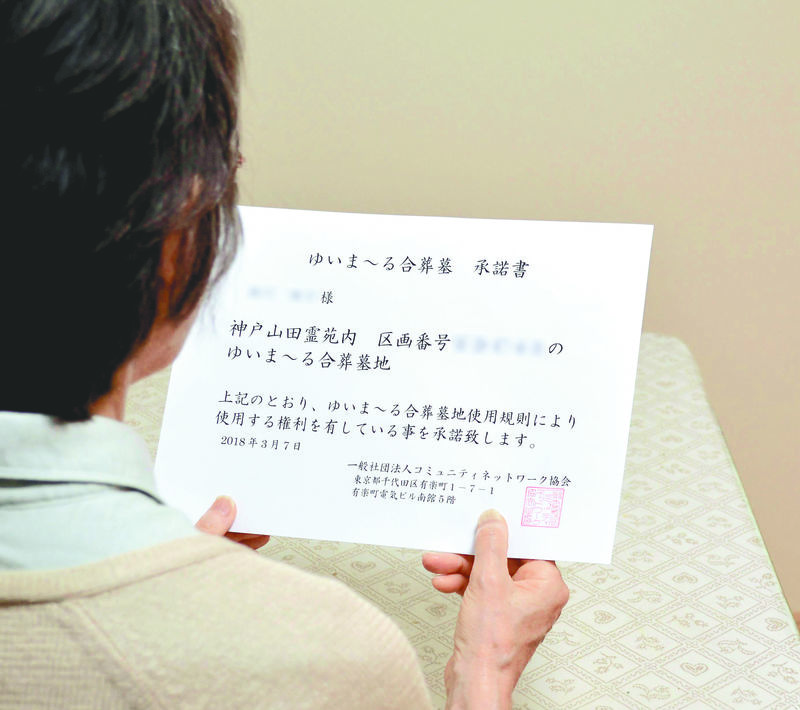
She said this with a smile, while holding the certificate she received this spring guaranteeing her a place in the "Yuimaaru Gassobo" shared grave.
She has two sisters and a brother. Among the siblings, the woman is the only one who is not married.
After leaving her hometown in Ishikawa Prefecture, she got a job at a pharmaceutical company based in Osaka and worked for the company until her mid-50s.
She'd always imagined her remains would be buried in her family grave when she died. But one day, she thought about her younger brother, who is responsible for the grave.
The woman said to her brother, who now lives in Sendai, that if he wants to relocate the family grave to a place near his house, it might bother him if her remains were also buried in the relocated grave.
Last year, the woman moved into a home for the elderly, where she intends to spend the remaining years of her life. The operator of the home introduced her to a shared-grave cemetery in Kobe and the woman applied for burial there.
According to research on population migration conducted by the National Institute of Population and Social Security Research in 2016, only about 50 percent of residents in the Tokyo and Osaka metropolitan areas in their 70s were born in those areas. The Tokyo metropolitan area comprises Tokyo, Kanagawa, Chiba and Saitama prefectures, and the Osaka metropolitan area comprises Osaka, Kyoto and Hyogo prefectures.
During Japan's postwar period of high economic growth, a large number of people flowed into cities, partly because young people received job offers from companies in urban areas.
It's not rare for people in this generation to have lived for many years away from their hometowns, one factor that has made it difficult to maintain inherited family graves.
"It's no longer common for many generations of the same family to live in the same place with children and grandchildren maintaining family graves. I think there will be an increasing number of cases in which family graves will remain unattended," the woman said.
Demand among elderly parents
The shared grave for which the woman applied was set up by the Institute of Community Association Network Ltd. in autumn 2012 at the request of residents living in a home for the elderly.
Residents or members of the foundation who pay membership fees are eligible to use the shared grave. For members, the cost of the grave and burial is 380,000 yen per person; there are no annual management fees or other additional charges. So far, about 40 people have signed up for burials in the shared grave.
Foundation director Nanako Yonezawa said: "Among the people who've applied was a couple who signed their contract saying, 'We don't want to burden our daughter.' Another person sought advice saying, 'It won't be possible for my son to maintain my grave.'"
A preference for shared graves seems to be spreading regardless of whether the elderly people are single or have children. There are also events held for people who have signed up for shared graves. Organized to allow people to become better acquainted with others who will share the plots, the events have helped people form friendships, dubbed "hakatomo," or "grave friends."
Sakura-so Bochi is a woodland burial section at a cemetery in Machida, Tokyo. It's managed by the nonprofit organization Ending Center.
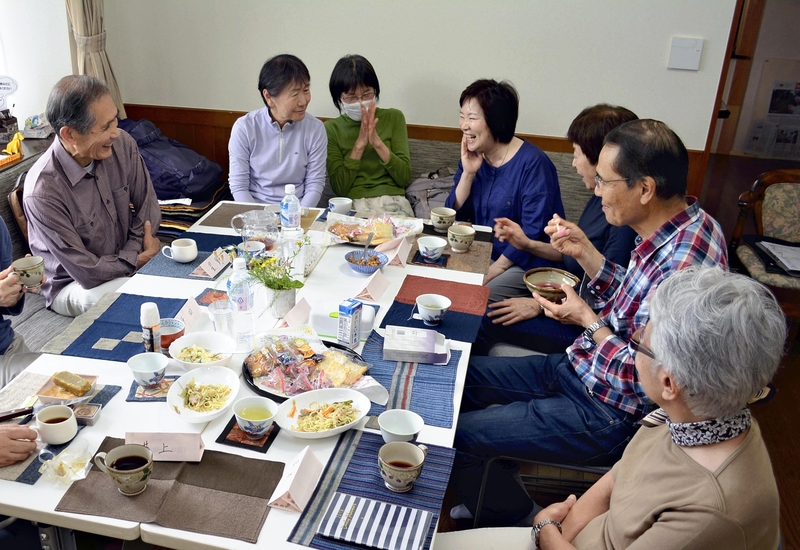
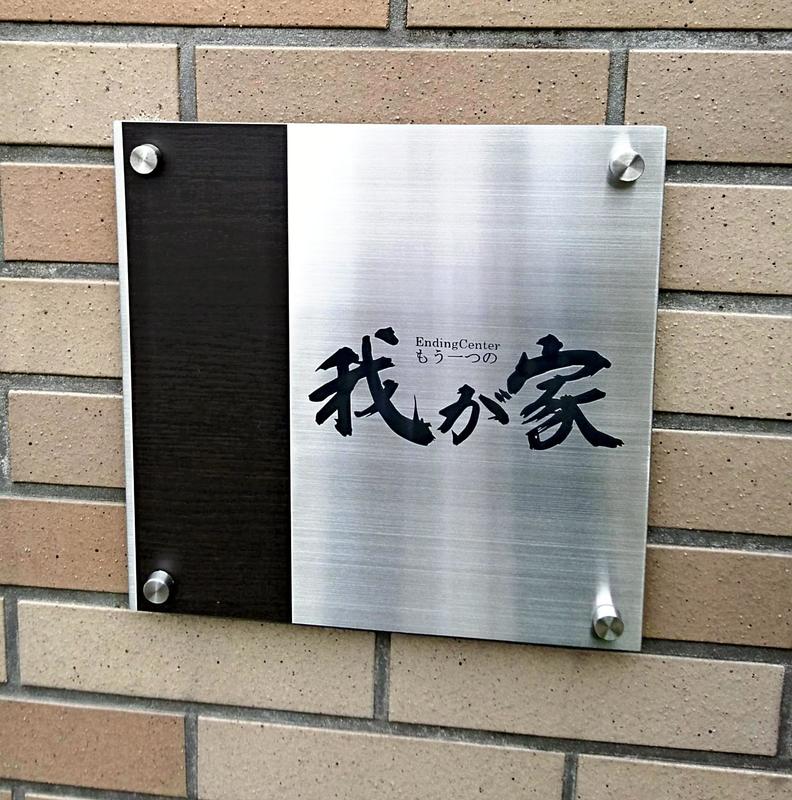
The NPO has a house in the city's residential area called "Mo Hitotsu no Wagaya" (Another home of mine), which it uses as a facility where grave friends can meet. In late May, members of the service had meals and tea together in the house. They also mourned hakatomo members who had passed away.
A divorcee in her 70s who lives alone said, "Because we're connected by the grave, we can casually talk about diseases, deaths and other things that we can't speak to ordinary acquaintances about."
Appropriate resting place
In the Sakura-so Bochi section, burial compartments are lined up below cherry trees on a gentle hill. The choice of burial site seemed to differ widely among hakatomo.
A 73-year-old woman who moved to the city last year had previously moved from the Kansai region to her husband's hometown in a provincial city in the Tohoku region when her husband retired. The couple rebuilt his family house there.
Ten years later, her husband died of cancer and she had his remains interred at a grave in his hometown.
"Because he was the eldest son, it was best to have him interred in the same grave as his parents. But I decided to choose somewhere more suitable for my final resting place," she said.
She said she treasures the time spent speaking with her fellow hakatomo.
In the case of a 73-year-old man in Hachioji, Tokyo, whose wife died nine years ago, he learned about the woodland burial section from his wife. For a while after his wife's death, he suffered bouts of depression and stayed at home. But now, he talks with his grave friends and sometimes has meals with them.
"I can spend joyful times here. It's thanks to my late wife who guided me to this place," he said.
Haruyo Inoue, a sociologist and the author of the book, "Haka to Kazoku no Henyo" (Transformation of graves and families) published by Iwanami Shoten Publishers, also serves as the head of the Ending Center.
Inoue said: "The people share a sense that all of them will finally rest on the hill. In an age when the power of family alone cannot overcome everything, new kinds of relationships, with the graves at the core, are replacing blood relationships."
Many people in the generation of Japan's postwar baby boom have four or five siblings, but the majority of people in subsequent generations grew up in households with two children or less.
An increasing number of younger people are unmarried. Even if people have children who can inherit their family graves, will their children bear them grandchildren, and will the grandchildren also eventually have their own children? It's a very delicate situation in terms of probability.
Midori Kotani, a senior research fellow at Dai-ichi Life Research Institute who studies deaths and graves, said, "Households in which family members from three generations live together have been decreasing, and many people with elderly grandparents today regard them as distant relatives rather than family members."
She added, "As an increasing number of people have become unable to rely on cross-generational connections within their families, we'll enter an age in which people will choose shared graves even if they have children and grandchildren."
95,000 graves relocated
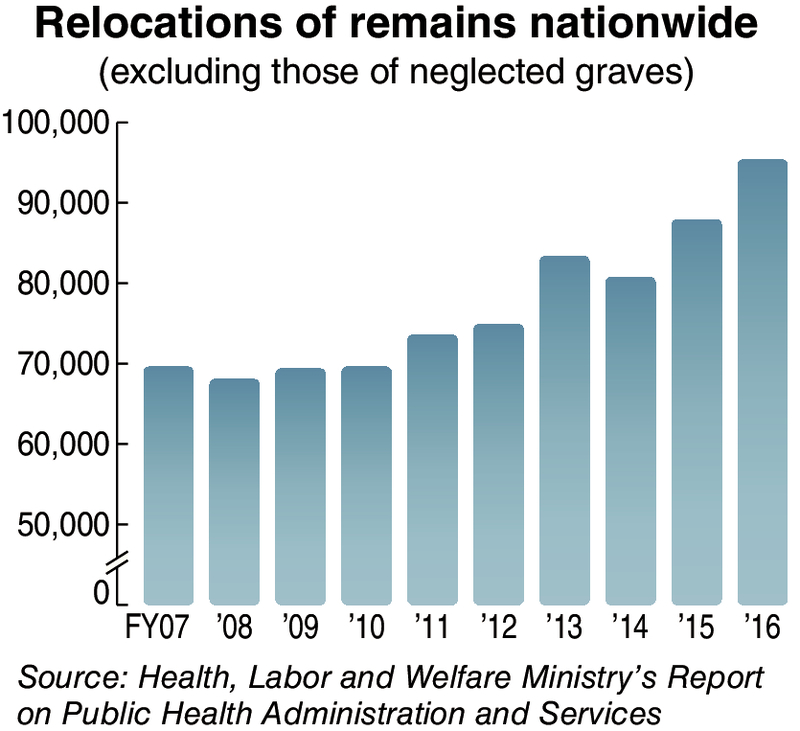
According to the Report on Public Health Administration and Services of the Health, Labor and Welfare Ministry, the number of relocations of remains, excluding those of neglected graves, was 95,000 in fiscal 2016.
The number has been on the rise recently and has increased by about 20,000 in the last five years.
The ministry assumes that an increasing number of people who inherited family graves in distant locations feel burdened managing them and thus have the remains of family members relocated to cemeteries near their homes.
Kotani of Dai-ichi Life Research Institute said, "I've heard there are many cases in which people give up grave plots in provincial areas and have the remains moved to shared cemeteries in urban areas."
Read more from The Japan News at https://japannews.yomiuri.co.jp/