When a taxpayer filed his income tax return (ITR) on December 18, 2020 declaring a total income of Rs 38.1 lakh, the ITR was successfully processed by CPC (Bengaluru) on December 26, 2021 with a revised calculation. The CPC (Bengaluru) revised his total income at Rs 1.18 crore and made the following disallowances:
A) Disallowance of expense under Section 37 for Rs 90,240
B) Disallowance of Gratuity under Section 43B for Rs 79.25 lakh
C) Disallowance under Section 36 for Rs 4398
Feeling aggrieved, the taxpayer (corporate not individual) filed an appeal with the commissioner of appeals (CIT A) but raised the only one grievance i.e. disallowance of tax deduction for gratuity.
According to Taxmann research the facts of this case are:
●The assessee (a corporate) filed the ITR and disclosed gratuity of Rs 79.25 lakh as an allowance under Section 43B in Part-A OI, item 10(b), instead of claiming it under any other allowance in Schedule BP (A-33).
●The said gratuity deduction was not reported by the tax auditor in Form 3CD.
●The Assessing Officer processed the return under Section 143(1) and disallowed the gratuity on the ground that the deduction was not reported in the tax audit report in Form 3CD.
●After receipt of the intimation, the assessee explained that the gratuity had actually been paid during the year and the disallowance arose only due to an inadvertent error in classifying the claim in the return.
●The assessee subsequently filed a revised tax audit report, a revised ITR, and a rectification application under Section 154, all of which were rejected.
●On appeal, the Commissioner(Appeals) upheld the disallowance of gratuity under Section 43B.
On June 24, 2026 the taxpayer won the case in ITAT Chennai. Judicial Member Manu Kumar Giri and Accountant Member Manoj Kumar Aggarwal heard the case in ITAT Chennai.
Keep reading to know how the taxpayer (a corporate, not individual) won the case ([2026] 188 taxmann.com 331 (Chennai - Trib.).
Tax on Gratuity for individuals employed in private and government sector
Taxmann research says that death-cum-retirement gratuity received by the employees of the Central Government, State Governments, local authorities and members of the defence services are totally exempt from tax.
In case of Covered non-government employee, gratuity received by a private sector employee (non-government employee), who is covered under Chapter V of the Code on Social Security Act, 2020, is subject tax to the extent of lower of following:
- 15/26 X last drawn salary X completed year of service
- Rs 20 lakh
- Gratuity actually received
| Status of Employee | Payment of Gratuity in the event of | Deduction |
| Govt. Employee | Death of an employee | Fully deductible |
| Member of the defence services | Retirement | Fully deductible |
| Non-Govt. Employee (Covered under Chapter V of the Code on Social Security Act, 2020) | Death of an employee | Lower of the following: (a) 15 days' salary (last drawn) for every completed year of service (b) Rs 20 lakh (c) Gratuity actually received |
| Non-Govt. Employee (Not covered under Chapter V of the Code on Social Security Act, 2020) |
Death of an employee | Lower of the following: (a) Half-month average salary for every completed year of service (b) Rs 20 lakh (c) Gratuity actually received |
| Govt. Employee | Retirement or Resignation (after completing 5 years of services) |
Fully deductible |
| Govt. Employee | Retirement or Resignation (before completing 5 years of services) | Fully taxable |
| Non-Govt. Employee (Covered under Chapter V of the Code on Social Security Act, 2020) |
Retirement (after completing 5 years of services) |
Lower of the following: (a) 15 days' salary (last drawn) for every completed year of service (b) Rs 20 lakh (c) Gratuity actually received |
| Non-Govt. Employee (Covered under Chapter V of the Code on Social Security Act, 2020) |
Retirement or Resignation (before completing 5 years of services) |
Fully taxable |
| Non-Govt. Employee (Not covered under Chapter V of the Code on Social Security Act, 2020) |
Retirement or Resignation (after completing 5 years of services) |
Lower of the following: (a) Half-month average salary for every completed year of service (b) Rs 20 lakh (c) Gratuity actually received |
Source: Taxmann research
Where gratuity is received from more than one employer either in the same year or different years, the total deduction shall not exceed the prescribed deduction limit. In other words, the prescribed deduction limit is to be reduced by the deduction already claimed in earlier years.
For the purpose of the calculation of the above deduction, the last drawn salary shall include dearness allowance but exclude bonus, commission, HRA or any other allowance.
The completed year of service shall mean that employment of more than 6 months (i.e. at least 6 months and 1 day) shall be counted as a full year. The period of employment may be under one employer or more than one employer. However, if an employee has already received gratuity from the previous employer for any period of service, such period cannot again be computed for the purpose of calculating the amount of exemption (deduction for the Income Tax Act, 2025) under this provision.
Summary of the judgment
Discussing the case, Chartered Accountant Suresh Surana said to ET Wealth Onlin e: The assessee, preferred an appeal before the Income Tax Appellate Tribunal (Tribunal) challenging the order dated December 22, 2023 passed by the Commissioner of Income Tax (Appeals) [CIT(A)] for Assessment Year (AY) 2020-21.
The tax dispute revolved around the disallowance of a gratuity deduction of Rs 79.25 lakh claimed under Section 43B of the Income-tax Act, 1961.
The deduction was mistakenly reported under 'Part A-OI Schedule 10(b)' instead of the appropriate schedule in the Income-tax Return (ITR) and was also omitted from the Tax Audit Report (Form 3CD).
Consequently, while processing the ITR under Section 143(1), the Central Processing Centre (CPC) disallowed the claim due to the mismatch between the particulars reported in the ITR and those reflected in the tax audit report.
The assessee subsequently filed a revised Tax Audit Report, a revised ITR and also sought rectification under Section 154 of Income Tax Act, 1961. However, the CPC rejected the rectification request and the CIT(A) upheld the disallowance, observing that the deduction could not be allowed since it had been claimed under an incorrect head in the ITR.
Before the tax tribunal, the assessee contended that the gratuity expenditure represented a genuine claim allowable under Section 43B and that the disallowance arose solely due to an inadvertent reporting error. It was argued that the deduction could not be denied merely because it was reflected under an incorrect schedule in the ITR and omitted from Form 3CD.
Surana says the tax tribunal accepted the assessee's contention and observed that the inadvertent non-reporting in the tax audit report by the auditor was a bonafide mistake, particularly when the relevant details were already available on record, albeit under an incorrect classification in the return of income.
The tax tribunal further held that the income of an assessee should not be over-assessed merely because of a mistake committed by the assessee, and that the legitimate deduction the assessee is otherwise entitled to must be allowed while determining the taxable income.
In support of its decision, the Tribunal relied upon the Allahabad High Court’s ruling in the Dhampur Sugar Mills Ltd. v. CIT [1973] (90 ITR 236) and the Gujarat High Court in S.R. Koshti v. CIT [2005] (276 ITR 165) cases.
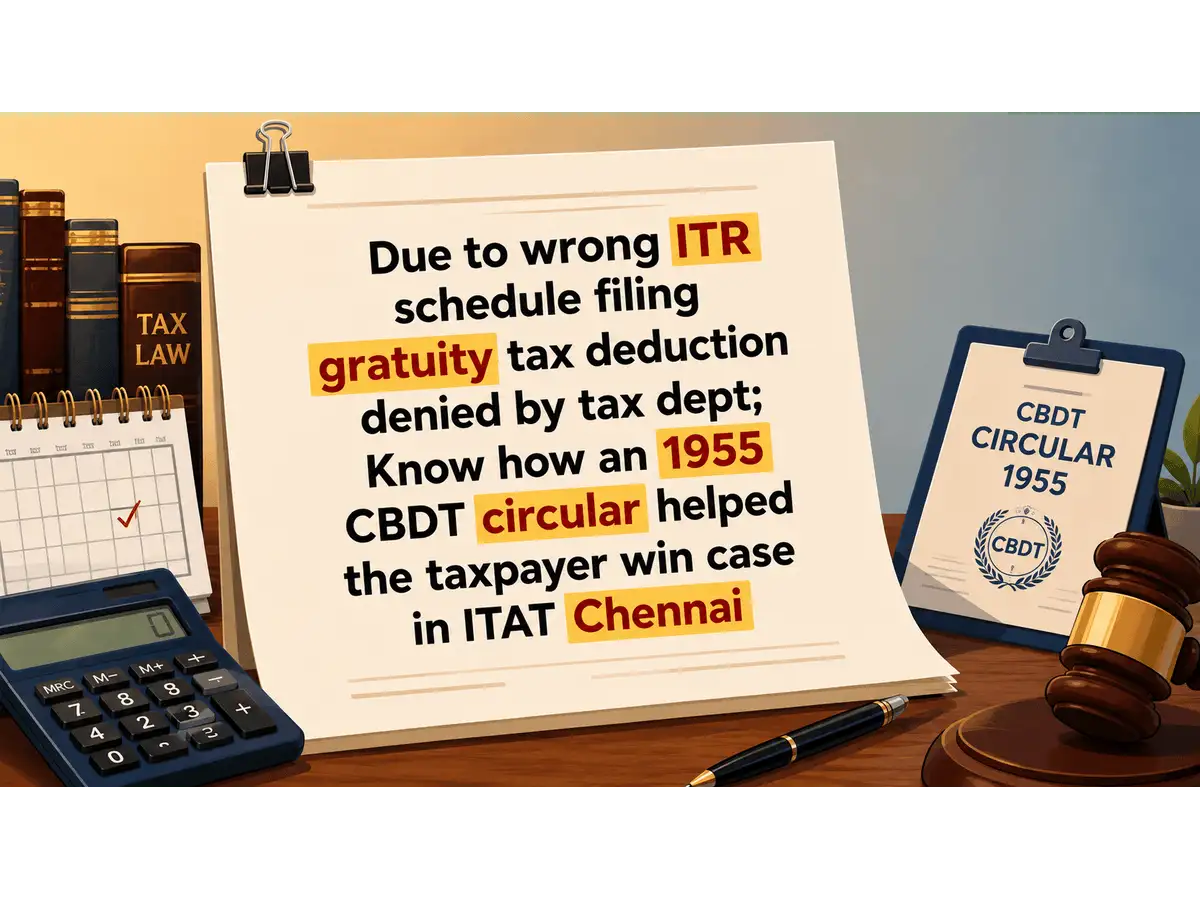
Surana says that ITAT Chennai also referred to CBDT Circular No. 14 (XL-35) dated April 11, 1955, which emphasized that tax authorities should assist taxpayers in securing lawful reliefs and must not take advantage of technical mistakes.
Accordingly, the tax tribunal held that a genuine deduction cannot be denied merely because it was reported under an incorrect schedule in the ITR or was not reflected in the Tax Audit Report (Form 3CD), particularly since all relevant facts are available on record.
ITAT Chennai therefore, set aside the order of the CIT(A) and directed the Assessing Officer to delete the disallowance of Rs 79.25 lakh.
An screenshot of page 1 of the said CBDT circular: