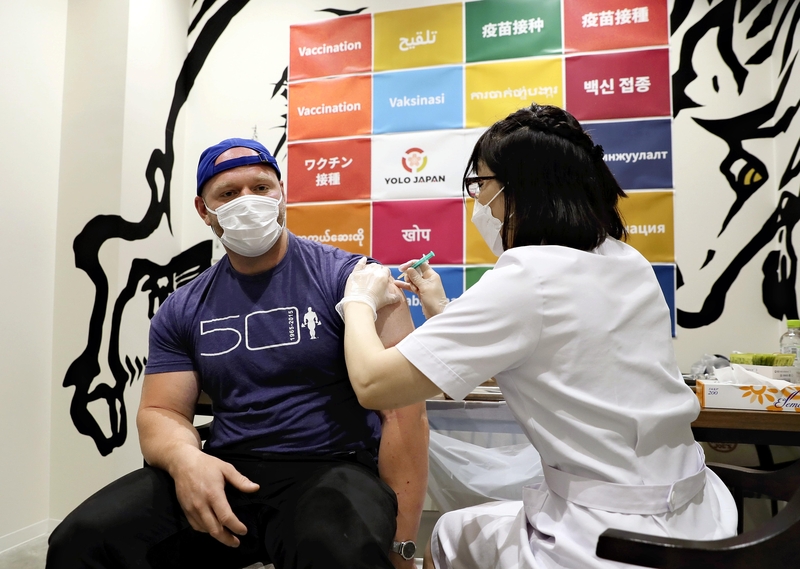
The language barrier can be a health hazard, particularly if it keeps foreigners living in Japan from getting vaccinated against the novel coronavirus.
Residents in Japan, regardless of nationality, are eligible to get vaccinated as long as they have a certificate of residence. But Japanese-language paperwork, such as vaccination eligibility cards and pre-vaccination questionnaires, have inhibited some from getting their shots.
In light of this, local governments and companies that support the employment of foreign nationals have begun to offer help by translating foreign-language answers to screening questionnaires, or sending interpreters to the vaccination sites.
--Choice of 17 languages
"I couldn't get vaccinated as I didn't understand Japanese. Now that I've gotten a shot at last, I feel reassured," a 21-year-old Vietnamese student studying in Japan said with a smile. He was at a workplace vaccination site, where the vaccination started at a job-training facility tailored for foreigners on the morning of Sept. 12 in Naniwa Ward, Osaka. Not knowing how to fill out the screening questionnaire, he had previously been unable to get a vaccination.
The program was organized by Yolo Japan Corp., a company that operates a job-search website for foreigners. When the company prepared about 1,000 doses of the COVID-19 vaccine for foreigners living in Japan and called for applications via social media, slots were fully booked within a few days, according to the company.
The company developed a system for handling screening questionnaires in 17 foreign languages, including English, Korean and Thai. When people seeking shots input their questionnaire answers in their own languages, the responses are printed out in Japanese. The company is using the system at its workplace vaccination sites, but anyone can use it for free via the company's homepage.
Taisuke Kaji, president of the company, said, "I would like to create an environment in which foreigners can get vaccinated with no inconvenience."
Interpreters adept at Vietnamese, Chinese and three other foreign languages were assigned to the workplace vaccination site. A 44-year-old doctor in charge of administering the vaccine said: "I was able to ask foreigners seeking vaccinations about their conditions, with a sense of assurance. As it would be difficult for a doctor to single-handedly deal with foreigners who face language barriers, it is easier for us to cooperate at places like this."
--Soaring calls for advice
In principle, anyone 12 or older who is inscribed on the basic residents' register is eligible to be vaccinated, regardless of nationality. The basic requirement is a residence card issued to those who are to stay in Japan for more than three months or who have special permanent resident status.
There were about 2.6 million eligible foreign residents in Japan as of January. Just like Japanese citizens, they are being sent vaccination cards and can get their shots free of charge. Even those with no record of registration as residents can get vaccinated if the head of a local government -- the mayor of a city, town or village -- recognizes a special reason.
According to the Immigration Services Agency and other offices, there are many cases in which foreigners failed to get vaccinated because they threw away vaccination eligibility cards that they were unable to read, or because they could not fill out the pre-vaccination questionnaire. Some hesitate because they are unable to explain their preexisting medical problems during an interview with a doctor.
In general, widespread vaccinations in Japan began with the elderly. As about 80% of foreign residents in Japan are under 50, their vaccinations are expected to get into full swing from now.
In the city of Osaka, where about 130,000 foreigners are eligible to be vaccinated, the number seeking advice at municipal government consultation counters has been rising sharply since July, when the distribution of vaccination cards for younger people was completed. In August, 462 such consultations were sought. About 70% of the consultations concerned making vaccination reservations, followed by questions regarding reissuance of vaccination cards, according to the city government.
An official at the Immigration Services Agency said: "It is highly likely that vaccinations among foreigners lag far behind those of Japanese, because of language problems. It has become a matter of urgency for some effective measures to be taken."
--Preferential vaccination
Many local governments have begun reaching out to help their foreign residents.
When the city government of Toyonaka, Osaka Prefecture, sends vaccination cards to foreigners, it includes a document in 10 languages that explains such matters as how to make a reservation for the vaccination. The Gifu prefectural government has made foreigners eligible for preferential vaccinations since June as clusters of infections involving foreigners had occurred in the city of Minokamo and elsewhere during the fourth wave of infections this spring.
Read more from The Japan News at https://japannews.yomiuri.co.jp/