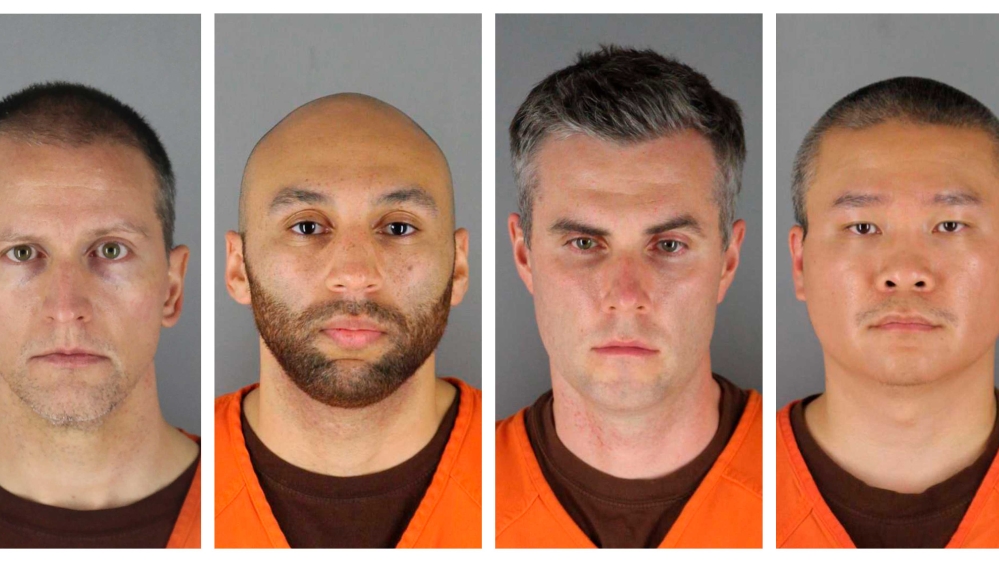
A federal grand jury indicted four former Minneapolis police officers on charges they violated George Floyd’s civil rights, according to a three-count indictment unsealed on Friday.
Floyd was killed on May 25, 2020, when former officer Derek Chauvin kept his knee on the Black man’s back for more than nine minutes. A jury found Chauvin guilty of three counts of unintentional murder and manslaughter in April. Chauvin has appealed and asked for a new trial.
The third count of the civil rights indictment claims that Chauvin, along with the three officers who were present as Floyd died; Thomas Lane, Tou Thao and J Alexander Kueng, “willfully deprived” Floyd of the civil right guaranteed by the US Constitution “not to be deprived of liberty without due process of law”.
Chauvin is charged with violating Floyd’s right to be free from unreasonable seizure and unreasonable force by a police officer. Chauvin was also charged in a second indictment, stemming from the arrest and neck restraint of a 14-year-old boy in 2017.
Thao and Kueng are also charged with violating Floyd’s right to be free from unreasonable seizure, alleging they did not intervene to stop Chauvin as he knelt on Floyd’s neck. All four officers are charged for their failure to provide Floyd with medical care.
To bring federal charges in deaths involving police, prosecutors must believe that an officer acted under the “color of law,” or government authority, and wilfully deprived someone of their constitutional rights, including the right to be free from unreasonable seizures or the use of unreasonable force.
That is a high legal standard; an accident, bad judgement or simple negligence on the officer’s part is not enough to support federal charges.
Roy Austin, who prosecuted such cases as a former deputy assistant attorney general in the Department of Justice’s Civil Rights Division, explained to the Associated Press that prosecutors have to prove that the officers knew what they were doing was wrong in that moment but did it anyway.

Chauvin’s guilty verdict gave hope to police reform activists that the US was turning the page on what they view as impunity for killer cops.
Chauvin filed a request for a new trial earlier this week, citing the media frenzy surrounding his trial.
Chauvin’s lawyer Eric Nelson argued during his murder trial that Chauvin acted reasonably in the situation and that Floyd died because of underlying health issues and drug use.
“The publicity here was so pervasive and so prejudicial before and during this trial that it amounted to a structural defect in the proceedings,” Nelson wrote in the motion, CNN reported.