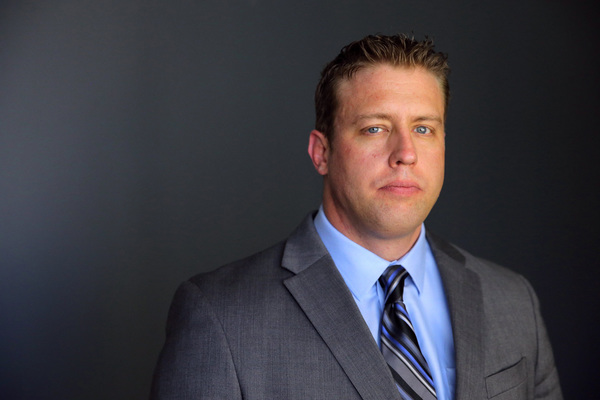
ST. LOUIS _ The lead internal affairs investigator in the Jason Stockley case made misleading and sometimes inaccurate statements to a grand jury that indicted the former officer on a murder charge, according to court transcripts obtained by the St. Louis Post-Dispatch.
The documents also show that the same investigator testified in a sworn deposition that he knew of no new evidence given to former Circuit Attorney Jennifer Joyce as she had claimed when she charged Stockley last year with killing drug suspect Anthony Lamar Smith in 2011. The investigator said police had provided Joyce's office with nothing new in the case since federal agencies finished reviewing it, and declined to charge the officer, in 2012.
St. Louis Circuit Judge Timothy Wilson acquitted Stockley, 36, now of Houston, on Sept. 15, igniting protests across the region nearly every day since.
A grand jury indicted Stockley in August 2016, after hearing testimony from former city police internal affairs investigator Kirk Deeken.
The indictment raised the hopes of those who say many police shootings aren't justified _ and dashed them when a judge found Stockley not guilty after a bench trial.
Stockley's attorney, Neil Bruntrager, believes Deeken's testimony was crucial.
"Without Deeken's testimony, I believe they never would have got an indictment," Bruntrager said. The indictment gave the case "integrity that it didn't deserve. (Prosecutors) gave people an expectation that there was something here when, in fact, there wasn't."
Deeken, now a police lieutenant, declined an interview without clearance from the police department, which did not make him available. Joyce has not responded to several requests for comment.
After Stockley was charged in May 2016, prosecutors, as with any criminal case, had the option of airing evidence in a preliminary hearing before a judge or before a grand jury, a secret proceeding. Most cases in St. Louis go to a grand jury, before which prosecutors present evidence without cross examination or defense witnesses.
"You have in the prosecutor a position of trust when you have a grand jury," Bruntrager said. "And when you put a witness like Deeken on, you are saying to them, 'This is believable,' and they take your lead and they ultimately got an indictment, and I think that's a violation of the public trust."
Deeken testified before the grand jury July 5, 2016. He was one of at least nine witnesses, including eight police officers, called to testify.
Ten months after Deeken's grand jury testimony, his interpretation of some evidence changed on several key points under questioning from prosecutors and defense lawyers in sworn depositions.
At Stockley's trial, discrepancies and inaccuracies in Deeken's grand jury testimony weren't revealed because the defense chose not to cross-examine him. They include:
�� 'Kill shot': Deeken repeatedly told grand jurors that Stockley executed Smith with a fifth shot, at close range, about 22 seconds after he'd fired four other shots.
Prosecutors relied on Deeken's theory at trial in August, describing a puff of gun smoke that was seen on the police SUV's dash camera as proof that a fifth shot had been fired later.
But a cellphone video clip taken by a nearby business owner showed Officer Elijah Simpson was there when the fifth shot was allegedly fired. Simpson testified before the grand jury and at trial that he neither saw nor heard any additional shots.
Wilson concluded the puff of smoke was "in reality exhaled breath in cold air."
�� DNA: Only Stockley's DNA was found on a silver .38-caliber Taurus revolver that he said he found inside Smith's car. According to police reports, the gun was reported stolen after a car break-in in April 2008 in the south St. Louis County police precinct.
Deeken told the grand jury that a DNA expert told him that Stockley's DNA on the gun came from blood, suggesting that it was there before the shooting. That helped bolster the prosecution's claims that the gun had been planted.
But during his deposition in May, Deeken said he couldn't remember why he told the grand jury Stockley's blood was on the gun.
At trial, the same DNA expert denied telling Deeken that Stockley's blood was on the gun, saying that the city's crime lab can confirm the presence of DNA but not its biological source.
The revolver _ Deeken told grand jurors that authorities seized a .38 Taurus revolver from Stockley when he was arrested in Houston _ the same type of gun he was accused of planting in Smith's car.
Stockley testified that he had a .357 Magnum when U.S. Marshals arrested him in Houston.
�� Department violation: Deeken told grand jurors that Stockley admitted he had unloaded Smith's gun. Stockley violated department policy just by handling the gun, Deeken said.
In his deposition, Deeken acknowledged that at the time of the shooting in 2011 the police department had no policy forbidding officers from handling weapons used against them.
�� OnStar audio: Deeken told grand jurors that he believed he heard Smith say, "Don't shoot," or "Please don't shoot," and "No, no, no!" on car audio and police video recordings.
But he revised that during his deposition, saying the "Don't shoot" audio was of such poor quality that he and his commanders believed it should not even be used as evidence, and an officer was actually saying, "Go, go, go!" after the shooting had occurred.
The OnStar audio was not presented at trial.
�� Matching memos: Deeken told grand jurors that Stockley's firsthand account of the shooting was "almost identical" to that of his partner, Brian Bianchi, implying that they had coordinated their stories.
In his deposition, however, he said that it was not unusual, nor improper, for officers to compare notes before submitting their reports, and at the time, the department had a checklist of facts that officers were required to include in their memos.
Prosecutors never raised issues with the memos at trial.
Joyce, the circuit attorney at the time of the shooting, claimed that the Internal Affairs Division presented her with new evidence, enabling her to charge Stockley with murder years after her office and federal prosecutors had declined to charge him.
Joyce, who did not run for re-election in 2016, still has never identified the new evidence. Her successor, Kim Gardner, said she could not say what it was.
Since the verdict Sept. 15, Joyce has made just one public comment in a text message to a Post-Dispatch reporter on that day: "I'm confident that the citizens understand why this case was prosecuted."
In a May 2016 article in the Riverfront Times, Joyce said Internal Affairs had contacted her office two months earlier with new evidence developed by city investigators and the FBI.
But in his deposition, Deeken testified that he was unaware of any new evidence. Deeken said his colonel called him into his office in April 2016 and said, "Hey, the Circuit Attorney's Office is picking up this case. And they need you to compile evidence, compile whatever you got."
"I'm like, 'I already gave them everything I had back in 2012,'" Deeken said in the deposition.
After a couple of more meetings with local prosecutors in 2016, Deeken said, "the next thing I know, I'm on a flight to Houston," where he and other officers arrested Stockley.