It was a Sunday in April 1967 in the Sun News Pictorial’s newsroom and, like everywhere in Melbourne after a match, the talk was of football, football, football. Journalist and foreign correspondent Douglas Wilkie had finally had enough.
He remarked to colleague Keith Dunstan: “There must be a better life than this. Couldn’t we start an anti football organisation?”
Dunstan agreed and said a badge should be made so people who were anti-football could recognise each other on the street. They chose a cube, a shape that couldn’t bounce, and, according to Dunstan’s biography, just two months later 5,600 of them had been sold.
The anti-football league (AFL) even had its own version of the Brownlow: the Douglas Wilkie medal, for those who had done the least for football. When mounting the podium to receive their award, the winner was expected to destroy a football in a “unique and creative manner”.
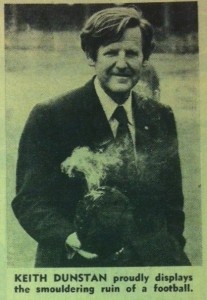
The legendary Dunstan died in 2013, and in his absence the (football loving) AFL machine has continued to grow. In Melbourne, its industry town, the only way for a person who doesn’t like football is a season-long exile in Sydney.
Sydney is agnostic to codes. For the most part people don’t really care whether you follow union, league or Aussie rules. Conversations in the workplace on a Monday aren’t dominated by blow by blow recaps of the weekend’s AFL matches, the way they are in Melbourne.
The Swans might win a grand final and there’ll be a parade down George Street, but the enthusiasm is always cranked a down a few notches from the finals frenzy of Melbourne, which now requires a public holiday to keep it under containment. Sydney, deep down, would rather be at the beach.
To not have a team is to be a sort of unperson in Melbourne. Maybe that’s why Dunstan and his co-conspirators needed a badge – to denote that they did indeed belong.
It’s all right if you’re a newborn baby (but even then, Victorians will usually inquire after the baby’s team, not long after they’ve discovered her name) or a recently arrived immigrant (but even then people will enthusiastically try and push their team onto him).
But to be Victorian and not have allegiance to a club is to be without a tribe. It means on some level you do not belong.
The sports writer Martin Flanagan has, over the years, written columns about how engagement with the AFL either as a supporter or as a player can provide the entry-point to belonging in Melbourne.
Whether you’re an Indigenous kid from Arnhem land or a recently arrived Iraqi refugee, a team, and passion for that team, folds you into Melbourne life more efficiently and lovingly than any church group, drama society or choir would ever do.
A former colleague from the Sydney Morning Herald who had served a stint as its Melbourne correspondent once told me why he thought the city was the most egalitarian place in the country.
“No matter who you are – whether you’re the office cleaner or the CEO – you’ll always have something to talk about: the game. It’s a great leveller that doesn’t exist in Sydney.”
Which is great, if you actually have something to say about the game. If you have nothing to say about the game, you are excluded.
My animosity towards Aussie Rules is nothing personal. It even got me through university (I sold meat pies and beer in the concrete dugouts under the stands of the MCG).
But I just don’t get it. I could never get too interested in Geelong, the team I was born into. I just couldn’t latch on for some reason, and tuned out when people talked about football.
Last winter I was living in Melbourne, when James Hird dominated the back and front pages of every newspaper. It was a double dose of the thing I didn’t like – like being made to sit through a play I didn’t want to see, performed in a language I didn’t understand.
I sometimes wonder if the Winter of Hird was a factor in my September move back to Sydney.
Although we don’t wear badges any more, I’m sure there are others in Melbourne like me: listlessly guessing their footy tips each week, avoiding Richmond and East Melbourne on game days, bereft of an opinion on Hird. We’re the ones who don’t get invited to grand final barbecues, who are unmoved by the sight of the MCG haloed in lights, and are relieved when the final siren sounds at last.
Now that the season has ended, perhaps I’ll go to Melbourne. The streets will stink of jasmine, that bitter edge the wind gets in winter will have left the air, and people, for a few months at least, will stop talking about football.






.png?w=600)