Billie Eilish dominated the 62nd Grammy Awards in four major categories, but my mind was on Japanese jazz composer, Miho Hazama, whose album was nominated for the Best Large Jazz Ensemble Album. Although she didn't win, there is no doubt her New York-based music is world-class.
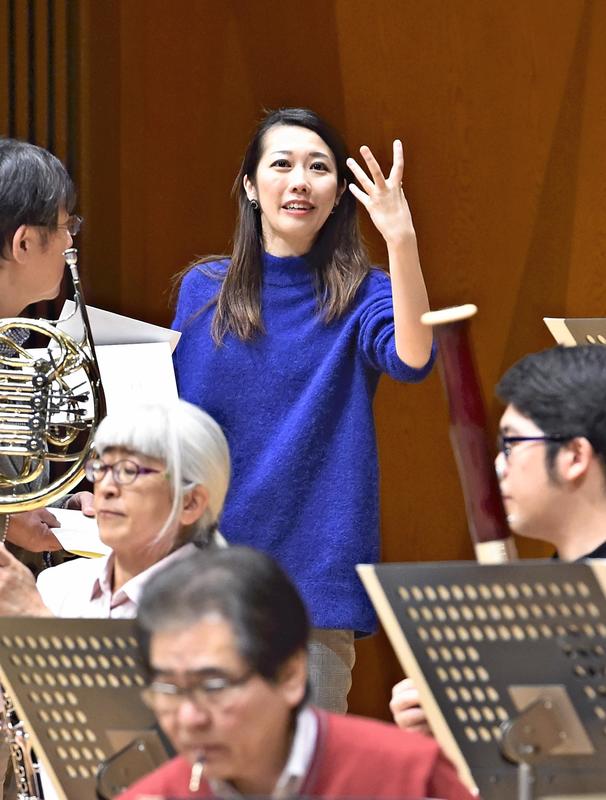
Hazama spoke to The Yomiuri Shimbun in Kanazawa before the awards ceremony, as she just happened to be back in Japan for the world premiere of her music "Minamino Bo no Chikai [Dom Justo's Faith]," which she composed at the request of Orchestra Ensemble Kanazawa.
In rehearsal, she was busy hopping around the conductor and musicians between performances to convey an image of her composition. My impression of Hazama was, "She runs around a lot."
Hazama is active in a wide range of fields, composing for orchestras and arranging music for such musicians as Ryuichi Sakamoto and Hiroshi Itsuki as well as for music programs on TV.
However, Hazama attaches herself to the unfamiliar job title of "jazz composer." No matter what kind of request she receives, she persists in her belief of only taking jobs that can be done as a jazz composer.
Asked why, she said: "For many Japanese, jazz still carries a dark image of improvised music tainted with drugs and alcohol. The age group of jazz listeners is relatively high. Since it's a genre that tends to be stigmatized, I see it as my mission to keep spreading the term "jazz composer," which is common in the United States, throughout Japan."
Born in Tokyo, Hazama moved from place to place in her childhood, from Hokkaido to Ibaraki and Aomori prefectures, due to her parent's job transfers. She attended a music school to learn how to play an electronic organ and compose, so that no matter where she moved, she could keep playing music.
At Kunitachi College of Music, she majored in classical composition and devoted herself to big bands in after-class activities to commit herself to jazz. She then studied at the Manhattan School of Music before making her debut in 2012.
Her "Dancer in Nowhere," which was nominated for this year's Grammy, was recorded by her chamber orchestra known as m_unit. Big bands are the most common style for large music groups in jazz, but Hazama's band has violinists and a cellist among other string players, which are uncommon in such ensembles.
"I grew up listening to orchestras, so I created an arrangement of instruments that help me compose sounds that sound natural to me," she said.
Handling various kinds of works, Hazama considers her original compositions as a "tool to purely disseminate what she thinks is interesting."
At the end of the interview I asked Hazama a question, which to her may have sounded cliche, but I was eager to hear her response : How do you describe jazz? "Improvisation," Hazama replied. "What's so special about composing jazz is the mixture of composition and improvisation. Inevitability and randomness flow back and forth in jazz."
-- Miho Hazama appears at TOKYO JAZZ +plus on May 24.
Read more from The Japan News at https://japannews.yomiuri.co.jp/