My childhood was not a conventional one. Life in London today is a distant cry from the sunshine, noise and chaos which represented a majority of my early education and childhood growing up in Lagos, Nigeria. Like most young people around the world, I looked to others for inspiration. It was (and remains) important to admire others' success and aspire to achieve something similar. During my childhood I had a combination of inspirational figures as well as role models who inspired my early ambition.
Imagine a child growing up in a Lagos suburb and being interested in Steve Jobs, Bill Gates and Michael Dell while his friends followed popular action characters. That was me. From a young age, I was fortunate to have access to international media publications such as the Times and Forbes magazine and I closely followed the successes of global brands including Apple, Microsoft and Dell. The problem was that my local environment lacked individuals within this sector to support and drive my passion.
Despite my obsession with these companies, I didn't have a clue on important processes that drive businesses, such as conceiving product ideas, designing prototypes, or financing product development and marketing activities. All that interested me was the success and fame of my idols. They had changed the world by starting a business, and I wanted to be just like them. What was lacking was a concrete understanding of the core skills required to conceive ideas and transform them into products people wanted.
Armed with my naivety, I packed my bags and travelled to the closest destination to Silicon Valley I could afford, to make it big in the start-up world. I ended up in London. Fortunately, while London was a sea away from Silicon Valley, it was pretty close in heart and spirit. My plan was simple – attain a degree in a useful field, get valuable work experience, start a series of software businesses and the rest would fall into place. So I set about to do just that.
In reality, things didn't quite work the way I envisioned. It started according to plan: got a degree from the University of Manchester in international business, then followed that with a stint at a major multi-national, but when it came to taking the final leap to pursue my big ambition of starting my software business, I quickly realised that my focus on my favourite business pioneers were important in shaping my early vision, but not relevant to my day-to-day pursuit. I lacked the basic knowhow of developing a credible business plan that would attract investment required to effectively execute an idea. I also realised that I needed a different set of individuals for inspiration, and I began to look at those who looked and sounded like me, and had been quite successful in the area I was intending to venture into.
Again, I faced a similar challenge. I knew who my role models needed to be. They needed to have a similar educational, social, cultural background. These are the folks, not my earlier Silicon Valley group, to whom I can turn to for inspiration. I quickly realised that they where few and, were they existed, there wasn't enough information about them to inform me on how to navigate my early challenges.
Some would wonder why I need a particular type of role model? I admire and respect any entrepreneur who has built a successful business. But these are more inspirational figures. People like Richard Branson, Alan Sugar, Stelios Haji-Ioannou. Their inspiration is insufficient when it comes to equipping me to go and achieve in the start-up space. I needed a familiar face.
The sort of new role models I wanted are people I can have open and honest conversations with. They make me believe I have what it takes to be successful; I just need to apply myself better. Their success is sufficient to convince me that no barriers, environmental, racial, social, cultural, educational or legal, can determine my success. Their success says: "Yes you can."
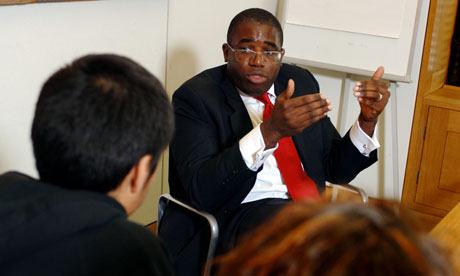
I don't think this applies to me alone. Look at the number of young black people who want to be rap artists or footballers, to understand the relationship between aspiration and achievement. Just as I eventually did, most young people chose role models who look like them. In one of his interviews, Chuka Umunna (MP for Streatham, London) talks about having role models such as Oona King, David Lammy and Diane Abbott. Some of these individuals were MPs when Umunna contested and won his seat in the 2010 elections. A small minority of individuals will pioneer, and become the first of their generation to achieve a certain status: David Lammy was the first black British man to attend Harvard Law School in 1997, and when Tidjane Thiam was made CEO of Prudential, he also became the first person of African descent to be a CEO of a FSTE100 company.
I recently found a role model who is a young, dynamic, intelligent successful, black person whose success challenges me to outthink myself. I have learned and continue to learn from their successes and failures as I watch them evolve and share their lessons learned in a language I can relate to.
In the corporate world, the same rules apply. I've heard folks talk about going on school trips to corporate offices and the only black people they see are the cleaners and security guards. These images make such experience less fulfilling. While the dynamics are changing rapidly with companies engaging and attracting more diverse talents, more needs to be done to connect aspiring young black kids with black professionals; not only does it make the experience genuine, it also makes the lessons shared more relevant, and acts as a catalyst for their ambition. When black kids come across black professionals, it makes the whole experience transparent and tangible.
A word of caution though: you need to craft a delicate balance between the achievements of role model and your own aspirations. The idea is not to limit your ambition, but to propel yourself to achieve more, using their achievements as a benchmark.
How do you begin to find a relevant role model? I'd say look local, because the success recipe is universal. Within every neighbourhood, education institution, community, sports arena or peer group are folks who are ambitious, smart, and hardworking. The most impactful role models are people you can relate to, those who exist in your day-to-day life. They set the benchmark for you to match or smash. These are the folks who can inspire us to achieve your dreams.
Hugo Obi is the founder of the ACS Project, a platform connecting black students with black professionals through the African Caribbean Society university network.
This content is brought to you by Guardian Professional. To get more content and advice like this direct to your inbox, sign up for our weekly Careers update.