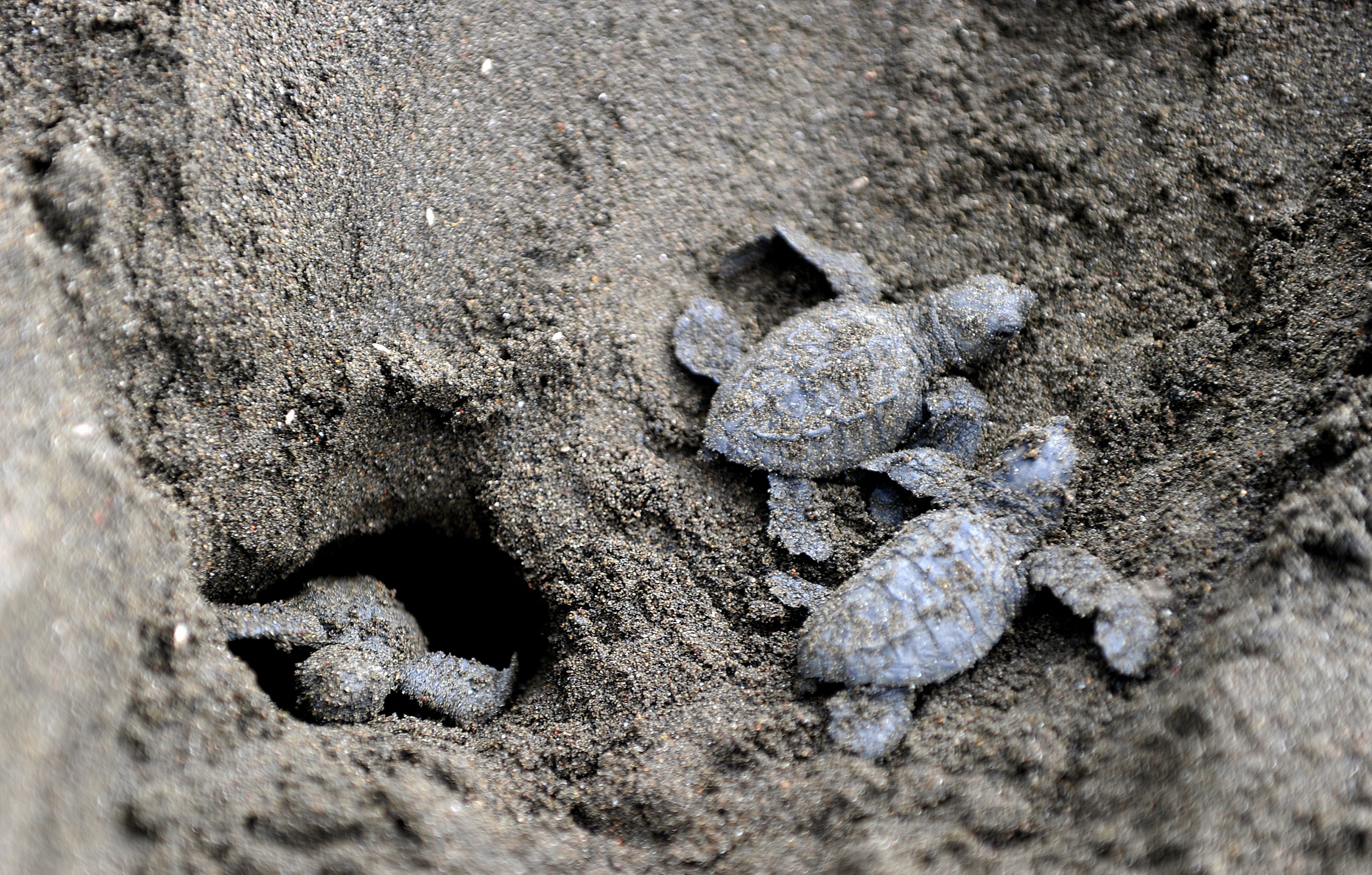
Conservationists are using decoy turtle eggs fitted with a GPS tracker to catch criminals involved in the illegal wildlife trade.
Researchers from the University of Kent worked with conservationists in Central America to develop a 3D-printed turtle egg that can be placed undetected into a live nest.
The decoy - dubbed the InvestEGGator - emits a signal once an hour, allowing the team to follow the movement of the traffickers once a clutch of eggs has been taken.
GPS-tracked eggs were planted in 101 turtle nests on four beaches in Costa Rica.
In one case, they were able to identify an entire trade chain extending more than 85 miles (137 km).
Helen Pheasey, from the University of Kent, said: "Our research showed that placing a decoy into a turtle nest did not damage the incubating embryos and that the decoys work.
"We showed that it was possible to track illegally removed eggs from beach to end consumer.
"Knowing that a high proportion of eggs remain in the local area helps us target our conservation efforts. We can now focus our efforts on raising awareness in the local communities and direct law enforcement to this local issue.
"As trafficking is a more serious crime, those handover points are far more valuable from a law enforcement perspective than catching someone taking a nest."

Despite the long journey of one clutch of stolen eggs, the majority remain close to the beach they were taken from, the researchers found. One went to a nearby residential property, another to a bar 2km away.
Turtle eggs are considered a delicacy in parts of Central America, with poachers able to sell them for about £1 each.
Conservation organisation Paso Pacifico said poachers were destroying more than 90 per cent of sea turtle nests on beaches in Central America.
Kim Williams-Guillen, who designed the decoy for Paso Pacifico, said: "The idea was kind of an 'Aha' moment. In Breaking Bad, the DEA places a GPS tracking device on a tank of chemicals to see who receives the chemicals.
"In one episode of the Wire, two police officers plant an audio device in a tennis ball to surreptitiously record a suspected drug dealer.
"Turtle eggs basically look like ping pong balls, and we wanted to know where they were going - put those two ideas together and you have the InvestEGGator.”
The study was published in Current Biology.