With the number of new coronavirus infection cases falling nationwide, the government will lift the state of emergency and the less strict priority measures in all of the prefectures where they are now in effect. Ahead of winter, when the coronavirus might spread again, the government plans to relax behavioral restrictions in a phased manner.
--Before the end of term
"The number of new infection cases has declined dramatically, and the situation is improving," Prime Minister Yoshihide Suga said to reporters at the Prime Minister's Office after discussing coronavirus measures with relevant Cabinet ministers Monday, suggesting his willingness to lift the state of emergency and priority measures for all prefectures.
During the current fifth wave of the pandemic, the delta variant of the virus had a huge impact, and the daily number of new infections across the nation exceeded 25,000 in mid- to late August.
However, from the beginning of September, the number began to decline notably.
The states of emergency declared by the government have been intended to limit the movements of people, but the repeated issuance of such declarations has diluted their effect. In light of that, a close aide to the prime minister admitted, "I don't know why the number has declined so much."
Yasutoshi Nishimura, minister in charge of economic revitalization, listed 10 possible factors for the decline based on analysis by experts. These factors include the thorough implementation of preventive measures such as wearing masks, the reduced number of people commuting, the effects of vaccinations and seasonal change. However, all these are just hypotheses.
Suga believes that the vaccination rollout, which he led, played the key role. The two goals of "giving 1 million shots per day" and "vaccinating all elderly people by the end of July" were both achieved, and more than half the population had received the required two doses of vaccine by the first half of September. Also, the number of people receiving shots shows no sign of declining soon.
Since Suga has been seeking to revitalize the economy, he has stuck to the idea of lifting the state of emergency for as many places as possible before his term of office ends and he passes the baton to a new administration. Given the declining number of new infection cases and seriously ill COVID-19 patients, Suga had eyed the possibility of lifting all measures before he departed for the United States last week.
--Concerns
However, if the state of emergency and priority preventive measures are lifted for all relevant prefectures by Thursday as the government plans, social and economic activities will not return to their pre-pandemic state immediately.
On Monday, Suga said to reporters, "We should continue to be on high alert and gradually relax restrictions imposed on restaurants and other places."
To ease restrictions on events and restaurants, the government will start technical verification in October to look into measures to prevent infections even if the number of visitors and customers increases.
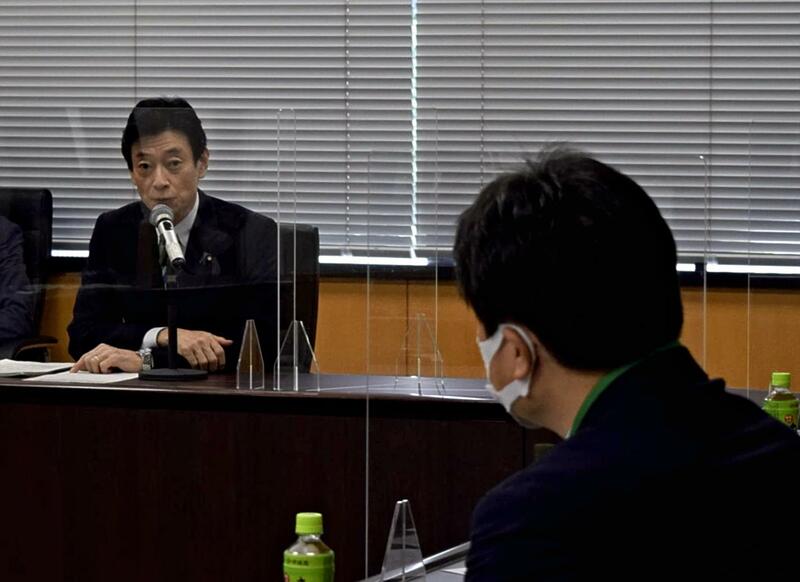
Then, the government hopes to fully lift these restrictions in November or later. With such a strategy in mind, Nishimura said during a meeting with sports and event-related organizations Monday: "By October, the vaccination rate will exceed 60%. I would like to try to balance infection prevention measures, people's everyday lives and social and economic activities."
It is also risky to relax behavioral restrictions before winter, when the virus is more likely to spread. The government had the bitter experience of facing the spread of infections at the end of last year. It was forced to suspend its Go To Travel tourism promotion campaign across the nation and declare a state of emergency at the beginning of this year.
Regarding the latest across-the-board lifting of the state of emergency and priority measures, some government officials have voiced concern. Health, Labor and Welfare Minister Norihisa Tamura cautioned, "We don't exactly know the reason why the number [of infection cases] is declining, which means there is a possibility of the number increasing again."
Even though the number of new infection cases has peaked and started to decline, more than 1,000 people are still newly infected each day. "In order to steadily relax behavioral restrictions, the 'winter measures' of the new cabinet to be launched next month will be extremely important," a senior official at the Cabinet Secretariat said.
Read more from The Japan News at https://japannews.yomiuri.co.jp/