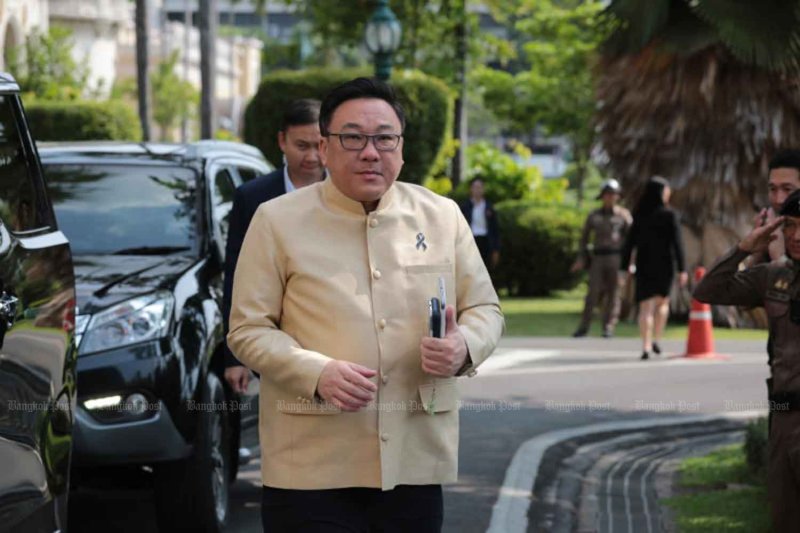
Labour Minister Julapun Amornvivat has pledged to accelerate the renewal and expansion of labour agreements with four neighbouring countries after business groups warned that worsening labour shortages could affect economic growth and key industries.
The Joint Standing Committee on Commerce, Industry and Banking (JSCCIB), comprising the Thai Chamber of Commerce, the Federation of Thai Industries and the Thai Bankers' Association, submitted a letter to Mr Julapun urging the government to urgently address shortages in labour-intensive sectors and implement more concrete measures.
Following the submission, both sides discussed ways to reduce the impact on manufacturing and export industries. The private sector proposed speeding up migrant worker management and improving labour recruitment systems to better meet business demand.
Poj Aramwattananont, chairman of the Thai Chamber of Commerce and the JSCCIB, said Thailand was currently short of around 500,000 workers across the industrial, agricultural and service sectors, particularly in construction.
He said the most urgent issue was extending work permits for migrant workers from Myanmar, Laos, Cambodia and Vietnam who are already employed in Thailand under memorandums of understanding (MOUs), without requiring them to return home to renew their documents.
"Labour shortages have continued for some time," Mr Poj said. "The government has tried to regularise the system, but border-related problems have caused some migrant workers to return home. In particular, Myanmar workers are increasingly being recruited by competing countries."
He added that Thailand's ageing population and shrinking working-age demographic had further worsened labour shortages, while businesses in industry, agriculture and tourism continued to depend heavily on migrant workers.
"Despite advances in technology, labour is still needed in industry, agriculture and tourism," he said. "Human capital remains essential, especially in maintaining the quality of service that supports Thailand's tourism industry."
Mr Poj urged the government and the Labour Ministry to take a more proactive approach to the issue, warning that prolonged shortages could affect economic expansion.
He added that the private sector was also exploring new labour markets and possible agreements with additional countries, although any future recruitment arrangements would require formal international MoUs.
Mr Julapun, who said he had been assigned by Prime Minister Anutin Charnvirakul to receive the petition, acknowledged the seriousness of the labour shortage and reaffirmed the need to move forward with labour agreements involving Myanmar, Laos, Vietnam and Cambodia.
He said border tensions between Thailand and Cambodia last year had complicated labour issues, but stressed that the dispute was between governments and not between the peoples of the two countries.
"The MoU process for importing labour remains essential to driving the economy and is a direct responsibility of the Labour Ministry," Mr Julapun said. "I assure the JSCCIB that we will urgently consider all dimensions of this issue and submit proposals to the cabinet so the process can continue."