From April at the earliest, the government will ask operators of crucial infrastructure (see below) such as power and water suppliers to store their electronic data on servers located in Japan, as part of security measures against the threat of cyberwar.
The measure is aimed at protecting information indispensable for the security of people's lives and for industrial competitiveness, with an eye on possible cyber-attacks by China and other countries.
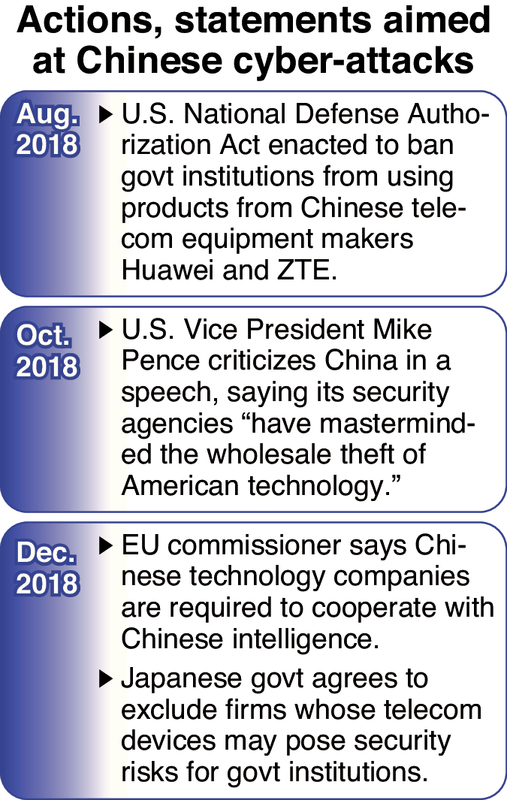
In Western countries, the products of two major Chinese manufacturers of telecom equipment -- Huawei Technologies Co. and ZTE Corp. -- are increasingly being excluded from government procurement. The Japanese government agreed in December to effectively stop procurement from those companies, with the operators of domestic infrastructure expected to follow suit. The measure to store electric data exclusively on Japanese servers is an extension of this alliance against China.
The government will hold a meeting of its Cybersecurity Strategic Headquarters, aiming for April, to revise the Guideline for Establishing Safety Principles for the security of 14 areas of infrastructure deemed crucial by the government.
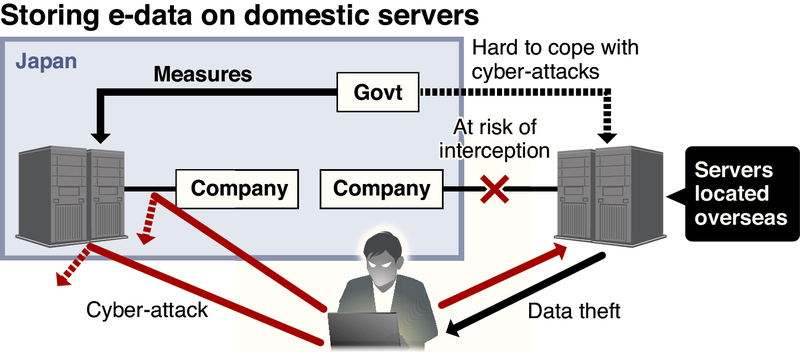
The guideline will stipulate the storage of data on servers governed by domestic law as a "desirable security measure." Since there are limitations to applying domestic law to servers located overseas, the government is effectively asking operators to keep data within Japan.
The government has conducted field surveys to ascertain how many servers used by Japan's administrative bodies and important companies are located outside Japan.
"Although it's not crucial, data [belonging to those bodies] were found to have been stored outside Japan," a government source said.
Targeted data will include utility firms' power-generating systems and the state of Shinkansen trains.
Cyber-attacks aimed at such information would cause tremendous harm to people's lives, and it would be difficult for Japanese police and supervisory agencies to cope with the attacks if the data was stored outside Japan. If the countries that house those servers severed connections, Japanese companies would have no access to their own data.
If servers are kept within Japan, the authorities concerned can quickly investigate and conduct searches. The measure also makes it easier for the government to impose tougher safety standards in advance or investigate problematic servers. The government will set a guideline for crucial industries other than the 14 fields to apply the same standards, envisioning data regarding automated driving technology and other areas.
The government will encourage companies in each field to voluntarily store data in Japan, but the establishment of a guideline would effectively be compelling because companies in such fields as electric power and financial services are obliged to take adequate measures on information security that meet certain standards under related laws.
Companies in those fields have considered adding the storage of data on servers in Japan to their safety standards.
Crucial infrastructure
Part of the foundation of society, with tremendous impact on people's lives and the functioning of society and the economy. The government has designated 14 fields: information and communication, finance, aviation, airports, railways, electricity, gas, government and administrative services, medicine, water, logistics, chemical industries, credit cards, and petroleum.
Read more from The Japan News at https://japannews.yomiuri.co.jp/