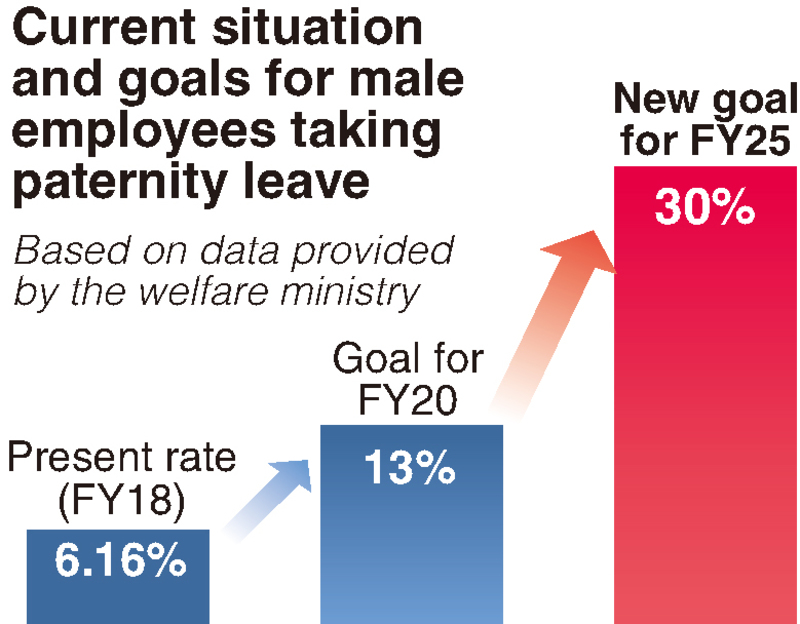
The government decided this month to increase the target rate for male employees taking paternity leave to 30% by fiscal 2025 from the original target of 13% by fiscal 2020 in order to encourage male employees to utilize the system.
There are many male employees who complain that although the system exists, it is difficult to take such a leave. The actual rate for men who take paternity leave is only at 6%. From fiscal 2020, the Health, Labor and Welfare Ministry plans to expand its subsidies to companies that support their employees who want to take paternity leave.
Based on the Child Care and Family Care Leave Law, all companies are required to give childcare leave to their employees until their children turn 1 year old. During their leave, they are provided with 67% (50% from the seventh month) of their salaries through the employment insurance, and are exempt from paying premiums for social insurance programs, such as employees' pension.
The government set the target rate for male employees taking paternity leave at 13% by fiscal 2020 in its outline of measures compiled in 2015 to deal with a society plagued with a declining number of children.
However, according to the welfare ministry, the rate was 6.16% in fiscal 2018. Concerning the length of the period for childcare leave, about 90% of women took six months or longer, while nearly 40% of men took less than five days, which is a stark contrast, but it is the reality of a system that has yet to be firmly established.
On the other hand, according to a ministry survey on male full-time employees nationwide who have a young child, 28.3% want to take paternity leave. Based on that data, the government specified the target rate for men taking paternity leave to 30% by fiscal 2025 in its comprehensive strategies to deal with a declining population and other issues.
But, in the same ministry survey, the reasons male employees do not take advantage of paternity leave, in addition to the system's flaws, were that "there is an atmosphere in their workplaces which makes it difficult to take leave" and "their superiors and workplaces do not understand the system."
Currently the ministry has a system to provide subsidies to companies that promote a childcare leave, through such methods as the company sending emails to all the employees to make the paternity leave system more commonly known. It provides up to 720,000 yen to a small and midsize company if the company succeeded in encouraging a male employee to take their paternity leave.
The ministry intends to expand the present system from fiscal 2020 and increase the amount of subsidies to companies that urge individual employees to take leave such as by having company superiors meet with individual employees.
The ministry plans to increase the subsidies to up to 840,000 yen for a small and midsize company. About 6.5 billion yen is included for that purpose in the fiscal 2020 budget plan, nearly double of what was included in fiscal 2019.
According to a government estimate, the number of Japanese babies born in 2019 is expected to drop below 900,000 for the first time. The number of Japanese children has been declining at a faster pace than anticipated.
A ministry official in charge at the section for promoting coexistence of family and professional lives, said that the ministry aims to support companies and create a society in which male employees are easy to participate in child-rearing.
Read more from The Japan News at https://japannews.yomiuri.co.jp/